• العربية
  • فارسی
Brand
  • Iran Insight
  • Politics
  • Economy
  • Analysis
  • Special Report
  • Opinion
  • Podcast
  • Iran Insight
  • Politics
  • Economy
  • Analysis
  • Special Report
  • Opinion
  • Podcast
  • Theme
  • Language
    • العربية
    • فارسی
  • Iran Insight
  • Politics
  • Economy
  • Analysis
  • Special Report
  • Opinion
  • Podcast
All rights reserved for Volant Media UK Limited
volant media logo

US Expects Escalation By Iranian Proxies In Mideast
Iran International Newsroom
Oct 23, 2023, 07:28 GMT+1Updated: 11:43 GMT+0
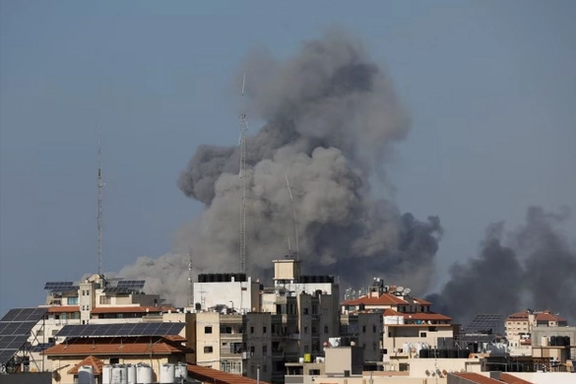
Israeli forces continue to strike targets in northern and central Gaza.

US Secretary of State Antony Blinken has warned that Iran-backed militant groups may escalate their activities against American forces in the Middle East.

Houthis in Yemen and Hezbollah in Lebanon, both propped up by the regime in Iran have already launched limited attacks against Israel.

"There's a likelihood of escalation by Iranian proxies against our forces," Blinken cautioned in an NBC interview. "We're taking steps to make sure that we can effectively defend our people and respond decisively if we need to."

Blinken's alert came as the Pentagon announced measures to tackle growing threats from Iran proxies in the region, including the deployment of a new warship and anti-missiles systems.

Secretary of Defense Lloyd Austin said Saturday that he had made these decisions after detailed discussions with President Joe Biden, and aiming to bolster regional deterrence, enhance US force protections, and contribute to the defense of Israel.

Last week a squadron of B1b Lancer strategic bombers were moved from their Texas base to the Fairford base in Britain. The bombers can carry 50 tons of bombs each and have enough range from Britain to Lebanon/Iran and back.

In the week gone by, Houthis in Yemen and Hezbollah in Lebanon, both supported by the regime in Iran, have entered the war theater, albeit on a limited scale and with no official declaration of war.

The heightened tension and the attacks on US forces by emboldened Iran-backed militants caused the US embassy in Baghdad to order the evacuation of non-essential personnel after recent attacks by Iran’s proxy forces across the Middle East, reports Fox News.

On Sunday, one Israeli soldier was killed in a local IDF raid into Gaza. Several others were injured. The operation was reportedly conducted to locate missing individuals and dismantle Hamas infrastructure but met ‘unexpected resistance.’

Only a day prior, Iran's intelligence chief had issued a warning, suggesting potential reprisals against the US and its allies and unconfirmed reports emerged that IRGC Quds Force Commander Ismail Qaani traveled to Syria to “supervise” the Iran-backed armed groups along the Syrian border with Israel.

Israel has amassed its forces on the border with Gaza but has so far refrained from a full-on ground invasion, apparently heeding the Biden administration’s advice.

Critics of President Biden say he is to blame (partly at least) for the critical situation in the Middle East, pointing, especially, to his lenient approach towards the regime in Iran.

John Ratcliffe, former Director of National Intelligence, accused the Biden administration of ignoring the ‘intelligence’.

“Throughout 2020, Iranian military and political leaders were telling us as we listened to their conversations, we’re broke, we can’t afford to fund Hamas, we can’t afford to fund Hezbollah,” Ratcliff said in an interview with Fox News, “essentially saying that the maximum pressure campaign of the Trump administration was working, and Iran was less dangerous than they had been at any point in time.”

Ratcliffe then suggested that all the intelligence had been shared with the Biden administration ‘as it came into office.

Amid the escalation, diplomatic and humanitarian efforts are gaining momentum. President Biden held critical discussions with Israeli Prime Minister Benjamin Netanyahu, underlining the need for a sustained flow of humanitarian assistance into Gaza and the release of hostages held by Hamas, including US citizens, before a land invasion.

However, aid agencies have expressed concerns about the inadequacy of the humanitarian aid reaching Gaza, with the limited number of trucks permitted into the region falling far short of the pressing need for essential supplies, including food, fuel, and medical resources.

Since October 7, when Hamas special forces attacked Israel, at least 1400 Israelis and 4500 Palestinians have been killed, many more injured and displaced.


Most Viewed

State media slam Araghchi's Hormuz tweet, say it let Trump claim victory
1

State media slam Araghchi's Hormuz tweet, say it let Trump claim victory

2

Iran International says it won’t be silenced after London arson attack

3
INSIGHT

How Tehran bends its own red lines to boost state rallies

4
VOICES FROM IRAN

Hope and anger in Iran as fragile ceasefire persists

5

Iran halts petrochemical exports to supply domestic market

Banner
Banner

Spotlight

  • Too early to tell who is winning Iran war, experts say
    PODCAST

    Too early to tell who is winning Iran war, experts say

  • How Tehran bends its own red lines to boost state rallies
    INSIGHT

    How Tehran bends its own red lines to boost state rallies

  • Iran blackout cripples freelancer, small business incomes
    VOICES FROM IRAN

    Iran blackout cripples freelancer, small business incomes

  • Ideology may be fading in Iran, but not in Kashmir's ‘Mini Iran'
    INSIGHT

    Ideology may be fading in Iran, but not in Kashmir's ‘Mini Iran'

  • US blockade enters murky phase as tankers spoof signals and buyers hesitate
    ANALYSIS

    US blockade enters murky phase as tankers spoof signals and buyers hesitate

  • Why the $100 billion Hormuz toll revenue is a myth
    ANALYSIS

    Why the $100 billion Hormuz toll revenue is a myth

•
•
•

More Stories

Iran’s Statistics Center Reports Housing Inflation After Months Of Silence

Oct 22, 2023, 23:47 GMT+1
•
Iran International Newsroom

Amid the Iran-funded Hamas war with Israel, Iran’s Statistics Center has finally released a report on housing inflation after eight months of withholding data. 

According to the center, housing prices in Tehran have risen 84 percent since last year, a figure so big that it may be the reason behind the government’s reluctance to publish the data. The data blackout deteriorated the already murky situation of the capital’s housing market.

The newly released data indicate that the average price per square meter of housing in Tehran has increased 20-fold in the past eight years. In 2015, the average price was about 40 million rials, and now it is about 800 million rials (about $1,600 in today’s exchange rate). Back in 2015, the dollar was traded at about 30,000 rials, meaning that the average price per square meter was about $1,200. 

Buying property for Iranian wage-earners has become virtually impossible with an average monthly salary of about $200. The rents have also increased across Iran so drastically that currently more than half of a household's income will be spent on rent. In Tehran, the proportion is even more alarming, with workers spending an astounding 100 percent of their wages on housing expenses. The minimum wage for a married worker with all benefits hovers just above $180 per month, while the minimum cost of food for an average three-person household is at least $140 to $160.

Iran’s leading economic newspaper Donyaye Eghtesad (World of Economy) reported Sunday that considering the inflation rate and the government's failure to actualize its announced economic plans, the country’s budget deficit will further increase this year, as is the case in Iran every fiscal year. The daily added that in the previous year, the government covered part of the budget deficit by borrowing from banks, raising government's debts to the banks by 150 percent. 

Whenever the government seeks loans from banks, it pushes the Central Bank of Iran to print more money to supply the funds. As a result of the increasing money supply, the rial has fallen 12-fold in the past five years and has halved in value in the past one year. It is now trading around 500,000 to one US dollar.

Abdolnasser Hemmati, the former governor of Iran's central bank who is among the most outspoken critics of the current administration, said Sunday that macroeconomic indicators prove that the country’s economic woes stem from a lack of proper governance and financial policies over the past three decades. 

Bemoaning the country’s meager annual growth rate, the chief banker under former president Hassan Rouhani said "investment and efficiency" are among the main influential factors in economic growth. He claimed that ‘efficiency’ is a term only used on paper in government’s five-year development plans that never materializes. 

Additionally, Bahram Shakouri, a member of Iran’s Chamber of Commerce, also criticized the administration of President Ebrahim Raisi for its policies regarding attracting investment. He stated, “When domestic investors are disappointed, how can we expect foreign capital owners to be willing to invest in the country?" adding that there is no investment security in Iran until the country improves its relations with the international community and connects its banking system to the world. 

Earlier in the month, the deputy chief of the Central Bank of Iran, Mohamamd Shirijian, claimed that Iran's GDP grew by 4% in 2022, and the growth rate in Q1 and Q2 of 2023 increased 5.3 and 6.2 percent, respectively. The claims seem to contradict a report by reformist daily Ham-Mihan also in October that forecast a budget deficit twice as big as the figure in the previous year. The paper said if the country’s revenues in the second half of the Iranian year (which ends in March 2024) mirror the trend in the first six months, the budget deficit would significantly worsen in comparison with last year.

It is very difficult to judge the veracity of the Central Bank's optimistic claim, given the lack of any positive movement in Iran's currency markets or the nearly 50-percent annual inflation rate. The current government dominated by hardliners is notorious for making outlandish claims of economic success.

Against the backdrop of all its economic hardships, the regime has been spending heavily on the development of its drone and missile technology and gives hundreds of millions of dollars per yet to its proxy militia groups, such as Hamas that has rained thousands of rockets on Israel since its multi-thronged operation earlier this month in spite of its people in Gaza unable to eat and drink.

Economist Parviz Jahed said Saturday that 45 million of Iran’s 88 million population live in poverty, another reason that justifies Iranians to chant "Neither Gaza nor Lebanon, I sacrifice my life for Iran" during their anti-government protests, showing the frustration with the regime’s allocation of resources.


Sen. Graham Warns Iran: If Gaza War Grows, It's Coming To You

Oct 22, 2023, 21:21 GMT+1

US Senator Lindsey Graham on Sunday accused Iran of involvement in the October 7 Hamas attack and warned that any escalation of the war could exact a cost from Tehran.

"We're here today to tell Iran: 'We're watching you. If this war grows, it's coming to your backyard,'" Graham starkly warned during a visit to Tel Aviv, without elaborating on what that meant.

Although the warning seemed to be directed at the Lebanese Hezbollah, which can open a northern front against Israel, any such decision needs to be approved by Tehran, the backer of all Arab militant groups in the region.

"The idea that this happened without Iranian involvement is laughable," Graham said in what was a rebuttal to the Biden administration that after the Hamas attack said there is no direct evidence of Iran’s involvement.

Although President Joe Biden has acknowledged Iran’s continuous support for Hamas and Hezbollah, he said last week that “Iran constantly supports Hamas and Hezbollah …. [but] did they have foreknowledge, did they help plan the attack, there’s no evidence of that at this point.”

Last week, speaking on NBC News Sen. Graham had issued a warning to Iran. He vowed to introduce a resolution in the Senate to allow “military action by the United States in conjunction with Israel to knock Iran out of the oil business.”

The Iranian regime has praised Hamas for its “heroic” attack, denying that the militants killed civilians, and pledging to continue support. Some Iranian hardliner lawmakers have even threatened direct involvement and the closure of the Hormuz Strait in the Persian Gulf if the United States directly intervenes to support Israel.


Explosion At Iranian Power Plant Claims Lives

Oct 22, 2023, 20:04 GMT+1

An explosion has rocked the Parand power plant on the outskirts of Tehran, with at least two dead and several others injured.

Governor Omid Ahmadi, who is overseeing Robat Karim County where the power plant is located, attributed the explosion to "staffers' negligence." The blast occurred in a gas pipeline responsible for delivering fuel to the plant's turbines.

Ahmadi further claimed despite damage to a section of the gas pipeline, the power plant's operations continued without interruption with no reports of damage to its infrastructure.

The Parand power plant, designed to generate 50 megawatts of electricity, was part of a plan to connect it to the national power grid, aiming to address voltage issues within the capital's electricity network.

The incident is part of a series of unexplained explosions and fires that have plagued various Iranian military, nuclear, and industrial facilities since mid-2020.

Of particular note is a significant fire that erupted on January 28 in an Iranian military industry factory in Esfahan, suspected to be a result of a drone strike. While authorities have not provided comprehensive explanations for the incidents, they have linked several high-profile sabotage attacks on facilities to Israel. Israel has not officially claimed responsibility for any of these events.

Iranian FM Plays On South African Apartheid To Continue The Rally To War

Oct 22, 2023, 17:56 GMT+1
•
Iran International Newsroom

As regime officials continue to call for an escalation of Israel’s war against Iran-backed militant group Hamas, the country’s foreign minister rallied his counterpart in South Africa.

While he said the meeting was a follow up to the recent visit of President Ebrahim Raisi to South Africa in addition to discussions on bilateral relations, he used it as a chance to rally support under the banner of apartheid amid a battle against terror which threatens to become an Iran-driven proxy war.

Touching on the old wound of apartheid, Hossein Amir-Abdollahian told a press conference after meeting his counterpart Naledi Pandor: “Mr [Nelson] Mandela is widely recognized as a symbol of the struggle against apartheid, especially today, when the world witnesses the massacre by the illegitimate Israeli regime against the resilient and oppressed people of Gaza.”

Apartheid by its definition is a policy of segregation on the grounds of race or religion, as was seen in the black versus white policies of South Africa. In Israel, a multitude of faiths live together including Jews, Muslims, Christians, Druze and Baha’i.

Continuing the war cry, which has been loud and clear from the foreign minister and a wealth of other regime officials from the Supreme Leader and President to lawmakers, he once again warned of the explosive nature of the war declared by Hamas on October 7, which has incurred brutally devastating airstrikes in retaliation from Israel.

”From this tribune, I declare that today the region is like a powder keg,” said Amir-Abdollahian. “Any miscalculation in continuing the genocide and compulsory displacement can have serious and bitter consequences, both in the region and against the interests of warmongers,” referring to Iran’s multitude of proxies around the region baying for blood.

Iran's Foreign Minister Hossein Amir-Abdollahian (right) and his South African counterpart Naledi Pandor in Tehran on October 22, 2023
100%
Iran's Foreign Minister Hossein Amir-Abdollahian (right) and his South African counterpart Naledi Pandor in Tehran on October 22, 2023

It comes just days after Pandor spoke with Hamas’ political head, Ismail Haniyeh, who rules from Turkey and Qatar. She told him of “South Africa’s solidarity and support” for the Palestinian people and “expressed sadness and regret for the loss of innocent lives on both sides”, causing domestic backlash from the South African Jewish community which accused her of siding with the terror proxy.

Fearing Iranian interference, the US and UK have mobilized warships and support for Israel after the attacks of October 7 which left at least 1,400 civilians dead and has seen over 300 more soldiers killed.

Israel’s harsh response as it vows to wipe out Hamas, has led to thousands more Palestinians dead and around 750,000 displaced as the proxy’s war continues to strangle the people of Gaza.

US Defense Secretary Lloyd Austin announced on Sunday that after detailed discussions with President Joe Biden on recent escalations by Iran and its proxy forces across the Middle East, he had directed a series of additional steps to further strengthen the Department of Defense posture in the region.

In the announcement on X, he said: “These steps will bolster regional deterrence efforts, increase force protection for U.S. forces in the region, and assist in the defense of Israel. I will continue to assess our force posture requirements in the region and consider deploying additional capabilities as necessary.”

While airstrikes in Gaza continued to target Hamas infrastructure and leadership, buried deep in civilian heartland from mosques to hospitals, in neighbouring Syria, where Iran has a military presence, Damascus and Aleppo international airports were hit once again in the early hours of Sunday, putting both out of service and killing two workers.

A key route for Iranian weaponry and other military shipments into the region, disabling Syrian infrastructure has been an ongoing shadow war for Israel in its battle to keep its borders safe from Iran. During Sunday morning’s Israel Defence Forces press briefing, its spokesman typically claimed he could not comment.

On Israel’s northern border, further clashes came from Iran’s biggest regional proxy, Hezbollah, which had terrorists killed during attempted infiltrations and attempted UAV and anti-tank missiles fired during Sunday.

It has become the most deadly escalation between Israel and Lebanon since the 2006 Israel-Hezbollah war. Hezbollah said four fighters were killed in heavy exchanges of fire on Sunday and another died of wounds sustained earlier, raising to 24 the number of its members killed since October 7.

Lebanese security sources said 11 fighters with Palestinian militant groups in Lebanon had also been killed in the volatile border region, alongside four civilians. At least five Israeli soldiers and one civilian have been killed on Israel's side of the frontier, according to Israeli military reports.

A further 14 villages have also been evacuated and 120,000 Israelis from both north and south are now in evacuation facilities.

Exodus Of Iran's Healthcare Professionals Continues

Oct 22, 2023, 16:52 GMT+1

Masoud Pezeshkian, a member of the Iranian parliament, has warned of the growing migration of healthcare professionals threatening to leave the country in a dire shortage.

In an interview with Rouydad 24, Pezeshkian stated that, while precise statistics on doctor emigration are lacking, it is evident that a significant number have left Iran for various reasons.

“Those who have remained are often constrained by low salaries, making it increasingly challenging to maintain their quality of life. With a monthly income equivalent to $200 to $300, many healthcare professionals find it difficult to afford housing and their children's education,” he said.

Driven by a combination of economic hardships, professional constraints, and the lack of social and political freedoms, a growing number of healthcare professionals, including physicians, dentists, midwives, and nurses, have either emigrated in recent years or are actively planning to do so.

He emphasized that the primary challenge driving the exodus is financial, as low salaries and high living costs push professionals to seek better opportunities abroad. Despite Iran's abundant resources, which include oil, gas, minerals, water, and a well-educated workforce, mismanagement, and a failure to utilize these resources efficiently contribute to the country's economic challenges.

Pezeshkian concluded by warning that the consequences of the ongoing healthcare professional migration crisis will become apparent in the coming years, sentiments echoed now for many months, worsened since the uprising of the Women, Life, Freedom movement last September.

In February, Mohammad Sharifi-Moghadam, a member of the central council of Iran's Nurses’ Organization, estimated that between 2,500 to 3,000 nurses emigrate from Iran annually.

More recently, in May, MP Hossein Ali Shahriari, chairman of the Iranian parliament's Health and Treatment Committee, said Around 10,000 healthcare practitioners have left Iran over the past two years to work in the Arab world.