• العربية
  • فارسی
Brand
  • Iran Insight
  • Politics
  • Economy
  • Analysis
  • Special Report
  • Opinion
  • Podcast
  • Iran Insight
  • Politics
  • Economy
  • Analysis
  • Special Report
  • Opinion
  • Podcast
  • Theme
  • Language
    • العربية
    • فارسی
  • Iran Insight
  • Politics
  • Economy
  • Analysis
  • Special Report
  • Opinion
  • Podcast
All rights reserved for Volant Media UK Limited
volant media logo

Tehran Reacts To Iran International’s Report On Its Influence Web
Iran International Newsroom
Oct 2, 2023, 19:30 GMT+1Updated: 11:50 GMT+0
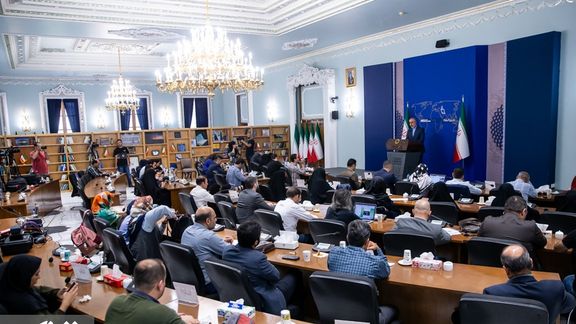
Foreign Ministry spokesman Nasser Kanaani during a press briefing in Tehran

After a week of silence following Iran International’s report on Tehran’s influence network in the US, the Iranian foreign ministry was forced to react. 

During a press briefing on Monday, Foreign Ministry spokesman Nasser Kanaani was asked about the joint report by Iran International and Semafor revealing that several individuals closely connected to President Joe Biden's former Iran special envoy, Robert Malley, were part of an influence network established by Iran's foreign ministry. 

Kanaani dodged a direct answer but attempted to portray the issue as part of domestic US politics, saying, "We do not wish to comment on issues that are raised in the competition between political parties in the United States, and we leave these matters to the internal parties in the United States."

He claimed that the revelation is playing an “Iran card” in the domestic politics of the US,” without further explanation. It took a week for Iran’s foreign ministry to come up with this response. However, the investigative report did not involve US domestic politics and was about its foreign policy issues, directly relating to Iran.

Media in Iran have also started to analyze the repercussions of the compromised network of the Islamic Republic’s “Soft War” which has revealed deep holes in the regime's so-called watertight secrecy. 

Faraz Daily, an online pro-reform newspaper based, raised a series of questions, such as who leaked the correspondence between the Iran analysts and Iran’s Foreign Ministry officials. Iran International’s Bozorgmehr Sharafedin combed through thousands of emails from Iranian diplomats to reveal the Islamic Republic's network of academics and journalists under the aegis of the Iran Experts Initiative (IEI), established by the Iranian foreign ministry in 2014.

(from left to right) Dina Esfandiary, Ariane Tabatabai, Ali Vaez, and former US special envoy for Iran Robert Malley
100%
(From left to right) Dina Esfandiary, Ariane Tabatabai, Ali Vaez, and former US special envoy for Iran Robert Malley

The IEI members simultaneously worked for top Western think tanks and gave advice to the US and Europe. At least three individuals, namely Ariane Tabatabai, Ali Vaez, and Dina Esfandiari, were, or later became, key aides to Robert Malley, who was placed on leave this June following the suspension of his security clearance.

Out of the individuals exposed in the report, only one, Ariane Tabatabai, is still a US government employee. She holds the position of Chief of Staff for the Assistant Secretary of Defense for Special Operations and Low Intensity Conflict, a high-ranking role with access to top-secret information. Dozens of US senators have demanded her security clearance be revoked.

Faraz Daily also claimed that the revelation was also welcomed by Iranian hardliners who seek to tarnish the efforts by [former Iranian foreign minister Mohammad Javad] Zarif, a figure in Iran’s political sphere known as an advocate of diplomacy with the US. “They (hardliners) have always been pursuing the elimination of Zarif and diminishing his influence,” the outlet stated.

Iran's former foreign minister Javad Zarif outside the Foreign Ministry building  (undated)
100%
Iran's former foreign minister Javad Zarif outside the Foreign Ministry building

Faraz Daily also highlighted the timing of the report that came out amid rumors of negotiations between Iran and the United States, implying that it was aimed at stifling the efforts of diplomatic ties between the two. Sharafedin, the writer of the investigative report, has said in several interviews that the data was available to them for months but the fact-checking process delayed the publication of the report. 

Conservative online magazine Tablet published an article Monday titled “High-Level Iranian Spy Ring Busted in Washington,” opening with how the Biden administration’s now-suspended Iran envoy “helped to fund, support, and direct an Iranian intelligence operation designed to influence the United States and allied governments.” 

Even at home, Iranian reformist newspaper Ham-Mihan described the report as an effort to smother secret Iran-US talks and tried to whitewash the analysts exposed in the report as well as all other Iranian-American individuals who are trying to promote relations between the US and the Islamic Republic. The daily cited several pundits to justify that “lobbying” for Iran is different from “infiltration.” 

Quoting Jahanbakhsh Izadi, a university professor in Iran, Ham-Mihan said, "Direct negotiations between Iran and the United States have always existed since the beginning of the Islamic Republic, but this issue has often been hidden.” 

Jahanbakhsh Izadi (undated)
100%
Jahanbakhsh Izadi

Another pundit, Mehdi Zakerian, said that if a country seeks to exert influence in another country and impact its policymaking to secure greater gains using influential individuals, “we no longer call this infiltration, we refer to it as lobbying," which he said could be done by figures "from athletes, artists, and journalists to university professors and researchers". 

Izadi underlined that "Lobbying is a widely accepted principle in international politics... and is considered legal in many countries, including the United States." He apparently ignored the fact that to be a lobbyist in the US, one must be registered as one and have a contract for it, not like the analysts exposed in the report who claimed neutrality and independence. 

London-based Arabic newspaper Asharq Al-Awsat said in an article Sunday that the report provided details and evidence for an “open secret” that “the Iranian lobby is real and has been operating in Washington since the Obama years.” 

“The experts were the liaison between the US and Iran when the nuclear negotiations kicked off. Their role was to bolster Iran’s image and drown out critical voices in Washington,” read the article, adding: “The question now is, has the network succeeded? Has the IEI succeeded in deceiving American and European officials? I believe the Democrats, especially those affiliated to Obama, wanted to be deceived.” 

Iran International continues to be stonewalled, declined comments from key figures and institutions in the unraveling web including Iran’s Foreign Ministry, its in-house think tank, the Institute for Political and International Studies (IPIS), and former foreign minister Javad Zarif who was the mastermind of the network. Others approached include Mostafa Zahrani, a former director general of strategic affairs in the foreign ministry and an advisor to Zarif, and Saeed Khatibzadeh, a diplomat and an IPIS member.

Most Viewed

Ideology may be fading in Iran, but not in Kashmir's ‘Mini Iran'
1
INSIGHT

Ideology may be fading in Iran, but not in Kashmir's ‘Mini Iran'

2
INSIGHT

Hardliners push Hormuz ‘red line’ as US blockade tests Iran’s leverage

3
VOICES FROM IRAN

Hope and anger in Iran as fragile ceasefire persists

4

Iran International says it won’t be silenced after London arson attack

5

US sanctions oil network tied to Iranian tycoon Shamkhani

Banner
Banner

Spotlight

  • Hardliners push Hormuz ‘red line’ as US blockade tests Iran’s leverage
    INSIGHT

    Hardliners push Hormuz ‘red line’ as US blockade tests Iran’s leverage

  • Ideology may be fading in Iran, but not in Kashmir's ‘Mini Iran'
    INSIGHT

    Ideology may be fading in Iran, but not in Kashmir's ‘Mini Iran'

  • War damage amounts to $3,000 per Iranian, with blockade set to add to losses
    INSIGHT

    War damage amounts to $3,000 per Iranian, with blockade set to add to losses

  • Why the $100 billion Hormuz toll revenue is a myth
    ANALYSIS

    Why the $100 billion Hormuz toll revenue is a myth

  • US blockade targets Iran oil boom amid regional disruption
    ANALYSIS

    US blockade targets Iran oil boom amid regional disruption

  • Iran's digital economy battered by prolonged blackout
    INSIGHT

    Iran's digital economy battered by prolonged blackout

•
•
•

More Stories

President Claims Iran 'A Champion Of Human Rights'

Oct 2, 2023, 17:33 GMT+1

In spite of a mass rebellion against the mandatory hijab and oppressive policies against women, Iran's President has accused the West of manipulating the issue of women's rights.

In a typical regime slanted speech, Ebrahim Raisi claimed on Monday that Westerners “are not genuinely advocating for women's rights or human rights,” meanwhile the government's repressive measures continue to deepen, with punishments against hijab rebels including fines, imprisonment and bans from public spaces.

Speaking at a festival in Tehran, Raisi went as far as to claim that "Iran considers itself a champion of human rights", ignoring the Women, Life, Freedom movement which has grown in the wake of the death of Mahsa Amini who died in morality police custody for the inappropriate wearing of her hijab.

Since the inception of the movement, tens of thousands of girls and women have chosen to remove their compulsory hijabs. The Iranian government aims to criminalize hijab defiance, but no branch of the government wants to bear sole responsibility for the potential societal complications arising from such a provocative action.

Innumerable women have been imprisoned and sexually abused as a state-sanctioned punishment across Iran as state crackdowns have become harsher as the last year of uprising continued. New 'hijab and chastity' laws are set to come into force with ever more strict punishments for hijab rebels.

Human rights advocates have warned that the implementation of this law could result in increased violence, harassment, and arbitrary detentions of women and girls in Iran, and the United Nations has branded it gender apartheid.

Iranian Ride-Hailing App Refuses To Address Data Breach

Oct 2, 2023, 16:33 GMT+1

A month after a major personal data hack impacting 27 million passengers and six million drivers of an Iranian taxi app, the company remains silent about the breach.

Tapsi's official communication channels, including their website, Instagram, Telegram, and blog, have seen updates since the incident, but they provide no information regarding the hack's specifics, how it occurred, or related details.

The news of the hack and data leak involving over 33 million Tapsi users first came to light on September 2, through a Telegram channel. Shortly afterward, Milad Monshipour, Tapsi's founder and CEO, confirmed the incident on his Twitter account, noting that the hackers had attempted extortion.

The hackers claimed to have engaged in a two-week negotiation with Tapsi's management before publicly disclosing the breach and demanding a $35,000 ransom payment, which the company refused.

Ultimately, the hackers publicly traded the stolen information, leaving the identity of those accessing the sensitive data unclear.

While large-scale privacy data breaches might not be uncommon in Iran, the magnitude and significance of the particular incident have elevated the Tapsi hack to one of the most prominent cases of a private company data breach in the country.

The situation underscores the absence of robust laws and substantial penalties for mishandling personal information, as well as the inability for users to request the removal of their data. It also highlights the recurring concern of data leaks impacting the financial and emotional lives of Iranian citizens.

Frankfurt Book Fair Denies Participation To Islamic Republic

Oct 2, 2023, 15:26 GMT+1

The organizers of the Frankfurt International Book Fair have once more denied participation to the Islamic Republic in this notable international event for the second consecutive year.

Narges Eskandari-Grunberg, an Iranian-German city councilor in Frankfurt, conveyed to Iran International correspondent Ahmad Samadi in Berlin, according to the organizer’s decision, the Islamic Republic is not allowed to take part in this book fair.

The exclusion of the Islamic Republic from the fair is attributed to several factors, including the ongoing suppression of the Iranian population, especially women, the detention of journalists, writers, and artists, the forced closure of publishing houses and bookstores for admitting women without compulsory hijab, as well as continued denial of access to and censorship of the internet. 

Eskandari-Grunberg emphasized that, due to the actions taken against the people of Iran, the Islamic Republic will not have a presence at this year's fair either. She added, "Last year, instead of the Islamic Republic setting up booths, several panels were organized to discuss women's rights and human rights in Iran, and this year, these panels will once again take place."

Last year, the Islamic Republic was barred from attending the fair due to its harsh response to nationwide protests in Iran, internet censorship, and the detention of journalists. More than 500 people were killed by the security forces in the five-month-long protests that started in September 2022, thousands injured and 22,000 arrested.

The seventy-fifth annual Frankfurt International Book Fair is scheduled to take place from October 18th to October 22nd, 2023.


Iranians Increasingly Reject Khomeini’s Legacy, 1979 Revolution

Oct 2, 2023, 15:18 GMT+1
•
Mardo Soghom

The weakening of the Islamic Republic’s legitimacy among Iranians is most evident in increasingly bold statements against its founder, Ayatollah Ruhollah Khomeini. 

Younger people seeing their deteriorating economic situation in Iran, and those who have left their country for exile abroad, blame the 1979 revolution for their hardships.

Many former revolutionaries who wholeheartedly supported Khomeini in 1978-1979, as the father-figure of the revolution, sooner or later admitted that he hijacked what they believed was a revolution for democracy, social equity, and non-alignment in international relations. They accuse him of purging loyal revolutionaries and setting up a dictatorial clerical regime, with Islamic rule.

Some former regime supporters, who avoid criticizing Khomeini, have vehemently turned against his successor, Supreme Leader Ali Khamenei, labeling him as the enemy of the people.

Khamenei has also become a hated figure among many younger Iranians, to the degree that university students protesting on campus last year unleashed the worst derogatory and unheard-of insults at him. Most of the slogans during the protests were in fact political and even sexual insults directed at Khamenei, such as, “Khamenei the dictator”, the “bloodsucker”, the killer of the youth, just to mention some of the political statements.

Top regime insiders have come to admit that “the sanctities” of the revolution have been badly assaulted and lately they have tried to at least save Khomeini’s reputation.

Last week, Khomeini’s grandson, Hassan Khomeini had to address the issue of increasing disdain for his grandfather by speaking to local media. He said to blame Ruhollah Khomeini for today’s economic and social crises is unfair, and the younger generations are not aware of his philosophy and personality.

However, for many Iranians, facts speak for themselves. The Iranian economy has persistently deteriorated since Khomeini established the Islamic Republic. While before the revolution incomes were rising and the Iranian rial was a stable and strong currency, in 44 years it has declined from 70 rials per US dollar to 500,000. The inflation rate has seldom been single-digit, with consistently above 40-percent annual rate in the past five years. Around 1.5 trillion dollars in oil income has evaporated in four decades, with Iran having little to show for it. Iran’s GDP in the past year was less than half of Turkey’s and Saudi Arabia’s, with no prospects for improvement. Even without sanctions, the economy would be seriously under-productive, with the government, clerical foundations and the military controlling 80 percent.

On top of economic hardship, younger Iranians with access to information in the Internet and social media era, deeply resent to be told how to live by clerics whose education and worldview is limited to half-mythical Islamic teachings from the 7th and 8th centuries.

Another senior cleric, Mohammad Ali Movahedi Kermani, Tehran's interim Imam for Friday Prayers responding to attacks on Khomeini stated last week that "Such claims are unfounded, and the public does not subscribe to them. People recognize [Ayatollah Ruhollah] Khomeini as a divine and spiritual figure who dedicated himself to service."

But many Iranians not only reject Ayatollah Khomeini, but they also even strongly dislike former US President Jimmy Carter who is perceived as having abandoned the Shah in 1979 and indirectly helped the Islamists to gain power. A young female user wrote on ‘X’: “You betrayed the late Shah of Iran and helped Khomeini to power. You deserve a miserable life and I hope you will never be happy, any second of this life, for what you did to generations of Iranian people and the whole middle east.”

Nearly 2.5 Million Afghans Reside in Western Tehran

Oct 2, 2023, 13:07 GMT+1

Almost two and a half million Afghans now live in the western part of Tehran, posing "a significant challenge" to the economy and dividing the government.

Abbas Johari from the Tehran governor's office said the issue "entails expenses, particularly in the realm of education."

Mohammad Taghi Naghdali, a parliament member from Khomeinishahr, said, "People are displeased with the increasing presence of foreign nationals in schools," referring to it as an "invasion".

Foreign nationals is a term commonly referring to Afghans, whose numbers have been steadily rising as they flow across borders in the wake of the Taliban takeover two years ago.

In January, the Director-General of Foreign Nationals and Foreign Migrants Affairs at the Ministry of Interior stated that there were five million Afghan citizens residing in the country.

Naghdali has called for an explanation from the parliament's speaker regarding the matter, while others have raised complaints.

Last month, it was revealed that plans are underway to grant many of the Afghan population citizenship. Announced by MP Mahmoud Ahmadi Bighash, he said the regime wants to formalize the presence of one of the country's largest immigrant populations, a move dividing the establishment. 

The issue of unauthorized entry of Afghans continues to trouble the country, both economically and demographically. While the Islamic Republic might be considering accepting more Afghan Hazaras, who share Shiite beliefs with Iranians, there is a concern that an influx of Sunni migrants could potentially alter the country's social balance. Currently, Sunni Muslims constitute around 10 percent of Iran's nearly 88-million population.






