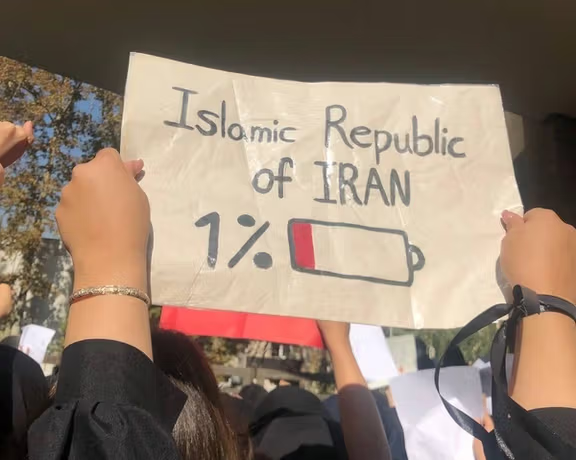
Iranian students protesting at Tehran University in 2022
The weakening of the Islamic Republic’s legitimacy among Iranians is most evident in increasingly bold statements against its founder, Ayatollah Ruhollah Khomeini.
Younger people seeing their deteriorating economic situation in Iran, and those who have left their country for exile abroad, blame the 1979 revolution for their hardships.
Many former revolutionaries who wholeheartedly supported Khomeini in 1978-1979, as the father-figure of the revolution, sooner or later admitted that he hijacked what they believed was a revolution for democracy, social equity, and non-alignment in international relations. They accuse him of purging loyal revolutionaries and setting up a dictatorial clerical regime, with Islamic rule.
Some former regime supporters, who avoid criticizing Khomeini, have vehemently turned against his successor, Supreme Leader Ali Khamenei, labeling him as the enemy of the people.
Khamenei has also become a hated figure among many younger Iranians, to the degree that university students protesting on campus last year unleashed the worst derogatory and unheard-of insults at him. Most of the slogans during the protests were in fact political and even sexual insults directed at Khamenei, such as, “Khamenei the dictator”, the “bloodsucker”, the killer of the youth, just to mention some of the political statements.
Top regime insiders have come to admit that “the sanctities” of the revolution have been badly assaulted and lately they have tried to at least save Khomeini’s reputation.
Last week, Khomeini’s grandson, Hassan Khomeini had to address the issue of increasing disdain for his grandfather by speaking to local media. He said to blame Ruhollah Khomeini for today’s economic and social crises is unfair, and the younger generations are not aware of his philosophy and personality.
However, for many Iranians, facts speak for themselves. The Iranian economy has persistently deteriorated since Khomeini established the Islamic Republic. While before the revolution incomes were rising and the Iranian rial was a stable and strong currency, in 44 years it has declined from 70 rials per US dollar to 500,000. The inflation rate has seldom been single-digit, with consistently above 40-percent annual rate in the past five years. Around 1.5 trillion dollars in oil income has evaporated in four decades, with Iran having little to show for it. Iran’s GDP in the past year was less than half of Turkey’s and Saudi Arabia’s, with no prospects for improvement. Even without sanctions, the economy would be seriously under-productive, with the government, clerical foundations and the military controlling 80 percent.
On top of economic hardship, younger Iranians with access to information in the Internet and social media era, deeply resent to be told how to live by clerics whose education and worldview is limited to half-mythical Islamic teachings from the 7th and 8th centuries.
Another senior cleric, Mohammad Ali Movahedi Kermani, Tehran's interim Imam for Friday Prayers responding to attacks on Khomeini stated last week that "Such claims are unfounded, and the public does not subscribe to them. People recognize [Ayatollah Ruhollah] Khomeini as a divine and spiritual figure who dedicated himself to service."
But many Iranians not only reject Ayatollah Khomeini, but they also even strongly dislike former US President Jimmy Carter who is perceived as having abandoned the Shah in 1979 and indirectly helped the Islamists to gain power. A young female user wrote on ‘X’: “You betrayed the late Shah of Iran and helped Khomeini to power. You deserve a miserable life and I hope you will never be happy, any second of this life, for what you did to generations of Iranian people and the whole middle east.”
Almost two and a half million Afghans now live in the western part of Tehran, posing "a significant challenge" to the economy and dividing the government.
Abbas Johari from the Tehran governor's office said the issue "entails expenses, particularly in the realm of education."
Mohammad Taghi Naghdali, a parliament member from Khomeinishahr, said, "People are displeased with the increasing presence of foreign nationals in schools," referring to it as an "invasion".
Foreign nationals is a term commonly referring to Afghans, whose numbers have been steadily rising as they flow across borders in the wake of the Taliban takeover two years ago.
In January, the Director-General of Foreign Nationals and Foreign Migrants Affairs at the Ministry of Interior stated that there were five million Afghan citizens residing in the country.
Naghdali has called for an explanation from the parliament's speaker regarding the matter, while others have raised complaints.
Last month, it was revealed that plans are underway to grant many of the Afghan population citizenship. Announced by MP Mahmoud Ahmadi Bighash, he said the regime wants to formalize the presence of one of the country's largest immigrant populations, a move dividing the establishment.
The issue of unauthorized entry of Afghans continues to trouble the country, both economically and demographically. While the Islamic Republic might be considering accepting more Afghan Hazaras, who share Shiite beliefs with Iranians, there is a concern that an influx of Sunni migrants could potentially alter the country's social balance. Currently, Sunni Muslims constitute around 10 percent of Iran's nearly 88-million population.
Hardliners have labeled concerns about rising Afghan immigration as "Afghan-Phobia," defending the government's perceived "open borders" policy, despite public outcry.
The fast-growing Afghan population in Iran has given rise to protests on social media and even debates in Iran's government-controlled media, with many claiming that the government has a hidden agenda in letting thousands of Afghans enter the country illegally every day. Videos from the border regions show crowds of Afghans simply walking into Iran, and some claim that “a network” quickly helps find housing and jobs for them.
Iranian officials say there are five million Afghans in Iran now of which only 780,000 have refugee status. Most others are undocumented. Some estimates of the Afghan population reach as high as 8 million. A Tehran province official said Monday that 2.5 million Afghans have settled just in areas west of the capital.
The Fatemiyoun brigade of Afghan fighters fought for the Revolutionary Guards in Syria.
Thousands of Afghan militia, recruited and trained by the Revolutionary Guard, played a significant role in supporting Bashar al-Assad's government by fighting in Syria.
Tehran Municipality’s Hamshahri newspaper is among the hardline media that has been describing popular concerns as “Afghan-phobia”. The newspaper whose chief editor Abdollah Ganji is a former editor of the IRGC-linked Javan newspaper, published an article entitled “Who Benefits From the Afghan-Phobia Project” last week.
The article said “exaggerated” news about the apparently fast-growing number of Afghan immigrants has affected the mindset of Iranians and that the concerns raised on social media have resulted in “unkind attitudes toward Afghan citizens”.
State media and other hardliner publications also appear to be unusually sympathetic to this unprecedented policy of opening the doors to Afghan immigration.
Recent video of Afghans celebrating the Taliban rule in Mashhad.
Not only reformist media that over the years had been more sympathetic to Afghan immigrants, but also some conservative media and figures such as Jomhouri Eslami newspaper and the former chairman of Iranian parliament's national security and foreign policy committee Heshmatollah Falahatpisheh, have become increasingly vocal in criticism of what they call uncontrolled Afghan immigration and warned about “security threats” that may result from that.
A commentary entitled, “The Dangerous Aspirations of Radical Afghans in Iran” published by the newspaper Sunday warned that the Taliban may be harboring dangerous plans for Iran and may attempt to use “radical Afghans in Iran” toward securing their own interests given “the [existence of a] divide between the people and government in Iran and extensive frustration of the Iranian people”.
The warning came after a video of pro-Taliban Sunni Afghans celebrating in Mashhad on September 29 went viral on Persian-language social media. The video showed the celebrants raising the flag of the Taliban Islamic Emirate of Afghanistan and chanting anti-American slogans.
The religious city of Mashhad is Iran's second largest city where the shrine of Imam Reza, the eighth Imam of Shiites, is located, while at least a segment of Afghan migrants are fierce Sunnis.
Hardliners’ positive attitude in the past two years toward the Taliban despite the Shiite-Sunni divide is unprecedented in the history of the Islamic Republic where hardliners and top Shiite clergy have always been highly sensitive to the growth of the Sunni population in the country.
“Around Mashhad, the Sunnis are buying land and houses from Shiites to increase their weight in the population. I told the officials that if they do not find a solution to these problems today, it may reach a point where no action can be taken," Nasser Makarem Shirazi, a source of emulation in Qom, warned in 2016.
Similar religious concerns may be behind some hardliners’ concerns over allowing an increase in the number of Afghan immigrants including Kayhan, a flagship newspaper close to Supreme Leader Ali Khamenei which has been extremely supportive of President Ebrahim Raisi and his government.
On Sunday Kayhan printed a reader’s message who has urged authorities to expel “illegal” Afghan immigrants because they are benefitting from “hidden subsidies including food, housing, public transportation and healthcare [subsidies]”.
Mahsa Amini's death in morality police custody sparked the last year of uprising which has rocked the regime to its core.
The initial court session for Nikbakht took place in August, during which he was accused of the charges stemming from his interviews, including one discussing the legal aspects of Mahsa Amini's case.
Ali Rezaei, Saleh Nikbakht's attorney, revealed that the court was adjourned to a later date because the judge insisted on hearing the Ministry of Intelligence expert's opinion, who is also a complainant in the case.
During that session, Nikbakht refuted the allegations and criticized the formation of the case as being contrary to the law. He had previously raised objections to the forensic report attributing Amini's death to a "heart attack" and an "underlying disease."
He had called for a "reinvestigation and the establishment of a new committee with the presence of respected and trusted medical professionals from the country's medical community."
Additionally, nine interviews conducted by Nikbakht between 2019 and 2023, covering topics such as the challenges faced by Kolbars and confrontations between security forces and Afghans, have been included as "evidence" in his case.
Islamic Republic’s propagandist Ali Akbar Raefipour
The presence of Iranian hardliners on platform X has sparked criticism within Iran while ordinary citizens are banned from that and many other social platforms.
One such user is the propagandist Ali Akbar Raefipour, whose recent purchase of the blue verification tick has stirred massive controversy on social media.
Hashem Firouzi, a social media activist, voiced his concerns, stating, "They pay $8 a month for the Blue Tick to the United States, and then they tell us that the United States is on the verge of decline."
Several other Iranian officials, including Labor Minister Solat Mortazavi, also subscribed to X in June. Elon Musk, the owner of X (formerly Twitter), has rebranded the platform and introduced a premium option as the exclusive means of obtaining the coveted Blue Tick verification.
Parliamentarian Bijan Nobaveh Vatan recently criticized the presence of Iranian officials on the former Twitter platform (X), highlighting the hypocrisy, stating "The first step in fostering trust in domestic platforms and discouraging the use of foreign platforms is the adherence of officials to the relevant laws."
In a related development, a new Iranian social network called Virasty has emerged, closely copied from Twitter in both its features and logo design.
Iran has long maintained strict internet censorship, blocking major social media platforms such as Facebook, Twitter, and YouTube. In the wake of recent protests, Instagram was also blocked.
Social media users in Iran have largely refrained from using domestically developed social media applications like Rubika, Eitaa, Soroush, and Nazdika, citing concerns about their quality and privacy shortcoming as digital surveillance continues to gain pace.
Vehicles carrying refugees from Nagorno-Karabakh, a region inhabited by ethnic Armenians, queue on the road leading towards the Armenian border, in Nagorno-Karabakh, September 25, 2023.
The former head of Iranian parliament's National Security and Foreign Policy Committee says Azerbaijan's attack on Karabakh is the beginning of a regional crisis.
Heshmatollah Falahatpisheh told Didban Iran [Iran Monitor] website in Tehran that the country is facing a serious challenge as one of its gateways to Europe is threatened because of the military development in the Caucasus.
Falahatpisheh also pointed out that Iranian officials and military commanders who used to deliver passionate speeches about Iran's interests and authority in the region are silent in the face of threats to Tehran's interest.
During the past months, several Iranian military commanders and politicians warned Azerbaijan not to attack Armenia and avoid closing Iran's gateway to Europe at its borders with Armenia. As Azerbaijan expelled 120,000 Armenians from the enclave, it now threatens to enter and occupy the narrow strip of land connecting Iran via Armenia to Russia and Europe.
Iran has also long warned Azerbaijan about its close military relations with Israel, which is the Baku’s main arms supplier.
Heshmatollah Falahatpisheh, the former head of Iranian parliament's National Security and Foreign Policy Committee
Mashregh News, a media outlet with close links to Iranian security and intelligence organizations on September 9, called an attack on Karabakh Iran's "red line" and maintained that such an action will entail consequences for Azerbaijan. The threat later proved to be hollow.
Iran's silence in the face of the development is apparently linked to a visit to Iran by Russia's Defense Minister Sergey Shoigu immediately before the attack. Meanwhile, Tehran's inaction was quite embarrassing for the regime and its military commanders considering months of bragging on IRGC media outlets and social media channels about Iran's swift reaction in case Azerbaijan attacked Karabakh.
Some Iranian social media users ridiculed the Iranian military and posted a photo of a smiling Iranian military attache' walking alongside victorious Azeri officers in Karabakh following the attack. One user wrote: "I wrongly thought that the Iranian regime's officials were trying to be strategically patient in the face of Azerbaijan's alliance with Israel."
Falahatpisheh told Didban Iran that "All this is an outcome of Iran's outdated foreign policy. At times we saw Iranian officials delivering irresponsible speeches at the borders with Azerbaijan. If what is happening now is Iran's real policy, those speakers should be accountable for agitating the society at the expense of Iran's national interests."
The former lawmaker said that the forced displacement of ethnic Armenians in Karabakh is not the end of the conflict. On the contrary, it marks the beginning of a new crisis in the region. Tens of thousands of Armenians have been displaced and their private and public rights poses a new challenge for the region's leaders. This is likely to turn into a chronic challenge not only for Azerbaijan and Armenia, but also for other players such as Turkey and Israel. Particularly because Iran will perceive Israel's presence at its borders as a true challenge.
He said: "Turkish leader Recep Tayyip Erdogan's stance during the conflict were more realistic that the other leaders involved. At least he acknowledged that Iranians are not going to like the closure of one of their key gateways to Europe and the outside world.
Meanwhile, Erdogan’s call for a meeting between the leaders of Turkey, Russia, Azerbaijan and Armenia to discuss the aftermaths and implications of the attack on Karabakh, without mentioning Iran.
Falahatpisheh pointed out that Iran's policy about the region dated back to three decades ago and Tehran was oblivious to the developments and dynamics that have been taking shape during the past thirty years in the region.
He argued that as a result of the current conflict, Azerbaijan will have to allocate a major part of its annual budget to military spending. He added that by inviting countries from beyond the region into this conflict, Azerbaijan has made a mistake. It could have solved its problems with Armenia in a different way.