• العربية
  • فارسی
Brand
  • Iran Insight
  • Politics
  • Economy
  • Analysis
  • Special Report
  • Opinion
  • Podcast
  • Iran Insight
  • Politics
  • Economy
  • Analysis
  • Special Report
  • Opinion
  • Podcast
  • Theme
  • Language
    • العربية
    • فارسی
  • Iran Insight
  • Politics
  • Economy
  • Analysis
  • Special Report
  • Opinion
  • Podcast
All rights reserved for Volant Media UK Limited
volant media logo

Riyadh Seeks US Security Guarantees For Peace With Israel
Iran International Newsroom
Sep 29, 2023, 12:24 GMT+1Updated: 11:51 GMT+0
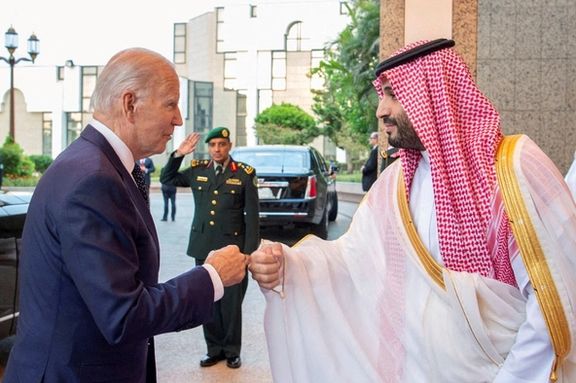
Saudi Crown Prince Mohammed bin Salman fist bumps US President Joe Biden upon his arrival at Al Salman Palace, in Jeddah, Saudi Arabia, July 15, 2022.

Saudi Arabia is seeking binding US security guarantees, primarily against Iran, before it agrees to establish relations with Israel, sources have confirmed to Reuters.

Three unnamed regional sources said that the Palestinian issue is not paramount for the Saudis, who are determined to secure a military pact with the United States to defend the kingdom.

Although a pact might fall short of the cast-iron, NATO-style defense guarantees the kingdom initially sought when the issue was first discussed between Crown Prince Mohammed bin Salman and President Joe Biden during his visit to Saudi Arabia in July 2022.

Instead, a US source told Reuters it could look like a US agreement with Bahrain, where the US Navy Fifth Fleet is based. Such an agreement would not need congressional backing, which can be implemented before Biden’s first presidential term ends next year.

Washington could also sweeten any deal by designating Saudi Arabia a Major Non-NATO Ally, a status already given to Israel, the US source said.

Then-Vice President Joe Biden (right) prepares to sign the guest book before his meeting with Israel's Prime Minister Benjamin Netanyahu at Netanyahu's residence in Jerusalem on March 9, 2010.
100%
Then-Vice President Joe Biden (right) prepares to sign the guest book before his meeting with Israel's Prime Minister Benjamin Netanyahu at Netanyahu's residence in Jerusalem on March 9, 2010.

Although Iran re-established diplomatic ties with Saudi Arabia earlier this year, top Iranian officials have been criticizing Riyadh’s plans for establishing relations with Israel as a step detrimental for the Palestinians. Tehran supports militant Palestinian groups who have intensified their attacks against Israel and its civilian population this year.

Palestinian groups such as Hamas and the Islamic Jihad are parts of Iran’s militant network of proxy forces from Iraq to Lebanon and in Yemen. They receive financial and military assistance that Tehran is not reluctant to boast about.

Riyadh is well aware of Tehran’s ability to foment unrest across the region or even directly harm Saudi Arabia. Prince Mohammed bin Salman is said to have been “traumatized” by a devastating attack on Saudi oil installations in September 2019, and follow-up missile and drone attacks by Iran-aligned Houthis in Yemen.

Despite close Saudi ties with former President Donald Trump’s administration, the US failed to immediately take any action against Iran for its brazen missile and drone attack, which posed a major risk to global energy supplies. As a result, Reuters’ sources said Saudi Arabia would not settle for less than binding assurances of US protection if it faced attack. 

Agreements giving the world's biggest oil exporter US protection in return for normalization with Israel would reshape the Middle East and binding Riyadh to Washington after China's inroads in the region. For Biden, it would be a diplomatic victory to vaunt before the 2024 US election.

In reviving relations with Iran, Riyadh hoped to pacify the Houthis in Yemen and perhaps reach a lasting peace to focus on its grand development plans at home. However, so far there are no major positive developments. 

Another Saudi goal could have been to reduce the chances of a harsh reaction by the militant regime in Iran to any agreement with Israel. Riyadh tried to balance its regional policies by improving ties with Tehran before normalizing relations with Israel.

While the Biden administration is insisting on securing some Israeli guarantees regarding concessions to Palestinians, Saudi Arabia seems less interested in tying its goals to their fortunes.

"The normalization will be between Israel and Saudi Arabia. If the Palestinians oppose it the kingdom will continue in its path," said one of the regional sources. "Saudi Arabia supports a peace plan for the Palestinians, but this time it wanted something for Saudi Arabia, not just for the Palestinians."


Most Viewed

Ideology may be fading in Iran, but not in Kashmir's ‘Mini Iran'
1
INSIGHT

Ideology may be fading in Iran, but not in Kashmir's ‘Mini Iran'

2
INSIGHT

Hardliners push Hormuz ‘red line’ as US blockade tests Iran’s leverage

3
VOICES FROM IRAN

Hope and anger in Iran as fragile ceasefire persists

4

Iran International says it won’t be silenced after London arson attack

5

US sanctions oil network tied to Iranian tycoon Shamkhani

Banner
Banner

Spotlight

  • Hardliners push Hormuz ‘red line’ as US blockade tests Iran’s leverage
    INSIGHT

    Hardliners push Hormuz ‘red line’ as US blockade tests Iran’s leverage

  • Ideology may be fading in Iran, but not in Kashmir's ‘Mini Iran'
    INSIGHT

    Ideology may be fading in Iran, but not in Kashmir's ‘Mini Iran'

  • War damage amounts to $3,000 per Iranian, with blockade set to add to losses
    INSIGHT

    War damage amounts to $3,000 per Iranian, with blockade set to add to losses

  • Why the $100 billion Hormuz toll revenue is a myth
    ANALYSIS

    Why the $100 billion Hormuz toll revenue is a myth

  • US blockade targets Iran oil boom amid regional disruption
    ANALYSIS

    US blockade targets Iran oil boom amid regional disruption

  • Iran's digital economy battered by prolonged blackout
    INSIGHT

    Iran's digital economy battered by prolonged blackout

•
•
•

More Stories

IRGC Commander Praises Retired Officers For Suppressing Protests

Sep 29, 2023, 09:18 GMT+1

Retired Revolutionary Guard officers were deployed to suppress protesters in Iran during anti-regime demonstrations, IRGC commander Hossein Salami said on Thursday.

Addressing retired officers during a gathering in Tehran Salami said that the IRGC “organized” retired officers and “deployed” them to the “battlefield” during the Women, Life, Freedom movement. The protests broke out after a 22-year-old woman was killed in the custody of Iran’s notorious hijab police in September last year.

Salami, calling the protests “riots” according to the Iranian regime’s terminology told retired officers, “Even now, you are in the battlefield…and when there are riots, you are present, you show up, get organized and go [to confront the protests].

The Islamic Republic deployed the regular police, riot police, IRGC forces and plainclothes agents in tens of thousands across the country to suppress the protests. They were armed with military weapons, shotguns, clubs and knives. More than 540 civilians were killed by these forces and 22,000 arrested in five months. Scores of you people lost one or both eyes when agents fired at their faces with shotgun ‘birdshots’.

Salami emphasized that retired IRGC officers have always been present in the past in suppressing protests. However, during the protests, Salami had threatened young demonstrators that the regime will “come after them” with its young supporters.

According to past statements by other IRGC commanders, during the 2009 protests to a fraudulent presidential election, thousands of criminals were freed from prisons and ordered to attack demonstrators.

US Voices Concern Over Iranian Satellite Launch

Sep 29, 2023, 08:20 GMT+1

US State Department expressed concern Thursday about a recent Iranian space launch, saying that the program offers a pathway to more advanced ballistic missiles.

“We have long made clear our concerns about Iran’s space launch vehicle programs, that they provide a pathway to expand its longer-range missile systems. Space launch vehicles incorporate technologies virtually identical and interchangeable to – with those used in ballistic missiles,” State Department’s spokesperson Matthew Miller said during a press briefing.

On Wednesday, Iran announced the successful placement of its Nour 3 satellite with an imaging satellite into orbit, positioned in an orbit approximately 450 kilometers above the Earth's surface. Nour belongs to a class of Iranian military Earth-imaging CubeSats. To date, two Nour satellites have been launched from Iran's Shahrud Desert, using three-stage Qased space-launch vehicles.

The announcement came amidst escalating tensions between Iran and Western nations, as Tehran continues to expand it nuclear program, accumulating enough enriched uranium for five nuclear warheads..

When the United States and other world powers concluded the 2015 JCPOA nuclear accord with Iran, a UN resolution put vague limitations on Iran’s ballistic missile program, forbidding the development of weapons systems that could deliver nuclear warheads. The United States has previously accused Iran of violating a UN Security Council resolution by conducting satellite launches. However, Iran argues that its space launch vehicles are not developed for that purpose.

“Iran’s continued advancement of its ballistic missile capabilities poses a serious threat to regional and international security and remains a significant nonproliferation concern,” Miller added.

IRGC Navy Harasses US Attack Chopper In Persian Gulf

Sep 28, 2023, 22:56 GMT+1
•
Iran International Newsroom

The United States Navy has condemned Iran’s Revolutionary Guard's Navy for pointing lasers against a US attack helicopter operating in the Persian Gulf.

According to a statement by US Naval Forces Central Command Spokesman Cmdr. Rick Chernitzer on Thursday, personnel aboard vessels belonging to the IRGC’s Navy pointed lasers at a US Marine Corps AH-1Z Viper attack helicopter while in flight, calling it “unsafe, unprofessional and irresponsible.”

The chopper, assigned to the 26th Marine Expeditionary Unit (Special Operations Capable), was conducting routine operations in the international airspace of the Persian Gulf when the interaction took place on Wednesday, the US Navy said, explaining that “The aircraft is attached to Marine Medium Tiltrotor Squadron (VMM) 162 (Reinforced), deployed aboard the Wasp-class amphibious assault ship USS Bataan (LHD 5), on a scheduled deployment to the Middle East Region.”

“Iran’s Islamic Revolutionary Guard Corps Navy (IRGCN) vessels shone a laser multiple times at the aircraft while in flight," the Navy statement said. No one aboard was injured, and the helicopter was not damaged.

USS Bataan (LHD-5) (file photo)
100%
USS Bataan (LHD-5)

Warning about such acts by the Iranian military, Cmdr. Chernitzer said, “These are not the actions of a professional maritime force. This unsafe, unprofessional, and irresponsible behavior by the Iranian Revolutionary Guard Corps Navy risks US and partner nation lives and needs to cease immediately.”

Chernitzer noted that naval forces will “remain vigilant and will continue to fly, sail and operate anywhere international law allows while promoting regional maritime security.”

This is the second time in six years that Iranian units have targeted a helicopter associated with the USS Bataan with lasers. In 2017, an Iranian naval patrol boat used lasers against a Marine helicopter moving through the Strait of Hormuz with three US vessels.

Iranian state media also reported in 2022 that the Iranian military was developing a laser cannon to shoot down aerial targets. In September 2019, Electronic Industries Organization of Iran announced it has succeeded to acquire the knowledge for the laser weapons technology, saying its laser weapons can destroy radar evading UAVs that are made up of composite layers.

Although Iran wants to highlight its laser weapon capabilities to target drones and cruise missiles, the directed-energy weapons including lasers are still at their experimental stage, and are not seen as practical, high-performance military weapons, because a laser generates a beam of light which needs clear air, or a vacuum, to work. The US-Israeli project for such a weapon was canceled in 2005 because of "its bulkiness, high costs and poor anticipated results on the battlefield".

Tensions in the Persian Gulf region have intensified following a series of maritime incidents involving Iran's seizure and harassment of vessels that prompted the US to strengthen its military presence in the region.

In recent months, Tehran's military forces have tried to hijack several Western tankers in what is seen as retaliation for previous Western seizures of Iranian oil. In early-July, Iran tried to seize two oil tankers near the Strait of Hormuz, opening fire on one of them, the US Navy said, adding that the Iranian naval vessels backed off after the US Navy dispatched a guided missile destroyer to the scene.

Iran's introduction of advanced maritime weaponry prompted Washington to extend armed protection to commercial ships traversing the Strait of Hormuz. Later in July, the US Defense Department announced the deployment of additional F-35 and F-16 fighter jets along with a warship to the Middle East in a bid to monitor key waterways in the region following Iran's seizure and harassment of commercial vessels.

Having found itself under US pressure in the Persian Gulf, Iran unveiled a series of what it called new maritime weapons in August. The IRGC held drills around three Iranian islands in the Persian Gulf contested by the United Arab Emirates and claimed that it has added a 600-kilometer-range new missile to its arsenal “for defending the islands’ territory.”

Another Mysterious Explosion Shakes Iranian Military Site

Sep 28, 2023, 17:45 GMT+1

Another mysterious explosion has hit a facility belonging to Iran's sanctioned Ministry of Defense and Armed Forces Logistics (MODAFL) in Tehran.

It marks the third such incident in just a matter of days, with a particular focus on MODAFL installations across Iran. According to the Iranian Ministry of Defense, the incident was played down, described as a fire that was extinguished within one of its battery storage warehouses, causing no casualties.

The ministry released a statement on Thursday, stating, "Following last week's fire in a storage facility linked to our organization, the area was undergoing cleaning procedures when the remaining debris and waste unexpectedly ignited."

Last week, another explosion was contained at the battery warehouse belonging to Iran's Ministry of Defense.

Since July 2020, a series of sabotage acts and drone attacks have targeted sensitive military and industrial installations within Iran. These incidents have included at least three major operations resulting in substantial damage to nuclear facilities.

Iran has attributed these attacks to Israel, while successive Israeli administrations have refrained from publicly acknowledging or accepting responsibility. However, they have consistently issued warnings that Israel would employ all available means, including military actions, to thwart Iran's progress in its nuclear weapons program and the acquisition of such capabilities.

Back in March, the US Department of the Treasury's Office of Foreign Assets Control (OFAC), in cooperation with the Federal Bureau of Investigation (FBI), designated four entities and three individuals in Iran and Turkey for their role in procuring equipment, including European-origin unmanned aerial vehicle (UAV) engines, in support of Iran's UAV and weapons initiatives. The procurement network operates on behalf of MODAFL, overseeing several firms engaged in UAV and ballistic missile development.

Iran Deploys Forces To Zahedan Ahead Of Bloody Friday Anniversary

Sep 28, 2023, 10:23 GMT+1

The Iranian regime has deployed a significant number of military forces to Zahedan in the southeast of the country ahead of the anniversary of Bloody Friday.

The Bloody Friday massacre in Zahedan, the capital of Sistan and Baluchestan Province, last September, saw security forces kill at least 93 protesters with dozens more injured.

Zahedan is one of the few Sunni-majority cities in predominantly Shiite Iran.

According to Halvash, the deployment of military personnel and convoys of vehicles saw a significant increase, particularly on Wednesday.

Halvash stated, "Dozens of military vehicles have entered the cities of Baluchestan from the provinces of Kerman, Hormozgan, and South Khorasan since Monday."

Over the past year, Zahedan has been the site of weekly protests against the regime, often occurring on Fridays.

Mowlavi Abdolhamid, the Sunni leader of Zahedan known for his outspoken criticism of the regime, addressed the death of Mahsa Amini during his Friday sermons.

Mahsa Amini's tragic death on September 16th last year at the hands of the morality police triggered months of anti-government protests, representing one of the most significant challenges to the Islamic regime since its establishment in 1979.

In recent weeks, the regime has intensified its efforts to quell dissent as part of a broader campaign to discourage protests. This has led to the arrest of dozens of individuals in the past week. Heavily armed military forces have been deployed in restive regions, and anti-riot police forces have become increasingly visible on the streets of major cities.