• العربية
  • فارسی
Brand
  • Iran Insight
  • Politics
  • Economy
  • Analysis
  • Special Report
  • Opinion
  • Podcast
  • Iran Insight
  • Politics
  • Economy
  • Analysis
  • Special Report
  • Opinion
  • Podcast
  • Theme
  • Language
    • العربية
    • فارسی
  • Iran Insight
  • Politics
  • Economy
  • Analysis
  • Special Report
  • Opinion
  • Podcast
All rights reserved for Volant Media UK Limited
volant media logo

US Admits Iran May Use Ransom To Buy Weapons
Iran International Newsroom
Sep 20, 2023, 23:17 GMT+1Updated: 11:53 GMT+0
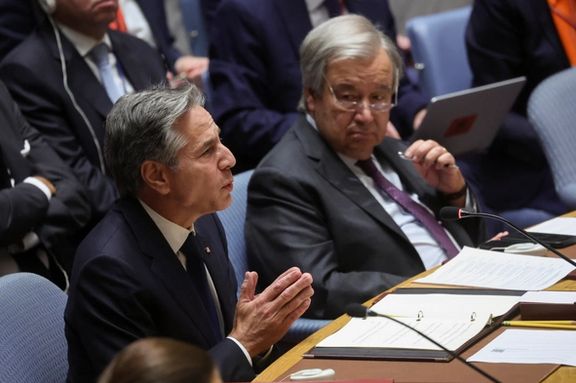
US Secretary of State Antony Blinken addresses the United Nations Security Council as UN Secretary-General Antonio Guterres listens at UN headquarters in New York, September 20, 2023.

Despite outcry over the US-Iran prisoner swap, Secretary of State Antony Blinken defended the deal but acknowledged that Iran may use the money for military purposes.  

During an interview with CBS News on Wednesday, Blinken addressed concerns that the deal to release five Iranians in addition to $6 billion of the frozen assets in exchange for five Iranian-Americans who were held hostage could encourage further hostage-taking. 

“These proceeds from Iran’s oil sales, they’ve always been entitled to use. Just as a practical matter, they couldn’t. But the other thing is whether we like it or not – and we don’t like it – the Iranians have always found ways to use money, whether there are sanctions or not, for military purposes," Blinken said, describing the agreement as a hard decision. "These are hard decisions, hard decisions for the president to make.”

However, a few minutes earlier in the interview, he had claimed that “we made an arrangement with the bank in question – this is a bank in Qatar – to make sure that we would have clear visibility over the way the money is spent,” claiming that if it is not being spent for humanitarian reasons such as food and medicine, “it’ll get shut down.”

The top US diplomat reiterated that “From day one for our sanctions, this has always been exempt, being able to use money, including by Iran, for humanitarian purposes – it’s always been exempt from our sanctions.”

US officials arrange a group photo after freed Iranian-Americans Siamak Namazi, Morad Tahbaz, Emad Shargi, Reza Behrouzi and Fakhr al-Sadat Moeini arrived at Davison Army Airfield at Fort Belvoir, Virginia, September 19, 2023.
100%
US officials arrange a group photo after freed Iranian-Americans Siamak Namazi, Morad Tahbaz, Emad Shargi, Reza Behrouzi and Fakhr al-Sadat Moeini arrived at Davison Army Airfield at Fort Belvoir, Virginia, September 19, 2023.

Countless activists and politicians – mainly Republicans – have voiced opposition to the exchange, saying financial reward in a hostage situation will incentivize future hostage-taking. 

The sentiment was echoed by several editorial articles in the past few days, even by the Washington Post, whose editorial board has predominantly endorsed Democrats in various elections. 

The Post said the prisoner deal rewards noxious regimes and continues a miserable cycle of state-sponsored hostage-taking, “a barbaric practice that thrives on rewards and concessions from the United States and other nations.”

The daily pointed out that even if the Biden administration manages to step up monitoring on how the released money will be disbursed, the economic boost “will undoubtedly free up other funds to spend on more nefarious purposes, such as buying weapons.”

Highlighting that too many Americans remain unjustly held in Russia, Venezuela, Syria, and elsewhere around the world, the Post said these regimes view hostages as “a currency to be traded for future gain.” 

It argued that the best deterrent to end this vicious cycle would be for the United States and other nations to refuse to negotiate for the release of such hostages, otherwise, “Rogue states clang the jail door shut and wait for the next payoff, and they almost never suffer consequences for stealing people off the street.” “The harsh truth is that rewarding hostage-taking breeds more of the same.”

In another editorial highlighting somewhat similar concerns, The Wall Street Journal Tuesday delved into the question of how Biden could prevent future attempts at ransom grabs. It underlined that the Islamic Republic has paid no price for imprisoning Americans and has now been paid ransom for them, calling it “part of Tehran’s business model" which works fine for the regime.

The Journal calls it “insulting” that White House National Security Council official Brett McGurk claims that the funds will be spent “only on a limited category of humanitarian trade: food, medicine and agricultural products,” saying that McGurk may be technically right about those specific funds. “But that leaves the Tehran regime able to devote other funds they would have spent on those goods for such malevolent purposes as terrorism by the Islamic Revolutionary Guard Corps.”


Most Viewed

Iran negotiators ordered to return after internal rift over Islamabad talks
1
EXCLUSIVE

Iran negotiators ordered to return after internal rift over Islamabad talks

2
EXCLUSIVE

Iran’s central bank warns economy may take 12 years to rebuild after war

3
INSIGHT

Iran's digital economy battered by prolonged blackout

4
ANALYSIS

US blockade enters murky phase as tankers spoof signals and buyers hesitate

5
ANALYSIS

Why the $100 billion Hormuz toll revenue is a myth

Banner
Banner

Spotlight

  • Hardliners push Hormuz ‘red line’ as US blockade tests Iran’s leverage
    INSIGHT

    Hardliners push Hormuz ‘red line’ as US blockade tests Iran’s leverage

  • Ideology may be fading in Iran, but not in Kashmir's ‘Mini Iran'
    INSIGHT

    Ideology may be fading in Iran, but not in Kashmir's ‘Mini Iran'

  • War damage amounts to $3,000 per Iranian, with blockade set to add to losses
    INSIGHT

    War damage amounts to $3,000 per Iranian, with blockade set to add to losses

  • Why the $100 billion Hormuz toll revenue is a myth
    ANALYSIS

    Why the $100 billion Hormuz toll revenue is a myth

  • US blockade targets Iran oil boom amid regional disruption
    ANALYSIS

    US blockade targets Iran oil boom amid regional disruption

  • Iran's digital economy battered by prolonged blackout
    INSIGHT

    Iran's digital economy battered by prolonged blackout

•
•
•

More Stories

Iran Discloses Identities Of Two More Prisoners In Swap Deal With US

Sep 20, 2023, 21:29 GMT+1

Iran's regime has revealed the identities of two American prisoners it recently released along with five known hostages as part of a swap arrangement with Washington.

According to Nour News, which is linked to Iran's Supreme National Security Council, the previously unnamed prisoners are Reza Behrouzi and Fakhr al-Sadat Moeini, who had chosen to remain anonymous.

“While US government was hiding pictures and identities of two prisoners released from Iran, National Security Advisor Jake Sullivan published their photos,” wrote Nour News.

The two individuals, along with Emad Sharghi, Siamak Namazi, and Morad Tahbaz, were released on Monday as part of the agreement between Tehran and Washington, which also included $6 billion blocked in South Korea due to US sanctions.

The daughter of Jamshid Sharmahd, a German-Iranian, and a US permanent resident currently facing the death penalty in Iran, called upon reporters and US lawmakers to investigate the issue of these two prisoners.

She posed several questions, seeking information about their connection to the US, their activities in Iran, the reasons for their imprisonment, and the circumstances surrounding their release. She also questioned why these individuals received expedited treatment from the State Department, contrasting it with the extended captivity of others in Iran for years, such as her father Jamshid Sharmahd.

Sharmahd, a 68-year-old software developer and California resident, was abducted during a visit to the United Arab Emirates in 2020 and forcibly taken to Iran. He was subsequently sentenced to death by on charges of "spreading corruption on Earth," a verdict that Amnesty International has already denounced as a sham, and his family vehemently disputes the allegations against him.

Regime Mob Leader Accompanies Iranian President During US Visit

Sep 20, 2023, 20:24 GMT+1

A leader of a government vigilante mob who carried out the 2011 storming of the British embassy in Tehran is now accompanying Iran's president during his visit to the United States.

Mojtaba Amini is also the producer of a TV series that has been criticized for glorifying the imprisonment of dual nationals and journalists.

Amini's producing of the Gando TV series was aimed to undermine the administration of former President Hassan Rouhani while receiving praise from supporters of Supreme Leader Ali Khamenei.

Members of President Hassan Rouhani's administration, including Foreign Minister mohammad Javad Zarif, protested the series and even wrote a letter of complaint to Khamenei, requesting its cancellation.

Despite the protests, a second season of the series was produced. The first season had drawn inspiration from Khamenei's repeated warnings about the "enemy infiltration" of the nuclear negotiating team.

Gando can be seen as a reflection of the complex power dynamics within the Islamic Republic. Despite the presence of an Intelligence Ministry, the IRGC's Intelligence Organization was formed in 2009 and now holds significant influence, if not more than the ministry. Gando was evidently intended to undermine the Intelligence Ministry and Rouhani's government.

In June, Mohammad Mehdi Esmaeili, Iran's Minister of Culture, appointed Mojtaba Amini as his advisor. Amini also served as the secretary of the 41st edition of the annual International Fajr Film Festival in 2021, a significant event in the Iranian cinema scene.


EU Condemns Iran's Arbitrary Detention of Europeans

Sep 20, 2023, 15:21 GMT+1

The EU's top diplomat strongly condemns the arbitrary detention of numerous EU citizens, including those with dual nationality, in Iran.

During a meeting held on Tuesday on the sidelines of the UN General Assembly in New York with Iranian Foreign Minister Hossein Amir-Abdollahian, Josep Borrell, the EU's Foreign Policy Chief, raised critical concerns regarding EU-Iran bilateral relations and the latest developments concerning the JCPOA nuclear agreement.

Borrell reiterated his call for the immediate release of all EU citizens in Iranian custody. In a statement released on the EU's official website, the bloc emphasized that its stance remains unchanged regarding the deeply troubling human rights situation within Iran.

"Iran must ensure the preservation of fundamental freedoms, as articulated by all 27 EU Member States on the anniversary of Mahsa Amini's tragic death."

Regarding the JCPOA, Borrell stressed the importance of pursuing a path of de-escalation. He urged Iran to reconsider its decision to revoke the official status of around one third of the International Atomic Energy Agency (IAEA) inspectors in Iran and to enhance its cooperation with the watchdog.

On Saturday, Iran withdrew the designation of several inspectors tasked with verifying activities in Iran under the Non-Proliferation Treaty Safeguards Agreement. Rafael Grossi, the Director General of the IAEA, stated, “This profoundly regrettable decision by Iran is another step in the wrong direction and constitutes an unnecessary blow to an already strained relationship between the IAEA and Iran in the implementation of the NPT Safeguards Agreement."

Borrell also expressed his strong belief in the necessity of seeking a diplomatic resolution to the Iran nuclear issue within the framework of the JCPOA and once again urged the Iranian government to cease its ongoing military cooperation with Russia in the unlawful war of aggression against Ukraine.

Qatar Pursues More US-Iran Talks After Hostage Release Deal

Sep 20, 2023, 14:32 GMT+1
•
Iran International Newsroom

After US hostages were released this week, Qatar is pressing Iran and the United States to engage in more talks over nuclear and other issues, Reuters reported.

Quoting three regional sources familiar with discussions that Doha has held with Tehran and Washington, the effort is aimed at reaching “understandings” to iron out some differences. The aim is to address slowing Tehran's uranium enrichment alongside more international monitoring, curbing activities of Iran's proxy militias in the region and halting Iran's drone exports, all in return for some waivers on US sanctions on Iranian oil exports, the three sources said.

Officials in Doha said Qatari officials would hold separate meetings with Iranian and US officials on the sidelines of the UN General Assembly in New York this week. One source briefed on the talks told Reuters those meetings would include discussing enrichment and Iranian drones.

If there is progress, Qatar aims to host indirect talks between Tehran and Washington, the source said. Qatar helped forge the hostage release deal with shuttle diplomacy between Iranian and US negotiators staying in separate hotels in Doha. The Biden administration agreed to authorize the release of $6 billion in Iranian funds blocked in South Korea since 2018.

Iran's President welcoming Qatar's foreign minister in Tehran in May 2022
100%
Iran's President welcoming Qatar's foreign minister in Tehran in May 2022

Various media have been long reporting about a potential limited and unwritten agreement after formal talks to revive the 2015 JCPOA failed last year. Speculations in this regard became more frequent since June when the US authorized the release of $2.7 billion blocked in Iraqi banks. The Biden administration has played down any prospect of a wider deal, because according to the law, it must report to the US Congress about any nuclear agreement with Iran.

Republicans and some Democrats are becoming more critical of the Iranian regime and the administration’s apparent secret dealings with Tehran. The House of Representatives overwhelmingly passed the Mahsa Act September 13, which hardened US sanctions against Iran’s ruler Ali Khamenei and President Ebrahim Raisi.

When the US hostages were released earlier this week, Secretary of State Antony Blinken left the door open to diplomacy on the nuclear file, which he described as "perhaps the number one issue of concern", but said nothing was imminent.

"In this moment, we're not engaged on that, but we'll see in the future if there are opportunities," he said in New York, in his response to a question about whether there could be more indirect talks with Iran soon.

Two Iranian insiders said there would be indirect meetings between Tehran and Washington in New York that could pave the way for talks on a nuclear "understanding". They said Iran had never shut the door to nuclear diplomacy.

Another Iranian insider briefed on discussions so far with Qatar told Reuters: "Considering the upcoming US elections, it is possible to reach an understanding that will involve issuing waivers on banking and oil sectors that would allow Iran to export its oil freely and get its money back via the banking system" - currently barred by existing US sanctions.

This would mean an almost total unravelling of economic sanctions imposed since 2018, while leaving Iran on the nuclear threshold, with more than 100 kilograms of uranium enriched to 60 percent.

The three regional sources said Tehran had already committed to lowering enrichment of uranium to 60% - below the roughly 90% needed for a nuclear weapon - and was ready to resume cooperation with the UN International Atomic Energy Agency (IAEA) which monitors Iran's nuclear work.

However, last week Iran withdrew accreditation to several UN nuclear inspectors, angering the IAEA and Western powers that later issued a statement calling on Tehran to rescind its decision. Iran could be upping the ante precisely because there are behind the scenes talks, to extract maximum concessions.

Russia's Defense Minister Highlights Advancing Relations With Iran

Sep 20, 2023, 14:05 GMT+1

Russia's Defense Minister says despite opposition from much of the Western world, Russia and Iran have taken their relations to a higher level.

During his visit to Tehran on Tuesday, Sergei Shoigu said, "We are pursuing a comprehensive range of planned activities, notwithstanding opposition from the United States and its Western allies."

He went on to emphasize that the pressure of sanctions on both Russia and Iran has proven to be “ineffective”, while the interaction between Russia and Iran is progressing to a new stage.

For his part, Mohammad Baqeri, the Chairman of the Chiefs of Staff of the Iranian Armed Forces, declared that Tehran and Moscow have intentions to solidify their military and technical cooperation through a long-term treaty.

Baqeri characterized the relations between Tehran and Moscow as "advancing and evolving" and disclosed that, based on decisions made by the leaders of both nations, a document outlining their long-term cooperation will soon be finalized.

Baqeri also noted that a joint military exercise between Iran and Russia is slated for February, with the objective of bolstering military ties between the two nations.

Shoigu arrived in Tehran on Tuesday, leading a delegation of Russian military officials.

The news of increased military cooperation between the Islamic Republic and Russia comes at a time when Tehran's provision of military support to Moscow during the Russian war on Ukraine has led to yet more sanctions.

Although officials from the Islamic Republic have consistently denied any involvement or cooperation with Russia during the Ukraine war, the United States, the European Union, Australia, and New Zealand have imposed sanctions on Iran based on on-site evidence and intelligence, alleging its supply of drones to Russia.





