• العربية
  • فارسی
Brand
  • Iran Insight
  • Politics
  • Economy
  • Analysis
  • Special Report
  • Opinion
  • Podcast
  • Iran Insight
  • Politics
  • Economy
  • Analysis
  • Special Report
  • Opinion
  • Podcast
  • Theme
  • Language
    • العربية
    • فارسی
  • Iran Insight
  • Politics
  • Economy
  • Analysis
  • Special Report
  • Opinion
  • Podcast
All rights reserved for Volant Media UK Limited
volant media logo

Iran Regime May Be Slowly Harming Critics In House Arrest
Iran International Newsroom
Sep 6, 2023, 05:27 GMT+1Updated: 17:37 GMT+1
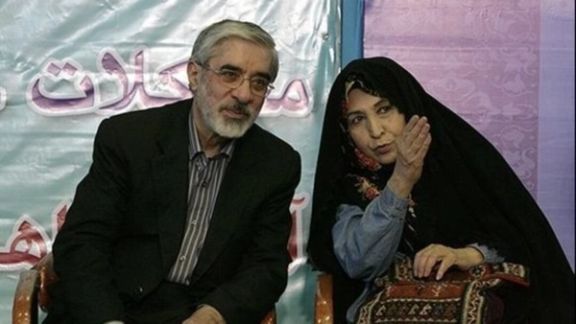
Iranian dissident figure Mir-Hossein Mousavi and his wife Zahra Rahnavard

Circles close to prominent Iranian dissident figure Mir-Hossein Mousavi have raised concerns regarding the health of Mousavi and his wife who are under house arrest.

Mousavi, a former prime minister and Zahra Rahnavard, have been under house arrest, living in seclusion under the control of security forces at their home since 2011. The situation arose when they and former Majles Speaker Mehdi Karroubi were put under house arrest for leading the protests the post-2009 presidential election protests, which followed the contested election and the subsequent re-election of populist Mahmoud Ahmadinejad as Iran's President.

The Telegram channel Kaleme reported Tuesday that medical examination results handed to Mousavi and his wife do not conform to the actual symptoms of their medical conditions. 

The channel, which is close to Mousavi and his supporters, revealed that medical test results pass through several security layers before reaching the two detainees, and do not reflect the extreme changes in their conditions during the past few months. 

Some Iranian analysts have charged that what has been revealed in this report might indicate that the government is gradually murdering the two.

The Telegram channel added that their health conditions have visibly deteriorated after Mousavi and Rahnavard issued a statement earlier this year and supported the Woman, Life, Freedom movement and called for a referendum to change the regime based on people's demands. 

Iran's Supreme Leader Ali Khamenei (left) and dissident figure Mir Hossein Mousavi  (undated)
100%
Iran's Supreme Leader Ali Khamenei (left) and dissident figure Mir Hossein Mousavi

Meanwhile, unusual electronic signals are beamed constantly into their house to disrupt their communication with the outside world and these signals are likely to have affected their health, Kaleme said. Furthermore, their living situation remains highly restrictive, with security forces maintaining complete control, including holding all the keys to the property. Notably, Mousavi and Rahnavard are prohibited from accessing the rooftop water tank, which serves as their source of drinking water. The report even suggests that political allies of Mousavi fear that the water in the tank could have been tampered with or poisoned.

The Telegram channel also mentioned that the same concern also exists about food delivery to the house.

The report also highlighted that there has never been any acknowledgment of responsibility from any individual, security agency, or judicial body regarding the decision to place the Mousavi family under house arrest. This raises suspicions that the government may be using their health as a means to suppress their voices. Kaleme stressed the importance of holding the Iranian government accountable for any threats to the well-being of Mousavi and Rahnavard.

Meanwhile, in an interview with Iran International TV, Iranian political analyst Morteza Kazemian charged that the government's intervention and its total control over the medical examinations of Mousavi and Rahnavard could be interpreted as an attempt to gradually murder them under house arrest.

Another Iranian political analyst Jamshid Barzegar told Iran International TV that 6 Iranian inmates have lost their lives in Iranian prisons in recent months as security forces ignored their medical problems. Barzegar also called this a "gradual murder" and said that this has been a usual practice in Iranian prisons for a long time now. He said this report by Kalame should be taken seriously as the Islamic Republic might be attempting to terminally silence Mousavi his wife as vocal critics of the system.

Yet another analyst, Ali Hossein Ghazizadeh told Iran International that the information about the case reveals the government is most likely trying to kill Mousavi and Rahnavard by gradually poisoning them. 

Most Viewed

State media slam Araghchi's Hormuz tweet, say it let Trump claim victory
1

State media slam Araghchi's Hormuz tweet, say it let Trump claim victory

2
OPINION

The Hormuz get out of jail card turned to a grave

3
INSIGHT

How Tehran bends its own red lines to boost state rallies

4

Iran International says it won’t be silenced after London arson attack

5
VOICES FROM IRAN

Iran blackout cripples freelancer, small business incomes

Banner
Banner

Spotlight

  • Too early to tell who is winning Iran war, experts say
    PODCAST

    Too early to tell who is winning Iran war, experts say

  • How Tehran bends its own red lines to boost state rallies
    INSIGHT

    How Tehran bends its own red lines to boost state rallies

  • Iran blackout cripples freelancer, small business incomes
    VOICES FROM IRAN

    Iran blackout cripples freelancer, small business incomes

  • Ideology may be fading in Iran, but not in Kashmir's ‘Mini Iran'
    INSIGHT

    Ideology may be fading in Iran, but not in Kashmir's ‘Mini Iran'

  • US blockade enters murky phase as tankers spoof signals and buyers hesitate
    ANALYSIS

    US blockade enters murky phase as tankers spoof signals and buyers hesitate

  • Why the $100 billion Hormuz toll revenue is a myth
    ANALYSIS

    Why the $100 billion Hormuz toll revenue is a myth

•
•
•

More Stories

Obstacles Persist As Iran Seeks Top Fighter Jets From Russia

Sep 5, 2023, 16:31 GMT+1
•
Iran International Newsroom

Iran's pursuit of advanced warplanes from its ally Russia to modernize its aging fleet has faced numerous hurdles, plunging the regime into a state of uncertainty. 

While Iran recently took delivery of a batch of Russian-made Yakovlev Yak-130 pilot training aircraft, these light jet trainers fall far short of the twin-engine, supermaneuverable air superiority Russian fighters, like the Sukhoi Su-35, which Iran had been seeking for years.

For a considerable time, Iran had been making announcements about the "imminent" delivery of Su-35 fighter jets. However, the hopes of acquiring these advanced aircraft were dashed when Iran's Defense Minister confirmed in July that the deal had collapsed. Moreover, Iran's claims of domestic production capabilities for such fighters have yet to materialize. While Iran has supplied Russia with kamikaze drones for its war on Ukraine, these efforts have led to several rounds of sanctions against the Iranian regime. 

Paradoxically, Moscow has been unwilling to sell modern fighter jets or advanced aerial warfare systems to Iran. This reluctance stems from a range of concerns, including geopolitical considerations and regional stability.

A Russian-built Yakovlev Yak-130 pilot training aircraft parked at a hangar of the Iran Air Force  (undated)
100%
A Russian-built Yakovlev Yak-130 pilot training aircraft parked at a hangar of the Iran Air Force

One primary factor contributing to Russia's hesitancy to supply Iran with high-tech fighter jets is the absence of bargaining leverage on Iran's part. Iran's economic challenges, compounded by international sanctions, have limited its ability to secure favorable terms for such purchases. On a similar note, China has refrained from providing Iran with high-tech fighter jets, as Beijing is wary of potential US retaliation. What's more, China is known to be cautious about jeopardizing its own programs, as it seeks to profit from weapons deals. For example, Iran prefers to pay in oil and natural gas, rather than dollars or euros, in its dealings with China.

According to Zhou Chenming, a Beijing-based defense analyst, China has already accumulated significant energy reserves and is primarily focused on making money through arms deals. Consequently, China has been reluctant to engage in potential deals involving its Chengdu J-10C fighter jets with Tehran. Even attempts by the United States to sell advanced F-16 fighter jets to Taiwan, which concerned China greatly, did not persuade Beijing to offer its Chengdu J-10 fighter jets to Iran in retaliation.

The political climate between Iran and its two major allies, Russia and China, while often collaborative on other fronts, has not yielded significant advancements in Iran's deteriorating aerial arsenal. A significant factor contributing to Russia and China's caution is the delicate balance of their relations with Arab countries in the Middle East. Many Arab nations have expressed their unease and opposition to Iran acquiring fighter jets, fearing that it could shift the balance of power in the region. This apprehension has encouraged Russia and China to tread cautiously, as they do not wish to strain their relationships with key Arab trading partners.

Considering these challenges, the arrival of two Yak-130 light training aircraft in Iran has been portrayed by the regime's media as evidence that Russia would eventually start supplying its modern warplanes to Iran. Some analysts have speculated that the war in Ukraine has disrupted the delivery of Su-35s, leading to delays.

Defense Minister Ashtiani, in an article published in the government's Arabic-language daily al-Vefagh newspaper, claimed that all arms embargoes imposed on Iran are set to expire soon, expressing eagerness to expand military ties. European Union ballistic missile sanctions are scheduled to expire on October 18 under the UN resolution endorsing the 2015 nuclear deal. However, European diplomats are considering retaining these sanctions.

Analysts like Sasan Karimi have suggested that concerns by the US and Europe about Iran's plans to acquire high-tech fighter jets may have eased due to recent reports of behind-the-scenes negotiations between Tehran and Washington. While the exact timing of any Su-35 delivery remains uncertain, some believe that it is more logical for this to occur after the expiration of sanctions in October.

The aging nature of Iran's military aircraft is no secret. Some of Iran's fighter jets, like the F-4 and F-5, are well over half a century old, while the more advanced F-14 was procured before the Islamic revolution of 1979. Given Iran's pressing need to modernize its military fleet, China and Russia currently remain Iran's only options for procurement. This is because other fighter-producing countries, such as the United States, Europe, Sweden, and France, are unlikely to supply any weapons. Additionally, the production of fighter jets in Japan and South Korea is closely tied to joint programs with the United States.

Even if Russia and China were to consider supplying Iran with newer fighter jets, it is highly likely that the numbers would be limited to avoid posing a substantial threat to Tehran’s regional rivals. According to different sources, Russia itself has about 110 to 150 Sukhoi Su-35s.

Same-Sex Video Of Ex-Parliamentary Guard Stirs Controversy In Iran

Sep 5, 2023, 16:26 GMT+1

Another startling revelation has emerged, implicating officials in the Islamic Republic of Iran in a series of explicit sexual videos.

Among the individuals named in these videos is Mohammad Bagher Bazrafshan, the commander of the Basij base in Tehran's Evin district, whose alleged involvement has sparked considerable public concern and outrage.

The Telegram channel Radio Gilan, known for disseminating such materials, reported on Saturday, supported by visual evidence, that the head of the Crisis Management Supervisory Committee sent a confidential letter to the Director-General of the Tehran Municipality's Inspection Department.

The letter detailed an incident in which Mohammad Bagher Bazrafshan purportedly brought young men to his office after regular office hours, where they remained behind closed doors until the early morning hours.

According to this report, initial reports to the Director-General were disregarded, possibly due to Bazrafshan's association with officials appointed by Mohammad Bagher Ghalibaf, the current Speaker of the Iranian Parliament. However, the Crisis Management Supervisory Committee eventually obtained Bazrafshan's mobile phone during a work meeting, subsequently revealing its contents.

It is important to note that the accuracy of these claims cannot be independently verified. Nonetheless, the information disclosed by the administrator of "Radio Gilan" appears to have been meticulously documented over several months.

Bazrafshan, formerly part of Ghalibaf's security detail, currently serves as the commander at the Evin Basij base.

Mohammad-Bagher Bazrafshan was caught biting the hand of a man during a gathering when he was one of the bodyguards of parliament speaker Mohammad-Bagher Ghalibaf.  (undated)
100%
Mohammad-Bagher Bazrafshan was caught biting the hand of a man during a gathering when he was one of the bodyguards of parliament speaker Mohammad-Bagher Ghalibaf.

In the aftermath of these revelations, additional videos and images allegedly featuring Bazrafshan have circulated widely on social media platforms. One particularly controversial video is said to depict Bazrafshan engaging in explicit acts with another individual wearing red women's lingerie, purportedly the deputy of one of Tehran's Basij bases.

In the past several weeks, Radio Gilan, run by Germany-based journalist Payman Behboudi, has released three different videos that have raised a storm on Persian social media.

In the first video, a male City Council member of Bandar Anzali in the northern province of Gilan, was seen smoking opium and masturbating. The second video showed an official engaging in sex with a young man, and the third, released two days ago, shows a cleric engaged in sex with the husband of his wife’s sister. Radio Gilan has also published several screenshots of a sex chat between the cleric, Mehdi Haghshenas, and his brother-in-law.

Many social media users say they are outraged by the hypocrisy of the regime and its affiliated clerics and officials rather than the same-sex relationships between consenting adults.

Late in July, Ghalibaf criticized the leaking of the videos, following similarly critical remarks made by hardliner lawmakers on the parliament floor who claimed that it goes against Sharia law.

This is a typical response by regime officials in Iran who usually advocate ‘killing the messenger’ when faced with evidence of corruption or forbidden activities by insiders. Meanwhile, what Sharia in Iran clearly forbids is homosexuality among men, which it says is punishable by death.

Some analysts speculate that the release of this series of videos, revealing moral misconduct among mid-level officials of the Iranian regime, reflects internal power struggles and disputes. The surreptitious placement of cameras in the homes and workplaces of officials and regime affiliates, followed by the subsequent public exposure of this material, raises questions about the motivations behind these actions, which typically do not involve ordinary citizens.

Iranian News Outlet Suspended Over Critique Of Foreign Policy

Sep 5, 2023, 14:59 GMT+1

Iranian authorities have suspended the operations of the Entekhab news website, citing violations of press laws and decisions made by the Supreme National Security Council.

While the suspension has been reported by news outlets aligned with the Iranian regime, the precise reasons for the suspension have not been officially communicated to the website's owner or its management.

The Tasnim news agency, which is affiliated with the IRGC, reported on Monday the suspension of the Entekhab news website in accordance with "Article 12 of the Press Law." Tasnim also reported that the case had been referred to the judiciary for further investigation.

The suspension of Entekhab follows the examination of a video and report titled "Iran's Brand Auction: Why Has Iran's Foreign Policy Weakened So Much?" by the media supervisory body during its session on Monday. According to Tasnim, the content of the video was found to be "beyond legal boundaries, contrary to national interests, and against the fundamental policies of the Islamic Republic of Iran in foreign policy."

The video, which was published on August 22 on the Entekhab website, contained critical commentary on Iran's current foreign policy under the leadership of President Ebrahim Raisi. It asserted that the Raisi administration's "purely Eastern-oriented policy and Russia-centric approach" had dealt a significant blow to Iran's centuries-old foreign policy traditions.

It is worth noting that the Entekhab website had gained prominence in recent years, particularly after the closure of the Entekhab newspaper. The website was known for its alignment with a broad spectrum of political figures, including Akbar Hashemi Rafsanjani and the previous administration under President Hassan Rouhani.


Russia, Iran To Collaborate On New Major Treaty, Says Deputy FM

Sep 5, 2023, 12:26 GMT+1

Russia and Iran are actively negotiating a new treaty to strengthen and expand their bilateral cooperation, according to Russia's Deputy Foreign Minister Andrey Rudenko.

Deputy Minister Rudenko made this announcement during a session hosted by the Valdai Discussion Club, highlighting the increasing positive momentum in Russia-Iran relations in recent years.

"We are working on a new major treaty with Iran, which will encompass, among other things, our key areas [of cooperation]," stated Deputy Foreign Minister Rudenko.

The development of this new treaty underscores the commitment of both nations to strengthening their partnership and fostering closer ties. Over the past few years, Russia-Iran relations have steadily progressed, promising further advancements in their collaboration.

During the Iranian President's visit to Moscow in January 2022, he presented a draft of a 20-year cooperation agreement, which would update the previous 2001 version. However, Moscow has yet to sign this proposed agreement.

While Iranian officials had previously suggested that preparations for the agreement were finalized and anticipated a swift signing when the two presidents met, recent reports indicate that additional preparations are deemed necessary.

One factor affecting the pace of these negotiations is the impact of international sanctions on Iran's oil industry. Notably, major Chinese and Russian companies, recognized for their global presence, have been cautious about engaging in business with Iran due to these prevailing sanctions.

Despite Iran's existing 25-year contract with China, signed on March 27, 2021, and ongoing negotiations for a 20-year economic trade deal with Russia, there has been public discontent in Iran regarding these agreements. Concerns have been voiced by many Iranians who fear that such pacts may potentially compromise the nation's interests.

Will Iranian Proxies Target Israel In September Or October?

Sep 5, 2023, 11:45 GMT+1
•
Benjamin Weinthal

A former counter-terrorism advisor to two Israeli prime ministers triggered an intense debate about whether Iranian proxies will attack Israel in September or October.

There is, however, disagreement within Israel’s security and defense establishment over a planned Iran-backed attack against the Jewish state. 

Yigal Carmon, the founder of the Middle East Media Research Institute (MEMRI) and one of Israel’s leading counter-terrorism experts, wrote an August 31st article titled “Signs Of Possible War In September-October,“ in which he argued a “confrontation could result from an uncontrolled deterioration on the ground or from the use of new and unusually deadly weapons by these movements [Hamas and Hezbollah].” 

Carmon said, “neither Hamas nor Hezbollah are eager to start a comprehensive confrontation with Israel” but noted that growing acts of jingoism and saber-rattling by both Iranian regime-backed jihadi movements (including Palestinian Islamic Jihad) on Israel’s borders.

Yigal Carmon, the founder of the Middle East Media Research Institute (MEMRI) (Undated)
100%
Yigal Carmon, the founder of the Middle East Media Research Institute (MEMRI)

Hezbollah has set up tents in the Har Dov area within Israeli territory and was involved in “dismantling surveillance cameras along the border fence near Fatima Gate, and firing an anti-tank missile into Israel,” wrote Carmon.

Carmon, who is a fluent Arabic speaker, added “Hezbollah, which does not recognize the Blue Line as the international border between Lebanon and Israel, has recently made a new territorial claim, demanding that Israel give Lebanon sovereignty over the northern Rosh Hanikra railway tunnel, likewise in Israeli territory. At the same time, it also demands to curtail UNIFIL's freedom of action in South Lebanon.”

The US government and many European states have classified Iran’s strategic partner, Hezbollah, a foreign terrorist organization. Both the US and EU have designated Hamas and the PIJ terrorist entities.

Members of Lebanon's Hezbollah hold flags during a rally (November 2022)
100%
Members of Lebanon's Hezbollah hold flags during a rally

Carmon wrote, “There has also been an increase in efforts by Iran and Hezbollah to smuggle weapons into the West Bank, similar to the smuggling of weapons into Gaza. PIJ secretary-general Ziad Al-Nakhaleh said that, during his June 2023 meeting with Iranian Leader Ali Khamenei, the latter had ‘reiterated [the need to] develop the arming of the West Bank and the resistance there.’ Nakhaleh added: ‘We, as Palestinians and as resistance forces and movements, understand the importance of arming the West Bank, but this requires efforts by the Palestinians themselves, and also the assistance of our brothers in the Islamic Republic of Iran.’”

The spike in recent activity between Iran’s foreign minister Hossein Amir-Abdollahian and Tehran’s PIJ, Hamas and Lebanese allies in Beirut was also a subject of Carmon’s analysis.

Secretary-General of the Palestinian Islamic Jihad resistance movement Ziad al-Nakhaleh (2nd from right) meets with Iran’s Supreme Leader Ali Khamenei in Tehran on June 14, 2023.
100%
Secretary-General of the Palestinian Islamic Jihad resistance movement Ziad al-Nakhaleh (2nd from right) meets with Iran’s Supreme Leader Ali Khamenei in Tehran on June 14, 2023.

Abdollahian stressed that in the Beirut meeting the statements of Khamenei about the need "to help the West Bank" and about Iran's "ongoing [commitment to] assisting the resistance with all its might." Amir-Abdollahian added, "the establishment of the joint Hamas-PIJ [war] room reflected a smart move on the part of the resistance.”

Carmon noted that Amir-Abdollahian also met with Hezbollah Secretary-General Nasrallah, who then met with Al-'Arouri and Al-Nakhaleh to "make a joint assessment of the situation in the West Bank, the escalation of the resistance activity and the latest Israeli threats." 

Abdollahian and Iran’s allies underscored at the meeting "the steadfastness and steadiness of all the forces of the resistance axis in the struggle against the Zionist enemy," and cooperation between the "resistance movements" in Palestine and Lebanon.

When asked about Carmon’s analysis, Brigadier-General (res) Amir Avivi told Iran International, "While the specter of war unfortunately always looms along and beyond our borders, whether fueled by Iranian money and weapons or online incitement, at this time I do not share the assessment of an imminent war in September or October. 

The terrorist organization Hezbollah in Lebanon has indeed been conducting provocations along the border, and the other Iranian proxies have made belligerent statements.”

Avivi, the founder and CEO of the Israel Defense and Security Forum (IDSF), added, “And yes, religious holidays are historically periods of inter-community tensions, but at this time I believe that neither Hezbollah nor Hamas have an appetite for a full-blown confrontation with Israel, because they understand how devastating it would be for them.”

Carmon had also warned in his article that “During the Jewish holidays in September and October, Jews are likely to visit the Al-Aqsa compound, as happens every year. Hamas and Hezbollah spokesmen have stressed that this could lead to a regional war.”

Avivi noted that “Both Hamas and Hezbollah are suffering from internal unrest and lack of legitimacy in their respective fiefdoms, and it would be wise of them to refrain from jeopardizing their own future. Contrary to media reports and wishful thinking amongst Iranian proxies, the IDF is fully fit for combat, alert and ready to respond to any aggression."

Israeli air force F-35 pilots (undated)
100%
Israeli air force F-35 pilots

When presented with these arguments, Carmon told Iran International that “I said they [Hamas, Hezbollah and Palestinian Islamic Jihad] do not want it[war] but things can get out of control.”

Carmon raised the example of Nasrallah who said after the 2006 Second War in Lebanon about the kidnapping of Israeli soldiers that sparked the war: “We did not think, even one percent, that the capture would lead to a war at this time and of this magnitude. You ask me, if I had known on July 11 ... that the operation would lead to such a war, would I do it? I say no, absolutely not.”

A second factor that is part and parcel of Carmon’s “uncontrolled deterioration” framework during the lead up to the full-blown war in 2006 was the entry of an Israeli Merkava 2 tank into Lebanon that passed over a massive explosive device, destroying the tank and killing its four crew members. 

Carmon said “People do things without knowing repercussions. This is what happens when people like Avivi listen only to themselves and not to the other side.” Carmon also warned about the shipments of advanced new weapons, including Kornet anti-tank missiles, to Iran-backed terrorist terrorists, that can be used by against Israelis.