• العربية
  • فارسی
Brand
  • Iran Insight
  • Politics
  • Economy
  • Analysis
  • Special Report
  • Opinion
  • Podcast
  • Iran Insight
  • Politics
  • Economy
  • Analysis
  • Special Report
  • Opinion
  • Podcast
  • Theme
  • Language
    • العربية
    • فارسی
  • Iran Insight
  • Politics
  • Economy
  • Analysis
  • Special Report
  • Opinion
  • Podcast
All rights reserved for Volant Media UK Limited
volant media logo

Khamenei Says Iran Conducting Diplomacy To Lift Sanctions
Iran International Newsroom
Aug 30, 2023, 16:08 GMT+1Updated: 17:34 GMT+1
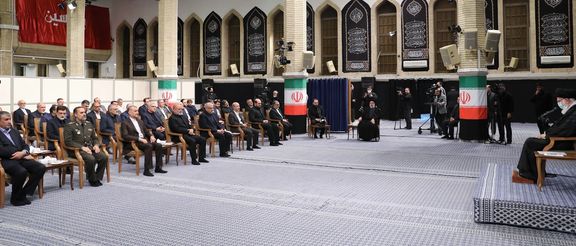
Iran’s Supreme Leader Ali Khamenei during a meeting with President Ebrahim Raisi and members of his cabinet on August 30, 2023

Iran is engaged in diplomatic efforts to lift economic sanctions, the country’s ruler Ali Khamenei said Wednesday in a speech to officials and top regime insiders.

“Efforts and negotiations are currently in progress to lift the sanctions, which are proceeding properly as they should. However, it is equally important to simultaneously pursue the path of neutralizing sanctions, with the most crucial indicator being the reduction of inflation,” Khamenei maintained.

‘Neutralizing sanctions’ is the terminology used by the Islamic Republic for referring to evading restrictions, for example by illicit oil exports or conducting banking transactions through front companies and intermediaries.

Khamenei’s reference to ongoing talks follows a deal announced earlier this month, whereby the United States agreed to unblock $6 billion of frozen in South Korea in exchange for the eventual release of five US citizens held hostage in Tehran. In June, the US had also agreed to release $2.7 billion from Iraqi banks.

Many observers suspect that the Biden administration has reached an unofficial, partial deal with the Islamic Republic to release nearly $20 billion in total and not enforce oil export sanctions if Tehran stops its uranium enrichment at 60 percent, which is just short of weapons-grade material.

This in effect leaves Iran in a stronger position, able to extract more concessions by threatening to breach an unwritten deal in the future.

Iran’s Supreme Leader Ali Khamenei during a meeting with President Ebrahim Raisi and members of his cabinet on August 30, 2023
100%
Iran’s Supreme Leader Ali Khamenei during a meeting with President Ebrahim Raisi and members of his cabinet on August 30, 2023

Having endorsed the ongoing talks, Khamenei immediately cautioned against a pro-Western outlook, saying those who see interaction with the world in “warm and intimate relations with a few Western countries” are making a mistake. “This outlook is wrong and relates to 100 years ago when a few European states controlled the world. Today, we should dispose of this old and reactionary outlook and understand that having global ties means relations with Africa, Latin America and Asia who have immense natural and human resources.”

Interestingly, Khamenei did not repeat his “Looking East” catchphrase, which means close ties with China and Russia with referring to Latin America and Africa. Sensing that amid sanctions and international economic isolation, Iranians blame the regime for their hardships, Khamenei and his subordinates claim that they are ready to extend a hand of friendship to many countries, with a few exceptions – namely Israel and the United States.

In fact, Khamenei praised the administration of President Ebrahim Raisi for having made progress in forging better ties with neighboring countries. In March, apparently urged by China, the Islamic Republic restored ties with Saudi Arabia after a seven-year hiatus.

Iran’s Supreme Leader Ali Khamenei during a meeting with President Ebrahim Raisi and members of his cabinet on August 30, 2023
100%
Iran’s Supreme Leader Ali Khamenei during a meeting with President Ebrahim Raisi and members of his cabinet on August 30, 2023

What the aging Iranian ruler seems not to understand is that most wealthy and technologically advanced countries and large corporations take the US sanctions and Iran’s authoritarian political and economic conditions into account when making major trade or investment decisions. 

Iran’s close allies are Syria and Venezuela, which rely on Tehran’s assistance, and Russia which itself is under heavy sanctions.

Khamenei also tried to defend the Raisi administration’s record, by praising the government’s rosy economic statistics and “successes” that most experts and many regime politicians in Iran reject as political propaganda. Even many loyalist conservatives dispute the administration’s claims of having reduced inflation and boosted production, as annual inflation is well over 50 percent and the national currency is near its all-time lows, trading around 500,000 rials per US dollar.


Most Viewed

US blockade enters murky phase as tankers spoof signals and buyers hesitate
1
ANALYSIS

US blockade enters murky phase as tankers spoof signals and buyers hesitate

2

US tightens financial squeeze on Iran, warns banks over oil money flows

3
INSIGHT

Ideology may be fading in Iran, but not in Kashmir's ‘Mini Iran'

4
INSIGHT

Hardliners push Hormuz ‘red line’ as US blockade tests Iran’s leverage

5
VOICES FROM IRAN

Hope and anger in Iran as fragile ceasefire persists

Banner
Banner

Spotlight

  • Hardliners push Hormuz ‘red line’ as US blockade tests Iran’s leverage
    INSIGHT

    Hardliners push Hormuz ‘red line’ as US blockade tests Iran’s leverage

  • Ideology may be fading in Iran, but not in Kashmir's ‘Mini Iran'
    INSIGHT

    Ideology may be fading in Iran, but not in Kashmir's ‘Mini Iran'

  • War damage amounts to $3,000 per Iranian, with blockade set to add to losses
    INSIGHT

    War damage amounts to $3,000 per Iranian, with blockade set to add to losses

  • Why the $100 billion Hormuz toll revenue is a myth
    ANALYSIS

    Why the $100 billion Hormuz toll revenue is a myth

  • US blockade targets Iran oil boom amid regional disruption
    ANALYSIS

    US blockade targets Iran oil boom amid regional disruption

  • Iran's digital economy battered by prolonged blackout
    INSIGHT

    Iran's digital economy battered by prolonged blackout

•
•
•

More Stories

Iranian Official Says JCPOA Dead, Time For Western Economic Concessions

Aug 30, 2023, 11:53 GMT+1
•
Mardo Soghom

The Deputy of Iran’s Atomic Energy Organization has said that the JCPOA nuclear deal is no longer effective, especially for Europeans and the United States.

Amir-Hossein Feghhi (Feqhi) speaking to the semi-official ISNA website stated that the 2015 nuclear deal, based on what the Westerners believed, was an instrument to create a pause in Iran’s nuclear industry and to ensure that Iran does not pursue nuclear weapons. “Now, the entire world has concluded that Iran is not seeking to develop weapons, and the possibility of stopping Iran’s nuclear program no longer exists,” Feghhi emphasized.

Iran has accumulated enough enriched uranium to be able to produce several nuclear bombs, according to the experts and the International Atomic Energy Agency, the IAEA. It has effectively reached a nuclear threshold state and can use the fissile material to produce weapons possibly within months.

Feghhi, seemingly taunting the West said that now is the time to focus on economic relations, hinting at sanctions that were imposed after the United States withdrew from the JCPOA in May 2018 and imposed crippling ‘maximum pressure’ on Tehran. The enforcement of these sanctions has gradually waned during the Biden administration, enabling Iran to boost its oil exports to almost pre-sanctions level, while enriching uranium to dangerous levels.

Amir-Hossein Feghhi (Feqhi), a deputy of Iran’s Atomic Energy Organization.  (undated)
100%
Amir-Hossein Feghhi (Feqhi), a deputy of Iran’s Atomic Energy Organization

He went on to say that “Iran used to negotiate for its undeniable right to enrichment and also for the removal of sanctions.” However, “we have moved past all these discussions. There is no one in the world who can reject Iran’s nuclear capability or claim it can be halted.” Regarding the sanctions, Feghhi said, “I believe shared economic interests should be the subject of negotiation.”

Earlier this month Washington agreed to release $6 billion of Iran’s money frozen in South Korea due to US sanctions, in exchange to free five American citizens held hostage in Tehran. In June, the US had also agreed to release $2.7 billion from Iraqi banks.

Many observers suspect that the Biden administration has reached an unofficial deal with the Islamic Republic to release nearly $20 billion in total and not enforce oil export sanctions if Tehran stops at 60-percent uranium enrichment, which is just short of weapons-grade material.

This in effect leaves Iran in a strong position, able to extract more concessions by threatening to breach an unwritten deal in the future.

Candidate Joe Biden announced in September 2020 that if elected President he would restore the JCPOA, signaling an end to former President Donald Trump’s maximum pressure policy. Immediately Iran’s illicit oil exports to China began to increase.

Days after the election, Iran’s parliament tabled a bill to obligate the government to increase the level of enrichment closer to weapons grade until the US would lift the sanctions. In early 2021, enrichment reached 20 percent and soon 60 percent levels, but the Biden administration entered talks with Tehran over the JCPOA in Vienna in April. After 18 months of protracted talks in Vienna the sides reached a deadlock, as Iran refused the last compromise offered by the European Union.

Biden seems not to have realized that Iran took advantage of his desire to restore the JCPOA to both evade sanctions and reach the nuclear threshold.

Iran’s nuclear deputy drove the point home, stating, We now comprehensive capabilities in the nuclear field, covering nearly all its dimensions and research and industrial sectors. We are well aware of what we possess, and of course, nuclear experts in advanced countries are also well aware of this, and they convey it to their policymakers as well.“


Iran’s President Promises Free Electricity, Gas, Water Amid Crisis

Aug 30, 2023, 08:15 GMT+1
•
Iran International Newsroom

While the head of Iran's wealth fund issued a dire warning about future, the president pledged to provide "free" water, electricity, and gas to low-income households.

President Ebrahim Raisi made the claim during a press conference on Tuesday, stating "Providing free water, electricity, and gas to low-income families is on the government's agenda."

The president also claimed that "health insurance has been provided for six million people in the country for free."

"The government is cares about paying subsidies, providing housing for the deprived strata, as well as allocating land and providing facilities to the low-income households," he said, adding that “we have been committed to what we have said in the elections, and we will be; we have not forgotten any of those promises, and we will not forget them.”

Iranian President Ebrahim Raisi during a press conference in Tehran on August 29, 2023
100%
Iranian President Ebrahim Raisi during a press conference in Tehran on August 29, 2023

A day earlier, Mehdi Ghazanfari, the head of Iran's National Development Fund, warned that "people are worried about the day when we become servants of neighboring countries" because they are progressing rapidly, and Iran is not.

Highlighting that the regime only attaches importance to "military strength" as an element of national power, he warned that if Iran neglects "economic development coupled with high growth rates" it might become a country "devoid of its human resources and investment opportunities."

Ghazanfari said a new type of colonialism may take place in Iran in the face of prosperous and wealthy neighboring nations. “If the current trend persists in Iran, it may become a country in the future that imports gas from Turkmenistan, wheat from Saudi Arabia, depends on Oman and Qatar for medical services and Qatar, and on the UAE for maritime and aerial logistics,” he warned.

Raisi’s remarks were reminiscent of promises by the Islamic Republic’s founder Ruhollah Khomeini, who famously promised Iranians free electricity, water and a cash share of the oil export income in his first speech upon arrival to the country after exile during the 1979 revolution. Khomeini made a variety of promises to Iranians for his Islamic regime such as a popularly elected governments that would represent the people without the interference of the clergy in addition to abolishing homelessness.

The Islamic Republic’s founder Rouhollah Khomeini addressing the nation at Behesht-e Zahra, the largest cemetery in Iran (February 1979)
100%
The Islamic Republic’s founder Rouhollah Khomeini addressing the nation at Behesht-e Zahra, the largest cemetery in Iran (February 1979)

Since the historic speech in February 1979, Iranian officials have made similar promises over the years, with former President Hassan Rouhani even claiming that he had managed to achieve these goals. Rouhani claimed in December 2020 that his government had realized Khomeini’s promise, providing low-income strata of the society with water, gas, and electricity free-of-charge.

Iran has survived on oil export revenues during 44 years of clerical rule and has used the income to provide tens of billion of dollars in subsidies to the population each year, while maintaining an unproductive, government controlled economy. The lack of planned and sustained economic growth, a closed economy not attractive for foreign investment and various foreign economic sanctions have led to the current crisis marked by very high inflation, low economic growth and increasing poverty.

Rouhani officials repeated bogus claims of more subsidies, with his government spokesman Ali Rabiei saying that some 35 percent of the country’s population – about 30 million people – had access to free utilities. “We supplied people with free gas, but we became self-sufficient in gas production beforehand so that we can meet the domestic demand in winter and even be able to export,” he said in 2020, a claim that contradicted reality, as more than 30 million Iranians live below the poverty line.

Elsewhere in his press conference, Raisi made other claims about the reduction in inflationary pace, a higher growth rate, and reduction in the unemployment rate.

Mehdi Ghazanfari, the head of Iran's National Development Fund (undated)
100%
Mehdi Ghazanfari, the head of Iran's National Development Fund

Over the past few years, many economists have warned about capital flight and the emigration of elites and skilled workers from Iran due to the Islamic Republic's policies.

The cost of living in Iran, including electricity, water, and gas bills, has consistently risen over the years and the majority of Iranians have fallen into poverty, no longer being able to afford meat and even fruit and vegetables, with consumption dropping by half.

The Islamic Republic has been struggling with high inflation since at least 2019, but the raging inflation in the past Iranian year which ended on March 20, was seriously different from previous years. Currently the official annual inflation rate is nearly 50 percent – the highest rate in Iran for more than 30 years-- but prices for foodstuff are most affected with some categories doubling or tripling in the past 12 months. The devaluation of Iran’s rial from 260,000 per US dollar to about 500,000 this year signals even higher economic woes for the people.

Iran Makes Contradictory Remarks About Frozen Funds Abroad

Aug 29, 2023, 19:35 GMT+1
•
Iran International Newsroom

Iranian officials continue to issue conflicting statements regarding the status of Iran's frozen assets abroad, with no clarity as to which funds have been released.

At times, they assert that all the funds have been unblocked, while on other occasions, their remarks suggest a different outcome.

The conflict between various statements is at times observed in the remarks of the same official in a matter of a few minutes. During his news conference Tuesday, President Ebrahim Raisi contradicted himself on the status of the funds.

When a Japanese reporter asked Raisi's opinion about $1.5 billion of Iranian assets in Japan, Raisi said in vague terms: "As we have declared earlier, we would welcome any hand extended to us as a sign of friendship but will cut off the hands of hostile countries." He added, "As regards the money you spoke about, one of the things we have done in my government was securing the release of our frozen assets. This is on our agenda in the area of foreign policy."

Raisi reiterated, "We would like to suggest to Japan to be independent and not be influenced by the Americans. We call on Japan not to freeze in any way any money we might have in that country, whether it is the price of goods we sold, or it is left in Japan as a trust."

Iranian Foreign Minister Hossein Amir-Abdollahian (left) and his Japanese counterpart Yoshimasa Hayashi in Tokyo on August 7, 2023
100%
Iranian Foreign Minister Hossein Amir-Abdollahian (left) and his Japanese counterpart Yoshimasa Hayashi in Tokyo on August 7, 2023

Some pro-government agencies such as the IRGC-linked news agency Tasnim first reported this part of Raisi's statement, which indicated there are frozen funds in Japan. But later Tasnim retracted it and replaced it with Rais insisting on not having any frozen assets in any foreign country.

A few minutes later, Raisi reversed himself while the news conference was still in progress that "We do not have any problems with Japan. The only country where our money was frozen in an oppressive way was South Korea. Our assets everywhere else are at the disposal of the Central Bank of Iran."

This, and remarks by Foreign Minister Hossein Amir-Abdollahian in day earlier, indicate that Iran has possibly been assured by the United States that Washington has already agreed, or will soon agree to approve the release of all of Iran’s frozen funds.

So far, the United States has confirmed that it has approved the release of around $2.7 billion from Iraq and $6 billion from South Korea, but there has been no clarity about another $8 billion in Iraqi banks and up to $3 billion in Japan. In exchange, Iran has agreed to eventually release five US hostages kept in Tehran.

The official Iranian news agency IRNA on Monday quoted Amir-Abdollahian as saying, "Iran has no frozen assets in any country." He added that "Iran can now use the assets it has at its disposal." However, the Iranian Foreign Minister denied humiliating reports that said Iran was allowed to use its released assets in South Korea within the frameworks of an oil-for-food scheme under the supervision of the United States.

Amir-Abdollahian said, "The reports about oil for food are not true." Meanwhile, speaking about Iran's assets in Iraq, he said our assets at the TBI Bank of Iraq are constantly on the rise, which was a vague statement. The released funds from Iraq are supposed to be transferred to Oman from where they could be spent on Iran’s humanitarian purchases around the world.

The Foreign Minister also added that "oil for food" also does not apply to the £390 million Iran has received from the United Kingdom as London's debts to Iran dating back to the years before the 1979 Islamic revolution. Earlier reports had said that the money would be held in Oman and spent to buy food and medicine for Iran by Omani authorities.

Former Central Bank Governor Abdolnasser Hemmati said in a series of tweets about Amir-Abdollahian's statements that "If what the foreign minister says is true, it means that Iran now has several billion dollars of hard currency at its disposal." This then raises the question of why the Iranian currency does not rebound from the almost historic low of 490,000 per US dollar.

Iran's Foreign Trade Balance Shows Nearly $5 Billion Deficit

Aug 29, 2023, 18:58 GMT+1

A report released by the Islamic Republic of Iran Customs Administration reveals there has been a decline in the country’s export value of almost $5 billion between March and July 2023.

During this period, which marks the first five months of the Iranian calendar year, the total value of Iran's foreign trade reached $43.5 billion with 55.9 million tons of goods worth $19.3 billion being exported. Although Iran's exports have increased by about 27% compared to the same period last year, non-oil exports have decreased by 8.6% in terms of value.

The report shows that the amount of goods imported into Iran was 14.4 million tons worth $24.2 billion, which had a growth of 2.17% in terms of weight and 7.49% in terms of value. However, Iran's overall trade balance was in deficit of $4.9 billion at the end of these five months.

The main reason for the decrease, according to customs experts, is the decline in the global prices of petrochemical exports, which account for a big share of the Iranian exported output.

According to the customs administration, the main destinations for Iran's exports were China with $5.6 billion, Iraq with $3.5 billion, the United Arab Emirates with $2.3 billion, Turkey with $2.2 billion, and India with $845 million – with these nations accounting for over 75% of weight and approximately 75% of the total export value from March to July.

The geography for imported goods bore a similar profile with the United Arab Emirates at $7.3 billion, China at $7.1 billion, Turkey at $2.5 billion, Germany at $879 million, and India at $813 million.


Iranian Minister Hails Raisi For His Part In The Death Commission

Aug 29, 2023, 13:21 GMT+1

Iran's Minister of Culture has praised President Raisi’s character as a trusted leader of the Islamic Republic, saying he has been “tested across various critical junctures.”

Mohammad-Mehdi Esmaeili, speaking in support of the president, also highlighted that during his youth, Raisi was entrusted with numerous judicial missions by the late Ruhollah Khomeini, the founding leader of the Islamic Republic.

President Raisi is facing domestic and international scrutiny due to his alleged involvement in orchestrating mass prison executions in 1988. Many of these executions targeted individuals associated with opposition groups such as the Mujahedin-e Khalq Organization (MEK), as well as leftist, secular, and Kurdish organizations.

Raisi was a member of an ad hoc judicial committee colloquially known as the "Death Commission." This committee was responsible for deciding the fates of prisoners during summary trials that were held in secret. While Raisi has denied direct involvement in issuing sentences, he has defended the actions against the MEK, citing their history of “violence” as justification.

Notably, some prisoners had been previously released from incarceration, only to be rearrested and retried during the execution spree, which was also referred to as a prison purge. The intention behind these retrials was to ensure prisoners fully denounced the MEK and demonstrated repentance.

The precise number of prisoners executed during the 1988 purges remains uncertain. However, according to Amnesty International, the Iranian authorities "forcibly disappeared" and "extrajudicially executed" an estimated 5,000 individuals between July and September 1988.





