• العربية
  • فارسی
Brand
  • Iran Insight
  • Politics
  • Economy
  • Analysis
  • Special Report
  • Opinion
  • Podcast
  • Iran Insight
  • Politics
  • Economy
  • Analysis
  • Special Report
  • Opinion
  • Podcast
  • Theme
  • Language
    • العربية
    • فارسی
  • Iran Insight
  • Politics
  • Economy
  • Analysis
  • Special Report
  • Opinion
  • Podcast
All rights reserved for Volant Media UK Limited
volant media logo

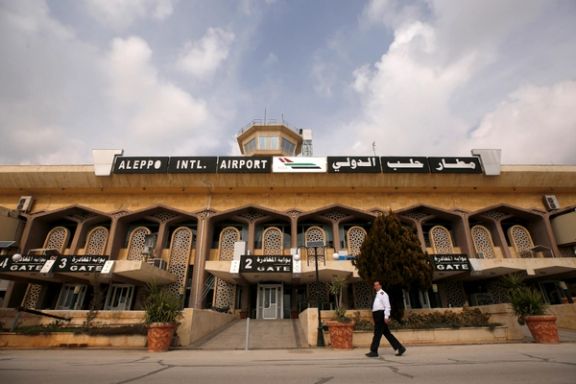
Aleppo Airport Rendered Non-Operational After Israeli Airstrike
Aug 28, 2023, 16:18 GMT+1
A man walks at Aleppo international airport after it was reopened for the first time in years, Syria, February 19, 2020.

The Aleppo International Airport has been left inoperable following what the state news agency SANA has attributed to an Israeli airstrike.

Citing an official from the Syrian military, SANA reported that Israeli aircraft, originating from the Mediterranean Sea, carried out the attack at approximately 4:30 am, Monday.

Whilst No casualties have been reported, the incident marks one of several attacks on the airport this year, including two strikes in March that also resulted in its temporary closure.

Israeli officials have yet to issue an immediate comment or acknowledgment about today’s event but the country has carried out a series of strikes on targets within government-controlled areas of Syria in recent years. While these operations predominantly focus on military installations or Iranian-backed factions, Israel rarely confirms or discusses its actions. It is believed that these targeted operations aim to intercept arms shipments from Iran destined for militant groups supported by Tehran, including Hezbollah in Lebanon.

Over the course of Syria's 12-year-long conflict, thousands of Iran-backed fighters from across the region have joined the conflict, contributing to the advantage of President Bashar Assad's forces.

Aleppo, which suffered substantial damage during the Syrian civil war, experienced further destruction following a powerful 7.8-magnitude earthquake that struck Turkey and Syria in February and also greatly damaged the city's infrastructure.

Reports have also emerged from The Washington Post, citing classified US intelligence, that Iran had covertly dispatched weapon shipments to Syria under the guise of humanitarian aid. These alleged actions were said to have occurred in the wake of the earthquake and were intended for use against US forces.


Most Viewed

State media slam Araghchi's Hormuz tweet, say it let Trump claim victory
1

State media slam Araghchi's Hormuz tweet, say it let Trump claim victory

2

Iran International says it won’t be silenced after London arson attack

3
VOICES FROM IRAN

Hope and anger in Iran as fragile ceasefire persists

4
INSIGHT

How Tehran bends its own red lines to boost state rallies

5

Iran halts petrochemical exports to supply domestic market

Banner
Banner

Spotlight

  • Too early to tell who is winning Iran war, experts say
    PODCAST

    Too early to tell who is winning Iran war, experts say

  • How Tehran bends its own red lines to boost state rallies
    INSIGHT

    How Tehran bends its own red lines to boost state rallies

  • Iran blackout cripples freelancer, small business incomes
    VOICES FROM IRAN

    Iran blackout cripples freelancer, small business incomes

  • Ideology may be fading in Iran, but not in Kashmir's ‘Mini Iran'
    INSIGHT

    Ideology may be fading in Iran, but not in Kashmir's ‘Mini Iran'

  • US blockade enters murky phase as tankers spoof signals and buyers hesitate
    ANALYSIS

    US blockade enters murky phase as tankers spoof signals and buyers hesitate

  • Why the $100 billion Hormuz toll revenue is a myth
    ANALYSIS

    Why the $100 billion Hormuz toll revenue is a myth

•
•
•

More Stories

Iranian Delegation Addresses Water Crisis During Kabul Visit

Aug 28, 2023, 13:23 GMT+1

An Iranian parliamentary delegation has visited Kabul to address the water crisis in Sistan and Baluchestan stemming from the Taliban's Helmand River flow obstruction.

During their visit to Afghanistan, the delegation met with the Taliban's Foreign Minister, to address the problem of lack of proper water sharing from the river as well as additional security issues. The delegation said that Iran is willing to share its "various experiences" with the Taliban.

According to the Taliban's Ministry of Foreign Affairs, the seven-member delegation, led by Javad Karimi-Qoddousi, met with Amir Khan Muttaqi, the Acting Foreign Minister of the Afghan Interim Administration.

Hafiz Zia Ahmad, the spokesperson for Afghanistan's Ministry of Foreign Affairs, stated that in the meeting, both sides engaged in detailed discussions on topics including "security, combating narcotics, preventing smuggling, border protection, and trade."

Iran says that the Taliban have restricted water flow from the Helmand River to Iran's parched eastern regions, but this accusation is denied by the Taliban.

A particular point of contention between the Iranian officials and the Taliban surround the crossing of hundreds of thousands of Afghan refugees across the borders, and the increase in cultivation and transit of narcotics.

These differences led to clashes between Iranian border forces and the Taliban in a border outpost area in the Zabol border region in late May, resulting in casualties among Iranian border guards. However, Iran's Foreign Minister stated that the actions of the Taliban forces in this conflict were "unjustified."

Some members of the Iranian parliament, including Ahmad Naderi, a representative, had previously referred to the Taliban as "one of the authentic movements of the region with a Pashtun ethnic background" before their return to power, emphasizing that "collaboration with the Taliban could lead to the expansion of stability in Afghanistan and prevent the infiltration of groups like ISIS."

Iranian Media Report Electronic Warfare Exercise To Counter Drones

Aug 26, 2023, 09:17 GMT+1

Iranian media have announced the commencement of an electronic warfare exercise held within the country's central regions to counter drone attacks.

According to a report by local media on Friday, the joint electronic warfare exercise was initiated by the Islamic Republic Army. The exercise involves practical evaluation and training of various stationary, mobile, ground-based, and aerial electronic warfare systems.

Units from the Navy, Ground Forces, Air Force, as well as air defense participated in this exercise, which took place primarily in a desert region.

The IRIB news agency wrote, "Electronic defense systems stationed in the exercise area successfully executed non-lethal defense operations and electronic protection against unmanned aerial vehicles and small attacking drones."

A day before this exercise, Habibollah Sayyari, the Deputy Coordinator of the Army, stated, "Given the importance of electronic warfare in today's battles and its significant role in future conflicts, special attention to electronic warfare technologies… have been on the agenda of the Islamic Republic of Iran Army in recent years."

This exercise takes place at a time when Iran's nuclear sites located in central areas of the country have been targeted by drone attacks in the past years.

In February, The Wall Street Journal, in an exclusive report quoting American officials and individuals, attributed a drone attack on a defense ministry complex in Esfahan to Israel.

While the Islamic Republic has been supplying drones to Russia for use in attacks on Ukraine, the spokesperson of the Ukrainian Air Force also declared at that time that the drone attack on military installations in Esfahan was a consequence of the policies of the Islamic Republic.

Russia Says Military Ties With Iran Will Withstand US Pressure

Aug 26, 2023, 07:50 GMT+1

Russia's military cooperation with Iran will not succumb to geopolitical pressure, Russian Deputy Foreign Minister Sergei Ryabkov said, referring to pressure from the United States.

Washington has been publicly demanding that Iran should stop providing military drones to Russia and scale down its bilateral military cooperation.

"There are no changes, and cooperation with Iran will continue," Ryabkov said, according to a report on Saturday from Russian state news agency RIA. "We are independent states and do not succumb to the dictates of the United States and its satellites."

The US is pressing Iran to stop selling the armed drones, which Russia is using in the war in Ukraine, the Financial Times reported earlier this month, citing an Iranian official and another person familiar with the talks.

Russia began using the Iranian-made Shahed drones to attack deep inside Ukraine last year. The so-called kamikaze unmanned drones do not need a runway to launch and explode on impact. Ukraine has learned to shoot down most of the unmanned aerial vehicles but Russia has been using them in conjunction with ballistic and cruise missiles to overwhelm Ukraine’s air defenses.

Iran has acknowledged sending drones to Russia but said in the past they were sent before Russia's February 2022 invasion in Ukraine. Moscow has denied its forces used Iranian drones in Ukraine.

However, Russia has used hundreds of the Iranian drones and Ukraine has reported regular deliveries reaching Russia.

A White House official said in June that Iran had transferred several hundred drones to Russia since August 2022.

Iranian Army Launches 'Electronic Warfare' Drills

Aug 25, 2023, 15:12 GMT+1

Iran on Friday launched exercises to test its “electronic warfare” capabilities against mock enemy drones, fighter jets and helicopters.

The electronic warfare drills -- codenamed Separ-e Hafezan-e Velayat 1402 (Shield of Velayat's Guardians 1402) -- involved various units from the military's navy, ground and air forces as well as air defenses and was staged in the central, largely desert region of the country.

The state broadcaster said that the exercises featured domestically manufactured radars, drones, manned and unmanned fighter jets, micro aerial vehicles and other military equipment as the country seeks to assess the performance and effectiveness of various fixed, mobile, ground-based and airborne electronic warfare systems.

“The army has the appropriate infrastructure, and we have achieved favorable results in countering threats in today’s world and predicting future threats in this sensitive and complicated arena,” said Rear Admiral Habibollah Sayyari, the deputy chief of the army’s coordination department.

Iran’s Army Commander-in-Chief Abdolrahim Mousavi (left) and Rear Admiral Habibollah Sayyari, the Deputy Chief of Iran's Army for Coordination (right) at the command center of an electronic warfare drills in central Iran (August 2023)
100%
Iran’s Army Commander-in-Chief Abdolrahim Mousavi (left) and Rear Admiral Habibollah Sayyari, the Deputy Chief of Iran's Army for Coordination (right) at the command center of an electronic warfare drills in central Iran (August 2023)

According to Friday's statement by the Army, various tactics and operations have been carried out during the drill, including identifying radio and data link communications, execution of group attack operations by micro aerial vehicles (MAVs) against targets, electronic operations to protect radars, and ground-based electronic operations to disrupt and deceive enemy radar systems.

Iran has recently unveiled a series of what it called new maritime weapons and an upgraded drone earlier this month as Washington appeared to be increasing pressure on Tehran.

Earlier in the month, the Biden administration signaled that it may soon offer to put armed sailors and Marines on commercial ships traveling through the Strait of Hormuz.

The Pentagon last month had already sent additional F-35 and F-16 fighter jets along with a warship to the Middle East in a bid to monitor key waterways in the region following Iran's seizure and harassment of commercial vessels.

Israel Arrests Four For Smuggling Iranian-Made Explosives

Aug 25, 2023, 11:00 GMT+1

Israel’s Shin Bet security agency says it arrested four Arab-Israelis in July on charges of smuggling Iranian-made explosive devices into the country and ties to Hezbollah.

According to Shin Bet, three individuals from the northern Arab town of Kafr Qasim were arrested on suspicion of smuggling "a substantial quantity of high-quality weapons" into Israel. The agency added that, during their arrest, they seized two Iranian-made explosive devices along with other weapons.

In a separate raid in the central city of Lod, security forces detained another Israeli who was allegedly planning to use a similar explosive device for a criminal-related bombing.

“The Shin Bet investigation revealed that Hezbollah worked to recruit and operate an infrastructure of smugglers in Israel for the purpose of distributing unusual illegal weapons to various parties, including criminal elements,” the agency said in a statement.

The Shin Bet identified the suspects as Jalal Khursa, 28, Ahmed Issa, 30, and Muhammed Issa, 39, from Kafr Qasim, and Nuh Assam, 30, from Lod. They were indicted Wednesday on various weapons offenses, making the agency publicize details of the investigation.

“This affair once again illustrates the efforts of terror elements from Hezbollah and Iran to exploit the Arab citizens of Israel for [terror] activities against the state,” a senior Shin Bet official said, adding, “It also emerged in the investigation that the line between [terror] and criminal [activity] is extremely thin.”

Hezbollah has been accused in the past of being involved in weapons and drug smuggling attempts. Most illegal guns in Israel and the West Bank are thought to have been smuggled via Jordan, with far fewer attempts from Lebanon. In late July, the military foiled a weapons smuggling attempt from Jordan.