• العربية
  • فارسی
Brand
  • Iran Insight
  • Politics
  • Economy
  • Analysis
  • Special Report
  • Opinion
  • Podcast
  • Iran Insight
  • Politics
  • Economy
  • Analysis
  • Special Report
  • Opinion
  • Podcast
  • Theme
  • Language
    • العربية
    • فارسی
  • Iran Insight
  • Politics
  • Economy
  • Analysis
  • Special Report
  • Opinion
  • Podcast
All rights reserved for Volant Media UK Limited
volant media logo

Iran Says High-Level Uranium Enrichment Going Steady
Iran International Newsroom
Aug 27, 2023, 15:35 GMT+1Updated: 17:38 GMT+1
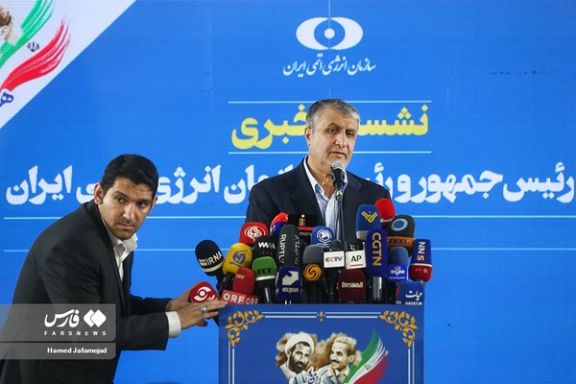
Mohammad Eslami, the head of the Atomic Energy Organization of Iran, during a press conference in Tehran on August 27, 2023

Despite reports of Iran slowing buildup of uranium needed for weapons, the regime’s nuclear chief says enrichment is going on in accordance with the law. 

Mohammad Eslami, the head of the Atomic Energy Organization of Iran, was referring to the bill passed by the parliament, dominated by hardliners, in December 2020, dubbed the “Strategic Action Plan to Lift Sanctions and Protect Iranian Nation's Interest.”

Eslami made the remarks during an event to unveil domestically-produced Cesium-137 radionuclide, announced as a “nuclear achievement” by the state media. The radioactive isotope of cesium is formed by the nuclear fission of uranium-235 in nuclear reactors and nuclear weapons. The product easily becomes volatile when released suddenly at high temperature, as in the case of the Chernobyl nuclear accident and with atomic explosions, and can travel very long distances in the air.

During a press conference on the sidelines of the event, Eslami was asked about reports regarding Tehran slowing down its 60% enrichment. "Our nuclear enrichment continues based on the strategic framework law," he replied, adding that “Our enemies were and are against Iran’s nuclear industry, but they all should know that the nuclear industry is a strategic industry."

Iran claims it managed to produce Cesium-137 radionuclide which used to be imported. (August 27, 2023)
100%
Iran claims it managed to produce Cesium-137 radionuclide which used to be imported.

The bill obligated the government to step up Iran’s nuclear program and enrich uranium beyond the limits set by the 2015 nuclear agreement, an effort aimed at forcing the United States to lift economic sanctions imposed in 2018, when former President Donald Trump withdrew from the JCPOA. The bill also mandated restrictions on monitoring by the United Nations nuclear watchdog, the International Atomic Energy Agency (IAEA), adding to the complicated dynamics of renewing the JCPOA.

The bill’s stipulation about higher levels of uranium enrichment was not an empty negotiating tactic. Iran actually began enrichment at 20 percent in early 2021, breaking the JCPOA limit of 3.65 percent. Subsequently, enrichment was increased to 60 percent during talks with West to revive the JCPOA. 

Tehran now has enough fissile material for at least two nuclear bombs, and it also gradually restricted IAEA monitoring access to its nuclear facilities, introducing another complicating factor into the JCPOA talks.

Earlier in August, the Wall Street Journal reported that Iran had significantly slowed the pace at which it was accumulating near-weapons-grade enriched uranium and diluted some of its stockpile, moves that could help ease tensions with the US and revive broader talks over Iran's nuclear program. 

Iran unveiled domestically-produced Cesium-137 radionuclide during an exhibition in Tehran on August 27, 2023.
100%
Iran unveiled 'domestically-produced' Cesium-137 radionuclide during an exhibition in Tehran on August 27, 2023.

The report came a day after Iran released four US citizens from prison into house arrest with another American already there, the first step in a planned prisoner swap that Washington expects will eventually see them return home. Iran will gain access to six billion dollars of oil revenues trapped in South Korea under US sanctions, If the US detainees are set free. The US agreed to the release of another $3 billion held in Iraq. 

Elsewhere in his remarks, Eslami said that Iran has maintained interactions with the IAEA, claiming that issues regarding four Iranian nuclear sites have been reduced to two. He added that a deputy of IAEA Chief Rafael Grossi is set to visit Iran in the near future. 

Iranian lawmakers are divided over cooperation with the IAEA, with some against any cooperation. After the UN nuclear watchdog signaled its unhappiness with what it said was slow progress in its dealings with Iran, lawmakers pointed out that parts of a recent agreement with the IAEA are contrary to the "strategic action."

In June, Iran said it reinstalled 10 cameras of the UN nuclear watchdog in one of its installations that were removed last year when the UN watchdog’s board of governors in June 2022 censured Tehran for its lack of cooperation with the agency. Lawmaker Ali Khezrian said that re-installing IAEA monitoring systems at Esfahan (Isfahan) nuclear site was beyond the Safeguards Agreement and based on the additional protocol to the IAEA-Iran agreement, which cover basic requirements of cooperation with the IAEA under the NPT.

The secretive unwritten deal between Washington and Tehran appears to have several dimensions not disclosed yet with reports claiming that Iran has also restrained proxy militias in Iraq and Syria in addition to limiting nuclear activities. 

“The prisoner deal is a key step forward for Washington and Tehran’s efforts to lower tensions as they eye a return to formal nuclear negotiations later this year,” the New York Times quoted Henry Rome, a senior fellow at the Washington Institute for Near East Policy. 

Most Viewed

US blockade enters murky phase as tankers spoof signals and buyers hesitate
1
ANALYSIS

US blockade enters murky phase as tankers spoof signals and buyers hesitate

2

US tightens financial squeeze on Iran, warns banks over oil money flows

3
INSIGHT

Ideology may be fading in Iran, but not in Kashmir's ‘Mini Iran'

4
INSIGHT

Hardliners push Hormuz ‘red line’ as US blockade tests Iran’s leverage

5
VOICES FROM IRAN

Hope and anger in Iran as fragile ceasefire persists

Banner
Banner

Spotlight

  • Hardliners push Hormuz ‘red line’ as US blockade tests Iran’s leverage
    INSIGHT

    Hardliners push Hormuz ‘red line’ as US blockade tests Iran’s leverage

  • Ideology may be fading in Iran, but not in Kashmir's ‘Mini Iran'
    INSIGHT

    Ideology may be fading in Iran, but not in Kashmir's ‘Mini Iran'

  • War damage amounts to $3,000 per Iranian, with blockade set to add to losses
    INSIGHT

    War damage amounts to $3,000 per Iranian, with blockade set to add to losses

  • Why the $100 billion Hormuz toll revenue is a myth
    ANALYSIS

    Why the $100 billion Hormuz toll revenue is a myth

  • US blockade targets Iran oil boom amid regional disruption
    ANALYSIS

    US blockade targets Iran oil boom amid regional disruption

  • Iran's digital economy battered by prolonged blackout
    INSIGHT

    Iran's digital economy battered by prolonged blackout

•
•
•

More Stories

Iran Acknowledges Qatar, Oman's Mediation In Release Of Frozen Assets

Aug 27, 2023, 12:49 GMT+1

Iran's foreign minister has expressed his gratitude for the mediation efforts of Qatar and Oman in the ongoing process to release Tehran's frozen assets.

Hossein Amir-Abdollahian made separate telephone conversations to his Omani and Qatari counterparts during which he recognized and commended their mediation efforts to facilitate negotiations to unfreeze Iran's assets.

These discussions also underline the multifaceted nature of Iran's diplomatic engagement, encompassing broader bilateral economic, political, and regional matters.

Earlier this month, Iran and the United States announced that $6 billion frozen in South Korea due to US sanctions will be released through Qatari mediation, as Iran releases five US hostages from prison into home detention.

The Iranians insist that the release of the US citizens was part of a prisoner exchange agreement not related to the release of the funds. However, it is clear that the hostages are being kept in Tehran until the money reaches Iranian bank accounts in Qatar.

Currently, the funds are with the central bank of Switzerland, which is exchanging them into Euros gradually and will transfer to Qatar where Iran will be able to access them.

Former Iranian Official Says Countries Reluctant To Buy Iranian Oil

Aug 26, 2023, 17:13 GMT+1

A former Iranian Oil Company official stressed Tehran's dependence on China's oil market citing global reluctance due to US sanction to import energy from Iran.

Mohsen Qamsari, during an exclusive interview with the Iranian Labour News Agency (ILNA), shed light on Iran's plans to bolster its oil production and exports in light of the declining trajectory of Saudi Arabia's oil exports.

He underscored the aspiration to achieve a daily production level of 3.4 million barrels, although he lamented the limited export opportunities beyond the Chinese market. Qamsari stated that Saudi Arabia's export reduction is insufficient to create a substantive opening for Iran's oil exports. He also argued that Saudi shipments fluctuate seasonally.

In the context of Iran's oil market dynamics, Qamsari illuminated Russia's perception of Iran as a competitor, exemplified by its decade-long actions aimed at diminishing Iran's presence in the oil markets. This competitive environment also endures regarding China. The proximity of Russia to China, fortified by a pipeline facilitating Russian oil exports to China, further exacerbates the challenge for Iran in the Chinese market.

Iran's oil minister recently announced a projection of reaching a daily crude oil output of 3.4 million barrels by the end of September, despite ongoing US sanctions.

TankerTrackers.com has reported that in the initial 20 days of August, Iran dispatched an average of over two million barrels of oil daily, marking a more than 30-percent surge compared to the past few months.

The renewed growth in production and exports coincides with an agreement permitting the release of $6 billion of Iranian funds frozen in South Korean banks, potentially indicative of broader diplomatic dealings beyond the public eye.

Iranian Diplomat Says US Had To Release Funds With No Nuclear Deal

Aug 25, 2023, 17:02 GMT+1
•
Iran International Newsroom

Iran succeeded in freeing its blocked funds without the revival of the JCPOA nuclear accord, Tehran’s chief negotiator Ali Bagheri-Kani told the state television.

The United States was insisting all along during nuclear talks that Iran’s funds would be released only after a nuclear deal was reached, Bagheri-Kani said during a television interview Thursday evening. However, “Iran’s diplomacy shaped conditions in such a way that the Americans were forced to retreat from their position and free Iran’s funds outside the framework of a [nuclear] agreement.”

Earlier this month, Iran and the United States announced that $6 billion frozen in South Korea due to US sanction will be released through Qatari mediation, as Iran moved five US hostages from prison into home detention. The Iranians insist that the US citizens will be released only as a prisoner exchange deal, and the release of the funds from South Korea is not related to the hostage deal. However, it is clear that the hostages are being kept in Tehran until the money reaches Iranian bank accounts in Qatar. Currently, the funds are with the Swiss central bank, which is exchanging them into euros gradually and will transfer to Qatar. 

Bagheri-Kani confirmed that talks over the hostages were taking place alongside nuclear negotiations in 2021-2022, but the process ended when Russia invaded Ukraine in February 2022 and the delegations left Vienna after almost a year of periodic meetings.

He added that Iran continued pursuing the issue of the blocked funds through intermediaries and the US was resisting. In September 2022, however, “Americans accepted to take steps for releasing the money outside the framework of the nuclear talks, after our persistent follow-ups.”

A scene of antiregime protests in Iran   (file photo)
100%
A scene of antiregime protests in Iran

This coincides with the start of nationwide antiregime protests in Iran immediately after the hijab police fatally wounded Mahsa Amini, a 22-year-old woman in mid-September. Once the protests began, the Biden administrations began voicing support for the Iranian people and their human rights. But if we believe the senior Iranian diplomat, this was the time the US administration agreed to discuss the release of the funds.

In early October, the State Department announced that the US was no longer pursuing the revival of the JCPOA.

“Our focus is not an accord that isn’t moving forward, but what is happening in Iran ... this popular movement and the brutal crackdown of the regime against protesters,” US special envoy Rob Malley said in Paris on October 14.“It’s the sale of armed drones by Iran to Russia ... and the liberation of our hostages…”

Two day later, Malley told CNN that "Right now the talks on revival of JCPOA are not on the US agenda; the focus is on what's happening in Iran as the talks are stalled," adding that “Iran has taken a position in those talks for the past two months, which is simply inconsistent with a return to the deal.” The same message was reiterated several times by Secretary of State Antony Blinken and other top officials.

Iranian protesters and their supporters in the US, Europe and elsewhere took these remarks as indication that the Biden administration had given up dealing with Tehran, while Bagheri-Kani’s remarks indicate behind the scenes talks were taking place for the release of the funds.

Bagheri-Kani said in his interview that the protests in Iran briefly “distracted” the Biden administration, “but they quickly returned to the talks at the end of autumn.”

Critics see the hostage deal as a dangerous step by the US, which will embolden Tehran to detain more Americans given the chance and the money can empower it to undertake anti-West actions.

Moreover, media reports have hinted that the administration has in fact reached a wider, unwritten deal with Tehran, because around $3 billion was also released from Iraq. Supposedly, Iran has agreed to marginally slow down its uranium enrichment in exchange for the funds and a US willingness not to actively enforce existing sanctions.

Qatar Hopes Iran-US Prisoner Deal Leads To Nuclear Talks

Aug 25, 2023, 14:03 GMT+1

Qatar has expressed hope that a recent Iran-US prisoners exchange agreement his country brokered leads to a wider dialogue on Iran's nuclear program.

Qatari Prime Minister and Foreign Minister Sheikh Mohammed Bin Abdulrahman Al Thani made the remarks on Friday, saying, "With Iran, we became a key mediator with the US in the prisoner swap agreement which we hope will lead to a wider dialogue on the nuclear deal."

During a media briefing earlier in the week, Qatar's Foreign Ministry spokesperson Majed bin Mohammed al-Ansari underlined Doha’s important role in achieving consensus between the two sides and facilitating communication with various stakeholders for the implementation of the agreement.

The deal entails the release of five American prisoners detained in Tehran in exchange for the liberation of five Iranian prisoners held in the United States as well as the release of $6 billion of frozen Iranian assets.

As a first step in this deal – which followed a two-year mediation effort by Qatar and Oman -- Iran on August 10 released four imprisoned US citizens from Evin prison into house arrest, where they joined a fifth already under home confinement.

These include businessman Siamak Namazi, 51, Emad Sharqi, 58, and environmental activist Morad Tahbaz, 67, who holds British nationality in addition to Iranian citizenship. The identities of the fourth and fifth Americans who either left prison or were under house arrest have not been disclosed.

World powers were in talks in Vienna for months to revive the 2015 Iran nuclear deal. The negotiations collapsed in March over Tehran’s demands that Revolutionary Guards be removed from a US list of foreign terrorist organizations and ‘guarantees’ to cushion its economy and nuclear program from the US again leaving the the Joint Comprehensive Plan of Action.

The Biden administration has been striving to bring the United States back into the JCPOA, a deal that was previously abandoned under the Trump administration.

Saudi Plays The Chinese Card In Race For Nuclear Parity With Iran

Aug 25, 2023, 12:13 GMT+1
•
Iran International Newsroom

As Saudi Arabia continues to pursue an ambitious nuclear program, it has turned to China to pressure Washington as US talks stall.

The Kingdom’s bid to reach parity with Iran, in spite of revived diplomatic relations this year, is driving the Persian Gulf’s oil powerhouse to reach out to China, according to the Wall Street Journal. 

Saudi Arabia has asked the US to help it develop a civilian nuclear program as part of a potential deal that would include diplomatic normalization with Israel, which Riyadh doesn’t recognize. Saudi Arabia is also asking the US to provide security guarantees for the kingdom as part of such a deal.

It is causing dilemmas for the United States, which is walking a tightrope in the region, with continuing tensions with Iran and an ever-hungrier Saudi Arabia seeking uranium enrichment on its home soil. 

Bypassing the US in favor of China, which earlier this year was a major part of the negotiations to reinstate diplomatic relations between Iran and Saudi, is a firm statement that with or without President Joe Biden’s agreement, Riyadh will do all it can to forge its way into the nuclear domain. 

Saudi Crown Prince Mohammed bin Salman and US President Joe Biden meet at Al Salman Palace upon his arrival in Jeddah, Saudi Arabia, July 15, 2022.
100%
Saudi Crown Prince Mohammed bin Salman and US President Joe Biden meet at Al Salman Palace upon his arrival in Jeddah, Saudi Arabia, July 15, 2022.

According to Israel’s Haaretz, leading American and Israeli experts are warning the Biden administration not to accept Saudi demands for uranium enrichment as part of a future US-Saudi-Israeli normalization agreement, for fear it will build its own nuclear weapons. 

The fears emerged after Israel’s Strategic Affairs Minister Ron Dermer did not rule out Saudi uranium enrichment during an interview with PBS. He argued the Saudis could go to China or France to set up a native nuclear enrichment program, suggesting it would be better to have the US, Israel’s most important ally, involved.

A Saudi-Israel deal, alongside the shadow war with Iran, is atop Israeli Prime Minister Benjamin Netanyahu’s agenda, and many in Israel fear he will reach it at any cost as he approaches the end of his decades-long political career. 

Opposition leader Yair Lapid said this week: “It is clear to everyone that if they [Saudi] start enriching uranium in the Middle East, everyone will want to."

Until now, the US has said American nuclear aid is contingent on the Saudis agreeing to not enrich their own uranium or mine their own uranium deposits in the kingdom—non-proliferation conditions not sought by China, which has been seeking to strengthen its influence in the Middle East.

China National Nuclear Corp., a state-owned company known as CNNC, has bid to build a nuclear plant in Saudi Arabia’s Eastern Province, near the border with Qatar and the United Arab Emirates, according to the WSJ, which claims the dealings with China are a pressure tactic on Washington as the two nations drifted further apart since the Biden administration came to power. 

Biden promised to make Saudi a ‘pariah state’ after the brutal assassination of US-Saudi journalist Jamal Khashoggi, which has caused years of tension between Biden and Saudi’s de facto ruler, Crown Prince Mohammed Bin Salman. 

Crown Prince Mohammed Bin Salman has made obtaining nuclear power a priority. After a decade of discussions, the Saudis are now impatiently pushing to award a contract for the Eastern Province plant, known as Duwaiheen—a two-reactor, 2.8-gigawatt facility—by the end of 2023 and eventually construct 16 reactors at a cost of some $80 billion to $100 billion.

Driven by the desire for parity with Iran in addition to looking towards a time when the kingdom’s main export, oil, is no longer a viable revenue source and nuclear power would offer a viable alternative, time is now ticking. MBS has made no secret of his willingness to develop nuclear weapons if Iran does.

China has already helped Riyadh build its own ballistic missiles and helped the Saudis with a facility for extracting uranium yellowcake from uranium ore, an initial step toward enriching uranium. 

There is no doubt that Saudi Crown Prince has his eye on being the region’s political powerhouse, a fact which has more recently created tensions with the UAE’s President and MBS’s initial mentor on his rise to power, Mohammed Bin Zayed.

Close allies of the US such as the UAE and South Korea have accepted stronger restrictions on their nuclear programs and will see US support for enrichment on Saudi soil as a justification to demand the same.

Where the Israeli factor plays into the next stages of the race to nuclear is yet to be seen, the Prime Minister’s office claiming hours after Dermer’s comments that it will not allow any of its neighbors to develop nuclear weapons, but there seems no doubt that Saudi Arabia will get its way, whatever the cost.