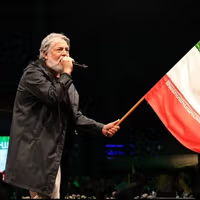
An Iranian mourner tied their own hands and feet to a flagpole to commemorate the death of Khodanour Lojei, a young man shot to death on October 1 in Zahedan, capital of southeastern province of Sistan and Baluchestan.
This week, Shiite Ashura ceremonies embraced a marked pro-protest theme, which angered hardliners as their own mourning ceremonies seemed to have waned in popularity.
Complaining that some people mourned the slaying of the revered third Shiite imam Hussein in a way that “pleases the enemy”, a pro-regime cleric said in a sermon in Qom that these mourners have chosen a style to be attractive to foreign media. He was referring to independent Persian broadcasters abroad that give coverage to protests and reflect critical views about regime.
Ashura, commemorated on the 10th of the Islamic lunar month of Muharram, is the anniversary of the death of Prophet Muhammed’s grandson and his 72 companions in the battle of Karbala in 680 AD.
Some of the mourning songs by ordinary people marking the occasion, particularly in the eastern city of Yazd, were ripe with allusions to the protest movement and those who were killed by security forces. Crowds led by maddahs or eulogists also sang verses about poverty and destitution among Iranians who have become poorer in the past five years mainly due to the impact of US sanctions and a failed economic system ripe with corruption.
In an Instagram post Friday, Ehsan Abedi, director general of Yazd Department of Islamic Culture and Guidance, also criticized the critical style of mourning that troubles the regime and its hardliner supporters, and alleged that the “enemy’s media” is cheering.
Over the years, the government has invested money and energy to make Ashura and other religious occasions a show for its support among ordinary people, but this year’s phenomenon of many people trying to take back their religion has received wide coverage on social media.
The online Institute for Iranian Civil Society (Tavaana) reported Friday that agents of the Revolutionary Guards Intelligence Organization (SAS) threatened the organizers of Yazd’s famous mourning ceremonies to stop them from singing songs that criticize the regime, but the congregation sang the “Poppies Growing From the Blood of Motherland’s Youth” while leaving the mosque in protest to their interference.
Social media users have reported that security forces clashed with mourners in the city and arrested some of them.
In several other cities people also paid homage to young people who were killed by security forces during the Mahsa Movement protests in 2022 and early this year.
In Amol in the northern Province of Mazandaran, mourners who were clad in white instead of the traditional black of Shia mourners gathered outside the house of Ghazaleh Ghalabi, 33, who was shot in the head on September 21, soon after protests broke out following Mahsa Amini’s death in the custody of the morality police and visited her grave.
Participants sang the well-known “Poppies Growing From the Blood of Motherland’s Youth”, a revolutionary song from the era of Iran’s Constitutional Revolution (1905-1911). Ghalabi’s mother, Fatemeh Mojtabaei, and some other women defiantly attended the ceremony unveiled.
In some cities including Tehran in protest to the regime’s brutality, some mourners tied their own hands and feet to flagpoles to commemorate the death of Khodanour Lojei, a young man shot to death on October 1 in Zahedan, capital of southeastern province of Sistan and Baluchestan.
A picture of Lojei with his hands and feet tied to a post with a bottle of water near him, which the thirsty young man could not reach, has turned into one of the icons of the protest movement. The performance alluded to the Shia belief that the Imam’s adversary, Yazid, cut his troops’ access to the waters of Euphrates and killed them after days of thirst in the parched desert.
In a distressing turn of events, renowned Iranian rapper, Saman Seidi (Yasin), has claimed that the regime injected him with an unknown drug in a psychiatric center.
Yasin revealed an ordeal of "unknown drug" injection at Aminabad Psychiatric Center, leading to instability in his mental and physical well-being.
Prison authorities transferred him to the center a week ago, following his arrest during last year's nationwide protests.
Sending a message to Hengaw Human Rights Organization, a Kurdish rights group, from within Rajaeeshahr prison in Karaj, the artist expressed grave concern about his deteriorating condition.
He revealed that on July 22, he was forcibly taken to the psychiatric center, where he was administered the unknown substance with considerable violence and physical assault.
As a result of the injection, Saman Yasin was unconscious for 24 hours, and upon regaining consciousness, found himself restrained to a hospital bed with impaired vision persisting for two days.
"They should take me to the forensic doctor, to see what they did to me," Yasin urged in his statement to Hengaw.
Yasin asserted that he was in "perfect health" prior to his arrest. Holding those responsible for his predicament, he pointedly mentioned notorious Judge Abodlghasem Salavati and other officials.
In a compelling audio message from prison on July 21, Yasin had passionately maintained his innocence, vehemently asserting that he had not committed any crime.
The artist's initial death sentence by the Tehran Revolutionary Court was later challenged, leading to a retrial that the Supreme Court granted. However, the ordeal has persisted, with his fate remaining uncertain.
A sign outside a hospital in Iran says no medical care for women with "bad hijab", July 2023
The circulation of a letter to hospitals requiring strict hijab for medical services in northern Iran has sparked strong public reactions.
The letter, signed by Mohammad Taqi Najafzadeh, Director of the health and treatment network in Lahijan city to the heads of local hospitals, has ignited a significant reaction on social media platforms.
In the directive, Najafzadeh unequivocally states that medical centers and health workers must abide by the hijab regulations set forth by the authorities. The letter, however, leaves the crucial question unanswered regarding the medical service protocol in emergency situations, where immediate care may be required irrespective of the patient's observance of hijab.
The publication of this directive has garnered diverse reactions, with notable figures and netizens expressing their concerns. Abbas Abdi, a political activist closely associated with the reformist movement, held both the government and the Ministry of Health accountable for endorsing such a measure. In a tweet, he remarked, "That doctor, being a government administrator, and the ministry, endorsing such an anti-human violation, amid the government's silence, should be held accountable."
Drawing historical analogies, another user likened the directive to the "darkest days of church supremacy" during the Middle Ages when religious decrees were imposed on societal matters.
Critics on Twitter also viewed this directive as a breach of the “medical oath," emphasizing the importance of providing medical services without discrimination or coercion.
Saeed Maliki, a journalist, went a step further and compared the authorities' action to that of ISIS, drawing parallels between the enforcement of hijab observance and the tactics used by the extremist group to force people to abide by its strict interpretation of Sharia law.
It is important to note that this is not the first instance where the issue of observing the hijab has affected medical services in Iran. Following the Women, Life, Freedom protests and the advent of women's movements, reports have emerged of medical centers and hospitals postponing care unless hijab regulations are strictly adhered to.
Earlier this month, an Iranian female medical staff member was subjected to a series of punishments, including performing "cleaning services," for not complying with the mandatory hijab. The US-based Human Rights Activists News Agency (HRANA) reported on July 14 that the judicial authority of the Islamic Republic sentenced her to a ban on employment and cleaning services due to her alleged failure to observe hijab while driving.
Amidst the challenges, a segment of the medical community sought to voice civil protests against these governmental pressures. In March, following an institution's order for compulsory black veiling for women in pharmacies, some pharmacist doctors and male technicians showed their anger by wearing black veils.
The Iranian government employs such punishments with the aim of suppressing opponents of the mandatory hijab. However, reports suggest that these punitive measures have not succeeded in quelling protests, and studies indicate an increase in the emigration of Iranian doctors and nurses in recent months.
Iranians mourning during a Muharram ceremony in Tehran’s bazaar on July 27, 2023
Some Iranians taking part in the annual Shiite mourning ceremonies this week chanted religious verses that were critical of the regime and its repressive actions.
In one large gathering to mark the anniversary of the revered Shiite saint, Imam Hussein, son of the first Imam, Ali, mourners chanted:
“O Motherland, do you know why I’m devastated?
It’s because these people (the regime) only care about hijab.
They don’t see the poverty in our houses,
They have stolen so much from public coffers,
They don’t see the tears and laments of workers,
They don’t see that widows are destitute,
No bread on their tables,
That fathers are ashamed, and mothers distressed.
God be my witness that this is not the Justice of Ali!
All our problem is not a strand of hair!”
These verses were sung in the local dialect in Dezful in the oil-rich Khuzestan Province by the maddah whose role is reciting the praises of the prophet and his companions and mourning the slaying of his grandson, Imam Hussein in the battle of Karbala. While the maddah sings, his audience rhythmically beat their chests and move in tandem.
In recent years some maddahs have increasingly been using the story of the grandson of Prophet Mohammed, Imam Hussein, and his martyrdom to express their opposition to an interpretation of Islam that the regime has been promoting for four decades during the Ashura ceremonies.
The Day of Ashura, the anniversary of the slaying of Imam Hussein and his 72 companions on the 10th of the Islamic lunar month of Muharram, is the highlight of the month-long mourning ceremonies. The Imam and his companions were killed in 680 in a battle that took place in the plain of Karbala in present-day Iraq.
An Iranian Shiite Muslim mourns after covering himself with mud during a ceremony to mark Ashura, the holiest day on the Shiite Muslim calendar, in Tehran, Iran July 28, 2023.
Every year during Muharram, the beginning of which fell on July 19 this year, thousands of local mourning groups known as hey'at organize large congregations and street processions with thousands of participants.
Thousands of others usually gather along the streets to watch the procession of men rhythmically beating their chests or using a bundle of chains to beat their backs to the beat of massive drums amplified by speakers. The self-beatings symbolize the pain and suffering of the Imam and his companions in Karabla.
Unlike the fearless maddah in Dezful who openly referred to present time issues of hijab and destitution of the people, others voice their criticism in veiled terms, often in the form of verses associated with certain historical and revolutionary eras that their audience easily understands.
“Stop oppression, God’s blood has come to boil,
heavens and earth are wailing,
because the earth has been clothed in poppies,” a maddah and his congregation sang in the very religiously conservative city of Yazd.
“Poppies have sprung from the blood of the youth of the motherland!
And cypress trees have bent under the grief of their lost lives,” the congregation continued singing. This verse was taken from the very famous poem of Mirzaadeh Eshghi, a 19th century poet who dedicated it to the martyrs of the Constitutional Revolution (1905-1911).
By creating a parallel between their own time and circumstances and the time and circumstances that led to Imam Hussein’s martyrdom, they identify the regime and it leaders with the Arab ruler, Yazid, whose troops killed the Imam. The verses and steps are often practiced for months before the actual ceremonies.
Muharram ceremonies have been held for centuries in Iran and among Shiites in other countries. However, since the Islamic Revolution of 1979, the ceremonies and rituals have gained more prominence as the clerical government have made them a vehicle to show that the people are religious and loyal.
Iranians mourning during a Muharram ceremony in the central city of Bam, Kerman province (July 2023)
But increasingly mourning gatherings pop up around the country that include non-regime religious groups, who use the very Shiite ideology of seeking justice and condemning oppression to direct criticism at the clerical rulers.
Some people believe that the regime’s actions have resulted in the weakening of religion among Iranians while others argue that it is only the regime’s interpretation of Islam that has weakened and led to thousands of mosques being abandoned.
In a note published on Telegram Thursday entitled “Confiscation of History”, sociologist Ali Zamanian argued that using religious occasions such as Ashura to create an “ideological dichotomy” in which one side is all good and the other is all evil is unacceptable whether by regime-affiliated maddahs or those who sympathize with the opposition.
Zamanian, however, pointed out that critical maddahs’ expression of their frustration with the current economic crisis may show the government that it is not only those who believe in a secular state who oppose religious rule, but many religious people are “at the end of their ropes” too.
Even under the Shah, who was very proud of being the ruler of the only Shiite state in the world, the country was shut down for several days for the ceremonies and Ashura sermons were broadcast live on national radio.
Iranians mourning during a Muharram ceremony in Tehran (July 2023)
The outspoken Sunni cleric of Zahedan has urged officials to exercise restraint and compassion amid the current economic crisis during Friday prayers.
Amid immense financial pressure faced by Iranians all over the country, Molavi Abdolhamid delivered a compelling Friday prayer sermon, emphasizing the need for support from the authorities and compassion for the situation of regular citizens.
Addressing the congregation, Abdolhamid criticized the common practice of attributing inefficiencies and problems to external "enemies." He was referring to the term "enemy," often used by Supreme Leader Ali Khamenei and his loyalists to refer to the United States, he deemed it incorrect to solely blame external factors for internal issues, particularly in relation to domestic economic challenges.
During the Friday prayer, which coincided with the 10th of Muharram and the Day of Ashura, Abdolhamid, the Imam of Zahedan said, "No government, whether Muslim or non-Muslim, should resort to violence against its own people merely to ensure its survival."
He further stressed that the regime, its rulers, and the entire system owe their existence to the people, adding that the right to govern and elect officials lies with the citizens, and therefore, it is essential to listen to their voices and their concerns.
As the sermon concluded on the 43rd Friday of protests in Zahedan, Abdolhamid urged demonstrators to leave the mosque without engaging in chanting or further protests. During the previous two Friday prayers, worshipper and protestors honored Abdolhamid’s request and observe silence as a sign of respect for the sacred days of Muharram.
The bipartisan Mahsa Amini Human Rights and Security Accountability (MAHSA) Act has been submitted to the US Senate, seeking more sanctions on Iranian leadership.
Following a unanimous approval at US House of Representatives Foreign Affairs Committee in April, Senators Marco Rubio (R-FL) and Alex Padilla (D-CA) introduced the bipartisan legislation to the Senate on Thursday, potentially tightening the noose on top leaders of the regime -- the Supreme Leader and the President as well as their inner circles – over human rights abuses and support for terrorism.
“The Ayatollah’s systematic human rights violations against the Iranian people are barbaric," Rubio said, underlining that “as a State Sponsor of Terrorism, the Iranian regime has actively wreaked havoc against its own people and countless other nations.”
The MAHSA Act – which has 68 Republican and 60 Democrat cosponsors – and is supported by the National Union for Democracy in Iran (NUFDI), United Against Nuclear Iran (UANI) and the American Israel Public Affairs Committee (AIPAC), was first introduced by Representatives Jim Banks (R-IN) and Eric Swalwell (D-CA) during the 117th Congress in January, about four months into pro-democracy and anti-regime protests following the death of 22-year-old Iranian-Kurdish woman Mahsa Amini at the hands of Iran's hijab police.
US Sen. Marco Rubio (R-FL) speaking during a Senate Committee
Essentially similar and a companion to the one passed in the House committee, the MAHSA Act will potentially commit the administration to report to Congress in 90 days after the date of the enactment and periodically thereafter, making determinations about whether certain existing sanctions apply to specified persons and impose the applicable sanctions.
“The US must evaluate and re-amp economic pressure against Senior Iranian regime officials who are actively partaking in the crackdown of Iranian protesters and civilians,” Rubio added in a statement.
Senator Padilla said, “Iranian protesters have demonstrated tremendous courage in voicing their outrage toward the Iranian regime after the brutal murder of Mahsa Amini,” noting that “we must do our part to hold Iranian leaders accountable for their violent crackdown of these protests and the regime’s ongoing repression, censorship, and abuse against its people.”
Senator Alex Padilla (D-CA)
The bipartisan bicameral move requires the executive branch to impose applicable sanctions on Ali Khamenei, his office and his appointees, as well as President Ebrahim Raisi and his cabinet officials, foundations and other entities affiliated with the Supreme Leader under section 105(c) of the Comprehensive Iran Sanctions, Accountability, and Divestment Act of 2010, section 7031 (c) of the Department of State, Foreign Operations, and Related Programs Appropriations Act, 2021, and Executive Orders 13876, 13553, 13224, and 13818.
“The Supreme Leader is an institution of the Islamic Republic of Iran...that holds ultimate authority over Iran’s judiciary and security apparatus, including the Ministry of Intelligence and Security, law enforcement forces under the Interior Ministry, the Islamic Revolutionary Guard Corps (IRGC), and the Basij, a nationwide volunteer paramilitary group, subordinate to the IRGC, all of which have engaged in human rights abuses in Iran,” read a paragraph of the MAHSA Act.
Some lobbyists and a few lawmakers have been seeking to dilute the act, describing it as “Islamophobic” or “not leading to any increased sanctions” because Khamenei and Raisi were already sanctioned by the US. NIAC, advocating non-confrontational policies toward the Islamic Republic, said in a statement that “the bill would make it more difficult for a President to lift sanctions on these officials as part of any diplomatic agreement... This bill does not include a sunset and would target the offices themselves, rather than individuals. As a result, it would remain in effect indefinitely and be applied to any future Supreme Leader or President of Iran until its repeal."
Amini’s death in September 2022 led to the boldest revolt against the clerical regime since its establishment in 1979 in Iran in what became known as the Woman, Life, Freedom movement. More than 500 people have been killed in the nationwide rallies, nearly 20,000 detained, and seven executed on trumped up charges.