• العربية
  • فارسی
Brand
  • Iran Insight
  • Politics
  • Economy
  • Analysis
  • Special Report
  • Opinion
  • Podcast
  • Iran Insight
  • Politics
  • Economy
  • Analysis
  • Special Report
  • Opinion
  • Podcast
  • Theme
  • Language
    • العربية
    • فارسی
  • Iran Insight
  • Politics
  • Economy
  • Analysis
  • Special Report
  • Opinion
  • Podcast
All rights reserved for Volant Media UK Limited
volant media logo

Iranian Cleric Says Hijab Rebels 'Loose', Deserving Punishment
Jul 17, 2023, 12:49 GMT+1
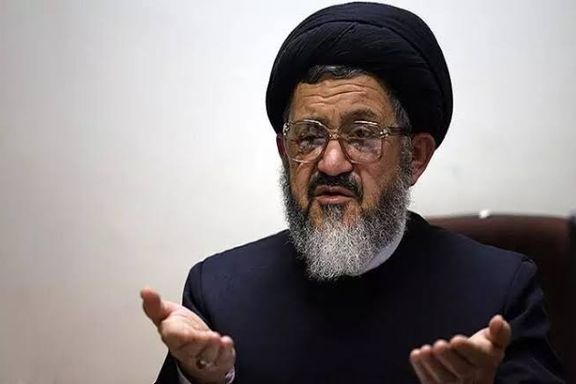
Reza Akrami, a member of the Society of Combatant Clerics

A well-known Iranian cleric says hijab rebels are loose and must be punished while observant women belong to their husbands.

Reza Akrami, a member of the Society of Combatant Clerics, not even the most hardline of Iran’s extremists, said women without hijab can belong to anyone and show themselves to all men.

Speaking to Rouydad24 news website in Tehran Monday, he repeated the supreme leader's argument that wearing the hijab is not a matter of personal choice, but a political and Sharia issue. He insisted that the Quran and religious teachings make hijab mandatory, though many clerics globally would disagree.

“A woman who does not follow the law regarding hijab must definitely be punished,” Akrami said, while at the same time proposing a persuasive path to convincing women about the merits of hijab. Akrami has held many government positions over the years, but is not part of the inner circle of hardliners who form the main base of support for Iran’s ruler Ali Khamenei. 

Iran re-launched its hijab police street patrols on Sunday after months of inactivity following popular anti-regime protests, triggered by the death of a young woman in custody. In mid-September 2022 Mahsa Amini, a 22-year-old woman was arrested in the street by the hijab or morality police and received fatal blows to the head.

She passed away in a hospital after three days, triggering the longest and most dangerous popular protests against the clerical regime.

Since then, many women appear on the streets without the mandatory large headscarf covering the upper body and hair. The regime considers this a serious challenge to its authority and hardliners are campaigning to use police patrols to force women to wear the hijab again.


Most Viewed

US blockade enters murky phase as tankers spoof signals and buyers hesitate
1
ANALYSIS

US blockade enters murky phase as tankers spoof signals and buyers hesitate

2
INSIGHT

Ideology may be fading in Iran, but not in Kashmir's ‘Mini Iran'

3
INSIGHT

Hardliners push Hormuz ‘red line’ as US blockade tests Iran’s leverage

4
VOICES FROM IRAN

Hope and anger in Iran as fragile ceasefire persists

5

US sanctions oil network tied to Iranian tycoon Shamkhani

Banner
Banner

Spotlight

  • Hardliners push Hormuz ‘red line’ as US blockade tests Iran’s leverage
    INSIGHT

    Hardliners push Hormuz ‘red line’ as US blockade tests Iran’s leverage

  • Ideology may be fading in Iran, but not in Kashmir's ‘Mini Iran'
    INSIGHT

    Ideology may be fading in Iran, but not in Kashmir's ‘Mini Iran'

  • War damage amounts to $3,000 per Iranian, with blockade set to add to losses
    INSIGHT

    War damage amounts to $3,000 per Iranian, with blockade set to add to losses

  • Why the $100 billion Hormuz toll revenue is a myth
    ANALYSIS

    Why the $100 billion Hormuz toll revenue is a myth

  • US blockade targets Iran oil boom amid regional disruption
    ANALYSIS

    US blockade targets Iran oil boom amid regional disruption

  • Iran's digital economy battered by prolonged blackout
    INSIGHT

    Iran's digital economy battered by prolonged blackout

•
•
•

More Stories

Hashd Al-Shaabi Forces Not To Suppress Iranian Students

Jul 17, 2023, 12:01 GMT+1

The Tehran University dean says the admission of Hashd al-Shaabi forces at Iranian universities is “academic cooperation with our friends”.

It comes as members of Iraq's Shia Hashd al-Shaabi militias and other proxies of the Islamic Republic have been given permission to study at Iranian universities.

Mohammad Moqimi on Monday called the reports about the use of Hashd al-Shaabi forces to repress the university protests "simplistic", students fearing the forces were being inserted to crack down on dissent as universities continue to be a hotbed of anti revolutionary sentiment.

He said the militia students are "sincere and genuine people."

On Thursday, a group of students from Tehran and Amirkabir Universities expressed opposition to the news of the new student admissions.

In a statement, Tehran University student activists said they would not accept “military forces, whether in combat or school uniforms, within the university premises".

Vowing to resist their presence, they said that the university’s atmosphere is already poisoned due to the presence of professors affiliated with the regime and Basij militiamen masquerading as students.

They accused the authorities of sidelining students by suspending, removing, and suppressing them, while replacing them with borrowed forces from Iraq.

Al-Hashd al-Shaabi was established back in 2014, following a fatwa to fight ISIS, which controlled four governorates and reached the borders of the capital Baghdad at the time.

The Iraqi state-sponsored umbrella organization is composed of approximately 67 different armed factions, with around 128,000 fighters that are mostly Shia Muslim groups, but also include Sunni Muslim, Christian, and Yazidi groups.

Iranian Hardline Official Brands Arts Students Worthless

Jul 17, 2023, 09:50 GMT+1

A Tehran University official has insulted fine arts and performing arts students saying they are worthless entertainers.

In an audio file released on Sunday, Abdolreza Seif, the Head of Faculty of Literature and Humanities and an advisor to the dean of Tehran University used a derogatory Persian word for dancers, which denotes immoral entertainers, to describe performing arts students.

Singing and dancing is forbidden in the strict interpretation of Islam, which the hardliners in Iran try to enforce.

Students at the fine arts faculty have been staging sit-ins against stricter hijab rules inside the university premises since last month.

Many were seriously injured by the campus security forces and several others arrested by plainclothes agents.

The sit-in began after the authorities announced new rules for the specialist arts institution which require girls to wear a pullover headscarf with stitched front (called maghna’e in Iran) which is like a nun’s coif, completely covering the head and the neck. Failing to comply, the university has announced, would result in suspension.

Following the incidents, several statements were issued online by students from institutions including Allameh Tabataba'i University, Tarbiat Modarres University and Shahid Beheshti University in Tehran, vowing to continue protests against the repressive policies.

Large Hijab Protest Breaks Out In Iran On Sunday Evening

Jul 16, 2023, 21:31 GMT+1

Images and reports on social media indicate that a large crowd in Rasht, northern Iran have been protesting evening after security forces tried to arrest three women over hijab.

A video received by Iran International shows thousands of people gathered gathered outside the city hall in Rasht after the hijab police tried to whisk away three women. Onlookers intervened and rescued the women. As the news of the incident spread in the city, residents began to gather in the square in protest.

Some tweets say that gunshots were heard and security forces also fired tear gas, but it is too early to verify those reports.

Iran on Sunday officially announced the return of the hijab police to streets and earlier videos and reports received from Iran showed numerous incidents of confrontations between women who chose to appear without covering their head and plainclothes hijab enforcers.

Last September, the death of 22-year-old Mahsa Amini in hijab police custody triggered months of protests and the government for a while ordered enforcers off the streets. But in the past six months more and more women have shed the hijab and appear in public in ordinary attire.

Clerics and hardliners however have been pushing for a forceful reaction to what they call "loss of honor", "lawlessness" and a phenomenon threatening the very foundations of the clerical regime.

A video emerged on Saturday showing a hijab enforcer attacking and trying to detain a teenage girl. The video quickly became viral on Persian Twitter.

Iranian Actor Arrested For Criticizing 'Morality' Police

Jul 16, 2023, 17:13 GMT+1

The police in Tehran arrested Mohammed Sadeghi, a young actor, during a raid on his home in an effort to clamp down on the anti-hijab movement.

Sadeghi posted a video on Instagram expressing his anger over the detention of yet another woman in morality police hands due to her inappropriate hijab.

“Believe me, if I saw such a scene, I might commit murder,” he wrote in the caption of his video. "Why do you get paid? To take people's daughters into a van and arrest them?"

Regime agents rushed to Sadeghi's house in Tehran in the wake of the post, when he jumped from the third floor in a bid to escape. A dramatic chase ensued, which he filmed and streamed live to Instagram, in spite of the regime's attempts to ban the app.

In a new campaign to enforce mandatory hijab, morality police have now returned to the streets in full force after a brief few months' respite following the worst of the unrest which erupted in September after the death of Mahsa Amini in morality police custody.

Women continue to defy the official dress code, particularly in Tehran, despite the crackdown, with huge numbers seen across the country's public spaces from malls to universities with their hair uncovered as they flout the mandatory hijab rules.

Experts fear the renewed zeal of the morality police risks reigniting tensions.

Iranian Activist: Police Broke Into My House After Smashing Door By Ax

Jul 16, 2023, 16:18 GMT+1

A famous victim of Iran's hijab rules, Sepideh Rashno has published details of how she was assaulted by several agents in her apartment last July, that electrified public opinion before the death of now famous Mahsa Amini.

In a post on Instagram, she dramatically explained the events after an acrimonious dispute with a hijab enforcer in a city bus on July 16.

A video of her quarrel with the hijab enforcer on social media went viral last year leading to her arrest by the regime forces.

“I was afraid and went to the balcony to scream and ask for help, but a number of regime agents threatened me not to scream, otherwise they would come up and break my neck!” read her post.

Rashno further added that over ten agents searched everywhere, and one was filming the procedure.

The 28-year-old artist and writer was tortured last year into denouncing herself and other activists, expressing regrets for her confrontation with the hijab enforcer.

Her ‘forced confessions’ was also aired on state-run television after she was brutally beaten before the telecast. Her suffering left a deep mark on many people and prepared the stage for large anti-government protests later in September when Mahsa Amini was killed in hijab police custody.

Rashno was found guilty of “association and collusion with the intention of committing a crime against the country's security" and “propaganda against the Islamic Republic” and given a five-year suspended jail sentence in December.

In May, she revealed on her Instagram account that she has been punished by her university with two semesters suspension.

"As a citizen, I have the right to choose the clothes I wear,” she wrote in response to the decision, adding that she plans to return to the university after her suspension with “her preferred outfit.”





