• العربية
  • فارسی
Brand
  • Iran Insight
  • Politics
  • Economy
  • Analysis
  • Special Report
  • Opinion
  • Podcast
  • Iran Insight
  • Politics
  • Economy
  • Analysis
  • Special Report
  • Opinion
  • Podcast
  • Theme
  • Language
    • العربية
    • فارسی
  • Iran Insight
  • Politics
  • Economy
  • Analysis
  • Special Report
  • Opinion
  • Podcast
All rights reserved for Volant Media UK Limited
volant media logo

Parliament Admits Iran’s Economic Limbo Will Exacerbate Poverty
Iran International Newsroom
Jul 10, 2023, 21:17 GMT+1Updated: 17:24 GMT+1
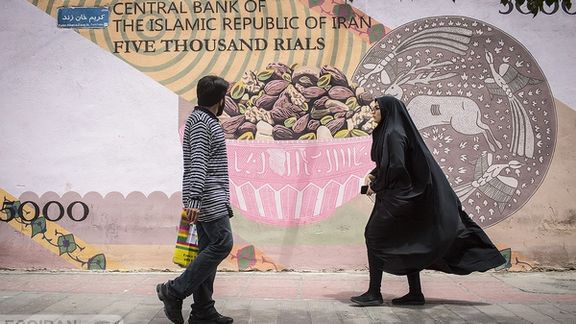
A man and a woman walking in front of a mural of a 5,000-rial banknote (now worth about one cent) in Tehran. Unlike the original design, the bowl in the mural is full of nuts whose price ranges between 5,000,000 to 100,000,000 rials (about $10 to $20) in the market.

Iran’s Parliament Research Center says the limbo in the regime’s economic policies will lead to further poverty and inflation in the country. 

In its latest report released this week, the research arm of the Iranian parliament said that if the economic trends of the last decade continue, no policies in the country's seventh national development plan would help curb the growing poverty.

“In order to realize high growth and improve productivity, policymakers should stop price suppression policies to control inflation and solve the inflation problem in a more fundamental way," read the report. The regime tends to put a cap on prices of certain goods and services, but there is little enforcement. 

According to the report by the parliament’s research center, which had said late in May that the population below the absolute poverty line in the country increased to 30.4% in 2021, the household income has not improved in the past decade and is set to become worse. Economist Farshad Momeni said a few days ago that the population of the poor has doubled in less than three years since in comparison with the average poverty in the 2010s. At that same time, the regime set a target of 116-percent growth until 2020 but the economy only grew about nine percent. 

Central building of Majlis (parliament) Research Center (November 2019)
100%
Central building of Majlis (parliament) Research Center

Since the 1940s Iran has launched 11 plans to build infrastructure, establish key industries, expand public services and education. Five plans were launched under the monarchy until 1979, and six during the Islamic Republic. Nevertheless, Iran is still considered a developing country, due to anemic growth in the past 44 years.

Annual growth since 1979 has barely averaged 2.5 percent, and it past decade growth has been zero, impacted by international and US sanctions related to Iran's nuclear program.

According to a report published by ILNA in January, one-third of the country’s population is now living in extreme poverty, after the number almost doubled in one year from 2020 to 2021. However, it is believed that the number could in reality be far higher. According to official figures released by the interior ministry, around 60 percent of the 84 million Iranians live under the relative poverty line of whom between 20 to 30 million live in "absolute poverty".

There have been several factors hindering Iran's economic development dating back decades. The revolutionary chaos of the early 1980s, immediately followed by the eight-year Iran-Iraq war that caused hundreds of thousands of casualties, derailed Iran from its modernization trajectory. The Islamic government, built on an anti-Western ideology engaged in hostage taking and supporting militant groups from its very inception, has left the country isolated.

The inefficiency of successive clerical governments during the past four decades, and many years of international sanctions that have crippled the country's economy, were acknowledged in the report to have contributed as adverse factors against growth.

The parliament’s research center also admitted that “foreign exchange resources have become the Achilles heel of Iran's economy, and the realization of sustainable growth depends on the provision of new foreign exchange resources for the country.”

Crushed by numerous rounds of sanctions by the US, EU, UK, and several others, the Islamic Republic faces crippling obstacles to cash its oil and gas revenues in foreign currencies, leading to tens of billions of dollars of assets frozen in foreign banks. 

Most Viewed

US blockade enters murky phase as tankers spoof signals and buyers hesitate
1
ANALYSIS

US blockade enters murky phase as tankers spoof signals and buyers hesitate

2
INSIGHT

Ideology may be fading in Iran, but not in Kashmir's ‘Mini Iran'

3
INSIGHT

Hardliners push Hormuz ‘red line’ as US blockade tests Iran’s leverage

4
VOICES FROM IRAN

Hope and anger in Iran as fragile ceasefire persists

5

US sanctions oil network tied to Iranian tycoon Shamkhani

Banner
Banner

Spotlight

  • Hardliners push Hormuz ‘red line’ as US blockade tests Iran’s leverage
    INSIGHT

    Hardliners push Hormuz ‘red line’ as US blockade tests Iran’s leverage

  • Ideology may be fading in Iran, but not in Kashmir's ‘Mini Iran'
    INSIGHT

    Ideology may be fading in Iran, but not in Kashmir's ‘Mini Iran'

  • War damage amounts to $3,000 per Iranian, with blockade set to add to losses
    INSIGHT

    War damage amounts to $3,000 per Iranian, with blockade set to add to losses

  • Why the $100 billion Hormuz toll revenue is a myth
    ANALYSIS

    Why the $100 billion Hormuz toll revenue is a myth

  • US blockade targets Iran oil boom amid regional disruption
    ANALYSIS

    US blockade targets Iran oil boom amid regional disruption

  • Iran's digital economy battered by prolonged blackout
    INSIGHT

    Iran's digital economy battered by prolonged blackout

•
•
•

More Stories

State Dep. Says Will Respond To Congressional Letter Over Envoy Malley

Jul 10, 2023, 20:19 GMT+1

The US State Department said Monday that they will be engaging with the office of House Foreign Affairs Committee Chairman regarding his letter about US Iran envoy being under investigation.

Iran International first reported June 29 that special envoy Rob Malley has been absent for a considerable time, his security clearance has been suspended and he is under investigation related to his handling of classified documents. Later it was revealed that he is on unpaid leave and the Federal Bureau of Investigation (FBI) is involved in the investigation.

Following the initial reports committee chairman Rep. Michael McCaul (R-Tx) wrote a letter to Secretary of State Antony Blinken and demanded answers as to why the State Department had not informed Congress directly and clarification on Malley’s case.

State Department spokesperson Matthew Miller in his press briefing confirmed the receipt of McCaul’s letter and said, “We take our oversight obligation extremely seriously, we obviously got the letter from the Chairman, and we’ve been reviewing it and we will be engaging with his office on the matter.”

McCaul in his letter set a deadline of Tuesday, July 11 at 5:00 pm for a response from the State Department.

“These reports raise serious concerns both regarding Malley’s conduct and whether the State Department misled Congress and the American public,” McCaul wrote to Secretary of State Antony Blinken.

Senator Bill Hagerty (R-TN) also tweeted on the matter June 30, raising a series of questions. “When did the investigation that led to the suspension of Malley’s clearance begin?”, asked Sen Hagerty, and added, “When were Secretary of State Antony Blinken and President Joe Biden informed of it?”

Regime Insiders In Iran Intensify Attacks On Government

Jul 10, 2023, 17:05 GMT+1
•
Iran International Newsroom

An increasing number of Iranian conservatives have joined reformist clerics and politicians, openly criticizing President Ebrahim Raisi and his government. 

It appears that last year's protests in Iran have even shaken Supreme Leader Ali Khamenei's authority and some public figures inside Iran are less reluctant to hold him responsible for the country's problems.

Last week, a conservative member of parliament referred to Iran's leading clerics as "2-rial mullahs," using the smallest denomination of Iran's currency as a metaphor. Although some hardliners objected to the remark, the MP faced no consequences due to his affiliation with the country's intelligence community. 

Meanwhile, two prominent Western-based Iranian political analysts, Mehdi Khalaji and Mehdi Mahdavi Azad said at a talk show on Iran International TV on Saturday that clerics including Khamenei have been losing their authority during the past months and the military and intelligence organizations are likely to replace Khamenei or to determine a weak successor to him once he is dead.

Rasoul Montajebnia, the Secretary General of reformist Jomhouriat Party said in an interview with Rouydad24 on Sunday, "The group of politicians who are in power in Iran will continue to defend the current situation even if it turns ten times worse than what we witness now." Motajebnia reiterated that the all-conservative government has dealt a hard blow to Iran's national interests.

 Rasoul Montajabnia, the Secretary General of reformist Jomhouriat Party (undated)
100%
Rasoul Montajabnia, the Secretary General of reformist Jomhouriat Party

He said as a result of the performance by officials in recent years, the people have come to believe they no longer can trust them and what they say, and this is rather worrying. 

Montajebnia said, under the circumstances, a majority of the people either oppose the government, or protest its behavior, or try to be indifferent. He added that there are two major elections in March 2024 and the people need to make sure that these are competitive elections in which they can choose whoever they want for parliament and the Assembly of Experts. 

Montajebnia further highlighted that successive governments over the past two decades have disappointed the people. Financial corruption cases and restrictions on people's power to choose their representatives have eroded trust in officials and rendered elections meaningless. Consequently, the regime's legitimacy is declining, and fewer people continue to support the government.

In another development, pointing out the division between the people and the government, the former chief of the Iranian parliament's national security and foreign policy committee Heshmatollah Falahatpisheh told reporters in Tehran that the fact ordinary young people are sent to defend the borders where many conscripts are killed in clashes with smugglers and opponents, while children of well-connected families often are exempt from military service, shows a high degree of discrimination. 

Former chief of the Iranian parliament's national security and foreign policy committee Heshmatollah Falahatpisheh (undated)
100%
Former chief of the Iranian parliament's national security and foreign policy committee Heshmatollah Falahatpisheh

Defending the government, hardline conservative politician and a member of the Islamic Coalition Party, Ahmad Karimi-Esfahani promised that "The government will gradually but slowly realize its potentials and the country's problems will be solved."

He then resorted to an outdated intimidating rhetoric and warned Iranians not to play into the hands of the enemies by criticizing the government. He added that the government hopes that prices will come down, while annual inflation is hovering between 70-120 percent, depending on who issues estimates.

Karimi-Esfahani added: "It is unfair to criticize the Raisi administration which is heir to a government that had made too many mistakes." He claimed that the Raisi administration has had major achievements that we cannot ignore.

His remarks contradict a chorus of harsh criticisms of the government from the early months of Raisi’s presidency.


Refinery Blaze Breaks Out In Iran's Persian Gulf Port

Jul 10, 2023, 15:40 GMT+1

Three petroleum product reservoirs belonging to the Aftab Oil Refining company have caught fire in Iran's southern port city of Bandar Abbas, state media reported on Monday.

"According to statements by local sources, efforts have been started to extinguish the fire, but there is a possibility of fire spreading and nearby reservoirs exploding," the official IRNA news agency said.

Bandar Abbas is located on the Persian Gulf coast and is one of the hubs for export of oil and oil products.

The official government news agency IRNA reported that six firefighters have been injured in trying to extinguish the blaze. Footage of a large black smoke coming out of an industrial compound was shared by IRNA.

The cause of the incident is still unknown, but similar industrial accidents in the past have usually led to speculations of domestic or foreign sabotage.

People work to put out a fire at an oil refinery in Bandar Abbas, Iran, July 10, 2023.
100%
People work to put out a fire at an oil refinery in Bandar Abbas, Iran, July 10, 2023.

Firefighters put out a fire at an oil refinery in Bandar Abbas, Iran, July 10, 2023.
100%
Firefighters put out a fire at an oil refinery in Bandar Abbas, Iran, July 10, 2023.

Iran Says Downed Ukrainian Airlines Case Filed With ICJ Is ‘Political’

Jul 10, 2023, 13:40 GMT+1
•
Iran International Newsroom

Iran’s has dismissed a lawsuit filed with the International Court of Justice by four countries over a Ukraine airliner downed in 2020 as politically motivated.

As the case drags past its third year, Western powers are growing tired of Iran’s lack of action and are now escalating to the global legal body, the principal judicial organ of the United Nations, filing action on July 5. 

The case, listed as “concerning a dispute under the Convention for the Suppression of Unlawful Acts against the Safety of Civil Aviation (the “Montreal Convention”), is a desperate bid to help gain justice for the families of the flight PS752 of January 8 2020, on which all 176 people on board died when it was downed by Iranian missiles.

The plane, which was en route to Kiev and transporting mostly Iranians, crashed minutes after takeoff near the Iranian capital, shot down by Iran’s air defenses amid tensions between Tehran and Washington following the US assassination of IRGC’s Qassem Soleimani in Iraq days earlier.

Victims who died when Iran shot down a Ukrainian passenger plane over Tehran.
100%
Victims who died when Iran shot down a Ukrainian passenger plane over Tehran.

The regime has since been claiming to be open to talks for years since the tragedy but nothing has moved forward since other than some low level prosecutions, several of which have even since been appealed.

In a press release last week, the ICJ stated that the the United Kingdom, Canada, Ukraine and Sweden “claim that Iran has violated a series of obligations under the Montreal Convention as a result of the shooting down on 8 January 2020 of a civil aircraft in service, Ukraine International Airlines Flight PS752, by military personnel of Iran’s Islamic Revolutionary Guard Corps”.

In the application, the joint statement accuses Iran of having “failed to take all practicable measures to prevent the unlawful and intentional commission of an offence described in Article1 of the Montreal Convention, including the destruction of Flight PS752. It also subsequently failed to conduct an impartial, transparent, and fair criminal investigation and prosecution consistent with international law”.

In a typically dogmatic response, Iran’s foreign ministry said Monday that the escalation of the case to the ICJ is only serving “political objectives”, and maintains that the country formed an independent technical group right after the incident and took necessary actions “with goodwill, transparency, and utmost seriousness” to investigate.

“Following the tragic incident involving the Ukrainian plane, the Islamic Republic of Iran has officially, in accordance with domestic laws, international commitments, and with goodwill, transparency, and utmost seriousness, taken necessary actions to shed light on various aspects of the incident,” the statement said.

However, Canda and Ukraine have repeatedly complained that Iran has stonewalled and not cooperated in allowing an independent investigation.

The recent join application reflects the growing fatigue not only for the scores of families left devastated, but for the global powers fighting for justice. 

Last year, Marilyne Guèvremont, a spokesperson from Global Affairs Canada, said the issue had become futile, with inaction from Iran making any attempt at discussions in vain. She told Iran International: “We are now focused on the subsequent actions to resolve this matter in accordance with international law. We will not rest until the families get the justice, transparency and accountability from Iran that they deserve.”

Iranian Activist Nargess Mohammadi Summoned For Fifth Time In 6 Months

Jul 10, 2023, 13:17 GMT+1

Iranian rights activist Narges Mohammadi has once again been summoned by the Evin Security Court.

It is the fifth time in the past six months that Mohammadi, a renowned author and campaigner, has been summoned but refuses to attend.

On June 18, Mohammadi received a notification from the Second Branch of the Evin District Security Court, to appear in court for her activities since her imprisonment in Evin Prison, where she continues to defy authorities by revealing the brutal conditions inside the country's notorious jail.

Mohammadi, whose punishment has included long stints of solitary confinement, has been summoned for a total of 11 times to Branches 1, 2, and 3 of the Evin District Security Court, as well as to Branch 29 of the Revolutionary Court. However, she has not attended any of the hearings.

Mohammadi has defiantly argued that the regime cannot silence her through fabricated cases, trials, and consecutive verdicts. She has also declared that she will not appear in any court and does not recognize the Islamic Republic, the judiciary, or court rulings.

She was arrested on November 16, 2021, and one year after being released, was detained again. Currently, she is serving a total sentence of 9 years and 8 months, along with 154 lashes and additional penalties in Evin Prison. She has also been denied access to medical care amid deteriorating health.

Mohammadi has been imprisoned several times over the past two decades for her work fighting for human rights.

In her letter to the UN Human Rights Council in Geneva in March, she said she is ready to testify against the authorities of the Islamic Republic regarding the torture, harassment and abuse of prisoners.