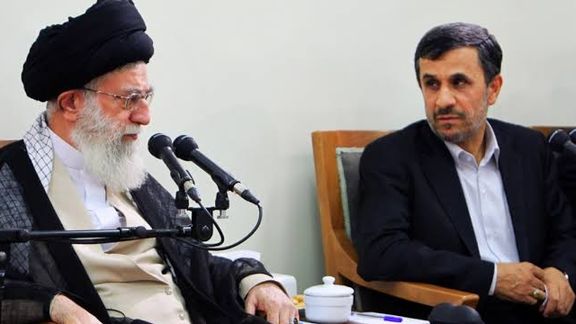
Iran’s ruler Ali Khamenei (left) and former president Mahmoud Ahmadinejad
Hardliners dominating Iran’s ruling circles are eager to fend off suspicions that their own vigilantes were behind mass poisonings of schoolgirls in recent months.
A lawmaker claimed this week that “many of the hundreds” responsible for schoolgirl poisonings were affiliated with former President Mahmoud Ahmadinejad and were arrested on “direct orders” of Supreme Leader Ali Khamenei.
Using the term “Deviant Current” to describe the political affiliation of those responsible for the poisoning of thousands of schoolgirls across Iran, Morteza Mahmoudvand said hundreds have been arrested and being interrogated.
“We saw that the incidents of poisoning subsided after an order [by Khamenei] and parliament’s investigations,” Mahmoudvand told the Iranian Labour News Agency (ILNA).
MP Morteza Mahmoudvand
The poisonings started in the religious city of Qom in central Iran November 30, spread throughout the country, and continued until the end of April, sending hundreds of students to hospitals and at least one case of death was reported.
Many ordinary Iranians have been suspicious that hardliners, at the core of the regime, or religious extremists protected by the regime were behind the chemical attacks as a revenge against the active role of young girls in anti-regime protests. Many on social media called the attacks “state terrorism”.
In a statement on April 28, the intelligence ministry denied any indication that poisonous substances had caused the illness of students and said samples taken from the scene of the incidents examined by “the most reliable laboratories” in the country had not yielded any suspicious substances.
The ministry tried to minimize the serial attacks claiming students fell ill by stink bombs (stinkpots), pepper sprays and similar substances used by some students to disrupt classes.
“Officials have not confirmed Mahmoudvand’s allegations against the Ahmadinejad group yet, but it would be conceivable that the regime is aiming to kill two birds with one stone if they confirm these allegations,” a political analyst in Iran who requested anonymity told Iran International. “This will clear the regime itself of any responsibility and will also discredit the Ahmadinejad group in the eyes of some of its supporters.”
A dissident group of experts based overseas which has been investigating the poisonings has said that preliminary results of tests done on clothing of poisoned schoolgirls suggests the use of a nerve agent. Such agents, many say, could only be available to regime insiders.
A young woman lies in hospital after reports of poisoning at an unspecified location in Iran in this still image from video from March 2, 2023.
Some of the victims reported falling ill after an aroma, resembling tangerines, or a putrid stench filled the air in their classrooms. Hundreds had to be hospitalized with some staying in hospital for up to a week due to the severity of their symptoms including palpitation, headache, nausea, cough, sore throat, or temporary paralysis and weakness but most others were released within hours. In some cases, symptoms lasted for weeks.
Mahmoudvand also told ILNA that the “Deviant Current grouplet had infiltrated everywhere”, presumably meaning the government and intelligence organizations.
However, Ahmadinejad has maintained public silence for nearly a year and there has been no sign of any pro-Ahmadinejad group engaging in political activities.
Since a public standoff between Ahmadinejad, then president, and Supreme Leader Ali Khamenei in May 2011, officials of the Islamic Republic have used the term “Deviant Current” to describe Ahmadinejad and his inner circle including his vice president and confidante Esfandiar Rahim-Mashaei.
The conflict arose when Ahmadinejad fired Khamenei’s favored intelligence minister Heydar Moslehi who took his orders from the Leader.
Ahmadinejad even stayed home and refused to carry out his presidential duties for eleven days when Khamenei insisted that he reinstate Moslehi.
He eventually surrendered to Khamenei’s will, but the autocrat known for his vengefulness never forgave Ahmadinejad whose views he had said were the closest to his own, backing him before the 2009 presidential elections.
Khamenei’s devotees, accordingly, turned against Ahmadinejad who they had ardently supported throughout the years. Ahmadinejad was not allowed to run for presidency in 2017 and again in 2021, clearly on Khamenei’s orders.
A cabinet meeting of President Ebrahim Raisi’s administration on June 28, 2023
A commentary published in Tehran says President Ebrahim Raisi and his aides are determined to bar many current lawmakers from running in the March 2024 elections.
Forouzan Asef Nakhaei wrote in the commentary that a group of managers appointed through lobbying by influential lawmakers are responsible for the economic crisis and widespread poverty in Iran.
Earlier in June a decision by the interior ministry to limit interference by lawmakers in local governments led to conflict among powerful conservative factions. President Raisi’s government ostensibly wanted to create a healthier political environment, but critics saw it as an attempt to clip the wings of those lawmakers who are not among the president’s hardliner supporters.
Khabar Online called the development "a major conflict among hardliners." But other reports in the media indicate the opposite, that hardliners around Raisi are trying to isolate independent lawmakers and tens of neo-cons close to Speaker Mohammad Bagher Ghalibaf and fill the 290 seats with ultraconservative.
Many agree that lawmakers in various factions have exercised their influence on local governors and Interior Ministry officials to ensure their re-election and their preferred candidates in larger cities.
But what the presidential administration wants is to make sure that only the ultraconservative Paydari Party members win the seats. However, the fact is that most top officials Raisi has appointed are from the Paydari front or people presented by them.
Journalist Forouzan Asef Nakhaei
However, Paydari hardliners in the parliament accuse their independent and neo-con colleagues of introducing inefficient individuals to the government or of facilitating their rise to political power by getting elected to parliament.
Meanwhile, Nakhaei wrote that hardliners fear without major administrative reforms to give prominence to efficient managers, voters will blame Raisi for all the country's problems and this will reduce the likelihood of his re-election in 2025.
Speaking along the same lines, lawmaker Alborz Hosseini told Rouydad24 news website that the country needs agile managers who are ready to fight their way forward. He added that President Raisi has had a lot of time to sort out the economic chaos in Iran but has failed to do so.
He argued that it is too late for the kind of "trial and error" Raisi is experimenting with. One of Raisi’s weakest points is the appointments he makes, and this impacts the economy, which is clearly not in a good condition.
MP Alborz Hosseini
"Raisi had said at the beginning of his presidency that his choices of officials will go beyond factional boundaries, but in practice his choices were very limited. Now Raisi needs managers who can understand the country's critical situation."
But in addition to internal factors hurting the economy, Hosseini also pointed at the regime’s foreign policy. He underscored that the government should find a way to interact with the world to boost trade, oil sales and repatriation of oil money.
He added: "Raisi failed to stand by his promises and the people are utterly dissatisfied as they cannot make ends meet. It is not acceptable that prices rise two to three times every month. We have failed to do what we had promised in the areas of industry, housing, agriculture and so on and the people have a right to be angry about this."
Meanwhile, centrist website Entekhab likened Raisi's government to former President Mahmoud Ahmadinejad's administration, saying that both governments followed a "purification" project that was aimed at handing over the entire government to populist ultraconservative politicians and both of them appointed individuals to key posts that lacked the right qualification.
Alleged Iranian terror operative Yousef Shahbazi Abbasalilo, in a photo released by the Mossad spy agency on June 29, 2023.
Israel says its intelligence agents in Iran succeeded in capturing the suspect behind an IRGC-planned attack on its nationals in Cyprus.
Mossad identified the suspect as Yousef Shahabazi Abbasalilo, who received “detailed instructions and weapons from senior Revolutionary Guard officials” to conduct the terror attack, thwarted a few days ago.
It also released a video showing the mastermind of the attack being interrogated. As part of the questioning, Abbasalilo confessed and revealed detailed plans.
“We’ll get to every person that advances terrorism against Jews and Israelis all over the world, including on Iranian soil,” a senior Mossad official said.
The man introducing himself as Yadollah Khedmati, deputy commander of the Revolutionary Guards (IRGC) Logistics, said he regretted his involvement in shipping weapons to Iran’s proxy groups in Syria, Iraq, Lebanon, and Yemen and urged other IRGC officials to avoid engagement in such activities.
This is the third time evidence emerges of Israeli agents detaining an IRGC operative inside Iran and taping confessions. A short audio recording was published by Israeli media in May last year with a photo of a man introduced as Iranian national Mansour Rasouli, 52.
In the audio recording, Rasouli said he was sent to Turkey by the IRGC to establish an operational network to assassinate an Israeli diplomat in Istanbul, a Germany-based US general, and a journalist in France.
US Special Envoy for Iran Robert Malley. File photo
Iran International has learned that US special envoy for Iran Robert Malley is under investigation and his deputy has assumed his duties at the State Department.
After multiple inquiries, State Department Spokesperson Matt Miller said Thursday afternoon in a statement that "Rob Malley is on leave and Abram Paley is serving as acting Special Envoy for Iran and leading the Department’s work in this area."
Multiple sources told us that Malley is under investigation for yet unknown reasons and one source said that the Federal Bureau of Investigation (FBI) is also involved.
According to our sources, Malley has been absent for a considerable period prompting speculation about potential conduct-related issues, which could affect his security clearance.
Speaking to Iran International on the condition of anonymity, a source familiar with the case confirmed Mr. Malley's absence, saying, "He has completely vanished. No calls, no meetings."
US Iran envoy Rob Malley meeting with a Russian diplomat in Vienna in December 2021 during Iran nuclear talks
Considering Mr. Malley's essential role in formulating US policy towards Iran, his abrupt and prolonged absence raised considerable questions. Iran International sought clarification earlier on Friday from the State Department regarding the nature of his leave and security clearance status.
In response, the State Department replied by email, "The Department of State, the Special Envoy for Iran, and his team remain deeply engaged on the formulation and implementation of US Iran Policy."
The Department's spokesperson reiterated the same during his daily briefing on Friday before spokesperson Miller confirmed that Malley is on leave.
The initial email did not clarify who is holding the position of ‘Special Envoy for Iran’. In further correspondence, we asked: "Can you please confirm whether Abram Paley is currently Acting Interim Special Envoy for Iran?" The state department's answer was short: "Hello, we decline to comment."
Journalist Barak Ravid tweeted after Iran International's exclusive report first appeared that Malley told him: "I have been informed that my security clearance is under review. I have not been provided any further information, but I expect the investigation to be resolved favorably and soon. In the meantime, I am on leave."
Another informed source confirmed to Iran International that Rob Malley did not participate in the early May negotiations with Iranians in Oman. Instead, the White House Middle East coordinator, Brett McGurk led the US delegation.
Axios had previously reported that McGurk journeyed to Muscat on May 8, following a visit to Saudi Arabia with National Security Advisor Jake Sullivan.
Rob Malley speaking to Iran International's Samira Gharaei in October 2022
Malley's absence from the Oman negotiations implies that the White House and the US National Security Council have assumed control of the discussions with Iran, effectively sidelining the special envoy.
President Biden appointed Mr. Malley primarily to revive the JCPOA, abandoned by former President Donald Trump in 2018. During 2021 and 2022, Malley worked on convincing Iranian leaders to comply with the JCPOA's stipulated limitations on their nuclear program. However, the Iranian nuclear negotiators never agreed to meet with him or with any other US official.
During his tenure, the Biden administration practically stopped enforcing US oil sanctions intended to persuade Tehran to scale back its uranium enrichment program.
Iran was barely exporting 250,000 barrels of oil per day during 2019 and first half of 2020, but shipments began to increase in the latter part of that year as Joe Biden signaled his readiness to negotiate for the revival of the JCPOA. Industry sources report that Iran’s daily oil exports have now reached 1.5 million barrels.
According to Iran International sources, Malley had been deeply involved in trying to free dual national prisoners from Iran before his unexpected leave. The sources suggest that he intended to step down from his position following their release, hoping to end his tenure on a high note.
Earlier this year, Iran International released an exclusive report disclosing Mr. Malley's dealings with Iran's UN ambassador, Amir Saeed Iravani, a former senior official in Iran’s Supreme National Security Council.
These discussions are thought to be the first direct contact between the US and Iranian officials since Washington’s withdrawal from the JCPOA in 2018. In response to our January inquiries about these meetings, the State Department stated, "We have the means to deliver specific and firm messages to Iran when it is in America's interest to do so." The Financial Times confirmed our initial report in June.
Iran’s judiciary says its former deputy was released from prison after serving just 45 months of a 31-year prison term after posting a bail of 3 trillion rials ($6 million).
Before being arrested in July 2019, Akbar Tabari held senior financial and executive positions within the Iranian judiciary for nearly 20 years.
He was jailed for leading a bribery network and accepting multiple bribes personally, sentenced to 31 years in prison, 12 1/2 years in prison for money laundering, and more than 15 years for other crimes that remain undisclosed.
In the announcement of his release, the judiciary claimed that Tabari "did not take any long-term leave during his term" and also "paid the fines he was sentenced to."
Transparency International ranked Iran 150th out of 180 countries in its 2021 Corruption Perception Index as one of the world's most corrupt countries.
As a result of Tabari's release, questions have been raised about the fairness of Iran's judiciary in high-profile cases, showing preferential treatment to former regime officials and those who can buy their way out of jail.
While regime opponents are subjected to immediate secret trials and severe punishment, including those arrested during the recent nationwide protests, the process of reviewing the charges of officials and their affiliates is usually slow, and the sentence is usually suspended after a short period.
The question also remains as to how a former government employee can post a $6 million bail when monthly salaries of top officials is around $1,000.
State media also announced the release of Mehdi Hashemi, the son of former prominent Iranian politician Ali Akbar Hashemi Rafsanjani, and Mohammad Ali Najafi, a former Tehran mayor and minister of education, suggesting a wave of reprieves for ex regime lackeys in the midst of the Eid festivities.
Drones are seen at a site at an undisclosed location in Iran, in this handout image obtained on April 20, 2023.
Iran International has obtained information about an IRGC-affiliated company active in supplying drones and missiles for Russia and Lebanese group Hezbollah.
An Iranian hacktivist group, called 'Lab-Dookhtegan' or Read My Lips, shared with Iran International exclusive information about the activities of the company, identified as ‘Tik’, sharing the photos and identities of several senior members of the company.
According to the group, the company has provided training on missile and drone production and their control systems to Hezbollah and Russian forces on several occasions this year.
The group also provided a list of the company’s senior executives, including CEO Rasul Sirati, his deputy Hamidreza Daneshi-Kohan, Kianoosh Morovatipour, the technical engineering manager of the company, Mohammad-Ali Razavi-Kohani, in charge of the assembly line and Heshmat Parsaifard, responsible for training Hezbollah forces.
The names of the cover companies used by the IRGC to evade sanctions are being revealed gradually, creating a crisis for the Islamic Republic.
Drones are seen at a site at an undisclosed location in Iran, in this handout image obtained on April 20, 2023.
The company Shakad Sanat Asmari, also called Chekad Sanat Faraz Asia, manufactures parts for the Iranian aviation industry and its former CEO Ehsan Rahat Varnosfadrani is the company's chief scientist. Daria Fanavar Borhan Sharif (Sadid Sazeh Parvaz Sharif) is the other company, specializing in communication, optical, and electronic circuits, and Ehsan Imaninejad is its CEO.
Pundit Jaber Rajabi told Iran International that the main reasons that Russia is using Iranian-made drones are their cheap prices and the fact that Moscow wants to have an accomplice in its invasion.
He said the Islamic Republic has spent three decades developing its military technology but since it cannot manufacture airplanes and jets, it has to focus its energy and assets on missiles and drones.
Political analyst Mehdi Mahdavi-Azad told Iran International that the issue of Iran’s drones and missiles had not been very grave for the West until Russia started to use them. He believes that before the Russian invasion, Europe and the United States were not seriously concerned about the Iranian missiles because their range is not more than 2,000 kilometers, therefore not reaching Europe's borders.
Mahdavi-Azad said the regime cunningly has not worked on long-range missiles to avoid worries by the Europeans. However, Reuters reported on Wednesday that European diplomats have told Iran they plan to retainEU ballistic missile sanctions set to expire in October under the defunct 2015 Iran nuclear deal, a step that would provoke Iranian retaliation.
Only hours after the report was released, Alireza Sabahifard, the commander of Air Defense Force of Artesh, Iran's traditional Army, said, “This year, the production of advanced long-range radar, missile and drone systems is on the agenda of the Air Defense Forces of the Army.”
In April, the US Treasury Department imposed sanctions on a procurement network, which consisted of Iran’s Pardazan System Namad Arman (PASNA) and the entity's front companies and suppliers in Iran, Malaysia, Hong Kong and China that Washington said have enabled PASNA's procurement of goods and technology.
In March, Treasury’s Office of Foreign Assets Control coordinated with the FBI to designate four other firms – including the Iran-based Defense Technology and Science Research Center and its procurement firm Farazan Industrial Engineering Inc -- and three people in Iran and Turkey for allegedly buying equipment, including European-made engines, to be used for the regime’s drone and weapons programs.