• العربية
  • فارسی
Brand
  • Iran Insight
  • Politics
  • Economy
  • Analysis
  • Special Report
  • Opinion
  • Podcast
  • Iran Insight
  • Politics
  • Economy
  • Analysis
  • Special Report
  • Opinion
  • Podcast
  • Theme
  • Language
    • العربية
    • فارسی
  • Iran Insight
  • Politics
  • Economy
  • Analysis
  • Special Report
  • Opinion
  • Podcast
All rights reserved for Volant Media UK Limited
volant media logo

Iranian President Expresses Full Support For Putin Over Wagner Munity
Iran International Newsroom
Jun 26, 2023, 16:11 GMT+1Updated: 17:47 GMT+1
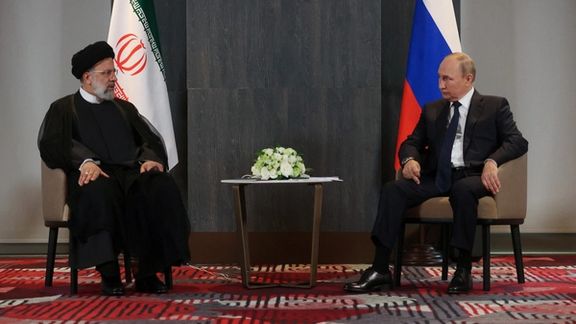
Russian President Vladimir Putin meets with Iranian President Ebrahim Raisi on the sidelines of the Shanghai Cooperation Organization (SCO) summit in Samarkand, Uzbekistan September 15, 2022.

Following Saturday's abortive Wagner Group mutiny, Russian President Vladimir Putin spoke with Iranian President Ebrahim Raisi.

The Iranian president expressed full support for the Russian leadership in the wake of the Wagner mutiny, going a step further than sentiments of Iran’s Foreign Ministry which had said that the Islamic Republic supports the rule of law in the Russian Federation and considers the latest developments to be an internal Russian matter.

In a phone call with his Russian counterpart on Saturday, Iranian Foreign Minister Hossein Amir-Abdollahian said he is sure Russia would survive the current events.

Wagner Group led by a former Putin ally Yevgeny Prigozhin launched the apparent mutiny on Friday after alleging that the military had killed many of his fighters in an airstrike. The Russian Defense Ministry however denied this.

The Wagner fighters captured the city of Rostov hundreds of miles to the south before racing in convoy through the country, transporting tanks and armored trucks and smashing through barricades set up to stop them.

Fighters of Wagner private mercenary group are seen atop of a tank while being deployed near the headquarters of the Southern Military District in the city of Rostov-on-Don, Russia, June 24.
100%
Fighters of Wagner private mercenary group are seen atop of a tank while being deployed near the headquarters of the Southern Military District in the city of Rostov-on-Don, Russia, June 24.

A deal was struck on Saturday, which spared Wagner's mercenaries from criminal prosecution in return for Prigozhin returning to base and moving to Belarus, ending the mutiny.

However, Russian state media reported Monday that Yevgeny Prigozhin is still facing charges for his armed insurrection, despite the Kremlin promising that the charges against him would be dropped.

Although Iran’s official reaction to the ‘Wagner rebellion’ was cautiously supportive of Vladimir Putin, Ali Motahari, the former deputy speaker of the parliament warned the authorities of the Islamic Republic not to continue linking the interests of the Iranian people to the interests of Russia.

He said that the authorities of the Islamic Republic should "know that Russia is not a strong party to lean on."

Former lawmaker Mahmoud Sadeghi tweeted Sunday that the Iranian authorities talk about being neutral but choose sides even in Russia's internal affairs, officially siding with Putin.

On Sunday, the former head of the Iranian parliament's National Security and Foreign Relations Committee, Heshmatollah Falahatpisheh, told Didban website that following Saturday's challenge by Wagner, Putin can no longer claim to be as powerful as before.

Falahatpisheh added that "It was naturally clear that Putin cannot have a stable future." He further remarked that "we are going back to the Yeltsin period".

Referring to the historic precedent, Falahatpisheh likened Putin to the actions of the Bolsheviks in 1917, sacrificing his foreign policy for his country's domestic politics. He opined that Putin might be able to defeat or isolate Wagner forces in the short run, but in the long run, he is no longer the powerful force of before.



Most Viewed

Ideology may be fading in Iran, but not in Kashmir's ‘Mini Iran'
1
INSIGHT

Ideology may be fading in Iran, but not in Kashmir's ‘Mini Iran'

2
INSIGHT

Hardliners push Hormuz ‘red line’ as US blockade tests Iran’s leverage

3
VOICES FROM IRAN

Hope and anger in Iran as fragile ceasefire persists

4

Iran International says it won’t be silenced after London arson attack

5

US sanctions oil network tied to Iranian tycoon Shamkhani

Banner
Banner

Spotlight

  • Hardliners push Hormuz ‘red line’ as US blockade tests Iran’s leverage
    INSIGHT

    Hardliners push Hormuz ‘red line’ as US blockade tests Iran’s leverage

  • Ideology may be fading in Iran, but not in Kashmir's ‘Mini Iran'
    INSIGHT

    Ideology may be fading in Iran, but not in Kashmir's ‘Mini Iran'

  • War damage amounts to $3,000 per Iranian, with blockade set to add to losses
    INSIGHT

    War damage amounts to $3,000 per Iranian, with blockade set to add to losses

  • Why the $100 billion Hormuz toll revenue is a myth
    ANALYSIS

    Why the $100 billion Hormuz toll revenue is a myth

  • US blockade targets Iran oil boom amid regional disruption
    ANALYSIS

    US blockade targets Iran oil boom amid regional disruption

  • Iran's digital economy battered by prolonged blackout
    INSIGHT

    Iran's digital economy battered by prolonged blackout

•
•
•

More Stories

Iranian Media, Pundits Discuss Iran-US ‘Understanding’

Jun 26, 2023, 14:04 GMT+1
•
Iran International Newsroom

A foreign policy analyst in Tehran says that “an interim verbal nuclear agreement” with the United States cannot bring the long-term stability Iran needs.

Former Iranian diplomat and scholar Kourosh Ahmadi wrote in an article last week that “If the 2015 nuclear deal [JCPOA] has lost its non-proliferation value…the objective should be improving it” instead of aiming for an interim and limited deal “that cannot last more than one or two years.” 

Ahmadi called a possible interim deal a temporary fix that cannot overcome the chronic instability that disrupts and hinders Iran’s economic progress. Do we want just to patch things up for a short period of time, he asked, or put the country on the road to progress. 

Referring to media reports about “a new wave of negotiations between Iran and the United States over an “understanding” or “a verbal agreement,” Etemad Online website pointed out in an analysis that Iranian officials have not provided any information about such an agreement, although they have confirmed that negotiations have taken place in Muscat, New York and Doha. US officials have also made minimal statements about the talks to swap prisoners and release Iran’s assets in Iraq but ruled out any talks over the JCPOA.

Former Iranian diplomat Kourosh Ahmadi (Undated)
100%
Former Iranian diplomat Kourosh Ahmadi

According to Etemad Online, it appears that Iran and the United States have reached an understanding about “stabilizing the current situation” and about some kind of “political cease-fire.” This will prevent crises at the points of contact, such as in Syria and the Persian Gulf. Etemad added that Iran on the other hand might be aiming for a détente with the United States alongside the rapprochement with Saudi Arabia, which can give Tehran access to its hard currency funds frozen abroad.

Etemad Online also opined that restored relations with Saudi Arabia can help Tehran achieve an agreement or an understanding with Washington. Based on the new deal Iran might agree not to enrich Uranium beyond 60 percent and stop installing new modern centrifuges while also promising to boost its cooperation with the IAEA, Etemad Online said, based on reports in Western media.

Also on the agenda of the negotiations are Iran’s cooperation with Russia in the war against Ukraine and the attacks on the US forces by Iran’s proxy groups in Iraq and Syria. The United States, on the other hand, will promise not to intensify the sanctions and instead, release more of Iran’s frozen assets abroad and facilitate Iran’s oil sales.

Kambiz Mehdizadeh, an aide and son-in-law of former President Hassan Rouhani (Undated)
100%
Kambiz Mehdizadeh, an aide and son-in-law of former President Hassan Rouhani

According to Nameh News website, Kambiz Mehdizadeh, an aide and son-in-law of former President Hassan Rouhani wrote in a tweet about the possibility of talks between Iran and the US: “An interim agreement or whatever you might call it is like a painkiller pill that can alleviate the symptoms of a cold. It can stop a runny nose, but it cannot help us to bring in foreign investments or help us purchase aircraft.”

On social media, Afifeh Abdi, an Iranian journalist and a foreign policy researcher, wrote in a June 22 tweet: “The ongoing negotiations over the Joint Comprehensive Plan of Action (JCPOA) are being furthered not because of the skill of Iran’s current negotiating team, but because of the strong US motivation to buy time and to keep Iran away from Russia and China. For the United States, these negotiations mean giving small concessions for strategic achievements!” Ms. Abdi added: “But what can Iran do? Iran has limited choices.” 

In a comment under the post, a Twitter user wrote: “When Iran refuses to bring about essential economic reforms because its officials benefit from the ongoing corruption, and refuses to grant social liberties to the people, then the officials run the country on a day-to-day basis and try to get hold of hard currency to temporarily control the markets. Later, the United States will break its promises and the exchange rates will jump like a spring.”


IRGC Commander Rejects Threats To Topple Regime

Jun 26, 2023, 11:25 GMT+1

Iran's Revolutionary Guard commander says enemies should know that the Iranian people will not allow separatists to challenge the country’s security.

“Today's colonialism has used all its efforts and resources to create division and insecurity in Islamic countries, and it is necessary to be ready against such an attack,” claimed Hossein Salami.

He acknowledged that the Islamic Republic has many enemies, a favorite collective term of Supreme Leader Ali Khamenei to refer to the United States, Israel, US allies in the region and in Europe.

His comments come amid the reports that the regime has deployed heavy military equipment to the Kurdish regions of the country in the west.

Foreign Ministry Spokesperson Nasser Kanaani, however, played down the actions, and claimed that sending extensive military equipment to the Kurdish regions is among “the normal actions of the armed forces of the Islamic Republic to create security at the borders.”

Since October last year, the IRGC has bombed the positions of Kurds opposing the Islamic Republic in the autonomous region of Iraqi Kurdistan on several occasions.

These attacks came as Tehran accused Kurdish opposition groups of inciting nationwide protests in Iran.

In March, Ali Shamkhani, the then Secretary of Iranian Supreme National Security Council, signed a security agreement with Iraq during his trip to the Arab country to end the activities of the opponents of the Islamic Republic in the Kurdistan Region.

Iran Tells US To Change ‘Hostile Behavior’ For A Shift In Relations

Jun 26, 2023, 11:23 GMT+1
•
Iran International Newsroom

Iran expects a “fundamental” change of behavior by the United States before a shift in relations can occur, the spokesman of foreign ministry said on Monday.

In his weekly media briefing, spokesman Nasser Kanaani repeated the Iranian regime’s narrative of “decades of crimes” by the United States.

“Iran’s approach to America emanates from their hostile behavior, and as long as America’s behavior does not fundamentally change, it is natural that Iran’s attitude toward America remains the same,” Kanaani announced.

He was speaking in the context of improving relations with neighboring countries and reports of secret talks and even an ‘understanding’ with the United States.

The reality that Tehran and Washington have been holding mediated talks in Oman, Qatar and even having direct contacts in New York is all but certain. Numerous media reports and statements by Israeli officials have pointed to a possible unwritten deal, whereby the US would allow the release of Iran’s frozen funds in exchange for some temporary restraint in uranium enrichment.

The Biden administration has denied any such “interim deal” but few believe that some kind negotiation is not taking place behind the scenes.

Kanaani also added that Tehran does not link its foreign policy and pursuit of national interests to relations with any one country or one issue, referring to the United States and the dispute over its nuclear program.

However, Kanaani also spoke about exchanging prisoners, an issue that Washington has hinted is a subject of talks and can reduce tensions and possibly open the way for more agreements.

The Iranian spokesman said that the United States should free Iranian citizens that “the American regime has jailed based on various false excuses related to violating sanctions.” Kanaani said that US sanctions in essence are illegal, and Iran has been trying for years to free these prisoners.

From left, Siamak Namazi, Emad Shargi and Morad Tahbaz-American-hostages
100%
From left, Siamak Namazi, Emad Shargi and Morad Tahbaz

The Iranian regime is currently holding three American dual-nationals hostage based on trumped-up charges of spying and after bogus trials without due process of law. On the other hand, individuals arrested in the US for violating sanctions have received the benefits of full and transparent trials.

Kanaani claimed that in the past and in different periods certain agreements were reached with Washington through intermediaries but when it came to implementation the US was not ready to make decisions. He confirmed that currently talks are taking place with the help of parties that have “goodwill” in this regard, but “we need to see if America is ready to make decisions or not.”

Earlier this month, the Biden administration allowed Iraq to release $2.7 billion it owed Iran for energy imports – part of a larger amount in Iraqi banks. This was seen as a gesture to reach a deal on prisoners, but so far nothing has been finalized.

It is not clear if the released funds will be made available to Tehran in cash US dollars or in credits that Iran can use to import food and medicine. No details were announced about the $2.7 billion released by Iraq. South Korea holds another $7 billion and apparently the unresolved issues in prisoner exchange revolves around these funds and how Iran can access the money.

At the same time, it is perhaps inevitable that release of the frozen funds and exchange of prisoners become entangled with the nuclear issue, especially if an interim deal is being discussed.

Iran's Deputy Oil Minister Says Iraq Cleared Gas Debts

Jun 26, 2023, 10:00 GMT+1

Iran's deputy oil minister says Iraq has cleared its debt for gas imports but confirmed there are problems in transferring money from the Arab state.

"The Iraqi Ministry of Electricity has paid all our gas claims and this debt is now zero, but sometimes there are problems in transferring money from TBI Bank of Iraq to Iran," said Majid Chegeni on Sunday.

On June 16, the spokesperson of the US State Department confirmed the reports about the release of 2.76 million dollars of frozen assets of Iran in Iraq.

The mechanism by which the money would be released remains murky, but Washington claimed it is part of a number of humanitarian transactions which have been taking place consistently over years since the previous administration.

“Iran can only access its funds held in accounts for Iraq for humanitarian and other non-sanctionable transactions,” said Matthew Miller.

Yahya Al-e Eshaq, the head of the Iran-Iraq chamber of commerce, was quoted by local media saying the Iraqi debt is between $7 to $8 billion but only $2.7b has been agreed to be released and that part of the funds has been earmarked for pilgrims and another portion has been used to purchase basic goods.

Last Monday, Iranian lawmaker Hassan Norouzi claimed that the money will be provided to the Hajj pilgrims in forms of subsidies to buy dollars at a slightly lower rate. However, he criticized the decision, saying that the money belongs to the Iranian public.

Iran Politicians Differ On Impact Of Wagner Mutiny

Jun 25, 2023, 21:01 GMT+1
•
Iran International Newsroom

Although Iran’s official reaction to the ‘Wagner rebellion’ was cautiously supportive of Vladimir Putin, some politicians have spoken more explicitly about the event.

Ultraconservative lawmaker and former IRGC general Esmail Kowsari, who is a member of the Iranian parliament's National Security and Foreign Relations Committee is adamant that the challenge will not weaken Putin. 

Kowsari said in an interview with Didban Iran website on Sunday that what happened in Russia was the work of Western infiltrators among the Wagner group. 

"Certainly, the Westerners have their infiltrators among these forces. The West uses them to weaken the Russian front in the war against Ukraine, but this will inevitably harm the West's position."

Speaking on the impact of the Wagner rebellion on Russia's relations with Iran, Kowsari said: "The Russian army has orders from Putin to suppress the Wagner forces. The event is not likely to affect Tehran's ties with Moscow. We believe there is an easy solution for this problem and Russia is powerful enough to overcome the situation."

Ultraconservative lawmaker and former IRGC general Esmail Kowsari (undated)
100%
Ultraconservative lawmaker and former IRGC general Esmail Kowsari

Referring to the Islamic Republic's alliance with Russia, Kowsari said that this does not mean “we are depending on Russia.” However, the two countries have commitments to each other. 

In the meantime, one IRGC-linked Telegram channel, The Cyber Army of Iran, quoted Russian sources as saying on Saturday that Putin spoke over the phone with his Iranian counterpart Ebrahim Raisi but it did not elaborate on what the two spoke about. The report was not seen on any other platform and thus cannot be verified independently.

In another development, the former head of the Iranian parliament's National Security and Foreign Relations Committee, Heshmatollah Falahatpisheh, told Didban website that following Saturday's challenge by Wagner, Putin can no longer claim to be as powerful as before.

Although a conservative, Falahatpisheh is certainly not a hardliner and his foreign policy views are generally less ideological than those of politicians like Kowsari.

Falahatpisheh added that "It was naturally clear that Putin cannot have a stable future." He further remarked that "We are going back to the Yeltsin period." 

He said: "Putin has learned all the lessons but one from Maciavelli.” That is where the Italian mastermind said, military objectives cannot be pursued by mercenaries, Falahatpisheh noted. He added that when Putin started to recruit criminals for the war, one could say that it was difficult for military commanders to establish a working relationship with the recruits.

The Iranian parliament's National Security and Foreign Relations Committee, Heshmatollah Falahatpisheh (undated)
100%
The Iranian parliament's National Security and Foreign Relations Committee, Heshmatollah Falahatpisheh

Nonetheless, Falahatpisheh refused to characterize Wagner's challenge as a coup and described it as an armed mutiny. This was the description also used by Putin in his address on Saturday. 

Meanwhile, the conservative pundit advised the Iranian government not to put national interests at risk by involvement in Russia’s or Putin’s affairs. Iran can easily become a victim of Putin pursuing his own domestic interests. 

Falahatpisheh pointed out that what the IRGC-linked Telegram channel did on Saturday by voicing support for Putin was “hasty” and unnecessary.

He explained that "what is happening in Russia is the outcome of Putin's ambitious strategies and was quite foreseeable. During the past months we saw that Prigozhin started to behave aggressively, probably demanding a higher compensation for his men, and then protesting that he was not receiving enough logistical support." 

Referring to the historic precedence, Falahatpisheh said Putin might behave like the Bolsheviks did in 1917 and sacrifice his foreign policy for his country's domestic politics. He opined that Putin might be able to defeat or isolate Wagner forces in the short run. But in the long run, he is no longer the same powerful man.