• العربية
  • فارسی
Brand
  • Iran Insight
  • Politics
  • Economy
  • Analysis
  • Special Report
  • Opinion
  • Podcast
  • Iran Insight
  • Politics
  • Economy
  • Analysis
  • Special Report
  • Opinion
  • Podcast
  • Theme
  • Language
    • العربية
    • فارسی
  • Iran Insight
  • Politics
  • Economy
  • Analysis
  • Special Report
  • Opinion
  • Podcast
All rights reserved for Volant Media UK Limited
volant media logo

Iran Tells US To Change ‘Hostile Behavior’ For A Shift In Relations
Iran International Newsroom
Jun 26, 2023, 11:23 GMT+1Updated: 17:40 GMT+1
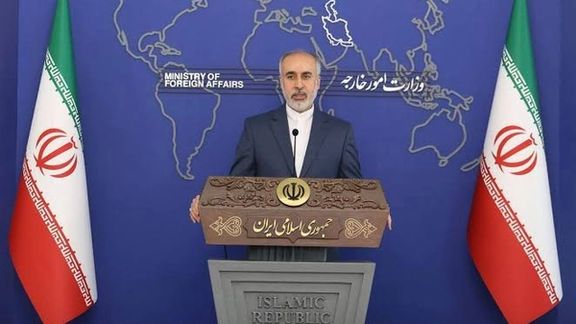
Iranian Foreign Ministry spokesman Nasser Kanaani

Iran expects a “fundamental” change of behavior by the United States before a shift in relations can occur, the spokesman of foreign ministry said on Monday.

In his weekly media briefing, spokesman Nasser Kanaani repeated the Iranian regime’s narrative of “decades of crimes” by the United States.

“Iran’s approach to America emanates from their hostile behavior, and as long as America’s behavior does not fundamentally change, it is natural that Iran’s attitude toward America remains the same,” Kanaani announced.

He was speaking in the context of improving relations with neighboring countries and reports of secret talks and even an ‘understanding’ with the United States.

The reality that Tehran and Washington have been holding mediated talks in Oman, Qatar and even having direct contacts in New York is all but certain. Numerous media reports and statements by Israeli officials have pointed to a possible unwritten deal, whereby the US would allow the release of Iran’s frozen funds in exchange for some temporary restraint in uranium enrichment.

The Biden administration has denied any such “interim deal” but few believe that some kind negotiation is not taking place behind the scenes.

Kanaani also added that Tehran does not link its foreign policy and pursuit of national interests to relations with any one country or one issue, referring to the United States and the dispute over its nuclear program.

However, Kanaani also spoke about exchanging prisoners, an issue that Washington has hinted is a subject of talks and can reduce tensions and possibly open the way for more agreements.

The Iranian spokesman said that the United States should free Iranian citizens that “the American regime has jailed based on various false excuses related to violating sanctions.” Kanaani said that US sanctions in essence are illegal, and Iran has been trying for years to free these prisoners.

From left, Siamak Namazi, Emad Shargi and Morad Tahbaz-American-hostages
100%
From left, Siamak Namazi, Emad Shargi and Morad Tahbaz

The Iranian regime is currently holding three American dual-nationals hostage based on trumped-up charges of spying and after bogus trials without due process of law. On the other hand, individuals arrested in the US for violating sanctions have received the benefits of full and transparent trials.

Kanaani claimed that in the past and in different periods certain agreements were reached with Washington through intermediaries but when it came to implementation the US was not ready to make decisions. He confirmed that currently talks are taking place with the help of parties that have “goodwill” in this regard, but “we need to see if America is ready to make decisions or not.”

Earlier this month, the Biden administration allowed Iraq to release $2.7 billion it owed Iran for energy imports – part of a larger amount in Iraqi banks. This was seen as a gesture to reach a deal on prisoners, but so far nothing has been finalized.

It is not clear if the released funds will be made available to Tehran in cash US dollars or in credits that Iran can use to import food and medicine. No details were announced about the $2.7 billion released by Iraq. South Korea holds another $7 billion and apparently the unresolved issues in prisoner exchange revolves around these funds and how Iran can access the money.

At the same time, it is perhaps inevitable that release of the frozen funds and exchange of prisoners become entangled with the nuclear issue, especially if an interim deal is being discussed.


Most Viewed

Ideology may be fading in Iran, but not in Kashmir's ‘Mini Iran'
1
INSIGHT

Ideology may be fading in Iran, but not in Kashmir's ‘Mini Iran'

2
INSIGHT

Hardliners push Hormuz ‘red line’ as US blockade tests Iran’s leverage

3
VOICES FROM IRAN

Hope and anger in Iran as fragile ceasefire persists

4

Iran International says it won’t be silenced after London arson attack

5

US sanctions oil network tied to Iranian tycoon Shamkhani

Banner
Banner

Spotlight

  • Hardliners push Hormuz ‘red line’ as US blockade tests Iran’s leverage
    INSIGHT

    Hardliners push Hormuz ‘red line’ as US blockade tests Iran’s leverage

  • Ideology may be fading in Iran, but not in Kashmir's ‘Mini Iran'
    INSIGHT

    Ideology may be fading in Iran, but not in Kashmir's ‘Mini Iran'

  • War damage amounts to $3,000 per Iranian, with blockade set to add to losses
    INSIGHT

    War damage amounts to $3,000 per Iranian, with blockade set to add to losses

  • Why the $100 billion Hormuz toll revenue is a myth
    ANALYSIS

    Why the $100 billion Hormuz toll revenue is a myth

  • US blockade targets Iran oil boom amid regional disruption
    ANALYSIS

    US blockade targets Iran oil boom amid regional disruption

  • Iran's digital economy battered by prolonged blackout
    INSIGHT

    Iran's digital economy battered by prolonged blackout

•
•
•

More Stories

Iran's Deputy Oil Minister Says Iraq Cleared Gas Debts

Jun 26, 2023, 10:00 GMT+1

Iran's deputy oil minister says Iraq has cleared its debt for gas imports but confirmed there are problems in transferring money from the Arab state.

"The Iraqi Ministry of Electricity has paid all our gas claims and this debt is now zero, but sometimes there are problems in transferring money from TBI Bank of Iraq to Iran," said Majid Chegeni on Sunday.

On June 16, the spokesperson of the US State Department confirmed the reports about the release of 2.76 million dollars of frozen assets of Iran in Iraq.

The mechanism by which the money would be released remains murky, but Washington claimed it is part of a number of humanitarian transactions which have been taking place consistently over years since the previous administration.

“Iran can only access its funds held in accounts for Iraq for humanitarian and other non-sanctionable transactions,” said Matthew Miller.

Yahya Al-e Eshaq, the head of the Iran-Iraq chamber of commerce, was quoted by local media saying the Iraqi debt is between $7 to $8 billion but only $2.7b has been agreed to be released and that part of the funds has been earmarked for pilgrims and another portion has been used to purchase basic goods.

Last Monday, Iranian lawmaker Hassan Norouzi claimed that the money will be provided to the Hajj pilgrims in forms of subsidies to buy dollars at a slightly lower rate. However, he criticized the decision, saying that the money belongs to the Iranian public.

Iran Politicians Differ On Impact Of Wagner Mutiny

Jun 25, 2023, 21:01 GMT+1
•
Iran International Newsroom

Although Iran’s official reaction to the ‘Wagner rebellion’ was cautiously supportive of Vladimir Putin, some politicians have spoken more explicitly about the event.

Ultraconservative lawmaker and former IRGC general Esmail Kowsari, who is a member of the Iranian parliament's National Security and Foreign Relations Committee is adamant that the challenge will not weaken Putin. 

Kowsari said in an interview with Didban Iran website on Sunday that what happened in Russia was the work of Western infiltrators among the Wagner group. 

"Certainly, the Westerners have their infiltrators among these forces. The West uses them to weaken the Russian front in the war against Ukraine, but this will inevitably harm the West's position."

Speaking on the impact of the Wagner rebellion on Russia's relations with Iran, Kowsari said: "The Russian army has orders from Putin to suppress the Wagner forces. The event is not likely to affect Tehran's ties with Moscow. We believe there is an easy solution for this problem and Russia is powerful enough to overcome the situation."

Ultraconservative lawmaker and former IRGC general Esmail Kowsari (undated)
100%
Ultraconservative lawmaker and former IRGC general Esmail Kowsari

Referring to the Islamic Republic's alliance with Russia, Kowsari said that this does not mean “we are depending on Russia.” However, the two countries have commitments to each other. 

In the meantime, one IRGC-linked Telegram channel, The Cyber Army of Iran, quoted Russian sources as saying on Saturday that Putin spoke over the phone with his Iranian counterpart Ebrahim Raisi but it did not elaborate on what the two spoke about. The report was not seen on any other platform and thus cannot be verified independently.

In another development, the former head of the Iranian parliament's National Security and Foreign Relations Committee, Heshmatollah Falahatpisheh, told Didban website that following Saturday's challenge by Wagner, Putin can no longer claim to be as powerful as before.

Although a conservative, Falahatpisheh is certainly not a hardliner and his foreign policy views are generally less ideological than those of politicians like Kowsari.

Falahatpisheh added that "It was naturally clear that Putin cannot have a stable future." He further remarked that "We are going back to the Yeltsin period." 

He said: "Putin has learned all the lessons but one from Maciavelli.” That is where the Italian mastermind said, military objectives cannot be pursued by mercenaries, Falahatpisheh noted. He added that when Putin started to recruit criminals for the war, one could say that it was difficult for military commanders to establish a working relationship with the recruits.

The Iranian parliament's National Security and Foreign Relations Committee, Heshmatollah Falahatpisheh (undated)
100%
The Iranian parliament's National Security and Foreign Relations Committee, Heshmatollah Falahatpisheh

Nonetheless, Falahatpisheh refused to characterize Wagner's challenge as a coup and described it as an armed mutiny. This was the description also used by Putin in his address on Saturday. 

Meanwhile, the conservative pundit advised the Iranian government not to put national interests at risk by involvement in Russia’s or Putin’s affairs. Iran can easily become a victim of Putin pursuing his own domestic interests. 

Falahatpisheh pointed out that what the IRGC-linked Telegram channel did on Saturday by voicing support for Putin was “hasty” and unnecessary.

He explained that "what is happening in Russia is the outcome of Putin's ambitious strategies and was quite foreseeable. During the past months we saw that Prigozhin started to behave aggressively, probably demanding a higher compensation for his men, and then protesting that he was not receiving enough logistical support." 

Referring to the historic precedence, Falahatpisheh said Putin might behave like the Bolsheviks did in 1917 and sacrifice his foreign policy for his country's domestic politics. He opined that Putin might be able to defeat or isolate Wagner forces in the short run. But in the long run, he is no longer the same powerful man.

Faced With Sanctions, Iran’s State Shipping Hires Foreign Vessels

Jun 25, 2023, 17:54 GMT+1
•
Iran International Newsroom

As Iranian ships face bans from international ports, the state shipping company charges the government extra money to hire foreign firms to haul cargos.

Masoud Daneshmand, member of the board of directors of the Center of Transport Institutions, told Iran's Labour News Agency (ILNA) that the main portion of the shipping company’s income is not obtained from shipment of goods, but rather from brokering cargo transportation deals between the government and foreign shipping companies.

According to him, the company -- commonly known by its business name IRISL Group – gets $50 for every ton of export and import cargoes but pays $40 to foreign firms and pockets $10 for every ton. 

His comments came a few days after the IRISL Group announced a substantial increase in its income. Mohammad Modarres Khiabani, the CEO of the company, said last week that the income of the IRISL Group has hit a new record with a 20-percent rise in revenues, without mentioning its role as an intermediary. 

Masoud Daneshmand, member of the board of directors of the Center of Transport Institutions
100%
Masoud Daneshmand, member of the board of directors of the Center of Transport Institutions

Daneshmand has not explained why the government does not directly make contracts with foreign companies and keeps the $10 difference in its coffers. 

Confirming that ports all over the world must obtain permission from the US Office of Foreign Assets Control to host Iranian ships, Daneshmand noted that most of Iran's shipping vessels are sanctioned and as a result they are inactive. 

"If a port does not receive permission from the OFAC, they will be subject to secondary sanctions,” he added, claiming that some countries like China, India and South Africa have obtained licenses to accept Iranian ships, but the permits are only for a few special governmental ports and they cannot berth in all the ports. 

Iran has been shipping oil and oil products despite US sanctions, imposed since 2018, to China and other buyers, using clandestine methods. Third parties involved in sanctions violations are subject to US punitive measures. 

According to reports by tanker tracking companies, revenue from oil exports is still the regime’s single largest source of income. Iran uses a fleet of oil tankers, known as the 'ghost fleet,' to transport its crude from the country’s ports to open seas. Then the tankers turn off their transponders so that their location would not be known, and during a couple of days the barrels of oil are loaded on other ships, which then ship them to the final buyers.

In March, the United States imposed new sanctions on Iran-linked shipping and petrochemical companies, including two shipping firms based in China.

The sanctions also targeted 20 shipping vessels linked to firms in China, Vietnam and the United Arab Emirates, the Treasury Department's website showed.

The sanctions were issued under a 2018 US executive order that restored sanctions targeting Iran's oil, banking and transportation sectors.

In 2019, OFAC issued an advisory to alert the global shipping community involved in shipping petroleum or petroleum products from Iran. “These shipments create significant sanctions risk for entities and individuals in the shipping industry, including shipping companies, vessel owners, managers, operators, insurers, and financial institutions,” read the advisory.

Only One In Five Iranians Exercise

Jun 25, 2023, 16:09 GMT+1

Amid warnings about the rise of obesity in Iran, the deputy minister of sports says only one in five Iranians exercise.

"Based on the latest numbers, only one fifth of Iranians exercise and that’s for half an hour twice a week," Sina Kalhor said on Sunday.

He claims that while in other countries, between 55 and 60 percent of people do more organized forms of exercise, he said most people in Iran consider walking the only way to be active.

One of the most important reasons for the lack of exercise in Iran is access to sports facilities and activities. According to Kalhor, less than 15% of the population in urban and suburban areas have access to such facilities.

He further warned about the obesity of three to five million students, claiming the move to online study left an epidemic of inactive and obese students in its wake.

In recent years, experts have repeatedly warned about the level of obesity in Iran. Shahab Shahabi, director of the obesity clinic of Rasool Akram hospital, said on Friday that about four million people in Iran need weight-loss surgery.

Citing the numbers by the Iranian Ministry of Health, Shahabi noted that about two-thirds of people suffer from obesity and in the last 40 years, the number of people who became obese in Iran has increased more than fivefold.


Housing Developers Leave Iran For Turkey, Georgia Amid Deteriorating Economy

Jun 25, 2023, 15:10 GMT+1

Iran's Real Estate Consultants Association says a significant number of housing developers have migrated to Turkey and Georgia, warning of the impact on the local economy.

“The more we boost the property market of foreign countries, the same amount of dollars will leave our country, and this is very dangerous for our country in the future,” Vice President of the Association, Davoud Beiginejad, said on Sunday.

The economic situation in Iran has been deteriorating for some time, with high inflation, a weak currency, and a lack of investment opportunities. Housing developers, who rely on the construction industry for their livelihood, have been hit particularly hard. With no end in sight to the economic crisis, many developers are looking for greener pastures abroad.

On the contrary, official figures in Turkey indicate a boost to the construction industry as well as rising sales of housing to foreign citizens.

Despite the strong earthquake of February this year in Turkey, which killed more than 50,000, during the first five months of this year, 16,779 residential units were sold to foreign citizens, 14 percent of whom were Iranians.

The lack of social and economic opportunities in the country has left many feeling disconnected and isolated, causing many to look for a better life elsewhere.





