• العربية
  • فارسی
Brand
  • Iran Insight
  • Politics
  • Economy
  • Analysis
  • Special Report
  • Opinion
  • Podcast
  • Iran Insight
  • Politics
  • Economy
  • Analysis
  • Special Report
  • Opinion
  • Podcast
  • Theme
  • Language
    • العربية
    • فارسی
  • Iran Insight
  • Politics
  • Economy
  • Analysis
  • Special Report
  • Opinion
  • Podcast
All rights reserved for Volant Media UK Limited
volant media logo

US, UK Navies Act As Iran Harasses Commercial Vessel
Iran International Newsroom
Jun 5, 2023, 09:23 GMT+1Updated: 17:47 GMT+1
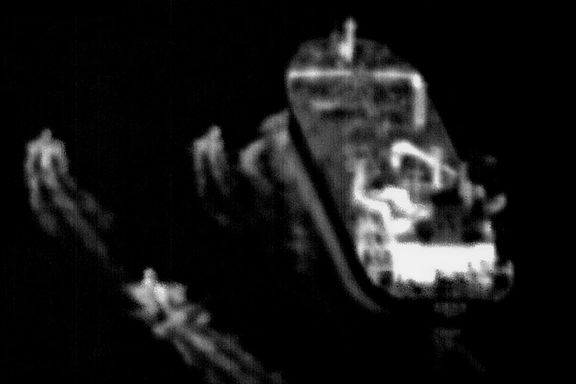
Photo issued by the US Navy showing Iranian fast-attack boats encircling the commercial ship on June 4, 2023

US and UK navies acted when a merchant ship was being harassed by Iranian forces in the Strait of Hormuz, in a sign of a more forceful policy in the Persian Gulf.

The vessel sent a distress call on June 4 while transiting the straits, a relatively narrow waterway controlled in the north by Iran but considered international waters for commercial and naval traffic.

Iran has hundreds of fast attack boats that for years not only have harassed civilian vessels but, on many occasions, have come dangerously close to US and other warships in a show of force.

“The internationally flagged merchant vessel made a radio distress call at 4:56 p.m. local time while transiting the narrow strait. The civilian crew reported three fast-attack craft with armed personnel approached and followed the merchant vessel at close distance. The fast-attack craft were assessed to be from the Iranian Islamic Revolutionary Guard Corps Navy,” a US navy statement said.

US Navy guided-missile destroyer USS McFaul and UK Royal Navy frigate HMS Lancaster both received the distress call, and Lancaster launched a helicopter to provide surveillance. US 5th Fleet also directed a P-8A Poseidon maritime patrol aircraft to monitor the scene, the Navy said.

Persian Gulf map showing the Strait of Hormuz
100%
Persian Gulf map showing the Strait of Hormuz

“The situation deescalated approximately an hour later when the merchant vessel confirmed the fast-attack craft departed the scene. The merchant ship continued transiting the Strait of Hormuz without further incident.”

It must be noted, however, that allied navies did not confront the Iranian forces, but simply "monitored" the situation. If fighter jets or attack helicopters had been dispatched, it would have sent a more forceful signal to the IRGC.

The incident followed Iran’s seizure of two commercial vessels in the Persian Gulf waters in May and an announcement by the US to send more naval forces to the region.

“[The] United States will not allow foreign or regional powers to jeopardize freedom of navigation through the Middle East waterways, including the Strait of Hormuz,” National Security Council Coordinator for Strategic Communications John Kirby told reporters on May 12, adding that there is “simply no justification” for Iranian actions to interfere, harass or attack merchant ships.

The Sunday incident also followed an announcement by the United Arab Emirates last week that it has pulled out of a US-led maritime coalition to provide security, which was later denied by the United States. However, Iran was quick to claim victory and announce that a new naval coalition is being formed with regional powers. The US also denied that claim, saying the Iranian statement “defies reason” as the Islamic Republic itself is the greatest threat to maritime security.

Sunday’s action, although not a direct naval confrontation, will reassure littoral countries that have relied on the West, and primarily on the United States, for security in the Persian Gulf.

The region contains some of the world's most important shipping routes where, in 2019, suspected Iranian attacks began against oil tankers amid tensions with the United States as the Trump administration imposed oil export sanctions on Tehran.

But Iran had long been harassing even US Navy vessels with its fast attack boat. The Obama, Trump and Biden administrations chose not to retaliate against Iranian naval provocations over the years or show a convincing military deterrent response.

As Saudi Arabia, the largest Arab power in the region shows signs of adopting a new policy of détente with Iran and close ties with China, the Biden administration feels it has to show that US security guarantees are important for the oil-rich Arab allies.

“US 5th Fleet remains vigilant and is bolstering defense around the key strait with partners to enhance regional maritime security and stability,” the US Navy said in its statement about the Sunday incident.


Most Viewed

Iran negotiators ordered to return after internal rift over Islamabad talks
1
EXCLUSIVE

Iran negotiators ordered to return after internal rift over Islamabad talks

2
ANALYSIS

US blockade enters murky phase as tankers spoof signals and buyers hesitate

3
ANALYSIS

Why the $100 billion Hormuz toll revenue is a myth

4

US tightens financial squeeze on Iran, warns banks over oil money flows

5
INSIGHT

Ideology may be fading in Iran, but not in Kashmir's ‘Mini Iran'

Banner
Banner

Spotlight

  • Hardliners push Hormuz ‘red line’ as US blockade tests Iran’s leverage
    INSIGHT

    Hardliners push Hormuz ‘red line’ as US blockade tests Iran’s leverage

  • Ideology may be fading in Iran, but not in Kashmir's ‘Mini Iran'
    INSIGHT

    Ideology may be fading in Iran, but not in Kashmir's ‘Mini Iran'

  • War damage amounts to $3,000 per Iranian, with blockade set to add to losses
    INSIGHT

    War damage amounts to $3,000 per Iranian, with blockade set to add to losses

  • Why the $100 billion Hormuz toll revenue is a myth
    ANALYSIS

    Why the $100 billion Hormuz toll revenue is a myth

  • US blockade targets Iran oil boom amid regional disruption
    ANALYSIS

    US blockade targets Iran oil boom amid regional disruption

  • Iran's digital economy battered by prolonged blackout
    INSIGHT

    Iran's digital economy battered by prolonged blackout

•
•
•

More Stories

Criticisms, Infighting Tarnish Iran Parliament’s Anniversary

Jun 5, 2023, 07:14 GMT+1
•
Iran International Newsroom

While the Islamic Republic’s parliament this week skipped marking the anniversary of its foundation, lawmakers continued their factional infighting in the media.

Mohammad Mohajeri, a conservative politician and a critic of the current all-conservative political establishment in Iran, wrote in a letter to parliamentary speaker Mohammad Bagher Ghalibaf: “Your criticism of the government stinks. It smells like an election campaign.” 

Mohajeri was referring to Ghalibaf’s statement on Tuesday night in the Northern Khorasan Province in which he criticised President Ebrahim Raisi administration, saying, “The way the country is being run and managed is wrong.” Ghalibaf further accused the Raisi administration of wasting $104 billion a year because of mismanagement. However, he did not explain where he got the figure from. 

Some observers commented that $104 is an exaggerated number, given that its twice the country’s annual budget and four times its annual oil export income.

Mohammad Mohajeri, a conservative politician (undated)
100%
Mohammad Mohajeri, a conservative politician

But Ghalibaf probably tried to jump on the bandwagon of criticism, as different factions and political institutions blame each other for the current economic mess.

The parliament speaker also faces uncertainty eight months before a new election.

Mohajeri further pointed out that had a media commentator said what you stated, he would have been sent to the court for “disturbing the public opinion and levelling accusations against the government.” He would even have been accused of speaking for the enemy, Mohajeri added. 

Mohajeri added: “For citizens who cannot afford buying fruits for their visiting grandchildren, $104 billion is a huge figure. They will divide it into 85 million (Iranian population) and will find out that the country’s managers have inflicted a loss of 1,223 dollars per Iranian. With that money an ordinary Iranian would have managed to buy fruits and many other things.”

“You probably know who the officials are who have wasted all that money. Why don’t you name a few of them? Are they at the parliament or in the government? And what about you? If you are one of them, why are you still in power? Do you want to waste another $104 billion next year?” Asked Mohajeri. 

Mohajeri added that “the members of the government keep saying on the state TV that they are the cleanest state officials in the world. If what you said is not part of your election campaign, are you brave enough to name at least one government official” who has wasted money?

Ghalibaf had said in his speech Tuesday night: “We waste $104 billion and then we beg a foreign company to come to Iran and invest only $4 billion in our oil industry. How can we explain this to coming generations?”

Meanwhile, in a statement issued to mark the anniversary of the Islamic Republic’s Parliament (Majles) the reformist National Trust Party said: “We should pay attention to the fact that Iranians have turned their backs to the polls in the last two elections (Majles election in 2020 and presidential election in 2021). We should not remain indifferent to that”.

The statement added: “The government needs to acknowledge its mistakes and make up for what it has done wrong and try to rebuild the people’s trust in the government as the chance to reform the system will not last forever.”

The National Trust Party was referring to the barring of reformists and moderates to run for those elections by the intervention of the Guardian Council, the Supreme Leaders office and the revolutionary guards (IRGC).

Critics have said that the restrictive policy has made Iranians reluctant to take part in elections and has eroded the people’s trust in the government and parliament. 

Huge Fire Breaks Out At Warehouse In Mashhad, Northeastern Iran

Jun 4, 2023, 22:00 GMT+1

A huge fire broke out on Sunday at a home appliances' warehouse in the northeast city of Mashhad in Iran, state media reported.

"Firefighters have been dispatched from different areas of the city," the official news agency IRNA said, without giving further details.

The Mashhad fire department said no casualties had been reported, while dozens of fire fighters were still working to put out the fire, the semi-official Tasnim news agency said.

In March, another large fire broke out at three warehouses of a home appliances manufacturer in the city.

There have been a number of explosions and fires near Iran’s military, nuclear and industrial facilities in recent years.

On January 28, a huge fire erupted at an Iranian military industry factory following a suspected drone strike in the central city of Esfahan.

Iran blamed Israel for the drone attack vowing revenge.

On the same day, another large blaze also engulfed an industrial area near the city of Tabriz, northwest Iran. The government said the fire started at a refinery producing motor oil.

Khamenei A Miracle Bestowed By Ruhollah Khomeini - IRGC Commander

Jun 4, 2023, 20:38 GMT+1

The deputy commander of the Revolutionary Guards says Ali Khamenei is the ‘greatest miracle’ performed by the founder of the Islamic Republic Ruhollah Khomeini.

General Mohammad-Reza Naghdi (Naqdi) said Saturday, on the anniversary of Khomei's death in 1989 that “We thank God for the blessings he gave us, including the great blessing of the leadership of Imam Khomeini.”

He claimed that with the emergence of Khomeini he ended the rule of thousands of years of oppression, slavery.

His comments come as the Islamic Republic is considered as one of the most oppressive regimes in the world that crackdowns on dissent through increased surveillance, detention, killing, torturing, censorship.

The Iranian regime has killed more than 500 people during popular protests that started in September, after the death of Mahsa Amini in hijab police custody.

“During the Pahlavi [monarchy] rule, people were living in poverty and did not have access to facilities, but with the leadership of Khomeini and under Khamenei these people are now making satellites and submarines,” added Naqdi.

Since the 1940s Iran has launched 11 plans to build infrastructure, establish key industries, expand public services and education. Five plans were launched under the monarchy until 1979, and six during the Islamic Republic. Nevertheless, Iran is still considered a developing country.

The Islamic government, built on an anti-Western ideology engaged in hostage taking and supporting militant groups from its very inception. This kept Iran isolated from advanced economies. Inefficiency of successive clerical governments during the past four decades, and many years of international sanctions that have crippled the country's economy, were added to the adverse factors.

Iran's Unsold Oil Stockpile Stands At 50M Barrels Amid Supply Glut

Jun 4, 2023, 19:43 GMT+1
•
Iran International Newsroom

Unsold Iranian oil stored on tankers and in ports is 50 million barrels as the world faces a supply glut and OPEC+ decided to keep production cuts to support prices.

Kpler, a data and analytics firm, has issues figures showing that Iran currently has 19 million barrels of gas condensate and over 30 million barrels of unsold crude oil on vessels, the Persian Service of Radio Free Europe in Prague reported. 

Mehr state news agency quoted Oil Minister Javad Owji on Friday as claiming that since Ebrahim Raisi's administration took office, the process of selling 78 million barrels of gas condensate stocked on oil tankers has started and has now reached zero.

However, figures obtained from Kpler indicate that Iran’s stockpiled condensate on tankers was 44 million barrels by the end of 2021, but it decreased to 18 million last month and now it has reached 19 million.

Meanwhile, Iran’s stocked crude oil on tankers around the Persian Gulf region has reached 30.5 million barrels, down by 16 million in the same period.

Mehr also said that some of these tankers were stranded on the waters for over three years inflicting an annual cost of 400 to 500 million dollars on the country.

A 3D-printed oil pump jack is seen in front of the OPEC logo in this illustration picture
100%

Saudi Arabia said Sunday it will make deep production cuts in July as part of a broader output-limiting OPEC+ deal as the group faces flagging oil prices and a looming supply glut.

Saudi Energy Minister Prince Abdulaziz said the cut of 1 million barrels per day (bpd) by Riyadh could be extended beyond July if needed. "This is a Saudi lollipop," he said.

OPEC+ production cuts have angered the United States and its European allies for adding to existing high global inflation.

Referring to the contract signed between Iran and Venezuela in October 2021 for the monthly export of two million barrels of gas condensate, Mehr estimated that 40% of Iran's unsold gas condensate reserves have been delivered to Venezuela. It is not clear if Caracas pays international prices for imports from Iran, but in the past, there have been reports of gold deliveries to Iran for fuel purchases.

However, figures by Kpler reveal that since October 2021, a total of nearly 28 million barrels of Iranian gas condensate have been delivered to Venezuela.

Kpler's figures also show that Iran has not had a new shipment of gas condensate to Venezuela in the past three months.

Iran's oil exports in recent months - mostly to China - have exceeded one million barrels according to some industry sources, but its financial condition deteriorates as it is not clear how much hard currency it earns.

OPEC+, which groups the Organization of the Petroleum Exporting Countries and allies led by Russia, reached a deal on output policy after seven hours of talks and decided to reduce overall production targets from 2024 by a further total of 1.4 million barrels per day.

However, many of these reductions will not be real as the group lowered the targets for Russia, Nigeria and Angola to bring them into line with their actual current production levels.

By contrast, the United Arab Emirates was allowed to raise output.

OPEC+ pumps around 40% of the world's crude, meaning its policy decisions can have a major impact on oil prices.

OPEC+ already has in place a cut of 2 million bpd agreed last year and amounting to 2 percent of global demand.

With reporting by Reuters

Iran’s Imports Show 57% Jump Compared To Last Year

Jun 4, 2023, 19:38 GMT+1

The figures by Iran’s Chamber of Commerce indicate a 57% jump in the country's imports in the month of May this year compared to the same period last year.

According to the latest report by the chamber, Iran imported $4.9 billion worth of goods last month with China, the UAE, Turkey, Germany and Russia as the largest exporters to the country.

Last month, the non-oil export was worth $3.8 billion, which shows a growth of 6.1%.

Therefore, in the month of May, the non-oil trade balance of Iran was estimated to be negative 1.1 billion dollars.

A large part of what the Islamic Republic call "non-oil" exports are actually crude oil products.

Customs data show that in the first two months of the current Iranian year-- which began on March 21 -- five main exported items of the country were propane, liquefied natural gas, butane, methanol and bitumen.

Among the imported goods, corn, smart phones, soybeans, car parts, and rice accounted for 15% of the country's total imports.

Last year, the country's non-oil trade balance was negative. It means that the exports were 53 billion dollars while the imports were nearly 60 billion dollars.

For several years in a row, the country's imports exceeded the non-oil exports.