• العربية
  • فارسی
Brand
  • Iran Insight
  • Politics
  • Economy
  • Analysis
  • Special Report
  • Opinion
  • Podcast
  • Iran Insight
  • Politics
  • Economy
  • Analysis
  • Special Report
  • Opinion
  • Podcast
  • Theme
  • Language
    • العربية
    • فارسی
  • Iran Insight
  • Politics
  • Economy
  • Analysis
  • Special Report
  • Opinion
  • Podcast
All rights reserved for Volant Media UK Limited
volant media logo

US And Israel Continue To Wrangle Over Iran
Iran International Newsroom
Jun 2, 2023, 11:26 GMT+1Updated: 17:43 GMT+1
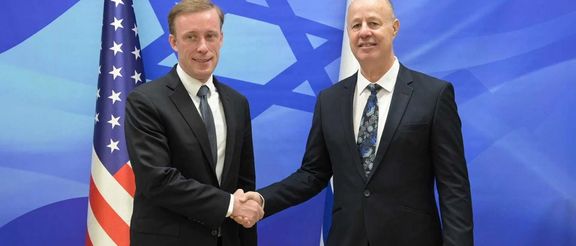
US National Security Adviser Jake Sullivan and counterpart Tzachi Hanegbi In January, 2023

Top US and Israeli national security officials met in Washington Thursday and discussed “enhanced coordination” to prevent Iran from acquiring a nuclear weapon.

Assistant to the President for National Security Affairs Jake Sullivan hosted Israeli National Security Advisor Tzachi Hanegbi and Minister of Strategic Affairs Ron Dermer at the White House to continue high-level discussions following up on the March US-Israeli Strategic Consultative group that had focused on Iran’s nuclear program and “ways to counter threats from Iran and its proxies.”

The meeting followed reports and speculations in recent days that Washington was discussing some possible deals with Iran to secure the freedom of American hostages in Tehran in exchange for expediting the release of Iranian funds frozen in South Korea and Iraq.

A State Department official Thursday told Iran International that US policy has not changed in regard with Iran’s nuclear program and President Joe Biden is “fully committed” not to ever allow Iran to acquire nuclear weapons. The official said that the United States “in full coordination with its allies and partners” is preparing all options to deal with Iran’s nuclear program.

However, the spokesperson reiterated that the administration continues to believe in diplomacy as the best way to achieve this goal, although talks to revive the JCPOA accord are not on Washington’s agenda.

However, the state of US-Israeli relations might not be so clear. Israel’s Channel 13 television reported that US Secretary of State Antony Blinken has called off a planned visit to Israel next week amid tensions between Jerusalem and Washington over Iran.

US Secretary of State Antony Blinken and Israeli Prime Minister Benjamin Netanyahu shake hands during a press conference, on January 30, 2023 in Jerusalem.
100%
US Secretary of State Antony Blinken and Israeli Prime Minister Benjamin Netanyahu shake hands during a press conference, on January 30, 2023 in Jerusalem.

At the same time, Blinken after a meeting with British, French and German foreign ministers tweeted that “I also underscored U.S. concerns about Iran’s nuclear escalation.”

Israeli Prime Minister Benjamin Netanyahu separately in a video message said, "I have heard all of the reports about Iran. I have a sharp and clear message for both Iran and the international community: Israel will do whatever it needs to do to prevent Iran from obtaining nuclear weapons."

Clearly, Israel is demanding tougher responses to continued Iranian nuclear build-up. Whether Jerusalem is insisting on a military attack at this point is not clear, but tougher diplomatic and economic measures are certainly among its demands from Washington.

UN’s nuclear watchdog, the International Atomic Energy Agency, IAEA, issued a report to its members states this week that reportedly said Iran now has 114 kilograms of uranium enriched to up to 60-percent – an increase of 26.6 kg from the previous quarter. This can be easily further enriched to 90-percent purity needed for nuclear weapons in around two weeks.

The IAEA also reported that Iran has shown some flexibility regarding the Agency’s demands. This could be an effort by Tehran to forestall censure at the IAEA board meeting this month. One of Israel’s demands might be a strong condemnation of the Islamic Republic by the board.

About 42 kg of uranium enriched to 60-percent is what the IAEA calls a "significant quantity", defined as "the approximate amount of nuclear material for which the possibility of manufacturing a nuclear explosive device cannot be excluded".

Although Washington says there is no evidence that Iran has decided to proceed and build a weapon, in testimony to Congress in March, Gen. Marky Milley, chairman of the Joint Chiefs of staff, warned that Tehran could “field” a bomb in several weeks, if it made the crucial decision.


Most Viewed

State media slam Araghchi's Hormuz tweet, say it let Trump claim victory
1

State media slam Araghchi's Hormuz tweet, say it let Trump claim victory

2

Iran International says it won’t be silenced after London arson attack

3
INSIGHT

How Tehran bends its own red lines to boost state rallies

4
VOICES FROM IRAN

Hope and anger in Iran as fragile ceasefire persists

5

Iran halts petrochemical exports to supply domestic market

Banner
Banner

Spotlight

  • Too early to tell who is winning Iran war, experts say
    PODCAST

    Too early to tell who is winning Iran war, experts say

  • How Tehran bends its own red lines to boost state rallies
    INSIGHT

    How Tehran bends its own red lines to boost state rallies

  • Iran blackout cripples freelancer, small business incomes
    VOICES FROM IRAN

    Iran blackout cripples freelancer, small business incomes

  • Ideology may be fading in Iran, but not in Kashmir's ‘Mini Iran'
    INSIGHT

    Ideology may be fading in Iran, but not in Kashmir's ‘Mini Iran'

  • US blockade enters murky phase as tankers spoof signals and buyers hesitate
    ANALYSIS

    US blockade enters murky phase as tankers spoof signals and buyers hesitate

  • Why the $100 billion Hormuz toll revenue is a myth
    ANALYSIS

    Why the $100 billion Hormuz toll revenue is a myth

•
•
•

More Stories

US State Department Providing VPNs For Iranians

Jun 2, 2023, 08:31 GMT+1

The US State Department says Washington has been providing VPNs to Iranians for access to the internet, especially since protests began in September 2022.

A State Department official briefed the media on Thursday saying that 30 million Iranians regularly use anti-censorship tools, including VPNs funded by the State Department.

Over the past years, the State Department has been funding a wide range of anti-censorship tools for the people who live in countries without free access to the internet, the US official explained.

Since the beginning of Iran’s September 2022 protests, the number of people using these tools inside Iran has risen exponentially and reached 30 million, roughly half of the adult population.

However, the official added that using these tools costs around 10 cents per user per month and currently the State Department is planning to increase the budget to continue providing this service.

Iran has been restricting and censoring the Internet since 2002, but using different techniques to deny access to users have surged during anti-regime protests.

The US Treasury Department expanded the range of internet services available to Iranians in the early days of the nationwide protests Iran following the death of 22-year-old Mahsa Amini in hijab police custody.

In October 2022, a bipartisan and bicameral group of US lawmakers urged Google, Amazon, Meta and other tech companies to facilitate access to online tools for Iranian protesters.

Internet restrictions and the use of anti-filtering tools have surged in Iran since protests began. Iranian hardliners push for restrictions to remain in place as long as street protests continue. Amid the heightened restrictions on Internet access, Iranians’ use of VPNs has risen over 3,000 percent in recent months.

Pundits Say Iran Is In A 'Quagmire' Where People Struggle To Survive

Jun 2, 2023, 07:47 GMT+1
•
Iran International Newsroom

A reformist figure widely known in Iran as a regime apologist has acknowledged that the Islamic Republic is entangled in a quagmire of problems and crises. 

At the same time, an Iranian academic has asserted that "ideology" is the root cause of the country's problems. 

Hamid Reza Jalaipour told Entemad Online website that Iran is currently entangled in a web of crises as most Iranians see no promising prospect for the country's future. "The elites are thinking of leaving the country for good. The youths evade marriage and those who are married do not want to have children as many are affected by widespread poverty," said Jalaipour. 

According to the politician, the Islamic Republic is facing all sorts of financial, environmental, social and international crises, which it is not capable of resolving. The government has failed to hold free and fair elections. On the other hand, the people have not managed to convince the government through their protests that its strategic policies are wrong, he said. 

Jalaipour added: "The government is in a political impasse and the people are painfully struggling to find a way out. It is as though the regime is holding a grudge against the people. As a result, society is in a state of political suspension." 

Iranian academic Hamid-Reza Jalaipour (undated)
100%
Iranian academic Hamid-Reza Jalaipour

He added that in the meantime, four different political narratives are being furthered in Iran by different groups. However, none of them is powerful enough to confront the country's crises. 

The first narrative is one of "unified government" or consolidation of power by limiting elections to contests among conservatives and restricting reformists and moderates' political participation. This was pushed through by hardliners in the past 3 years and has failed, angering the people. 

The next narrative is about bringing "reforms." This requires a free and fair electoral system which is non-existent in Iran. 

However, Jalaipour failed to say why real elections have not been allowed, probably because he did not want to annoy the Supreme Leader Ali Khamenei and Revolutionary Guards, who have been ‘engineering elections in Iran at least since 2005. 

The third narrative is one of "transition" from the current system by holding a referendum on key issues, and the fourth narrative is "regime change." The regime strictly rules out the idea of transition and is prepared to shed blood to prevent regime change. Jalaipoir insisted that none of these four narratives are able to solve the country's problems. The only solution is empowering the middle class. However, he stated that the economic crisis during the past decade has left no middle class as most sociologists and economists maintain. 

Iranian academic Mahmoud Jamsaz (undated)
100%
Iranian academic Mahmoud Jamsaz

Meanwhile, Iranian academic Mahmoud Jamsaz told Rouydad24 website in Tehran that Iran's chaotic economy which is based on giving concessions to well-connected individuals and is alien to the idea of development. He maintained that the root cause of Iran's problems is the ideological political system, which has effectively ruined the country's economy and international relations. This system, said Jamsaz, is against economic development as it does not serve the interests of the privileged few.

According to Jamsaz, the country is struggling in a quagmire created by rising inflation. It is interesting that both Jalaipour and Jamsaz likened the country's situation to a quagmire in which Iranians struggle for survival.

Jamzas said: "The quagmire is deeper and more turbulent in the areas of financial matters and housing. The annual inflation figures are unbelievable, but still many Iranians believe that actual inflation is way higher than the figures announced by the government. Even the government's own Planning and Budget Organization questions the validity of those figures."

He said, "one of the main problems of Iran's economy is that it is at the service of the government and is meant to serve the ideological interests of the regime. So, the government prefers its ideological interests to national interests." He added that the government is constantly deceiving itself to justify its wrong policies. In such a situation, even the revival of the JCPOA and lifting of the sanctions cannot resolve the crisis. He reiterated: "Ideology cannot solve the country's problems because ideology is the problem."

Record 142 Iranian Prisoners Executed In May

Jun 1, 2023, 22:12 GMT+1
•
Iran International Newsroom

A Norway-based human rights group says Iran executed 142 prisoners in May, hitting a dark record even for the Islamic Republic.

The Oslo-based Iran Human Rights Organization announced in its latest report on Thursday that the figure is the highest monthly executions since 2015, averaging five people hanged each day across the country during May.

According to the report, the regime has executed at least 307 people in the first five months of 2023, indicating a 76-percent year on year rise.

In addition to the first public execution of the year, 78 people were executed for drug-related charges, about 30 of whom were from the Baluch minority, perhaps the most persecuted community in Iran.

According to the data collected by the IHR, 59 percent – or 180 people -- of the 307 executions so far in 2023 were hanged over drug-related charges.

“As well as increasing drug-related executions, the Islamic Republic has also expanded the scope of charges it uses to carry out the death penalty by executing two people for blasphemy charges and one for adultery,” added the report.

The group reiterated warnings about the escalation of executions, calling on the international community “to stop the Islamic Republic’s killing machine with a strong reaction and practical punitive steps.”

IHR Director Mahmood Amiry-Moghaddam (undated)
100%
IHR Director Mahmood Amiry-Moghaddam

IHR Director Mahmood Amiry-Moghaddam told Iran International, “The purpose of the Islamic Republic’s intensification of arbitrary executions is to spread fear in society to intimidate people against holding further protests, thus prolonging its rule.”

He added that “if the international community doesn’t show a stronger reaction to the current wave of executions, hundreds more will fall victim to their killing machine in the coming months.”

Amiry-Moghaddam noted that the figures announced by the group are likely much lower than the real number of executions due to the secretive nature of the regime.

He noted that the Islamic Republic is not executing people to fight crime but to guarantee its rule as the regime is facing the boldest challenge it has ever faced since its establishment. “We are talking about a regime struggling with one of its biggest crises ever; it cannot solve the problems therefore it has to intimidate people to prevent further protests, and execution is the biggest tool for intimidation” he said.

Parastou Fatemi, a human rights expert, also believes that the rise in executions is a tactic to push back protesters from streets to their homes, saying that whenever the regime faces street protests, it expedites the execution processes to instigate fear among people. 

On Monday, Islamic Republic Judiciary Chief Gholamhossein Mohseni Ejei defended the hanging of protesters, saying "The [death] sentences of those [protesters] who were/are supposed to be executed for their crimes during the riots have either been or will be carried out without any consideration.”

The Islamic Republic has intensified its killing trend in recent weeks, fueling further protests across the country. At least 259 Iranians have been executed since January alone, according to the United Nations.

Amid a spike in executions since late April, on May 19, authorities arbitrarily executed three tortured protesters, Majid Kazemi, Saeed Yaghoubi and Saleh Mirhashemi who were unjustly convicted and sentenced to death in Isfahan (Esfahan).

The deaths brought to at least seven the number of protesters hanged since nationwide protests broke out in September 2022 following the death in custody of 22-year-old Mahsa Amini. The unrest posed the biggest internal challenge to the Islamic Republic since its establishment in 1979.

Earlier in March, Amnesty International said at least seven individuals in Iran face the death sentence in connection with protests, while dozens of others are at risk of being sentenced to death.

So far, around 750 civilians have been killed by security forces and at least 30,000 arrested. While many have been released, around 1,500 face criminal charges, and at least 80 detainees face the death sentence for the “moharebeh” and “corruption on earth”, Islamic-Arabic terms meaning to go against the will of God. Both carry the death penalty.

Iran Claims Diplomats Visited Women's Prison

Jun 1, 2023, 22:01 GMT+1

Iran’s judiciary says diplomats from 28 countries and representatives of international organizations have visited the women's ward at the notorious Gharchak (Qarchak) Prison south of Tehran.

Mizan, the Judiciary News Agency, reported Thursday that a delegation of 36 diplomats visited the penitentiary on Wednesday without citing the names of either the organizations or countries represented.

The visit comes about a month after the transfer of political prisoners from the prison and a few days after several detained female protesters revealed sexual assaults in Gharchak and Evin prisons.

"The women's penitentiary was chosen so that foreign guests can see the unique and diverse services and facilities for female inmates and get a correct understanding of the principles of Islamic prisons," claimed Kazem Gharibabadi, Secretary of Iran's High Council for Human Rights.

Pointing out that about 700 women are incarcerated in Gharchak prison, Gharibabadi claimed that women make up about 2.5% of Iran's prison population, which indicates "a very low rate of crime among Iranian women compared to the global rate."

In the past few days, several Iranian female political activists have spoken up about prison guards forcing them to strip naked, even in front of cameras, to humiliate them. Others have spoken of full sexual assault and rape. 

Anti-compulsory hijab activist, Mozhgan Keshavarz, told Iran International that she was first strip-searched after her arrest in April 2019 and detention at Vozara Detention Center in Tehran where the 22-year-old Mahsa Amini died in custody on September 16 last year.

Since her revelations, other female activists including Zeynab Zaman, Nasibeh Shamsaei, Shaparak Shajarizadeh and actress Mahnaz Afshar who were subjected to the same humiliation have also come forward with their stories.

Iranian Banks Keep Foreign Currency From Oil Revenues – Leaked Document

Jun 1, 2023, 18:35 GMT+1
•
Iran International Newsroom

Documents obtained from a hack into servers of Iran's president office revealed that €3.6 billion worth of oil revenues remained in banks and not entered the government’s systems.

According to a confidential report by the Islamic Republic’s Intelligence Ministry, leaked by the hacktivist group ‘Uprising till Overthrow,' banks kept currencies they received from government entities exporting oil and did not transfer them to the country’s special currency scheme known as NIMA.

NIMA is set up for foreign currencies to be sold at a lower rate by exporters and for importers to buy what they need at the same low rate to finance their purchases from other countries. However, only traders with connections to the regime can use the system to their advantage, and ordinary businesspeople would not be allowed to use such benefits. The official rate at NIMA is at least 40 percent lower than in the foreign currency free market.

The document released after the hack is a list of oil revenues in deposit account balances of 11 Iranian banks for about a six-month time span ending on May 9, 2023. The total balance with the banks stood at the equivalent of €3.27 to €3.6 billion in the period.

The document also provided some sort of analysis for the reasons behind the issue and proposals to solve it. According to the ministry, the main reason the banks refrained from injecting the foreign currency into the NIMA system is its low exchange rate, which is way below the open market. It added that the regulatory bodies are not able to push the banks to sell the foreign currencies according to a timetable that suits the government and not the banks, which do not seem to be in a hurry to exchange the currencies in the NIMA system.

A page of the leaked document (May 2023)
100%
A page of the leaked document

A point that is buried in the document is that the major portion of the money earned from oil exports are in Chinese Yuan because Chinese firms – particularly Chinese teapot refineries – are currently the main importers of Iran’s crude. And Yuan cannot be sold in the Iranian currency market like hard currencies such as the dollar and the euro.

Dalga Khatinoglu, an expert in Iran oil and energy issues, told Iran International that the foreign currencies offered in NIMA are mainly in Chinese Yuan, followed by smaller amounts in United Arab Emirates’ dirham, Kuwait’s dinar, Turkish lira and Russian ruble.

The analyst believes that the money has remained in the banks and cannot be used by the government because yuan does not have a lot of buyers in the market and the banks prefer to keep the funds in yuan instead of exchanging them with the national currency which has been losing most of its value.

The Iranian currency has been on a freefall since early 2018, when it became apparent that then-president Donald Trump would withdraw the US from the 2015 nuclear deal, the Joint Comprehensive Plan of Action (JCPOA), and impose sanctions on Iran. Under ‘maximum pressure’ Washington threatens to sanction third parties buying Iranian oil or dealing with its financial sector, which has deprived Tehran of foreign-currency revenues.

The leaked document did not explicitly mention the oil exporters but in recent years the government tends to issue permits for state organizations and the Revolutionary Guard to get oil from the country’s refineries and export it however they can. Then they can use the revenues to boost their budgets.

According to the document, the process of selling oil and extracting the revenues is very murky and the government, particularly the Central Bank of Iran, should devise plans to make the transactions clearer. The Central Bank should have tighter control over the amount of exported oil and the revenues from it and identify the exporters who refuse to sell the foreign currencies they earn in the NIMA system, the leaked document said.

The hacktivist group ‘Uprising till Overthrow' claimed on May 29 that it breached 120 servers at the presidential office, getting access to internal communications, meetings minutes, President Ebrahims Raisi’s online conference platforms and about 1,300 computers inside the office.

In the new cyberattack, the group is said to have gained access to “tens of thousands confidential documents” but is releasing them in daily batches.

Earlier in May, the group, affiliated with the Albania-based opposition Mojahedin-e-Khalq (MEK) group -- People's Mojahedin Organization of Iran, hacked into the Islamic Republic’s foreign ministry servers, disabling 210 sites and online services and leaking another large batch of documents.






