• العربية
  • فارسی
Brand
  • Iran Insight
  • Politics
  • Economy
  • Analysis
  • Special Report
  • Opinion
  • Podcast
  • Iran Insight
  • Politics
  • Economy
  • Analysis
  • Special Report
  • Opinion
  • Podcast
  • Theme
  • Language
    • العربية
    • فارسی
  • Iran Insight
  • Politics
  • Economy
  • Analysis
  • Special Report
  • Opinion
  • Podcast
All rights reserved for Volant Media UK Limited
volant media logo

'We Execute Those We Should' Says Iran’s Unflinching Judiciary
Iran International Newsroom
May 31, 2023, 16:49 GMT+1Updated: 17:55 GMT+1
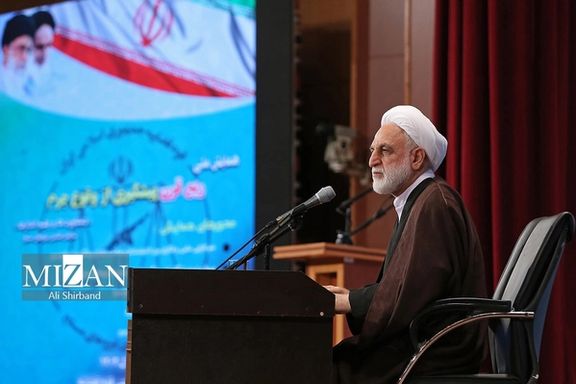
Islamic Republic Judiciary Chief Gholamhossein Mohseni Ejei on May 31, 2023

Amid global outrage over Iran's execution machine, the regime’s chief justice has defended the hanging of protesters, vowing to continue its killing spree.

Islamic Republic Judiciary Chief Gholamhossein Mohseni Ejei said Tuesday "The [death] sentences of those [protesters] who were/are supposed to be executed for their crimes during the riots have either been or will be carried out without any consideration while ensuring full observance of legal procedures, justice and fairness."

Emphasizing that the sentences will be implemented “without any delay,” he also defiantly called on security and intelligence agencies to arrest women who are flouting mandatory hijab rules and to hand them over to the judicial authorities for “severe punishment.”

Accusing protesters and those unveiling in public of being connected to “the enemies,” Ejei emphatically vowed: “Be sure that these elements will be severely punished.”

In the Islamic Republic's jargon "enemy" is used to refer primarily to the United States and Israel, and sometimes to their allies, and recently every entity and individual who has expressed support for the current wave of anti regime protests.

“The enemies are trying to create a divide in our society by psychological operations and bombarding the minds of young people and by taking advantage of some existing weaknesses,” the chief justice said, claiming these 'enemies' are trying to divide Iranian society.

Since the early weeks of the nationwide protests ignited by the death of 22-year-old Mahsa Amini by hijab or ‘morality’ police in September, the staunch regime mouthpiece has repeatedly ordered judges to issue tough sentences to protesters and those flouting regime diktat.

"I have instructed our judges to avoid showing unnecessary sympathy to main elements of these riots and issue tough sentences for them while separating the less guilty people," he said in October. In April, he warned of strict punishment for women flouting hijab rules.

Following the death of Amini for "improper hijab," a growing number of women have been ditching their veils in public, risking arrest by defying hijab laws in public places such as streets, malls, shops, banks, cafes, and even airports with videos and photos surfacing online everyday describing scenes with women casting off their headscarves as the new normal in Iran.

The Islamic Republic has intensified its killing trend in recent weeks, fueling further protests across the country. At least 259 Iranians have been executed since January alone, according to the United Nations.

Majid Kazemi, Saleh Mirhashemi, and Saeed Yaqoubi (file photo)
100%

Amid a spike in executions since late April, on May 19, authorities arbitrarily executed three tortured protesters, Majid Kazemi, Saeed Yaghoubi and Saleh Mirhashemi who were unjustly convicted and sentenced to death in Isfahan (Esfahan).

The deaths brought to at least seven the number of protesters hanged since nationwide protests broke out in September 2022 following the death in custody of 22-year-old Mahsa Amini. The unrest posed the biggest internal challenge to the Islamic Republic since its establishment in 1979.

Earlier in March, Amnesty International said at least seven individuals in Iran face the death sentence in connection with protests, while dozens of others are at risk of being sentenced to death.

So far, around 750 civilians have been killed by security forces and at least 30,000 arrested. While many have been released, around 1,500 face criminal charges, and at least 80 detainees face the death sentence for the “moharebeh” and “corruption on earth”, Islamic-Arabic terms meaning to go against the will of God. Both carries the death penalty.


Most Viewed

State media slam Araghchi's Hormuz tweet, say it let Trump claim victory
1

State media slam Araghchi's Hormuz tweet, say it let Trump claim victory

2

Iran International says it won’t be silenced after London arson attack

3
INSIGHT

How Tehran bends its own red lines to boost state rallies

4
VOICES FROM IRAN

Hope and anger in Iran as fragile ceasefire persists

5

Iran halts petrochemical exports to supply domestic market

Banner
Banner

Spotlight

  • Too early to tell who is winning Iran war, experts say
    PODCAST

    Too early to tell who is winning Iran war, experts say

  • How Tehran bends its own red lines to boost state rallies
    INSIGHT

    How Tehran bends its own red lines to boost state rallies

  • Iran blackout cripples freelancer, small business incomes
    VOICES FROM IRAN

    Iran blackout cripples freelancer, small business incomes

  • Ideology may be fading in Iran, but not in Kashmir's ‘Mini Iran'
    INSIGHT

    Ideology may be fading in Iran, but not in Kashmir's ‘Mini Iran'

  • US blockade enters murky phase as tankers spoof signals and buyers hesitate
    ANALYSIS

    US blockade enters murky phase as tankers spoof signals and buyers hesitate

  • Why the $100 billion Hormuz toll revenue is a myth
    ANALYSIS

    Why the $100 billion Hormuz toll revenue is a myth

•
•
•

More Stories

Activist Groups Slam Appointment Of Iran As Chair Of UNHRC Social Forum

May 31, 2023, 14:43 GMT+1

Twenty-six Iranian rights groups expressed fury over the appointment of the Islamic Republic as the chair of the UN Human Rights Council 2023 Social Forum.

A group of doctors, lawyers and civil activists such as the Kian Foundation and the Simourq Association are among the signatories to the letter to Vaclav Balek, the head of the UN Human Rights Council for 2023.

They defiantly condemned the appointment of Iran's UN ambassador Ali Bahraini as the forum’s chair after Vaclav Balek said in a statement earlier this month that he had decided to appoint Bahraini following the receipt of a nomination from regional coordinators.

The forum to be held in Geneva on November 2 and 3 will focus on the contribution of science, technology, and innovation to the promotion of human rights including in the context of post-pandemic recovery.

In their letter, the signatories stated that according to the UN Special Rapporteur on human rights in Iran, the violence of the security forces of the Islamic Republic during the nationwide protests led to the death of hundreds, including dozens of children and women, while hundreds of other protesters were seriously injured, and thousands were arrested.

Earlier, UN Watch launched a petition to the UN Secretary General Antonio Guterres to stop the Islamic Republic from chairing the forum and said there were still six months left to cancel the appointment.

The Islamic Republic was also voted out of the UN Commission on the Status of Women (CSW) in December for policies contrary to the rights of women and girls. It is in addition, also investigating rights abuses in Iran in a special committee, while simultaneously allowing the regime to chair a key rights event.


Female Activists Speak Up About Forced Stripping In Prisons

May 31, 2023, 07:34 GMT+1
•
Maryam Sinaiee

Several Iranian female political activists have spoken up about prison guards unnecessarily forcing them to strip naked, even in front of cameras, to humiliate them.

Anti-compulsory hijab activist, Mozhgan Keshavarz, who was the first to raise the humiliating stirp search of female detainees, told Iran International Monday via video conference that she was first strip-searched after her arrest in April 2019 and detention at Vozara Detention Center in Tehran where the 22-year-old Mahsa Amini died in custody on September 16 last year.

Keshavarz said the search took place in front of a camera and was repeated when she was taken to Qarchak Prison for women, and then at a Revolutionary Guards (IRGC) detention center where she was photographed completely naked and was told the photos were taken to add to her case file to make sure she would not later claim she was tortured during her detention.

At the IRGC detention center she was held in a solitary cell where she had to sleep on the carpet-covered ground and to shower and use the toilet in front of the camera in the cell.

“I had to wash my body with my clothes on,” she said, adding that she does not think the feelings of humiliation and shame she felt would ever go way. “I’m not the same Mozhgan that I was who always laughed.”

Keshavarz was assaulted by one of her interrogators there and her neck tendon was broken which required surgery. She was finally allowed to go on medical furlough in 2021 and was conditionally freed later. She is currently living in hiding as the IRGC has issued another arrest warrant for her.

Dissident and political prisoner Mozhgan Keshavarz. Undated
100%
Dissident and political prisoner Mozhgan Keshavarz

Keshavarz was arrested with two other activists for offering white roses to women on a Tehran metro train, the International Women’s Day, and asking them to support anti-compulsory hijab activists.

She was later sentenced by a revolutionary court to a total of twenty-three years and six months -- five years for “assembly and collusion for acting against national security”, one year for “propaganda against the regime”, ten-years for “encouraging moral corruption” and seven years and six months for “insulting sanctities”—but the sentence was later reduced to twelve years and seven months after appeal.

Keshavarz’s story was first shared with the public through the Twitter account of the Me-too-Movement-Iran on Saturday. She told Iran International that she only wanted to share her feelings with others but soon found out that what happened to her is a routine practice in prisons and many other activists have had the same experience.

Since her revelations, other female activists including Zeynab Zaman, Shaparak Shajarizadeh and actress Mahnaz Afshar who were subjected to same humiliation have also come forward with their stories.

In a series of tweets Sunday, former political prisoner Nasibeh Shamsaei said she was forced to fully strip in front of prison cameras at a ward run by the Revolutionary Guards (IRGC) at Evin Prison of Tehran and again at Qarchak Prison for women.

“I was forced to do this three times. I was told to strip in a cell measuring two by one and a half meters at A2 Ward of the IRGC at Evin Prison with a camera above my head and I didn’t know who was watching… She made me squat and get up twice under the pretext that she wanted to make sure I hadn’t hidden anything in my vagina. The same thing happened when I arrived at Qarchak and once again after an in-person visit,” she wrote.

According to Shamsaei women were forced into such humiliating search even if they were having their periods. “After the in-person visit she forced me into it when I was having my period.”

Hardliners In Iran Dismiss Government Hijab Bill, Demand Harsher Approach

May 30, 2023, 18:57 GMT+1
•
Iran International Newsroom

Heated debates over a new bill about how to deal with women who refuse to observe compulsory hijab continues inside and outside the Iranian parliament.

The bill is not forceful enough for hardliners, because it bans religious conservatives from confronting women who don’t cover their heads. The bill mainly relies on cash fines to force women to wear the hijab.

Part of the regime in Tehran fears strict and forceful enforcement of hijab might trigger another round of protests, similar to last September when a 22-year-old woman died after her injuries in ‘morality police’ custody. 

While some hardliners demand harsh treatment of bad-hijab women, Vice President for Legal Affairs Mohammad Dehghan told reporters in Tehran on Monday: "We wish to avoid making hijab a pretext for further deepening divides and disputes in the country." He added: "We are thinking of using the issue as a basis to bring about national solidarity."

Vice President for Legal Affairs Mohammad Dehghan (undated)
100%
Vice President for Legal Affairs Mohammad Dehghan

Dehghan said that the current bill, which has been criticized by some hardliners as being focused on levying monetary penalties rather than confronting women in the streets, has been prepared by the Judiciary and the administration has simply tried not to change it dramatically. 

Referring to the criticisms, Dehghan said, "After the recent protests which were organized by foreigners, the issue of hijab must be dealt with a more comprehensive approach." He probably meant that the government needs to take a pragmatic stance to avoid further unrest. He reiterated that the government believes in "a cultural approach" to the issue.

Dehghan, however, made it clear that the government agrees that celebrities who promote the idea of "hijablessness" should be dealt with legal prosecution. He added that the security forces will deal with those who promote anti-hijab ideas based on foreign views. In other cases, law enforcement will simply advise women to observe the hijab. If they accept the guidance, then that is all, but if they insist to defy the hijab, they will be fined. 

Lawmaker Jalal Rashidi Koochi (undated)
100%
Lawmaker Jalal Rashidi Koochi

One of the staunch critics of the hijab bill happens to be President Ebrahim Raisi's father-in-law Ahmad Alamolhoda, the Friday prayers Imam of Mashhad. Lawmaker Jalal Rashidi Koochi quipped that Raisi should take back the hijab bill from the Majles and hand it over to Alamolhoda for further review before giving it back to the parliament. 

Koochi charged that "the bill in its current form is all about arresting and fining women. If Alamolhoda wishes to make any change in the bill, he should not criticize the parliament as he did. He should instead address his complaints to his son-in-law Raisi." Alamolhoda had earlier called on the Majles not to ratify the bill as it will promote lack of hijab.

Koochi however criticized the bill for lacking any provision that would encourage women to observe the hijab. "The bill is mainly about if you do this, you have to pay this amount," Kooch said. 

During the past week, many conservatives and hardliners harshly criticized the bill. The hardline editor of Kayhan daily Hossein Shariatmadari said "It is funny that the police is only allowed to send text messages to women telling them that they have been seen without headscarf. This bill cannot enforce the hijab."

Former Deputy Judiciary Chief Mohammad Javad Larijani said: "If someone sees a naked woman standing behind the window, he should have the right to call the police." Meanwhile, responding to Iranian politicians who have called for holding a referendum about hijab, Larijani said that this will violate the Constitution of the Islamic Republic. 

Lawmaker Mohammad-Taghi Naghdali (undated)
100%
Lawmaker Mohammad-Taghi Naghdali

Lawmaker Mohammad-Taghi Naghdali, the secretary of the parliament's legal committee, in a video that quickly went viral suggested harsh punishments including lashes and deprivation from social rights as well as heavy fines for women who refuse to wear the compulsory hijab. 

Calls for harsher punishments than what is called for in the hijab bill continue by seminary clerics, Friday Prayer Imams and other hardliners in various parts of the country, while the number of women defying hijab has been on the rise in the streets during the past 8 months since the start of Women, Life, Freedom movement in Iran, despite the official ban on the entry of hijabless women to academic centers and administrative buildings and even subway stations. 

Interior Minister Blasts UN Fact-Finding Mission As War Against Iran

May 30, 2023, 18:11 GMT+1

Iran’s Minister of Interior has rebuffed the UN fact finding mission on Iran calling it a media war against the regime.

Speaking at an ambassadorial meeting, Ahmad Vahidi said: “The enemy has created an unrealistic image of Iran in the minds of people in all parts of the world using its mainstream media.”

In spite of the deaths of around 750 civilians and arrest of 30,000 more, he claimed that in protests following the death in morality police custody of Mahsa Amini, the police and security forces 'exercised restraint', blatantly denying the brutal crackdowns which have been wrought across the country.

The Human Rights Council decided to establish an independent international fact-finding mission on Iran's deadly repression of protests in October, after unrest broke out in September. 

The UN mission in particular asked for information concerning violent crackdown on peaceful protests by security forces, including alleged arbitrary arrests and detentions, sexual and gender-based violence, excessive use of force, torture and other inhumane treatment and enforced disappearances, as well as the deaths of hundreds of peaceful protesters and thousands of arrests.

The mission is also seeking documentation on physical, psychological and sexual abuse of women and girls for exercising their human rights and fundamental freedoms, and children’s rights violations in relation to the protests, including in raids on schools, and the incarceration of children in ‘psychological centers.'

Businesses Strike To Protest Heavy Charges Against Iran Protesters

May 30, 2023, 14:10 GMT+1

Businesses in Semirom city in Esfahan Province have gone on strike in protest to heavy charges against two local political prisoners.

Regime security and intelligence forces have framed Fazel and Mehran Bahramian for the murder of an IRGC Basij militia gunman during anti-government protests in the city last December.

The two were arrested in January after the government killed their brother Morad in November. Their detention was apparently aimed to silencing the family. Now they are being accused of killing the Basij member, Mohsen Rezaei, and face charges that could result in the death penalty.

The streets of Semirom witnessed a surge of protests on December 31. Security and military forces were heavily deployed throughout the city at the time. The paramilitary Basij force member, Mohsen Rezaei, allegedly died in clashes.

Hundreds of special police forces were deployed to Samirom starting January 1.

Several people, including Abbasi's sister and Bahramian's two brothers, were arrested during raids on the victims' families.

A source told IranWire that Fazel and Mehran Bahramian, a relative named Younes Bahramian, and another man named Dariush Saadi were tortured to extract confessions on the alleged murder of the Basij militiaman.