• العربية
  • فارسی
Brand
  • Iran Insight
  • Politics
  • Economy
  • Analysis
  • Special Report
  • Opinion
  • Podcast
  • Iran Insight
  • Politics
  • Economy
  • Analysis
  • Special Report
  • Opinion
  • Podcast
  • Theme
  • Language
    • العربية
    • فارسی
  • Iran Insight
  • Politics
  • Economy
  • Analysis
  • Special Report
  • Opinion
  • Podcast
All rights reserved for Volant Media UK Limited
volant media logo

Iran’s Inflation In March Broke Eight-Decade Record

Maryam Sinaiee
Maryam Sinaiee

Iran International

May 30, 2023, 07:40 GMT+1Updated: 17:40 GMT+1
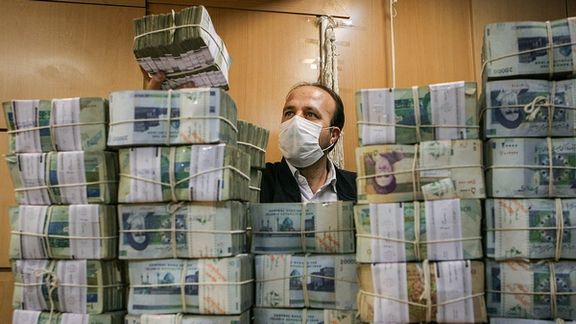
An Iranian man sitting behind a pile of national currency banknotes

Central Bank of Iran’s (CBI) latest figures indicate that in April inflation reached a level unprecedented since the Anglo-Soviet invasion of Iran in 1942. 

In a May 25 article entitled “Revolutionary Government Breaks 81-Year Inflation Record in Iran”, Aftab News, a website close to former President Hassan Rouhani listed the annual inflation rate over the years for comparison, pointing out that in 1990, a year after the end of the eight-year Iran-Iraq War, inflation was only 9 percent, in 1996 it had risen to around 23 percent, in 2006 it was less than 12 percent while in 2015 it was slightly over 11 percent.

Official figures released by the CBI indicate that prices in the food group rose by 79 percent between April 20, 2022, and April 20, 2023. 

The CBI and the Statistics Center of Iran have only published partial figures on inflation and other economic indicators over the past two years, with many doubting the veracity of the official numbers.

Economist Mohsen Ghobadlou told Aftab News that many people believe prices of items in the food basket have increased by over 100 percent. 

Ghobadlou also said to reduce inflation the government needs to take “real” measures including resolving the issue of sanctions and Iran's accession to the international watchdog, the Financial Action Task Force (FATF), reducing its own expenditures, and reducing liquidity, rather than “making promises and hackneyed slogans”.

Iran has been on the FATF blacklist, along with North Korea, since February 2020 for failing to pass legislation introducing transparency measures designed to combat money-laundering, corruption, and financing of ‘terrorism.’ FATF members – who host most of the world’s financial centers – are required to undertake enhanced diligence and countermeasures against blacklisted states.

Economist Mehdi Pazouki (undated)
100%
Economist Mehdi Pazouki

Economist Mehdi Pazouki told Aftab News, a website close to former President Hassan Rouhani, that the government and parliament have estimated astronomical revenues from oil exports, which could only be realized if oil prices reach $300pb. 

“Naturally failure to realize such revenues means a budget deficit,” he said, which in turn will force the central bank to print money. Printing money causes liquidity growth and higher inflation and eventually a drop in purchasing power of the people, he added. 

Rahim Mombeini, deputy head of Iran’s Planning and Budget Organization, said Saturday that Iran’s budget deficit for the previous Iranian year –which ended on March 20 – was about 8,000 trillion rials (about $16 billion in today’s exchange rates), or over 30 percent of the operating budget.

A report published by the Parliament’s research center on May 23 said that currently over one-third of Iranians live under the official poverty line and that anything such as a rise in rents or costs of treatment for an illness could quickly push many among the middle class down to below the poverty line. According to the same report, the rate of poverty rose from 19.4 percent in 2011 to over 34.4 percent in 2021 and 11 million Iranians dropped below the poverty line during this period. 

“The middle class, particularly the cultural middle class, is the driving force of cultural, social, and political change but in these circumstances, the middle class will shrink considerably while the lower classes will become more dependent on government aid to survive and may even be driven to rioting,” an Iranian political analyst who requested anonymity told Iran International. 

“People’s priorities in spending will also drastically change with the drop in their purchasing power and become limited to bare necessities such as food and housing which they will no longer afford to buy due to lack of savings,” he added.


Most Viewed

Iran negotiators ordered to return after internal rift over Islamabad talks
1
EXCLUSIVE

Iran negotiators ordered to return after internal rift over Islamabad talks

2
ANALYSIS

US blockade enters murky phase as tankers spoof signals and buyers hesitate

3

US tightens financial squeeze on Iran, warns banks over oil money flows

4
INSIGHT

Ideology may be fading in Iran, but not in Kashmir's ‘Mini Iran'

5
INSIGHT

Hardliners push Hormuz ‘red line’ as US blockade tests Iran’s leverage

Banner
Banner

Spotlight

  • Hardliners push Hormuz ‘red line’ as US blockade tests Iran’s leverage
    INSIGHT

    Hardliners push Hormuz ‘red line’ as US blockade tests Iran’s leverage

  • Ideology may be fading in Iran, but not in Kashmir's ‘Mini Iran'
    INSIGHT

    Ideology may be fading in Iran, but not in Kashmir's ‘Mini Iran'

  • War damage amounts to $3,000 per Iranian, with blockade set to add to losses
    INSIGHT

    War damage amounts to $3,000 per Iranian, with blockade set to add to losses

  • Why the $100 billion Hormuz toll revenue is a myth
    ANALYSIS

    Why the $100 billion Hormuz toll revenue is a myth

  • US blockade targets Iran oil boom amid regional disruption
    ANALYSIS

    US blockade targets Iran oil boom amid regional disruption

  • Iran's digital economy battered by prolonged blackout
    INSIGHT

    Iran's digital economy battered by prolonged blackout

•
•
•

More Stories

Russia Launches Another Air Attack On Kyiv With Iranian Drones

May 30, 2023, 07:19 GMT+1

Russia launched its 17th mass air attack this month targeting Ukraine’s capital Kyiv, the third in as many days, this time using only Iranian-supplied drones.

Kyiv City Military Administration said that at around 5 am on May 30 several waves of Iranian Shahed drones were launched from different directions against the capital. No missiles were used this time.

"The attack was massive, came from different directions, in several waves," Serhiy Popko, head of Kyiv's military administration, said on the Telegram.

"A massive attack!" Kyiv Mayor Vitali Klitschko said on the Telegram messaging app. "Do not leave shelters."

Air defenses intercepted over 20 Shahed drones, but falling debris caused casualties and fires. Damage to a high-rise building in Kyiv’s Holosiivkyi District killed one person and injured three others, Kyiv Independent reported.

Russia has used hundreds of the Iranian supplied Unmanned Aerial Vehicles (UAVs) since last September to attack Ukraine’s infrastructure, civilian targets and try to overwhelm air defenses.

Russia has repeatedly attacked Kyiv in May using a combination of drones and missiles, mostly at night, in an apparent attempt to undermine Ukrainians' will to fight after more than 15 months of war.

Although the United States and its European allies have strongly condemned Iran for supplying drones and other weapons to Russia, major European countries have so far have only announced some sanctions but have not designated Iran’s Revolutionary Guard as a terrorist entity.

The air attacks come as Ukraine prepares a counter-offensive backed with Western weapons to try to drive Russian occupiers out of territory seized since Moscow launched its unprovoked invasion in February 2022.

OPEC Says Will Welcome Iran’s Return To Oil Market When Sanctions Lifted

May 30, 2023, 06:30 GMT+1

OPEC will welcome Iran’s full return to the oil market when sanctions are lifted, the secretary general of the Organization of the Petroleum Exporting Countries (OPEC) said Monday.

Iran is an OPEC member, although its oil exports are subject to US sanctions aimed at curbing Tehran's nuclear programme.

Secretary General Haitham Al Ghais, who is visiting Tehran for the first time, also told Iranian oil ministry's website SHANA that Iran has the capacity to bring on significant production volumes within a short period of time.

"We believe that Iran is a responsible player amongst its family members, the countries in the OPEC group. I’m sure there will be good work together, in synchronization, to ensure that the market will remain balanced as OPEC has continued to do over the past many years," SHANA's English-language website cited him as saying.

Although US sanctions can penalize any third party engaged in Iranian oil exports, Tehran ships daily close to one million barrels of crude to China, often disguised as cargos from third countries. Before the US imposed its sanctions in 2018 and 2019, Iran was exporting around 2.2 million barrels per day and in if sanctions are lifted Iran’s export capacity can hardly surpass that without major investments in the sector.

Saudi Arabia, the kingpin of OPEC, and Iran announced in March that they would restore diplomatic relations after years of hostility, in a deal brokered by China, the world's No. 2 oil consumer.

Raisi Played Direct Role In Executing Prisoners In 80s: Ex-Warden

May 29, 2023, 19:07 GMT+1
•
Iran International Newsroom

The former director of the notorious Evin prison in Tehran has accused President Ebrahim Raisi of having a direct role in executing political prisoners under the founder of Islamic Republic, Ruhollah Khomeini.

Hossein Mortazavi Zanjani said in a virtual meeting on Clubhouse that Raisi, who was the deputy prosecutor of Tehran, told him: "We went and got an order from Ayatollah Khomeini to execute the prisoners."

This is the first revelation by a former judiciary official about the direct involvement of the Iranian president in the killing of political prisoners in the 1980s.

The executions during the 1980s were carried out based on a fatwa by Iran's then supreme leader, Ruhollah Khomeini, against the MEK (The People's Mojahedin Organization of Iran) which carried out a wave of bombings in Iran and struck an alliance with Saddam Hussein during the 1980-88 war.

“Showing mercy to those who take up arms against the Islamic government is being naïve,” Khomeini said in his fatwa.

Most victims were linked to the MEK but there were also others with links to leftist and secular groups such as Fadaiyan Khalq Organization (FKO) and the Tudeh Party as well as some Kurdish groups such as Komala and the Kurdish Democratic Party of Iran.

The exact number of prisoners executed during the purge of prisoners is not known but according to Amnesty International, the Iranian authorities "forcibly disappeared" and "extrajudicially executed" around 5,000 between July and September 1988.

The former director of Evin prison, which has held some of the country’s most high profile cases and is famed for its brutalities to inmates, added that he witnessed the bodies of the executed prisoners thrown into trucks and taken from the prison.

Mortazavi claimed he resigned to what was known as ‘the death board’, the group of decision-makers deciding whether prisoners lived or died. He claims his resignation was met with a death threat by the deputy intelligence minister.

Former director of the notorious Evin prison Hossein Mortazavi Zanjani (undated)
100%
Former director of the notorious Evin prison Hossein Mortazavi Zanjani

“Although I did not have a direct role in the execution of prisoners, I feel guilty because of my silence about the executions, and even if I repent, I will not be cleansed,” he said.

After his victory in the presidential election in 2021, in response to an Al-Jazeera reporter’s question, Ebrahim Raisi said he has been a "human rights defender" since the beginning of his tenure in the judicial system and "should be commended " for his actions.

Mortazavi further stated that female prisoners still virgins were forcibly married to jailers before the execution. According to the narrative of political prisoners, the clerics of the Islamic Republic believed if the virgin girls were executed, they would go to heaven, and for this reason, they raped them in the form of forced marriage so that they would not die virgins.

”The father of one of the executed virgin girls told me that after the execution of his daughter, the agents gave him money saying the money is for his daughter's marriage endowment."

Why Is Oman’s Sultan In Iran And Will It See The Revival Of JCPOA?

May 29, 2023, 15:37 GMT+1
•
Iran International Newsroom

Only two days after Muscat mediated a prisoner swap between Iran and Belgium, Sultan Haitham bin Tariq al-Said traveled to Tehran, meeting with President Ebrahim Raisi and Supreme Leader Ali Khamenei.

Traditionally, Oman works as a mediator between Iran and Western countries, and it also plays a role in facilitating relations between Tehran and Arab countries. It was one of the key players in the talks which eventually led to Iran and Saudi’s détente.

Given that this time the Sultan himself has come to Iran, there is no doubt this is a vital visit. Almost all of the reports by Iranian state media on the first day of the visit were focused on bolstering economic cooperation between the two countries, with some discussion on recent developments in the region. However, no details about trade or regional diplomacy were released.

The joint statement released after Oman’s sultan meeting with the Iranian president abounds with clichés such as “strengthening friendly and brotherly relations on the basis of common interests, especially in the fields of trade, energy, investment and culture.”

A meeting between Oman’s Sultan Haitham bin Tariq al-Said and his delegation with Iran’s President Ebrahim Raisi and senior officials in Tehran on May 28, 2023
100%
A meeting between Oman’s Sultan Haitham bin Tariq al-Said and his delegation with Iran’s President Ebrahim Raisi and senior officials in Tehran on May 28, 2023

On the second day of the trip, Sultan bin Tarik met with the Supreme Leader, apparently delving deeper into Iran’s détente with its classic rivals Saudi Arabia and Egypt. The only takeaway from the readout of the meeting by Khamenei’s office, was the Supreme Leader’s welcoming of better relations with Egypt.

Khamenei's comments came as Middle Eastern countries including Egypt are taking steps to ease regional tensions and relations between Egypt and Iran have often been fraught in recent decades although the two countries have maintained diplomatic contacts. In March, regional rivals Sunni Saudi Arabia and Shiite Muslim Iran ended years of hostility and agreed to restore diplomatic relations under a China-mediated deal.

The presence of Iran’s top nuclear negotiator Ali Bagheri-Kani during Oman’s sultan meeting with Khamenei, which is somewhat unusual, indicates that there must have been a nuclear aspect to the meeting, despite a possible media ban on this aspect of the talks. 

Iran’s top nuclear negotiator Ali Bagheri-Kani (center) during a meeting between Supreme Leader Ali Khamenei and Oman’s Sultan Haitham bin Tariq al-Said (not seen) in Tehran on May 29, 2023
100%
Iran’s top nuclear negotiator Ali Bagheri-Kani (center) during a meeting between Supreme Leader Ali Khamenei and Oman’s Sultan Haitham bin Tariq al-Said (not seen) in Tehran on May 29, 2023

The seeming lack of openness about the nuclear side of the talks has drawn suspicion from global Iran watchers who are looking to Oman to mediate in the possible revival of talks on the 2015 nuclear deal, which has fallen apart. There are also rumors that the US and the Islamic Republic are about to reach a deal in the near future, which could be among the secret topics discussed during the visit by Oman’s sultan.

Former diplomat Fereydoun Majlesi told Fararu on Monday that Oman has a respected position in the Persian Gulf. "Oman speaks on behalf of all the countries of the Persian Gulf and what is in the interest of Oman is in the interest of all Arab countries in the region,” he said, noting that minimizing the risks of tensions or wars and unease between the Islamic Republic and the US and Israel plays an important role in that.

“These countries are worried that any kind of conflict between Iran and its long-time enemies would overshadow all the peace and security they have achieved during the last half century," added Majlesi who said that Iran’s foreign minister has recently assessed the revival of the JCPOA as “important and vital and expressed willingness to restore the deal”.

Ali Bigdeli, another pundit, told Fararu that the most important possible reason for Sultan of Oman's visit to Iran is mediating for exchange of dual-national prisoners.

A source told Iran International last week that talks between Iran and the US on the release of Tehran's frozen assets could result in a deal soon.

Apparently, the talks that have made progress focused on Iranian funds held in Iraq and South Korea. Iran is apparently expected to show more flexibility on issues related to its nuclear program in exchange for the release of its funds in Iraq, and free hostages with dual nationality in exchange for its assets in South Korea.

Currently there are three dual nationals with American citizenship and two individuals with US permanent residency held by Iran on trumped-up charges of espionage.

Also on Monday, Israel’s state television channel Kan 11 reported that a deal between Tehran and Washington will be finalized in the coming weeks.

During an interview with Reshet Bet on Monday, Israeli opposition leader Yair Lapid expressed alarm about reports of the imminent nuclear agreement, saying: "Such an interim agreement is dangerous. Every effort must be made to prevent this from happening.”

Healthcare Headed For Crisis As 10k Doctors Left Iran In Two Years

May 29, 2023, 15:36 GMT+1

Around 10,000 healthcare practitioners have left Iran over the past two years to work in the Arab world.

With economic and financial conditions at rock bottom, MP Hossein Ali Shahriari, chairman of the Iranian parliament's Health and Treatment Committee, said most have gone to the Persian Gulf countries including Oman and the United Arab Emirates.

"Unfortunately, we are facing a human resources shortage in private and even state medical centers, but the government apparently has no plan to deal with it," he said.

The number of Iran's healthcare professionals leaving the country is on the rise, worsened by the country's lack of freedoms and the months of violent uprisings since September. Doctors earn an average of $450 in a sector which is now facing shortages of basic goods such as IV fluids and cold pills in addition to medicine, due to global sanctions.

Thousands of physicians, dentists, midwives, and nurses have either emigrated in the past few years or are planning to leave for other countries.

There is no transparent data on the emigration of healthcare and other professionals, but medical officials and lawmakers often offer fragmentary information on the scope of the problem.

In February, Mohammad Sharifi-Moghadam, a member of the central council of Iran's Nurses’ Organization, said between 2,500 to 3,000 nurses were emigrating from Iran each year.

A survey by Iran Migration Observatory in 2022 found that economic and social instability, institutionalized corruption, and the regime’s governance methods were responsible for the very high desire to emigrate among medical students, professors and other healthcare professionals. The sector employs around 100,000 people in total but emigration of such large numbers could pose major challenges to the system, especially in the more rural regions where healthcare is less accessible.

The report warned that those who failed to emigrate were in danger of losing their motivation for work.