• العربية
  • فارسی
Brand
  • Iran Insight
  • Politics
  • Economy
  • Analysis
  • Special Report
  • Opinion
  • Podcast
  • Iran Insight
  • Politics
  • Economy
  • Analysis
  • Special Report
  • Opinion
  • Podcast
  • Theme
  • Language
    • العربية
    • فارسی
  • Iran Insight
  • Politics
  • Economy
  • Analysis
  • Special Report
  • Opinion
  • Podcast
All rights reserved for Volant Media UK Limited
volant media logo

Israel Raises Prospect Of Military Action Against Iran
Iran International Newsroom
May 23, 2023, 17:07 GMT+1Updated: 17:53 GMT+1
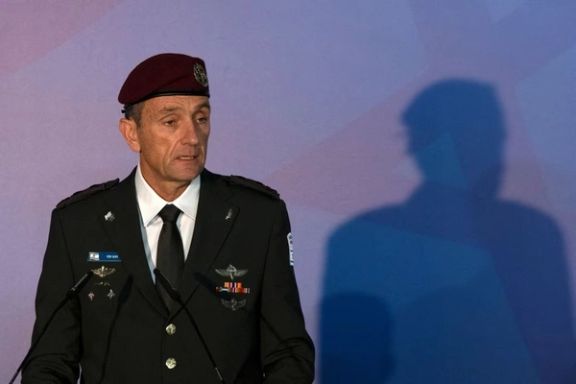
Israel Defense Forces Chief of Staff Herzi Halevi speaks during his transition ceremony with the Prime Minister, Defense Minister, and the outgoing chief, in Jerusalem, January 16, 2023.

Israel’s top military official has raised the prospect of "action" against Iran amid renewed concerns over Tehran’s nuclear activities.

Lieutenant-General Herzi Halevi, chief of Israel's armed forces, warned: "Iran has advanced with uranium enrichment further than ever before ... There are negative developments on the horizon that could bring about (military) action.”

Speaking at the Herzliya Conference, an international security forum, Halevi said global efforts to curb Iran’s nuclear activity have so far been in vain.

An Associated Press report Monday showed the regime is building a deep underground nuclear facility near the Zagros Mountains in central Iran, close to the Natanz nuclear site, with experts claiming development “is likely beyond the range of a last-ditch US weapon designed to destroy such sites."

Completion of such a facility “would be a nightmare scenario that risks igniting a new escalatory spiral,” warned Kelsey Davenport, the director of nonproliferation policy at the Washington-based Arms Control Association.

“Given how close Iran is to a bomb, it has very little room to ratchet up its program without tripping US and Israeli red lines. So at this point, any further escalation increases the risk of conflict,” Davenport added, reiterating worries that Iran is producing uranium close to weapons-grade levels after the collapse of its 2015 nuclear deal with world powers, officially known as the JCPOA.

Israeli National Security Adviser Tzachi Hanegbi told the Herzliya Conference that while the new underground site would be challenging to attack, ”there is nowhere that cannot be reached."

Experts are divided over whether Israel has the military might to deal lasting damage to Iranian nuclear facilities that are distant, dispersed and defended, leading to speculations that Israel might use countries on Iran's borders – such as Azerbaijan -- as springboards for strikes.

Deputy Azeri Foreign Minister Fariz Rzayev, who spoke at the same conference, said "We refrain from interfering in the disputes or problems (of other countries), including by allowing or giving our territory for some operations or adventures," denying previous reports about preparing an airfield to assist Israel during an attack on the Islamic Republic.

Halevi, Israel’s top general, said elsewhere in his speech that "We have capabilities, and others also have capabilities,” in an apparent allusion to the military clout of Israel's US ally which this month posted pictures of a powerful bomb designed to penetrate and destroy underground facilities.

The US Air Force released rare images of the weapon, the GBU-57, known as the “Massive Ordnance Penetrator,” designed to destroy weapons of mass destruction located in well protected facilities. However, it immediately took the photos down because they revealed sensitive details about the weapon’s composition and punch.

According to Rahul Udoshi, a senior weapons analyst at open-source intelligence firm Janes, the latest photos revealed stenciling on the bombs that listed their weight as 12,300 kilograms (27,125 pounds). It also described the bomb as carrying a mix of AFX-757 — a standard explosive — and PBXN-114, a relatively new explosive compound. The weight of the bomb, coming from its thick steel frame, allows the explosives to chew through concrete and soil before exploding.

This is not the first time reports surface about Iran building a vast tunnel network near Natanz, purportedly able to withstand cyberattacks and bunker-penetrating bombs. 

Last year, the spokesman for the Atomic Energy Organization of Iran, Behrouz Kamalvandi, reacted to a report by the New York Times revealing underground work, claiming Iran had notified the UN nuclear agency of its plan to relocate the activities of the Iran Centrifuge Technology Company (TESA) complex in Karaj to the city of Natanz.

He claimed the move aimed to prevent the recurrence of attacks, referring to a recent drone attack at the TESA complex near Karaj which manufactures parts for centrifuges.

Over the years, a series of attacks has seemed to slow Iran’s nuclear activities. In 2010, the Natanz uranium enrichment facility suffered serious damage following a major cyber-attack involving the Stuxnet virus. Three years later, the Fordow enrichment site was rocked by an explosion. More recently, in July 2020, a centrifuge assembly facility was hit by an explosion and in April 2021 an explosion at the enrichment plant caused a power outage that reportedly damaged thousands of centrifuges.

Most Viewed

US blockade enters murky phase as tankers spoof signals and buyers hesitate
1
ANALYSIS

US blockade enters murky phase as tankers spoof signals and buyers hesitate

2
INSIGHT

Ideology may be fading in Iran, but not in Kashmir's ‘Mini Iran'

3
INSIGHT

Hardliners push Hormuz ‘red line’ as US blockade tests Iran’s leverage

4
VOICES FROM IRAN

Hope and anger in Iran as fragile ceasefire persists

5

US sanctions oil network tied to Iranian tycoon Shamkhani

Banner
Banner

Spotlight

  • Hardliners push Hormuz ‘red line’ as US blockade tests Iran’s leverage
    INSIGHT

    Hardliners push Hormuz ‘red line’ as US blockade tests Iran’s leverage

  • Ideology may be fading in Iran, but not in Kashmir's ‘Mini Iran'
    INSIGHT

    Ideology may be fading in Iran, but not in Kashmir's ‘Mini Iran'

  • War damage amounts to $3,000 per Iranian, with blockade set to add to losses
    INSIGHT

    War damage amounts to $3,000 per Iranian, with blockade set to add to losses

  • Why the $100 billion Hormuz toll revenue is a myth
    ANALYSIS

    Why the $100 billion Hormuz toll revenue is a myth

  • US blockade targets Iran oil boom amid regional disruption
    ANALYSIS

    US blockade targets Iran oil boom amid regional disruption

  • Iran's digital economy battered by prolonged blackout
    INSIGHT

    Iran's digital economy battered by prolonged blackout

•
•
•

More Stories

Iran’s Intelligence Ministry Claims Arrests Of Spy Network

May 23, 2023, 15:35 GMT+1

Iranian intelligence has arrested individuals connected with a “foreign spy agency” who were collecting information about officials, a statement on Tuesday claimed.

The intelligence ministry said that individuals working in the Iranian government were collecting information for the foreign spy agency on officials traveling abroad.

The statement does not name any country or any suspects, nor identify people claimed to have been arrested.

According to the intelligence ministry, the foreign country was trying to collect information on Iranian officials who had “important information in sensitive institutions,” and were traveling abroad.

Iran’s intelligence organizations regularly claim the discovery of spy networks and saboteurs in the country, but there is rarely any follow-up information. Usually, no names or details are provided, and no news emerges about likely trials and convictions.

There have been numerous instances of sabotage and infiltration in Iran in recent years, with serious clandestine attacks on nuclear, military and important economic targets. Iranian intelligence was badly discredited when two large sabotage attacks took place in 2020 and 2021 against its most important nuclear facility in Natanz. A few key military and intelligence officials have also been assassinated.

The incidents are largely attributed to Israel, although Israeli officials have never officially taken responsibility.

The statement came one day after the long-time secretary of Iran’s national security council, Ali Shamkhani, was pushed out of his post. Earlier this year, Alireza Akbari, an associate of his was hanged as an alleged British spy.


Four Million Iranians Risk Displacement If Lake Urmia Dries Up

May 23, 2023, 14:59 GMT+1

The former Head of Iran's Environmental Protection Organization has warned that four million Iranians risk displacement if Lake Urmia in northwest Iran dries up.

“Transferring the residents of Tabriz to another place requires 500 billion dollars while the cost of reviving the lake is about one billion dollars,” Isa Kalantari said, explaining that the salt dust would be unbearable for residents in Tabriz and its surrounding cities.

Last year, he had also warned that if the lake is not restored, it will have security consequences, causing a flood of millions of displaced citizens.

Experts say groundwater extraction and using the water of the once bountiful Zarrineh Rud − which feeds Lake Urmia − for irrigating apple trees have both contributed to the lake shrinking by nearly 95 percent in volume over the past 20 years. In 2021 alone, more than 100,000 tons of apples of the province’s production went to waste.

Urmia, which is the largest lake in Iran and the sixth largest salt lake in the world, began shrinking in the mid-1980s and was in danger of disappearing altogether until recovery plans began to be implemented in 2014.

Japan, the United Nations Food and Agriculture Organization (FAO) and the United Nations Development Program (UNDP) allocated nearly ten billion dollars to save the lake. It is not clear whether or how the earmarked budget was spent.

Iran Appoints Senior Diplomat As New Envoy To Saudi Arabia

May 23, 2023, 14:34 GMT+1

Iran’s Ministry of Foreign Affairs has appointed Alireza Enayati, a seasoned diplomat, as the country’s new ambassador to Saudi Arabia.

The appointment, announced by semi-official news agencies, comes two months after a Chinese-brokered agreement between Tehran and Riyadh which revived relations after a seven-year hiatus.

Enayati previously served as an assistant to Iran’s foreign minister and the director general of the Foreign Ministry’s Persian Gulf affairs. He has also served as Iran’s ambassador to Kuwait.

Reports claim he played a key role in Iran-Saudi negotiations which resulted in the normalization of relations.

While in March Iran and Saudi Arabia had agreed to reopen their embassies within two months, the procedure seems to be taking longer than expected, especially because of the repairs needed in both embassies after years of neglect.

Saudi Arabia severed relations with the Islamic Republic in January 2016 after pro-government Iranian mobs attacked and ransacked its embassy in Tehran and consulate in Mashhad following the execution of a Saudi Shiite cleric.

The most crucial bilateral tension was over Yemen, where Iran supports Houthi rebels against the remnants of the country’s legal government, backed by Saudi led forces.

Ghalibaf Re-Elected As Iran’s Parliament Speaker For Fourth Successive Time

May 23, 2023, 13:04 GMT+1

Mohammad Bagher Ghalibaf was re-elected as the speaker of Iran's parliament for the fourth consecutive year.

On Tuesday, 210 out of 290 members of parliament voted for Ghalibaf's re-election, a 10-percent increase compared to the 2022 elections where he won only 193 votes in his worst-ever performance.

Ghalibaf has yet to enjoy the support he received during his first two rounds in 2020 and 2021, when he was supported by 230 MPs in both elections.

Former parliament speaker Ali Larijani won the highest number of votes in all annual elections with 237 votes cast for him in 2016. The lowest number was 140 votes cast in favor of Akbar Hashemi Rafsanjani in the second year of the first round of the parliament in Iran in 1980.

Larijani also holds the record of longest-serving speaker in Iran's parliament, in power for 12 consecutive years from 2008 to 2020.

During the Tuesday elections, hardline deputy speaker Abdolreza Mesri won re-election, but the second deputy speaker, Ali Nikzad lost his seat to Mojtaba Zolnouri in a fierce competition which ended in a tie. The decision was made by drawing lots.

While Ghalibaf won enough votes this year to remain in power as the Majlis speaker, he is expected to face a tough competition in 2024 parliamentary elections, which is vital if he seeks to realize his long-time dream of presidency in the 2025 presidential elections.

There are reports that hardliner parties Paydari and Sharian aim to knock Ghalibaf out of the Majles to send him the firm message that Ebrahim Raisi will serve a second term as Iran's President and there is no chance for Ghalibaf.

Iran’s Ultraconservatives Reinforce Position in Government, State TV

May 23, 2023, 12:41 GMT+1
•
Iran International Newsroom

A moderate conservative politician says the ultraconservative Paydari Party has occupied most power centers including the parliament and the state television. 

Former lawmaker Mansour Haghighatpour told Etemad Onlinethat the "audacious Paydari Party" has a lot of money, controls several powerful institutions and has seized and occupied the state television silently.

Haghighatpour is close to Iran’s former conservative parliament (Majles) speaker Ali Larijani who recently had a public run-in with ultraconservatives or hardliners.

Meanwhile, referring to the great number of Paydari members at the Iranian parliament, Haghighatpoor said “had the Guardian Council not disqualified” moderate and reform-minded candidates in the previous parliamentary elections, debates at the Majles would have replaced the nationwide protests that rocked Iran last year. 

The Guardian Council, which screens candidates for elections, disqualified hundreds of non-hardliners in the 2020 Majles elections. The Council is under the control of Iran’s ruler Ali Khamenei.

Former MP Mansour Haghighatpour (Undated)
100%
Former MP Mansour Haghighatpour

He added that Iran's ultraconservatives see themselves as the only revolutionary force in the country and call others spies and seditionists. He further said that the Paydari Party has access to money and media and has spent a lot of money on garnering support on social media. 

"They have been given privileged access to funds, political power and media although they are just two busloads of politicians," Haghighatpoor said. 

The moderate conservative politician added that when President Ebrahim Raisi took office in 2021, he did not have his own team to form the cabinet. Paydari promised to provide the team from its ranks. However, introduced to Raisi were a bunch of ineffective and unqualified individuals. He said the former Planning and Budget chief and the ministers who have been since removed from their posts show how inefficient Paydari's men are. 

Haghioghatpoor predicted that the inefficiency of the Raisi administration and the parliament, both of which are dominated by Paydari, are likely to lead to lacklustre parliamentary elections with a low turnout in March 2024, if the same individuals are the only ones who are allowed to run. 

At the same time, some in Iran say that hardliners campaignedincessantly in recent months to have Ali Shamkhani removedas secretary of the national security council. He was replaced by a Revolutionary Guard officer seen as ideologically in sync with Paydari.

Paydari's grip on the state television has also been strengthened during the past years after Payman Jebelli was appointed as the organization's chief. Jebelli chose Vahid Jalili of Paydari as his deputy for television and the latter appointed several party members as the heads of the broadcaster's key channels. This is going to give Paydari the upper hand in the next parliamentary elections in March as there are no private channels in Iran and the state television has exclusive broadcasting rights based on the country's Constitution. 

Referring to a letter from Majles Speaker Mohammad Bagher Ghalibaf to the leaders of Paydari, in which the speaker explained how Paydari members have obstructed the parliament's operations, Haghighatpoor charged that the ultraconservative party has recently increased its activities against Ghalibaf. He said Ghalibaf is likely to have to pay a high price as a result of the tensions created by Paydari members. 

Haghighatpoor's statements against Paydari Party came on the same day that the media were speculating on the fate of the election to form the parliament's last presidium in its four-year term of office.