• العربية
  • فارسی
Brand
  • Iran Insight
  • Politics
  • Economy
  • Analysis
  • Special Report
  • Opinion
  • Podcast
  • Iran Insight
  • Politics
  • Economy
  • Analysis
  • Special Report
  • Opinion
  • Podcast
  • Theme
  • Language
    • العربية
    • فارسی
  • Iran Insight
  • Politics
  • Economy
  • Analysis
  • Special Report
  • Opinion
  • Podcast
All rights reserved for Volant Media UK Limited
volant media logo

Smoldering Iran Nuclear Crisis Risks Catching Fire
May 5, 2023, 10:01 GMT+1Updated: 11:26 GMT+1
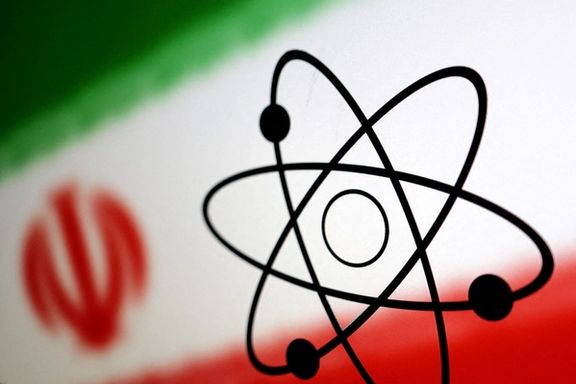
Atom symbol and Iran flag are seen in this illustration, July 21, 2022.

Even as the US and its European allies grapple with Russia's invasion of Ukraine and rising tensions with China, the smoldering crisis over Iran's nuclear program threatens to reignite.

In a sign of European concern, Britain, France and Germany have warned Iran they would trigger a return of UN sanctions against Tehran if it enriched uranium to the optimal level for a nuclear weapon, three European officials said.

The threat, made last year in a previously unreported letter sent by the countries' foreign ministers, underscores Western fears that Iran could produce bomb-grade uranium of 90% purity.

Those concerns intensified in February after UN inspectors revealed their discovery of uranium particles of 83.7% purity at an Iran nuclear facility built deep underground to protect it from air strikes.

A renewed crisis over Iran would come at a bad time for U.S. President Joe Biden who is focused on maintaining allies' support for the war in Ukraine and on rallying Western countries to push back on China's military and diplomatic ambitions.

But while some White House aides may prefer to keep Iran off the president's desk, officials and analysts suggested they may not have that luxury.

"They are busy with Ukraine, Russia and they don't want, for the time being, to open another front," said a Western diplomat on condition of anonymity. "Therefore, they want to do everything in their power to prevent this (90%) from happening."

'Snapback' Of UN Sanctions?

Western officials fear a nuclear-armed Iran could threaten Israel, Gulf Arab oil producers, and spark a regional arms race.

Iran denies seeking nuclear weapons.

US and European officials have been searching for ways to curb Tehran's program since the breakdown of indirect US-Iranian talks on reviving the 2015 nuclear deal between Iran, Britain, China, France, Germany, Russia, and the United States.

The accord, aimed at keeping Iran from developing a nuclear weapon, required Tehran to accept restrictions on its nuclear program and more extensive UN inspections, in exchange for an end to UN, US, and EU sanctions.

Iran's nuclear chief Mohammad Eslami and IAEA's Rafael Grossi, March 3, 2023
100%
Iran's nuclear chief Mohammad Eslami and IAEA's Rafael Grossi, March 3, 2023

The deal, which had capped Iran's uranium enrichment at 3.67%, was abandoned in 2018 by then-US President Donald Trump, who argued it was too generous to Tehran.

Trump reimposed broad US sanctions, many of which have the secondary effect of forcing non-US firms stop dealing with Iran or risk losing access to the US market, but UN sanctions were not reactivated.

The deal had set out a procedure for the veto-proof "snapback" of the UN sanctions on Iran – including an oil embargo and banking restrictions – in response to Iranian violations. Any of the states who signed onto the original deal can trigger the snapback.

US sanctions - even with their secondary effects - have failed to keep Iran from producing ever-purer levels of uranium and China has flouted them by buying Iranian oil, making it unclear if the UN measures would be any more effective.

But Iran might refrain from enriching to 90% to avoid the public rebuke implicit in the return of UN sanctions.

A senior Iranian nuclear official said Tehran would not take the revival of UN sanctions lying down.

"If the other parties under any pretext trigger it, they will be responsible for all the consequences," he told Reuters. "Iran's reaction could range from leaving the NPT (Nuclear Non-Proliferation Treaty) to accelerating our nuclear work."

Leaving the NPT would free Iran to develop nuclear arms.

The Iranian official's threat was more explicit than comments by an Iranian foreign ministry spokesman, who on Monday said only that Iran had told Western powers how it would react.

It remains unclear if the 83.7% particles were created deliberately. But Western officials and analysts say that Iran's production of 90% uranium would demand a significant response.

A US State Department spokesman said Biden "is absolutely committed" to making sure Iran never obtains a nuclear weapon.

"We believe diplomacy is the best way to achieve that goal, but President Biden has also been clear that we have not removed any option from the table," the spokesperson added, hinting at the possibility of military action.

'Face A Crisis At Some Point'

While Western officials want to leave the door open for diplomacy, tensions with Russia and China make that harder.

Divisions over the Ukraine war, which has seen Iran provide military aid to Russia, and rising Sino-US tensions further reduce the odds of resurrecting the deal because it is unclear how hard Moscow or Beijing might push for its revival.

If the deal is dead, the West has three broad options: deterrence, military action, or a new negotiated arrangement.

Deterrence has a downside: it could give Tehran time to creep toward a nuclear weapons capability.

Dennis Ross, a veteran US diplomat now at the Washington Institute for Near East Policy think tank, suggested Biden may have to do more to make Iran fear the consequences of enriching to higher levels.

"If you don't do enough to persuade the Iranians of the risks they are running, you will face a crisis at some point because they will go to 90%" or move toward weaponization, he said. "What you are seeing is an effort to walk that tightrope."

Analysis by Reuters

Most Viewed

Ghalibaf defends Iran-US talks amid hardline backlash
1
INSIGHT

Ghalibaf defends Iran-US talks amid hardline backlash

2
INSIGHT

100 days after carnage: Iran economy reels from war, inflation, unemployment

3
INSIGHT

A nation in limbo: 100 days after the massacre, has the world moved on?

4
ANALYSIS

From instability to influence: Pakistan’s pivotal role in US-Iran diplomacy

5
ANALYSIS

100 days on: why Iran’s January protests spread across social classes

Banner
Banner

Spotlight

  • War-hit homeowners feel abandoned as Iran’s reconstruction aid fades

    War-hit homeowners feel abandoned as Iran’s reconstruction aid fades

  • 100 days on: the anatomy of Iran’s January crackdown
    INSIGHT

    100 days on: the anatomy of Iran’s January crackdown

  • Ghalibaf defends Iran-US talks amid hardline backlash
    INSIGHT

    Ghalibaf defends Iran-US talks amid hardline backlash

  • 100 days on: why Iran’s January protests spread across social classes
    ANALYSIS

    100 days on: why Iran’s January protests spread across social classes

  • From instability to influence: Pakistan’s pivotal role in US-Iran diplomacy
    ANALYSIS

    From instability to influence: Pakistan’s pivotal role in US-Iran diplomacy

  • A nation in limbo: 100 days after the massacre, has the world moved on?
    INSIGHT

    A nation in limbo: 100 days after the massacre, has the world moved on?

•
•
•

More Stories

Britain’s Shadow Security Minister Slams Iran’s Harassment Of UK-Based Journos

May 4, 2023, 11:51 GMT+1

Britain’s shadow security minister has slammed threats from the Islamic Republic against journalists based in the UK covering Iran’s protests.

Speaking on World Press Freedom Day, Holly Lynch, the Labour MP for Halifax, said many of the threats to which the British security services and counter-terrorism police are responding to relate to the protection of journalists.

She said the threats by the Iranian regime include “assassination and kidnap plots against UK residents who are perceived as enemies of Iran owing to their coverage of the protests and the regime’s brutal crackdown”.

After a significant escalation in state-backed threats from Iran and advice from London’s Metropolitan Police, Iran International TV reluctantly closed its London studios and moved broadcasting to Washington DC in February. It is part of a long history from the regime which has for decades targeted dissidents and independent journalists who found refuge in other countries.

Faced with nationwide anti-government protests since mid-September, the Islamic Republic has blamed foreign-based Persian broadcasters such as BBC Persian and Iran International of “fomenting unrest”, while all media in the country are under tight government control and present protesters as “rioters” and “terrorists”.

In parallel, US State Department Deputy Spokesman Vedant Patel said Washington is committed to a free and independent press and commends the crucial work of journalists around the world.

“In honor of World Press Freedom Day, we call on countries to protect journalists and hold to account those who commit crimes against them,” he wrote in a tweet Wednesday.


Iran Official Says Tehran Ready To Accept EU Nuclear Deal Draft

May 4, 2023, 10:56 GMT+1

An advisor to Iran’s negotiating team has said that Tehran is prepared to reach an agreement in nuclear talks based on a document presented to the parties last year.

Mohammad Marandi, who is introduced as “media advisor” to the Islamic Republic’s negotiating team was quoted by Al Mayadeen television close to Tehran as saying that Iran is ready to reach agreement based on a text presented by the European Union.

Marandi’s comment comes as Iran’s economic crisis worsens, with its currency losing half its value in 8 months and prices doubling in this period.

After 18 months of indirect talks with the United States in Vienna, the EU acting as mediator in the negotiations, presented a compromise text in August 2022 to all JCPOA parties involved, asking for their final input.

Although Iran and the US never rejected the draft agreement, Washington dismissed Iran’s response to the document as unacceptable, because it contained “extraneous demands.”

The US announced in October that pursuing the nuclear talks was not a priority any longer, as Iran used deadly force against anti-regime protesters and began supplying killer drones to Russia.

Marandi, who is in the inner circle of Iran’s hardliners, argued last year that the war in Ukraine and the cut in Russian energy supplies would leave the Europeans in a winter freeze and Tehran would get strong leverage on the nuclear issue.

Since then, Europe successfully replaced Russian natural gas supplies and avoided any major problems.

Some in Iranian media later ridiculed the idea of counting on a “European freeze” and throwing away the chance for a nuclear deal that would have lift US sanctions.


US Says Deepening Iran, Syria Ties Should Be Of Concern To The World

May 4, 2023, 01:10 GMT+1

US State Department said Wednesday that closer ties between Iran and Syria should be of great concern, not just to US allies and the region, but to the world more broadly.

Department spokesperson, Vedant Patel, told reporters Washington has made clear to partners that it does not support others normalizing ties with Damascus.

Iranian President Ebrahim Raisi met his Syrian counterpart Bashar al-Assad in Damascus on Wednesday in the first visit by an Iranian head of state since Syria's war began in 2011, underlining close ties as Syrian relations with Arab states thaw.

Speaking to pro-Iran broadcaster al-Mayadeen on the eve of his visit, Raisi said the trip would "consolidate and develop" ties with Syria and other allies, including Lebanese armed group Hezbollah, which also intervened in Syria on Assad's behalf.

Raisi's visit comes as Iran and regional rival Saudi Arabia rebuild relations after years of tensions, and as Arab states that shunned Assad - including Riyadh - rebuild ties with his government.

Assad, speaking alongside Raisi, welcomed "the development" of ties between Tehran and Riyadh.

Raisi and Assad signed a long-term strategic cooperation agreement, including a memorandum of understanding on oil industry cooperation, the Syrian state news agency reported.

Raisi praised Syria for resisting what he described as U.S. pressure and confronting "takfiris", a term used to describe jihadists such as Islamic State. "Iran will always stand by Syria ... and supports its sovereignty," he said.

Raisi and Assad signed a long-term strategic cooperation agreement, including a memorandum of understanding on oil industry cooperation, the Syrian state news agency reported.

Reporting by Reuters

Exclusive: Iran Importing Phosphates From Syria To Extract Uranium

May 3, 2023, 21:30 GMT+1
•
Iran International Newsroom

While President Ebrahim Raisi is in Syria, classified information obtained shows Tehran is procuring uranium from phosphate mines in Syria to make yellowcake.

According to the secret documents received by Iran International, the Atomic Energy Organization of Iran (AEOI) had asked the government to let the agency import 800,000 tons of phosphate from the mines under the Islamic Republic’s control in Syria without paying the share of the administration.

One of the documents is a letter issued in January by Mojtaba Hosseinipour, a deputy at the president’s office, addressing Minister of Economic and Financial Affairs Ehsan Khandozi and Reza Fatemi Amin, the former Minister of Industry, Mines and Business who was sacked this week, as well as former head of Iran's Planning and Budget Organization Masoud Mirkazemi and Mohammad Dehghan, Raisi’s deputy in legal matters.

In the letter, the office of the president has asked the officials to decide whether or not they can give the green light to the nuclear agency for “the annual purchase of phosphates from Syria without paying the government’s share.”

In 2017, Tehran and Damascus signed a memorandum of understanding to cooperate in a phosphate mine in Syria’s Al-Sharqiya. Syria is among the world’s largest exporters of the rock phosphate, a raw material used in the production of phosphatic fertilizers. The main use of phosphate is production of fertilizers, but the rock is also an unconventional source to extract uranium, explained in another document attached to the letter.

While EU sanctions on Syria do not explicitly prohibit phosphate imports, they do ban deals with the Syrian minister of oil and mineral resources, who is in charge of phosphates. Cheap Syrian phosphate exports to Europe have boomed in recent years, The Guardian reported in January 2022, noting that European farmers are dependent on phosphate fertilizers. Anyhow, it seems that the Islamic Republic has found another way around sanctions to advance its nuclear program.

Another letter included in the bundle of documents is by the head of Iran’s atomic agency, Mohammad Eslami, who asked Raisi’s first deputy Mohammad Mokhber to allow the purchase of the product from Syria.

A sample of the documents revealing Iran is importing phosphates for uranium extraction
100%
A sample of the documents revealing Iran is importing phosphates for uranium extraction

“In order to supply part of the uranium needed for the country's nuclear industry, this organization (AEOI) is mulling a project to extract uranium from Syria’s phosphate mines, the exploitation of which is at the disposal of the Islamic Republic,” Eslami wrote.

“Due to the high grade of uranium in the phosphate soil of these mines, the extraction of the element and the preparation of yellowcake from it is technically more feasible than the extraction of uranium from low-grade radioactive mines of Iran,” he added, requesting the cabinet to give the go-ahead for the project without paying the government.

Yellowcake is used in the preparation of uranium fuel for nuclear reactors, for which it is smelted into purified uranium dioxide for use in fuel rods for pressurized heavy-water reactors and other systems that use natural unenriched uranium. It has both civilian use as well as application for weapons but it should be processed further. Highly enriched uranium can be blended down with uranium containing low levels of U-235 to produce low-enriched uranium -- less than 5% U-235 -- fuel for power reactors. Further processing can yield weapons-grade uranium with U-235 levels usually above 90%, suitable for nuclear weapons.

In an appendix attached to the letter, the nuclear agency said that there are two main sources for extracting uranium, but the Islamic Republic is barred from using the conventional sources under international sanctions.

It has been forced to resort to unconventional sources in which uranium is extracted as a byproduct, such as is the case for phosphate soil.Khunayfis mine in Homs Governorate with 300 million tons of phosphates is the better choice among the mines under contract with Iran because it has a higher amount of uranium, according to the document.

The presidents of Iran and Syria on Wednesday signed a long-term strategic cooperation agreement, including a memorandum of understanding on oil industry cooperation.

The signing came during a visit by Raisi to Damascus for talks with his Syrian counterpart Bashar al-Assad, in the first such visit by an Iranian head of state since war broke out in Syria in 2011. Tehran is helping Syria rebuild its roads, airports, power stations and ports — potentially benefiting the Revolutionary Guards, which own the biggest construction firms in Iran.

In March, the E3, made up of France, Germany and the UK, issued a tough statement addressing IAEA Board of Governors, demanding immediate response to Iran’s 84-percent uranium enrichment.

While the US responded to the IAEA chief’s visit to Tehran with a cautious approach, waiting to see what the outcomes would be, the E3 said the enrichment at up to 83.7% U-235 is an “extremely grave escalation” which comes against the highly concerning backdrop of continued accumulation of high enriched uranium up to 60% and Iran continuing to expand its enrichment capabilities.

Iran Expanding Its Cyber Influence Operations Globally: Microsoft

May 3, 2023, 11:24 GMT+1

Tech giant Microsoft warns Iran continues to be a global threat with its state-backed hackers expanding their activities.

To achieve its geopolitical goals, Iran is now expanding its cyber playbook to include disinformation campaigns, Microsoft said in a report on Tuesday.

According to the report, the Iranian government has been involved in 24 "cyber-enabled influence operations" in 2022, three times higher than 2021, when there were seven.

The majority of these operations are attributed to Emennet Pasargad, a sanctioned Iranian state actor that is seeking to undermine the poll integrity in 2020.

“[Iran] is now supplementing its traditional cyberattacks with a new playbook, leveraging cyber-enabled influence operations (IO),” added the big tech firm.

Although Iranian techniques may have changed, their targets have not. Persian Gulf states, prominent Iranian opposition figures and groups, and Israel remain the targets of these operations.

Accordingly, Iran directed nearly a quarter (23%) of its cyber operations against Israel between October of 2022 and March of 2023, with the United States, United Arab Emirates, and Saudi Arabia also bearing the brunt of these efforts.

“Iranian cyberattacks and influence operations are likely to remain focused on retaliating against foreign cyberattacks and perceived incitement of protests inside Iran,” warns Microsoft.

Microsoft Threat Intelligence revealed a threat from the Iranian hackers, known as "Mint Sandstorm" in April claiming they are targeting critical US infrastructure including transport, energy and ports.