• العربية
  • فارسی
Brand
  • Iran Insight
  • Politics
  • Economy
  • Analysis
  • Special Report
  • Opinion
  • Podcast
  • Iran Insight
  • Politics
  • Economy
  • Analysis
  • Special Report
  • Opinion
  • Podcast
  • Theme
  • Language
    • العربية
    • فارسی
  • Iran Insight
  • Politics
  • Economy
  • Analysis
  • Special Report
  • Opinion
  • Podcast
All rights reserved for Volant Media UK Limited
volant media logo

No Need For Referendum When Results Are Obvious – Sunni Leader
Iran International Newsroom
Apr 28, 2023, 17:49 GMT+1Updated: 17:40 GMT+1
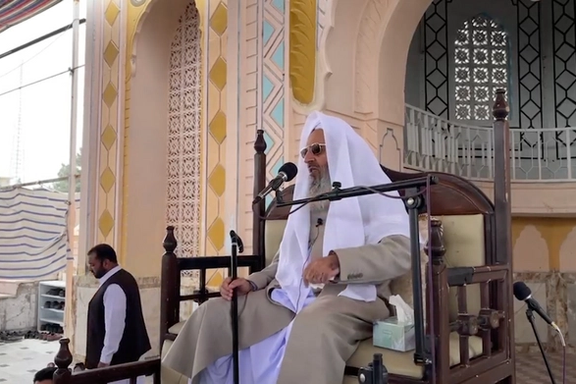
Iran’s leading Sunni leader Mowlavi Abdolhamid during Friday prayer sermons in Zahedan

Iran’s Sunni leader Mowlavi Abdolhamid said there is no hope for a referendum when its results are obvious in the hands of the corrupt regime.

Abdolhamid made the remarks during his Friday prayer sermons before more anti-regime rallies in his province, Zahedan, broke out for the 30th week in a row.

Abdolhamid was among the first regime critics whocalled for a referendum about 50 days into the current wave of protests following the death in custody of 22-year-old Mahsa Amini in September.

At the time, he said: “Now, the majority of people are unhappy. If you don't agree, hold a referendum with the presence of international observers and accept the result.”

By calling for a free referendum to decide the future form of government, Abdolhamid echoed a long-held demand by critics and opponents of the Islamic Republic. However, without international monitoring, the results would be clear and in favor only of the regime.

During his Friday sermon, Abdolhamid pointed to the obvious corruption which would ensue over any elections held in Iran. He said: “The result of a referendum is clear and the solution to the problems is to listen to the people's demands.”

He also touched on the renewed wave of strikes by workers of the country’s factories, particularly by the energy sector’s contract-workers, saying that the national currency has been devaluing and people face serious problems while authorities make no moves.

Since last Saturday, strikes by Iranian energy, petrochemicals and steel workers have been gaining momentum as new firms are joining the nationwide industrial action. On Friday, a government official said four thousand striking workers are being replacedas the action is spreading to dozens of plants.

“Every regime in the world, Islamic or non-Islamic, must stand with its people, and no regime will survive by the force of arms,” stressed Abdolhamid, who is seen as the unofficial voice of the country’s Sunni community – about 10% of Iran’s population of 88 million.

Addressing the military forces of the country, he warned the armed forces of the strength of the masses after months of violent repression against civilian protesters: "My advice to the armed forces is not to stand against the people. You are the sons of the nation, and if the people want change from you, change yourselves.”

Khamenei’s refusal to open a referendum has angered many. During a meeting with a cherrypicked number of students earlier in the month, Khamenei questioned the viability of a referendum and dismissed the possibility of a referendum, saying that people are not capable of making decisions.

In a mockery of the long established democratic political process, the Supreme Leader made the wild statement: “Is it possible to hold a referendum on various issues in the country? Where in the world do they do this? Do all the people who have to participate in the referendum have the ability to analyze that issue?”

Voices calling for a referendum include former regime insider and current opposition figure Mir-Hossein Mousavi, who was a presidential candidate in 2009 and has been under house arrest since 2011, as well as former president Hassan Rouhani. They have cited key issues such as a new constitution and the nuclear program.

Article 59 of the Constitution of the Islamic Republic, which was ironically approved by a referendum after the Islamic Revolution of 1979, stipulates that in extremely important economic, political, social, and cultural matters, the functions of the legislature may be exercised through direct recourse to popular vote by holding a national referendum. It must be approved by two-thirds of the members of parliament according to the Constitution.

Last week, the government’s official daily, Iran, published a commentary about the calls for a referendum, quashing its practicality and insisting that "issues related to national security can be very sensitive”, warning that “holding referendums on these issues may lead to unpredictable and dangerous results”.


Most Viewed

State media slam Araghchi's Hormuz tweet, say it let Trump claim victory
1

State media slam Araghchi's Hormuz tweet, say it let Trump claim victory

2

Iran International says it won’t be silenced after London arson attack

3
INSIGHT

How Tehran bends its own red lines to boost state rallies

4

Iran halts petrochemical exports to supply domestic market

5

US arrests Iranian national over alleged Basij-linked visa fraud

Banner
Banner

Spotlight

  • Too early to tell who is winning Iran war, experts say
    PODCAST

    Too early to tell who is winning Iran war, experts say

  • How Tehran bends its own red lines to boost state rallies
    INSIGHT

    How Tehran bends its own red lines to boost state rallies

  • Iran blackout cripples freelancer, small business incomes
    VOICES FROM IRAN

    Iran blackout cripples freelancer, small business incomes

  • Ideology may be fading in Iran, but not in Kashmir's ‘Mini Iran'
    INSIGHT

    Ideology may be fading in Iran, but not in Kashmir's ‘Mini Iran'

  • US blockade enters murky phase as tankers spoof signals and buyers hesitate
    ANALYSIS

    US blockade enters murky phase as tankers spoof signals and buyers hesitate

  • Why the $100 billion Hormuz toll revenue is a myth
    ANALYSIS

    Why the $100 billion Hormuz toll revenue is a myth

•
•
•

More Stories

Iran Official Threatens Replacing Thousands Of Striking Workers

Apr 28, 2023, 14:07 GMT+1

Four thousand striking energy workers in Iran are being replaced, a government official said Friday, as strikes that began last week spread to dozens of plants.

Sekhavat Asadi, the general manager of special Pars energy region on the Persian Gulf, including many natural gas and petrochemical operation told the official government IRNA news agency that striking workers “will be replaced by 4,000 new workers.” He added that the process already started on Thursday.

Workers in more than 80 companies, including steel workers, across the country joined industrial action, protesting poor working conditions, low wages and rising costs of living, the Council for Organizing Oil Contract-Workers' Protests said April 25.

In recent years, as the Iranian National Oil Company has ceded many operations to quasi-private companies, most of the work is done by temporary contract workers with little pay and no benefits.

The so-called private companies are controlled by military or other state entities, or by well-connected regime insiders who quash labor demands by using government security forces.

Asadi claimed that the strikes are being organized by anti-regime groups, a charge the Islamic Republic often makes to de-legitimize the demands of the workers who earn less than $200 a month.

At the same time he also claimed that “We had no strikes and protests in the petrochemical and gas sectors in recent days and all plants are working with full capacity.”

However, various reports by local media and labor groups indicate widespread strikes in the region.

Workers are demanding a 79-percent pay increase, on-time payment of wages and living amenities.

Iran's Conservatives Fear Losing Upcoming Elections

Apr 28, 2023, 08:18 GMT+1
•
Iran International Newsroom

An influential commentator in Iran says the weak performance of President Ebrahim Raisi's administration has seriously terrified his conservative allies.

Mohammad Mohajeri, a conservative himself and former editor of hard-line daily Kayhan, has said in an interview that conservatives believe the current government has left such a bad record that its opponents are highly likely to win the next parliamentary and presidential elections.

"However, their fear may be baseless as the supporter of reformists and a large part of Iranian voters are not willing to take part in the elections," Mohajeri said, adding that nonetheless, conservatives will continue their smear campaign against relative moderates such as former President Hassan Rouhani, former Majles Speakers Ali Larijani and Ali Akbar Nateq Nouri.

Meanwhile, Mohajeri said in another interview that Iran's reformists and conservatives have influence only among 15 to 20 percent of the society. He also charged that 90 percent of Iran's Friday Prayer Imams belong to the conservative camp and the Friday Prayers are a podium for only one political faction.

However, a national reconciliation is possible in Iran only if the government facilitates the political participation of all political groups in the elections. He added that there is not much time for that as fierce campaigning for the parliamentary elections will start in around two months from now.

Conservative pundit Mohammad Mohajeri (undated)
100%
Conservative pundit Mohammad Mohajeri

He suggested that to facilitate political participation, the government needs to bring about essential changes in economic, political and cultural arenas. He argued that the government's inability to improve the economy will keep deeply disillusioned voters away from the ballot box.

Many people are also currently annoyed by the government's unilateralism. Enforcing compulsory hijab and filtering the Internet have deeply annoyed the people so that they are reluctant to take part in political activities such as voting in the elections.

However, Mohajeri said in the interview that some ultraconservatives including those around the housing minister Mehrdad Bazrpash have already started their campaign.

Mohajeri warned that if the government does anything beyond what has been stipulated in the Constitutional Law, the people will feel their essential rights have been undermined.

Many protesters during the past months chanted slogans against Iran's rigid Constitution which gives every right to hardliner clerics to restrict the freedom of the populace.

Meanwhile, he lashed out at the government's heavy-handed approach against unveiled women and said that it was quite clear from the start that policies such as launching a morality police would face resistance by women.

Agreeing with Mohajeri on the situation of the current government, Sharyar Heidari, a member of parliament told Rouydad24 website in Tehran that in the next election Raisi is not likely to win a quarter of the votes he received in 2021.

Iranian sociologist Nematollah Fazeli (undated)
100%
Iranian sociologist Nematollah Fazeli

In another development, Iranian sociologist Nematollah Fazeli said in an interview with Khabar Online that the government does not have a true understanding of the people's demands. Fazeli said the government would have been at ease to accept some of the demands of the people if they were simply about the economy. But the people's understanding of politics and the gender issue has changed over the years and the government cannot understand that.

"Women had a focal position in the recent movement in Iran although there were other activists too. This is caused by a major development in social knowledge in Iran," he said, which “emanates from within the society and its everyday life and the people's collective experience."

Fazeli added that the understanding what happened in Iran during the past months requires a thorough understanding of women's role, but little attention has been paid to this matter by any government entity. This requires a new look at women and femininity, an issue that has been marginalized after the 1979 Islamic revolution, the sociologist said.

Exiled Prince In Italy To Garner Support For Iran Protests

Apr 28, 2023, 00:37 GMT+1
•
Iran International Newsroom

Iran’s exiled prince Reza Pahlavi, who is on a visit to Italy to galvanize support for the Iranian uprising, visited the Vatican on the second day of his stay on Thursday. 

Iran’s exiled prince Reza Pahlavi, who is on a visit to Italy to galvanize support for the Iranian uprising, visited the Vatican on the second day of his stay on Thursday. 

Earlier in the day, Pahlavi and his wife Yasmine also held a friendly meeting with a group of Iranians residing in Italy before taking a few minutes of their time to meet Elaheh Tavakolian, a PhD student who lost one of her eyes to shotgun pellets fired at protesters by the Islamic Republic’s security forces. She is in Italy to receive treatment for her eye.

Iran’s exiled prince Reza Pahlavi (right), his wife Yasmine (center) and Elaheh Tavakolian, a protester who lost one of her eyes to shotgun pellets fired by the Islamic Republic’s security forces, April 27, 2023
100%
Iran’s exiled prince Reza Pahlavi (right), his wife Yasmine (center) and Elaheh Tavakolian, a protester who lost one of her eyes to shotgun pellets fired by the Islamic Republic’s security forces, April 27, 2023

Wherever the Pahlavis went during their first two days in Italy, they were welcomed by a large Iranian crowd who had gathered to meet the prince. The moment he arrived at the Italian parliament, he was greeted by Iranians who were chanting slogans in support of “King Reza Pahlavi,” saying that they would bring him back to Iran. 

There, he spoke to people about their role in supporting the protests, calling on them to be the voice of the people who are suffering under the regime and do not enjoy the freedom and access to the free world to make their voices heard. “You are the voice of the future,” he told the crowd. 

Iran’s exiled prince Reza Pahlavi (left) and his wife Yasmine speaking to their supporters outside the Italian parliament on April 26, 2023
100%
Iran’s exiled prince Reza Pahlavi (left) and his wife Yasmine speaking to their supporters outside the Italian parliament on April 26, 2023

Your unison and unanimity not only invigorate our compatriots inside the country -- the ones in the Evin prison, or the ones who have lost their eyesight to regime’s bullets, or the schoolgirls who are attacked by chemical gas – but also result in the world hearing your voice,” he said. 

Pahlavi highlighted that the world countries have realized that they should not limit their interactions to the regime, which does not represent the Iranian people. "If I have come here today to talk to the representatives of the governments, it is to make your voice heard and to say that investing in the people of Iran means guaranteeing democracy and freedom in the future and ending the threats of the Islamic Republic," he said. 

During the meeting with the Iranian expatriates Thursday, Pahlavi talked about the transition to the future Iran free of the Islamic Republic, noting that after the collapse of the regime something similar to the South African Truth and Reconciliation Commission would be needed to deal with the crimes committed by regime officials. The commision was established by the new South African government in 1995 to help heal the country and bring about a reconciliation of its people by uncovering the truth about human rights violations that had occurred during the period of apartheid.

On Wednesday, Pahlavi also held a meeting with Senator Stefania Craxi, a member of the Chamber of Deputies, where he also held a presser following his talks with several other Italian parliamentarians.

During the Wednesday press conference, the leading opposition figure reiterated his call on world countries to support the uprising of the Iranians, saying, “We all recognize that sanctions are perhaps to some great extent able to weaken such regimes and limit their means to repress their own citizenry... it is of course necessary but not sufficient because at some point there has to be an element of direct support to the citizens.”

He went on to emphasize that it is of great importance for the people of Iran, especially the victims of the regime, to see and feel “that they are not alone, and the world has finally heard their voice and are taking actual measures to support them and further punish the regime.” 

“My political mission in life is to see to a transition,” he said, highlighting that “at the end of the day it's the Iranian people who make the final decision for their future.” He added, “for me that mission ends the day that the Constitutional project is offered to the nation by the Constitutional assembly and ratified by means of a referendum which will then establish the future system in Iran.” 

Since the beginning of the "Women, Life, Freedom" movement, ignited by the death in custody of 22-year-old Mahsa Amini in September 2022, well-known figures of the Iranian opposition, such as Pahlavi, have been holding meetings with the government and parliamentary officials of Western countries hoping to further isolate the Islamic Republic in the global community and ensure support for the Iranians. 

Prominent Political Activist Arrested At His Home In Tehran

Apr 27, 2023, 21:22 GMT+1

Iranian political activist and a former political prisoner, Abdollah Momeni, was arrested in his home in Tehran on Thursday.

While searching his house the security agents also seized his telephone and laptop.

Momeni is one of over 400 civil and political activists who, in a statement had said that the only violence-free and democratic solution for transitioning from the Islamic Republic is "appeal to the nation's votes by holding a free referendum.”

The detention of Momeni is part of a recent wave of arrests of political and civil activists, including Qorban Behzadianejad, Keyvan Samimi and Alireza Beheshti Shirazi.

The charges against these people have not been announced yet, but it seems they were arrested after participating in the "Dialogue to Save Iran" conference.

Over 40 political, social and human rights activists from inside and outside Iran for the first time attended a virtual conference called “Dialog To Save Iran” on Friday.

The meeting, which was held on Club House social media platform, also heard from eight detained activists who sent messages from inside prisons in Iran.

In his message, Keyvan Samimi, a journalist and political activist, who was rearrested last week, said Iranians everywhere should form a united national front to get rid of oppression.

Imprisoned human rights activist Narges Mohammadi also said in a message that “To save Iran, we must end the tyrannical, anti-woman regime and make a peaceful and low-cost transition for the people.”


Thousands Lose Jobs In Iran Due To Closure Of Businesses For Hijab

Apr 27, 2023, 20:39 GMT+1
•
Maryam Sinaiee

As the Iranian regime closed at least 2,000 businesses since late March for women’s refusal to wear compulsory hijab, tens of thousands have lost their jobs.

Reformist Shargh daily in a report Thursday said statements by the police and other officials about the implementation of a campaign against hijab-lessness indicate that around 2,000 businesses – including restaurants, cafes, tourist accommodations, retail shops and even a counseling clinic and a gym -- have suffered closure in the past month only. 

On Tuesday hardline media reported that some businesses, mainly restaurants and cafes, owned by celebrity artists and popular footballers have been shut down or received warnings over defiance of hijab rules by their staff and customers.

Authorities also announced on the same day that they had shut down Opal Mall, a massive modern shopping center with over 450 businesses in Tehran. Shargh said the closure of the mall alone has resulted in the loss of around 2,500 jobs.

Woman has a seizure at a shopping arcade in northern Iran after hijab enforcers fire their guns during a scuffle with business owners.

At the start of the month, Iran’s 83-year-old ruler Ali Khamenei reiterated the regime's stance on hijab, which became mandatory after the establishment of the Islamic Republic in 1979. He said: “Discarding hijab is haram (sinful) based on Sharia and also politically."

His declaration was a clear signal to all state and religious authorities to do anything it takes to re-establish control over women who are increasingly joining the civil disobedience movement against forced hijab rules.

However, legal experts say closure of businesses is unjustified even based on the Islamic Republic’s own laws and the Sharia.

“Has anyone ever heard of a street being banned because of a murder that happened there? Or is it possible to shut down a government office because of corruption? … Businesses cannot be sealed because someone removes their hijab there,” Mohammad Mansouri-Boroujeni, a professor of law at Esfahan University wrote in a commentary on April 20.

A group of Iranian women unveiling in public (undated)
100%
A group of Iranian women unveiling in public

Mohsen Borhani, an Islamic law expert and lawyer, argued in a tweet that nowhere in Sharia one can find reasons to justify the ban on selling commodities to hijab-less women or to shut down a shop if a hijab-less woman is spotted there. “You neither abide by the law, nor the Sharia. It’s flustering!” he tweeted April 18.

The police have also said they are prosecuting those who promote defiance of the compulsory hijab on social media and have warned hundreds of imminent prosecutions, placed hundreds of “hijab promoters” on the streets to warn women, and banned entrance of unveiled women to museums and other public venues.

Hijab banner in Tehran says it is mothers’ legacy for their daughters.

Tehran municipality has recently put up hundreds of banners on the streets to promote the hijab. “Hijab is the legacy of mothers,” one such banner which shows a mother donning a black veil on a very young girl says while another equates opposition to the compulsory hijab to destroying “the foundations of families.”

“My mother did not wear the hijab. Neither did my grandmother. I’d like to adhere to my own heritage,” a woman said in a video of one of the hijab banners she sent to Iran International.

In a tweet with a photo of the woman who protested the compulsory hijab, another woman said fighting against the compulsory hijab was “mothers’ legacy”

The recent campaign to enforce hijab rules has caused some violent incidents involving pro-hijab vigilantes and women who defy it. A 60-year-old woman had a cardiac arrest this week when a fight broke out between vigilantes and members of her family over hijab.

A member of the family of Kolsum Oftadehpour told Iran International TV that there was no autopsy and authorities did not allow them to see the body before and during the burial which they carried out without the family’s involvement. The family have been threatened not to talk, he said.





