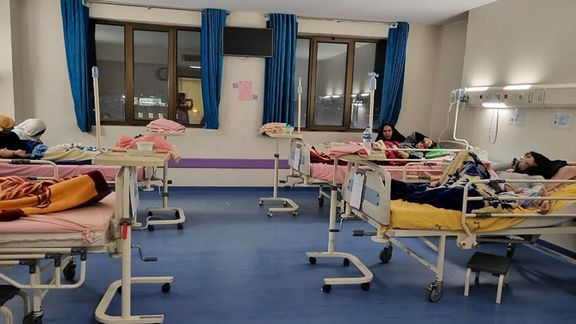
Some of the schoolgirls hospitalized with symptoms of poisoning
Iran's intelligence ministry said poisonous gas attacks on girls’ schools were pranks, blaming “enemies” for taking advantage of the incidents to discredit the regime.
In a statement Friday, the ministry denied any indication that poisonous substances had caused the illness of students and said samples taken from the scene of the incidents examined by “the most reliable laboratories” in the country had not yielded any suspicious materials.
The report followed months of demands by people on social media and even some newspapers for the government to tell the public what was happening to schoolgirls.
The ministry attributed the hundreds of hospitalizations to stink bombs (stinkpots) often used for creating unpleasant smells by pranksters, pepper sprays, tear gas and similar substances used by students to disrupt classes. It even mentioned spurious causes, such as gas fuel leak from vehicles and urban gas, smoke from trash burning outside schools, and mass psychogenic illness resulting from stress.
However, some of the students had to be hospitalized for up to a week due to the severeness of their symptoms but most others were released within hours. In some cases, symptoms have lasted for weeks.
It also claimed that nearly all the students hospitalized following the incidents had recovered by simple treatments such as oxygen, saline and dextrose intravenous injections, and sedatives to treat anxiety.
A young woman lies in hospital after reports of poisoning at an unspecified location in Iran in this still image from video from March 2, 2023.
A considerable number of students had faked illness after other students in the same class or school said they were ill, and the most reported cases of illness were in the southwestern province of Khuzestan.
The poisonings started in the religious city of Qom in central Iran November 30, but the intelligence ministry claimed that the first incident had taken place in Noor, Mazandaran Province, much earlier on November 6, and spread to other provinces in late February.
Many Iranians believe that the attacks which mainly target girls’ schools were perpetrated by the regime itself or a network of extremists who wanted to scare girls and keep them away from schools and called it “state terrorism”, but the ministry denied the existence of any such network.
The ministry tried to blame social media for the incidents, saying that suspicious networks spread rumors.
Naturally, once the attacks began, thousands of people began discussing it on social media.
However, after months of incidents at schools, police have not arrested anyone, although they have made vague claims of detaining 100 suspects.
The statement accused “foreign enemies” and media outside Iran, particularly those broadcasting in Persian, of using school poisoning incidents to ignite unrest because the Mahsa protests that started in mid-September had begun to subside.
In some cases, the statement claimed, the incidents were perpetrated with “anti-security goals against the people” by those who wanted to make footage of these incidents and send them to “hostile Persian-language media” outside Iran. “Perpetrators of such cases were arrested in most cases and handed over to judicial authorities,” the ministry said.
Again, the government has produced no proof of any such arrests, as they blame any negative incident or news to foreign enemies.
These “individuals with hostile motivations”, the ministry’s statement said, were under investigation to reveal their possible connection with terrorist organizations such as the Mujahedin-e Khalq Organization (MEK).
The police chief alleged that the accused had also made recordings of the school attacks and sent it to “hostile media including Iran International TV”. He claimed that the accused girls confessed they wanted to create an atmosphere of insecurity in schools and defame the Islamic Republic.
The Liberian-flagged oil tanker Ice Energy transfers crude oil from the Iranian-flagged oil tanker Lana (former Pegas), off the shore of Karystos, on the Island of Evia, Greece, May 26, 2022.
The United States says that Panama has removed 30 Iranian vessels designated by Washington from its shipping registry, and they have been re-flagged as Iranian vessels.
A State Department spokesperson told Iran International’s Samira Gharaei Friday that the US Treasury Department updated its Specially Designated Nationals and Blocked Persons List (SDN list), marking the change in the status of these vessels.
“This SDN list update reflects the strong and long-standing partnership between the United States and Panama on respect for US sanctions in the maritime context.
We routinely work with Panama and other countries to ensure that their shipping registries are not abused by entities seeking to circumvent US sanctions on Iran.
Consistent with Panama’s domestic laws and international commitments, they have de-flagged hundreds of vessels since 2019,” the spokesperson said.
The US has designated hundreds of Iranian and other individuals, companies and vessels for suspected links to Tehran’s support for terror activities or assistance in Iran’s nuclear and missile programs.
There are also US sanctions on sectors of Iran’s economy as well as weapons programs. Many have also been designated for violating these US sanctions.
In most instances, US sanctions are also third-party sanctions, meaning any individual or entity breaking the rules will be separately be designated.
“We will continue to work with partners like Panama to ensure their registries and jurisdictions are not abused by entities attempting to evade our sanctions on Iran,” the State Department said.
Saudi Arabia and Iran will open embassies in each other's capitals "within days," Iranian Foreign Minister Hossein Amir-Abdollahian said on Friday.
The two countries agreed March 10 to revive relations after years of hostility, with China’s mediation.
Speaking at a news conference in the Lebanese capital Beirut, Amir-Abdollahian did not give specific dates for the reopening of the embassies. The parties had agreed to restore full relations in two months.
The Iranian and Saudi embassies in the respective countries have been closed since 2016. The relationship started deteriorating in 2015 following the intervention of Saudi Arabia and the UAE in the Yemen war, after the Iran-aligned Houthi movement toppled the Saudi-backed government and seized control of the capital Sanaa.
Saudi Arabia accused Iran of providing weapons to the Houthis who attacked Saudi cities with armed drones and ballistic missiles. In 2019, Riyadh accused Tehran of being responsible for an attack targeting Aramco oil facilities, which resulted in stopping half of its oil production.
Iran denied those accusations.
The tension between the two regional rivals has fueled conflicts across the region, including the Syrian civil war.
"During the last phone call between the foreign ministers of Iran and Saudi Arabia on Eid al-Fitr, we agreed to work in the next coming days on the reopening of the Iranian and Saudi embassies in Tehran and Riyadh," Amir-Abdollahian said, according to the official Arabic translation.
When asked about a reported visit by Iranian President Ebrahim Raisi to Damascus, Amir-Abdollahian confirmed it, saying there was a "program" put in place for "the near future" without indicating a specific timeframe.
Syrian President Bashar Assad (left) and his Iranian counterpart Ebrahim Raisi during a meeting in Tehran on May 8, 2022
President Ebrahim Raisi is slated to travel to Damascus next week in the first visit by a head of the Iranian government to Syria in over a decade.
According to a senior regional source close to the Syrian government quoted by Reuters on Friday, a détente in ties between Riyadh and Tehran, as well as a thaw in Syria’s isolation among Arab states, have paved the way for the visit.
Since war broke out in Syria in 2011, no Iranian president has visited the country despite the Islamic Republic’s continuous military involvement and economic support to President Bashar al-Assad. Thanks to Iran and Russia, Assad was able to turn the tide of the conflict and regain control of most of his country.
The Syrian daily al-Watan, a privately owned government-aligned outlet, reported that Raisi's visit would last two days and a string of agreements, particularly on economic cooperation, would be signed during his stay.
Earlier this month, regional sources revealed that the Islamic Republic had been using the opportunity of earthquake relief to smuggle weapons and military equipment into Syriafollowing the devastating February earthquakes in Syria and Turkey. The fact that humanitarian relief is not subject to sanctions, makes it all the easier for Iran to capitalize on the catastrophe.
Syria became a key battleground between Iran and its adversaries, as Iran buttresses the threat from Israel and strengthens the Assad regime. Strikes in recent weeks by Israel have seen Iranian military figures killed from the Revolutionary Guards and Quds Force in Syria, as well as targeting weapons factories and infrastructure in Iran.
Iranian Foreign Minister Hossein Amir-Abollahian during a press conference in Lebanon on April 28, 2023
Iran’s foreign minister met with two of the regime's terror proxies during a visit to Lebanon, during which he was snubbed by Lebanese opposition.
Hossein Amir-Abdollahian, met with the head of Iran’s most dangerous proxy, Hezbollah, as well as the head of the Palestinian Islamic Jihad Movement (PIJ) while Lebanese politicians boycotted the diplomat after a request to meet at the Iranian embassy in Beirut.
The embassy had invited all parliamentary blocs to the meeting except for MP Michel Mouawad - a presidential candidate running against Hezbollah-backed Suleiman Franjieh - and nine members of the Change bloc.
According to Asharq al-Awsat newspaper, the embassy had only invited MPs Melhem Khalaf, Yassine Yassine and Elias Jradi from the Change bloc, disregarding others vocally opposed to Iran’s political interference in Lebanon where it funds its most dangerous proxy, Hezbollah.
The Kataeb Party, the National Liberal Party and a number of independent lawmakers had announced their boycott of the meeting, which was finally attended by only 16 out of 25 of the invited MPs, the majority from the Hezbollah-led camp.
Hezbollah is responsible for major terror attacks across the world and is designated a terror group by states including the US and UK, as well as the EU and the Arab League.
Amir-Abdollahian also held a meeting with Lebanese Prime Minister Najib Mikati, in which the regime’s leading diplomat urged political factions in Lebanon to speed up the presidential elections. Since former president Michel Aoun's term expired on 31 October, there has been no agreement on who shall succeed him.
Worsened by revolutionary unrest, Iran jailed three times the number of writers in 2022 than 2021 as it cracked down on voices of dissent.
The findings, from PEN America’s latest Freedom To Write Index, puts Iran in second place globally, only beaten to the top spot by the dictatorship of China.
The crackdown on anti-government protests after the death in custody of 22-year-old Mahsa Amini in September led to the particular targeting of writers and artists alongside other cultural figures, celebrities and athletes.
The numbers of those jailed rose from 22 in 2021 to 57, with one third of those behind bars now women, whose numbers rose from five to 16. The global study found that Iran jailed more than one-third of the total number of women writers jailed worldwide, 16 of 42 as the regime cracks down on the women led protests sparked by the death in custody of 22-year-old Mahsa Amini.
Some of the country’s leading voices have been severely punished, including Nasrin Sotoudeh, who was threatened with being returned to jail after speaking to or writing for international media outlets; author and activist Narges Mohammadi, who bravely continued to speak out from Evin prison; and writer Golrokh Ebrahimi Iraee, arrested in September.
Nasrin Sotoudeh, a prominent Iranian human rights lawyer
“Iran’s creative community—long at the forefront of fighting for free expression and human rights—was singled out as part of a broader crackdown on dissent in 2022,” said Karin Deutsch Karlekar, PEN America’s director of Free Expression at Risk Programs.
“Alongside the dozens of writers and artists detained, the harsh sentences handed down and custodial abuse faced by some prisoners were an attempt to warn others to keep silent.”
In 2022, 311 writers were jailed globally according to PEN America, whose database contains 813 active cases from over 80 countries of writers, poets, online commentators and journalists at risk for their writing.
Karlekar called on the United Nations Human Rights Council, Special Mandates, and newly-established Independent International Fact-finding Mission on the Islamic Republic of Iran to include a consistent focus on writers and artists in their investigations, reports, and public statements.
In its systematic targeting of writers, artists, and dissenting voices with arrest and detention, the Iranian government often deploys spurious charges based on national security or “propaganda against the state” to charge and sentence individuals. Some alleged “offenses,” such as mohrabeh, or “war against God,” potentially carry the death penalty.
Rapper Toomaj Salehi
The government has also singled out artists and singers whose work was critical of ruling authorities and explicitly addressed either political or social themes, including rappers Saman Yasin and Toomaj Salehi, both arrested in October and charged withmohrabeh, or “enmity against God,”. Both men have undergone torture in custody.
Poet and filmmaker Baktash Abtin died a tragic and preventable deathin custody on January 8, 2022, after authorities repeatedly refused to provide him needed medical care. Severe abuse was also recorded in the case of blogger Hossein Ronaghi, detained in late September, subjected to ill-treatment in custody and denied medical care.
Poet and filmmaker Baktash Abtin
Shorter periods of detention have also been handed down to several dozen writers and poets supporting the protests, many of whom have also suffered torture and mistreatment in Iran’s brutal jails.
These have included the poet and theater director Amirhossein Barimani, literary writer and commentator Farshid Ghorbanpour, and poets Mona Borzouei, Behnaz Amani, Atefeh Chaharmahalian, Behrouz Yasemi and Saeed Heleichi.
Kurdish researcher Mozghan Kavousi
Writers advocating for ethnic or religious minority rights continue to be particularly targeted, including Kurdish language teacher and rights advocate Zahra Mohammadi, Kurdish researcher Mozghan Kavousi, and Bahai writer and poet Mahvash Sabet.
Since protests began in September, over 500 civilians have been killed by regime security forces with around 20,000 arrested. At least four executions have taken place for protesters and an unconfirmed number of many others sentenced to death for their role in the uprising.
Rights groups say executions last year rose by 75% on the previous year with at least 582 people put to death in 2022.