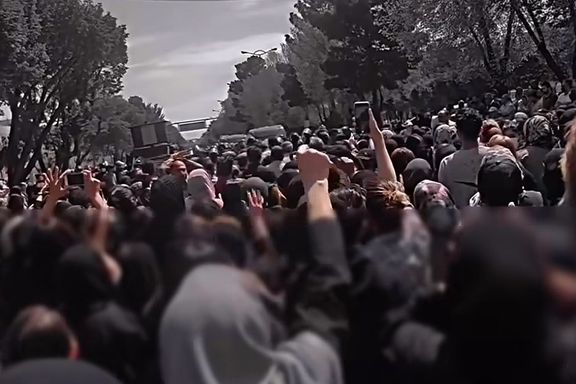
Parents and students protesting in Shahin-Shahr on April 15, 2023
Riot police in central Iran Saturday tried to disperse a large crowd of people with tear gas and shotguns who were protesting ongoing gas attacks on schoolgirls.
Parents and students who gathered spontaneously outside the education department of Shahin-Shahr, near Esfahan Saturday morning soon began chanting anti-government slogans. “We don’t want a child-killing government,” they chanted.
According to Hosseinali Haji-Deligani, representative of the district in the parliament, twelve schools were attacked in the city of around 175,000 on April 11.
Videos posted on social media also show people chanting “Down with the Dictator” and “Down with those responsible for the poisonings” and a member of the security forces threatening them over a loudspeaker.
Some of the women protesting in Shahin-Shahr, as videos show, attended the rally unveiled in defiance of the government’s new attempts to re-establish strict hijab rules.
Dozens of schools have been targeted by unidentified people using chemicals in various cities across the country including Esfahan, Tabriz, Shahin-Shahr, Genaveh, Kermanshah, Oshnavieh, Kamyaran, Ardabil, Sanandaj, Orumieh, Karaj, and Pardis to the south of the capital since the reopening of schools and dozens of girls have been hospitalized.
Attacks against girls’ schools started in November and subsided before the Iranian new year in March, but they have resumed in full force.
Many believe that the attacks are a coordinated effort by state-protected religious vigilante groups or the state itself to frighten students and their parents so that they will keep away from anti-government protests or even education for girls.
Women and girls having been at the forefront of anti-government protests that began in mid-September following the death of the 22-year-old Mahsa Amini in the custody of ‘morality police’. They have burned their headscarves and cut their hair in defiance of the regime, and many are vowing they will never wear the compulsory hijab again.
On Saturday several new attacks were reported in Izeh in the southwestern Khuzestan Province, Sanandaj, the capital of Kordestan Province and other cities. A call to protest outside the education department of Izeh on April 16 and 17 has been circulating on social media. The city of around 100,000 was the scene of some bloody protests in November and December.
Demonstrations were also held in the Kurdish majority city of Saqqez on April 9 after half a dozen schools were attacked. Protesters who chanted anti-government slogans and lit bonfires on the streets were similarly attacked by security forces and several protesters were arrested.
The principal of one of girl’s schools attacked in Saqqez last week resigned in protest to the authorities’ failure to find the perpetrators of the attacks. Parshang Ranjbari said her resignation should be considered as “civil protest”.
The scale of the intentional poisoning of female primary and secondary school students -- which started in the religious city of Qom - and reached schools in large and small towns and villages across the country has almost become a daily occurrence but deeply concerned parents are still waiting to see the authorities find the perpetrators.
Officials and the state media have continuously tried to downplay the seriousness of the incidents and the press were warned by the Islamic guidance ministry this week not to give coverage to news of the poisonings and even ignore “unreliable sources including some authorities in the province who may not be informed” to avoid “serious damage to the country.”
Meanwhile, on Saturday the police officially commenced using public CCTV images and image recognition software to identify and prosecute women who defy the strict Islamic dress code and hijab rules in a bid to end the ever-increasing appearance of “hijabless” women in public.
Many express outrage that surveillance cameras can be used to track women for not wearing hijab, while the government has failed to identify vigilantes attacking schools.
A Khamenei poster defaced with black paint in Iran in October 2022
Angry Iranians have ripped banners depicting IRGC’s Qasem Soleimani, and Supreme Leader Ali Khamenei during a football match in the southern city of Kerman.
The incident took place Friday during a match between popular football club Persepolis FC and Sanat Mes Kerman FC. It is not clear what triggered the protest.
Videos received by Iran International show the torn banners while spectators chant anti-government slogans with police using tear gas to disperse them. One citizen who shared a video says twice football fans ripped the posters and in the second half of the game they had to remove the banners.
Soleimani, who was Iran’s top military and intelligence operator in the Middle East, was killed by a targeted US drone strike on January 3, 2020, directly ordered by former US president Donald Trump.
Several pictures and statues of the Islamic Republic leaders and important figures were set on fire in recent months as anti-government protests and strikes have taken place on a regular basis in many cities throughout the country.
Statues and pictures of Khomeini, Khamenei, and President Ebrahim Raisi as well as the slain IRGC Quds Force Commander Qasem Soleimani are the top targets for the political vandalism.
As poverty is soaring in Iran and the regime keeps failing to deliver on its promises, such acts of political vandalism are growing across the country.
Many Iran watchers believe that one of the main reasons for the nationwide protests was that people have lost their hope and confidence in the future of their country.
The former head of the Tehran City Council Mohsen Hashemi has said this week that lack of hope and trust in the future was a factor in the ferocity of the protests.
Prominent sociologist Mohammad Fazeli has also said that hope in the future of Iran has weakened among the public and this casts a shadow of doubt on any solution that the government might offer for long-standing problems.
Former head of the Tehran City Council Mohsen Hashemi
Pundits from the two extremes in the Iranian political landscape, reformist commentator Abbas Abdi and conservative pundit Mohammad Mohajeri spoke to Tejarat Farda magazine’s issue published in late March about the outlook of Iran's political landscape as the new Iranian year began. The magazine's editor Sadaf Samimi concluded that their views about the future of Iran and what happened last year are strikingly similar.
Abdi opined that the Islamic Republic was under pressure from the protests and the foreign-based opposition.
"I believe the next two years will definitely bring about major changes in Iran." He did not expand on the nature of those changes but said, "Iran has many potentials for improvement, but this does not mean that today's official policies can continue."
Mohajeri said that last year's protests created a very good opportunity for the Iranian regime. Although the protests were threatening the regime, they also signalled dangers that alerted the regime. Mohajeri added that Iranian officials attributed the protests to the intervention of foreign countries, but they realized that the protests have their roots inside the country.
He observed that previous protests in Iran were motivated by economic problems, but this time there was no talk of the economic grievances among the protesters.
"Although everyone knew that there were problems relating to the people's livelihood, and nearly all of those arrested during the protests were coming from the lower strata…the main problems the protesters were concerned about were political and cultural issues.”
Conservative pundit Mohammad Mohajeri (left) and reformist commentator Abbas Abdi (right)
The two pundits however agreed that the receding of street protests did not mean that the movement is over. Anything can re-ignite the protests, they said.
Abdi said it is essential that major changes take place in Iran during the next two years, but the Iranian government seems incapable of problem solving. This is a government that does not accept even clear facts such as rising meat prices and in one instance banned a newspaper that published the news. The first thing that should be reformed in Iran is the media, he said that even do not cover recent gas attacks on girls' schools.
On the other hand, the government is not aware of the impact of international reporting, such as CNN's report on torture in Iranian prisons, Abdi said. More competitive election and equality before the law are essential to restore a semblance of normality.
Mohajeri said the people have lost their trust in the government so that even if it disseminated factual news, still people would not believe the government. This trust has been lost over many years.
He said, When the officials promise that the rate of exchange and market prices will come down but the opposite happens, the people have every right not to believe them again. He added: Although I believe the officials have realized the truth following the protests, I still have not received a signal that would indicate the likelihood of an improvement in the next year.
A group of Iranian women walking in public without the mandatory hijab
A group of UN human rights experts said Friday that Islamic Republic’s repressive measures to enforce hijab epitomize gender-based persecution.
The experts argued imposing compulsory veiling on girls from the age of seven at the start of elementary school are a manifestation of gender-based persecution and would lead to unacceptable levels of violations of the rights of women and girls in Iran.
The group is comprised of Javaid Rehman, UN Special Rapporteur on the Situation of Human Rights in Iran and four other special rapporteurs.
“It is deeply worrying that after months of nationwide protests, including against restrictive hijab laws, and following the death of 22-year-old Mahsa Amini in the custody of the morality police, Iranian women are increasingly facing harsh and coercive measures by State authorities,” the UN experts said.
The uprising that was sparked by the death in police custody of Amini has made it increasingly difficult for the clerical regime to enforce the mandatory Islamic dress code. Appearing in public without a full veil has become a common sight even in small and more conservative towns. Since the beginning of the ‘Women, Life, Liberty’ movement in September last year, thousands of girls and women have set fire to their headscarves in a symbolic move and voiced opposition to compulsory hijab.
To avoid the public backlash over the violent enforcement of hijab laws, the Islamic Republic has recently begun implementing a wide range of measures from public humiliation tactics -- such as preventing women without hijab to enter subway stations and public places -- to using traffic cameras to identify hijabless women.
An Iranian woman without the mandatory hijab in public
The authorities seek to enforce hijab through new methods and announced that women who unveil in public will be deprived of social services such as cellphone lines and mobile internet access. The new punitive measures also include blocking the bank accounts of women and impounding cars in which women remove their hijab.
The situation is extremely grave for students because all the education centers are controlled by the regime, and they can easily be expelled or suspended if they disregard mandatory hijab. The Ministry of Education has also announced recently that educational services will not be provided to students who do not comply with the rules of “chastity and hijab” – undermining their fundamental right to education.
The government can also ban women who unveil from leaving the country and exclude them from government or public positions for not observing its strict interpretation of the Islamic dress code.
The Islamic Republic, founded in 1979, is the only Muslim country other than Taliban ruled Afghanistan with such a strict interpretation of hijab and nationwide coercive measures for its observance, while Islam is the official religion in 26 countries in Asia, sub-Saharan Africa, North Africa, and the Middle East.
Decrying the compulsory veiling laws that are enshrined in Iran’s penal code, the UN experts pointed out that such laws allow authorities to subject women to arbitrary arrests and detentions, and deny them access to public institutions, including hospitals, schools, government offices and airports, if they do not cover their hair.
“These additional repressive measures would further exacerbate the negative impact of the compulsory hijab laws. Criminalizing refusal to wear the hijab is a violation of the right to freedom of expression of women and girls and opens the door to a range of other possible violations of political, civil, cultural and economic rights,” they said.
The rules extend to managers and business owners, who will effectively act as “police” to enforce the compulsory veiling in the event of non-compliance by female employees.
“These restrictive measures and repressive policies that do not rely on laws or legal process, but on enforcement by a range of State authorities and private actors are at the heart of the State's control over the public and private lives of its citizens, particularly women and girls. These draconian measures impose de facto social and economic paralysis on women who refuse to comply with these laws,” the experts said.
Although it may seem futile to Iranians, the UN experts concluded their statement by a call on the authorities to amend the Constitution, repeal existing gender discriminatory laws, and abolish all regulations whereby women's dress or behavior in public or private life is monitored and controlled.
Amid nationwide state-sponsored anti-Israel rallies, people of Zahedan held another round of antiregime protests following their Friday prayers.
The city’s prominent Sunni cleric, Mowlavi Abdolhamid, delivered another fiery sermon criticizing the regime for its heavy-handed crackdown on protesters, particularly women who have revolted against the Islamic Republic’s compulsory hijab rules.
Referring to the renewed wave of chemical attacks against schoolgirls across the country, he slammed the authorities who want to use traffic cameras to identify women who remove their headscarves in public but would not use the cameras to arrest the perpetrators of poisonous gas attacks on girls’ schools.
When the perpetrators of these attacks are not identified in a country which uses numerous surveillance devices, it means that these incidents have "roots in the system". This is why people do not believe the authorities and think that the regime is implicated in the attacks, he said.
During the past weeks, Abdolhamid had said several times that the chemical attacks are the regime’s revenge against the teenage girls who protested against the Islamic Republic, especially following the death in custody of 22-year-old Mahsa Amini in September 2022.
More than 300 schools have been targeted since November 2022, without any apparent effort by the government to seriously pursue the perpetrators or explain to terrified parents and students what was happening in so many schools.
Earlier in the week, Moineddin Saeedi, a member of the Iranian Parliament from Chabahar in Sistan and Baluchistan Province, also said, "If these cameras can detect crimes to such an extent, why are we currently facing the poisoning of girls?"
The cause of death for hundreds of people who died during the protests of "Women, Life, Liberty” movement is stated as "unknown", and the death certificates of dozens of others attested the use of "live fire and bullets" as the cause of death.
One of the death certificates published by 1500tasvir
Other causes of death mentioned in the certificates are ruptures of veins or blood vessels, crushing of the skull, hemorrhagic shock (loss of a large volume of blood), and severe tissue damage, all of which point to injuries caused by the security forces’ bullets and batons.
In several cases, the words live fire or bullet are intentionally avoided and replaced by alternative terms such as "accelerated metal projectile" or “metal object."
There are several cases in which the cause of death is declared as “unknown” despite testimonies by eyewitnesses who were present at the scene and directly testified otherwise. These include the cases of Mehrshad Shahidinejad and Sina Malayeri, two protesters who were beaten to death by batons during rallies in the city of Arak according to eyewitnesses.
One of the death certificates published by 1500tasvir
In one of the certificates published by 1500tasvir, the cause of the death of Behnam Layeghpour was declared as “violence by other protesters” despite his family's account of the incident. Layeghpour was reportedly shot two times in his throat and chest from close range in October as his fiancée was watching. A security agent stood over him and prevented people from helping him at gunpoint.
Human rights sources have reported the death of over 500 protesters, including about 70 children, during nationwide protests sparked by the death of 22-year-old Mahsa Amini in the custody of hijab police in September 2022.
There are no official reports about the number of casualties but several rights groups, such as the US-based Human Rights Activists News Agency (HRANA), have put the death toll at way more than 500.
One of the death certificates published by 1500tasvir
In addition to the people who were killed during the regime’s crackdown on street protests, the Islamic Republic has also stepped up its executions in the past several months.
Iran Human Rights organization and the ECPM (Ensemble contre la peine de mort or Together Against the Death Penalty) released on Thursday their latest annual report on the death penalty in Iran, revealing that 2022 had the highest annual number of executions since 2015. At least 582 people were executed, an increase of 75 percent compared to 2021.
The cover of the report on the Islamic Republic's executions
The report said that in 2022, the Islamic Republic’s authorities “demonstrated how crucial the death penalty is to instil societal fear in order to hold onto power,” adding that 88 percent of all executions (511), were not announced by the regime.
According to the report, at least 15 people, among them two protesters, were executed for security-related charges. It also claimed that hundreds of protesters were facing show trials at the Revolutionary Courts, many with charges punishable by death.