• العربية
  • فارسی
Brand
  • Iran Insight
  • Politics
  • Economy
  • Analysis
  • Special Report
  • Opinion
  • Podcast
  • Iran Insight
  • Politics
  • Economy
  • Analysis
  • Special Report
  • Opinion
  • Podcast
  • Theme
  • Language
    • العربية
    • فارسی
  • Iran Insight
  • Politics
  • Economy
  • Analysis
  • Special Report
  • Opinion
  • Podcast
All rights reserved for Volant Media UK Limited
volant media logo

China Pursues Peace While US Meddles In Region - Envoy In Tehran
Iran International Newsroom
Apr 11, 2023, 07:37 GMT+1Updated: 17:46 GMT+1
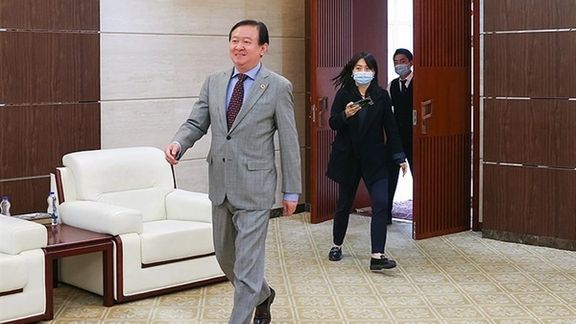
Chinese Ambassador To Iran Chang Hua on April 10, 2023

China's ambassador in Iran says Beijing’s mediation between Iran and Saudi Arabia stems from it desire to solve global security issues, not self interest.

In an exclusive interview published Monday by Tasnim news agency, affiliated with the Revolutionary Guards, Ambassador Chang Hua spoke about the reestablishment of relations between Iran and Saudi Arabia, the US troops in the region, and prospects of ditching the dollar in bilateral transactions among other things.

No Chinese media or Iranian media released a transcript of the interview, therefore Iran International cannot independently verify the readout published by the IRGC outlet.

Throughout the interview, Chang used every opportunity to gloat over Beijing’s role in the rapprochement between the arch-rivals, the Islamic Republic and the Al Saud and also reiterating that the US is in decline.

The long-term strategy for long-term peace and stability in the world is to take a new security path with dialogue instead of confrontation, and a win-win policy instead of a zero-sum strategy, the Chines diplomat said.

Chinese Ambassador To Iran Chang Hua during an interview on April 10, 2023
100%
Chinese Ambassador To Iran Chang Hua during an interview on April 10, 2023

The talks between Iran and Saudi Arabia in Beijing have provided new examples and ideas for solving global security issues, he was quoted as saying, promising that China will continue to do its best to provide necessary support to Iran and Saudi Arabia and help promote security and stability in the Middle East.

The United States and Western countries make the best use of their hegemony of public opinion, and manipulate contentious issues through deceptive propaganda, he said, claiming that continuous interventions in the Middle East is their tactic to maintain their hegemony.

Chang said that “the Beijing agreement between Iran and Saudi Arabia” was welcomed by the international community but Washington accused China of “entering the Middle East for energy,” which show the evil intentions of the US. “Foreign interference is an important factor that weakens the security and stability of the Middle East... The US has committed serious human rights violations and many other crimes in the region, which has caused permanent and irreparable damage to the countries and people of the region,” Tasnim quoted Chang as saying.

He also urged the international community, especially influential countries outside the region, to respect the sovereignty of the countries of the Middle East and not to interfere in their internal affairs.

“As a good friend of the Middle East countries, China has no personal interest in the region, and has always been committed to the settlement of hot political issues,” he claimed, according to Tasnim.

Following the China-brokered deal to restore ties, the foreign ministers of Iran and Saudi Arabia met in Beijing for the first formal meeting in more than seven years on April 6. After years of hostility that fueled conflicts across the Middle East, Tehran and Riyadh agreed to end their diplomatic rift and re-open embassies in a major deal facilitated by China last month.

Critics in the US have blamed the Biden Administration for pushing Saudi Arabia toward China by pursuing the restoration of the 2015 nuclear deal with Tehran and losing the trust of Saudi leaders, as the great power in the region. The US believes China has a role to play in telling Iran to end its “destabilizing activities,” the State Department said as Iran’s president visited Beijing in mid-February.

However, as Iran moves closer to Russia and China, leading Iranian lawmakers and pundits have warned the government against over-reliance on Moscow and Beijing.

Earlier in the month, a moderate Iranian news website claimed that the Islamic Republic’s frozen assets in China are worth between $22 and $30 billion, suggesting that amid US sanctions even Tehran’s close ally is not willing to pay back its debts.

Most Viewed

Ghalibaf defends Iran-US talks amid hardline backlash
1
INSIGHT

Ghalibaf defends Iran-US talks amid hardline backlash

2
INSIGHT

100 days after carnage: Iran economy reels from war, inflation, unemployment

3
INSIGHT

A nation in limbo: 100 days after the massacre, has the world moved on?

4
ANALYSIS

From instability to influence: Pakistan’s pivotal role in US-Iran diplomacy

5
ANALYSIS

100 days on: why Iran’s January protests spread across social classes

Banner
Banner

Spotlight

  • War-hit homeowners feel abandoned as Iran’s reconstruction aid fades

    War-hit homeowners feel abandoned as Iran’s reconstruction aid fades

  • 100 days on: the anatomy of Iran’s January crackdown
    INSIGHT

    100 days on: the anatomy of Iran’s January crackdown

  • Ghalibaf defends Iran-US talks amid hardline backlash
    INSIGHT

    Ghalibaf defends Iran-US talks amid hardline backlash

  • 100 days on: why Iran’s January protests spread across social classes
    ANALYSIS

    100 days on: why Iran’s January protests spread across social classes

  • From instability to influence: Pakistan’s pivotal role in US-Iran diplomacy
    ANALYSIS

    From instability to influence: Pakistan’s pivotal role in US-Iran diplomacy

  • A nation in limbo: 100 days after the massacre, has the world moved on?
    INSIGHT

    A nation in limbo: 100 days after the massacre, has the world moved on?

•
•
•

More Stories

Official Asks People In Iran To Report On Neighbors Defying Hijab

Apr 11, 2023, 00:23 GMT+1
•
Maryam Sinaiee

The Public and Revolutionary Prosecutor of a province in Iran says people should report their neighbors to the police if they see them not wearing hijab.

Ali Nesaei also said managers in both public and private sector are responsible for enforcing the hijab rules in the workplace. “If this happens in parks it is the municipality that is responsible. The same applies to universities,” he said at a press briefing while holding the police responsible for controlling the streets and businesses.

Nesaei added that civil servants will be referred to disciplinary committees even if they shed the hijab outside work and that in accordance with article 638 of the Islamic Penal Code they will initially have to pay a cash fine of over 10m rials ($20 or one fifth of minimum wage) for the first time they are charged with violating the hijab law. Vehicles could also be impounded from one to twenty days, if occupants are seen violating the dress code, he said.

Further infringements will entail more cash fines and deprivation from certain “privileges”, he said, referring to threats of seizing drivers’ licenses, passports, etc.

Iranian female Basij forces in chador  (file photo)
100%
Khamenei has dubbed the long black veil (chador) as “the best form of hijab”.

On Friday chief of Iran's law enforcement, Ahmadreza Radan, said that from April 15 police will use CCTV and facial recognition technology to document violation of hijab rules and provide the evidence to the judiciary for legal action against violators.

Radan said after only one warning, vehicles of those who remove their hijab in their vehicles will be “electronically impounded”, clamped on the street, or taken to a parking, while businesses, including restaurants, malls and catering halls will be shut down.

Hardliners keep insisting that most Iranians agree with hijab rules. “It’s good to [announce that] the hijabless will be photographed and that eventually they will be deprived of the privileges they have in the country…and punishments will be meted out to them. They cannot complain in the future because they have been warned,” said lawmaker Ahmad Karimi-Esfahani Monday while claiming that 90 percent of Iranian agree with hijab rules.

Encouraged by some clerics such as Ahmad Alamolhoda, Supreme Leader Ali Khamenei’s representative in Khorasan-e Razavi Province, vigilantes have been attacking hijabless women. Earlier this month, a video of a man pouring a tub of yogurt on the head of a woman in Mashhad went viral on social media and outraged many. Another video has emerged that shows a man, accompanied by several other men and women, beating a woman with his prayer beads.

A man beating a hijabless woman with his prayer beads, apparently after a quarrel over hijab. 

“The whistle warning has been blown about the consequences of polarizing [the society over hijab] and pitching people against each other, but hardliners are still not listening,” reformist Shargh Daily said in a commentary Monday.

It appears that conservatives are also aware of the consequences but have been unable to prevent hardliner regime loyalists from going too far to avoid instances such as those seen in the videos of physical assaults that could be embarrassing and backfire against the regime.

In a commentary Saturday, the Basirat weekly of Khamenei’s political representative in the Revolutionary Guards (IRGC) admitted that too much emphasis on the issue could potentially cause people’s confrontation with the regime while accusing the opposition and its media of using hijab controversies to polarize the society and create unrest.

Reza Shah with unveiled schoolgirls (undated)
100%
Reza Shah with unveiled schoolgirls

Hijab has been a very controversial issue in Iran for nearly ninety years. The founder of Iran's Pahlavi dynasty, Reza Shah, banned the hijab in January 1939 despite the strong opposition by clerics but a few years later under his son Mohammad Reza Shah Pahlavi the ban fell into oblivion.

Only five months after the Islamic Revolution of 1979, then leader of Iran Ayatollah Ruhollah Khomeini banned hijablessness in government offices. The ban gradually spread to the entire society within the next two years.

Iran State TV Poised To Catapult Hardliner Jalili To Parliament

Apr 10, 2023, 19:14 GMT+1
•
Iran International Newsroom

A website in Tehran says that former nuclear negotiator Saeed Jalili, and his brother who is programming chief at state TV plan to win control of the next parliament.

Khabar Online, wrote in an April 9 report that the Jalili brothers are determined to go from where they are in positions of power to the Iranian parliament (Majles) next year. Khabar Online added that all those who were in charge of the state television before were also political activists linked to major political groups.

The state television's current chief, Payman Jebelli appointed Vahid Jalili as his acting deputy during the first days after he got his mandate from Supreme Leader Ali Khamenei who supervises the organization and keeps an eye on the hiring and firing of key officials of the Islamic Republic of Iran Broadcasting (IRIB), which is the main tool for propagating his hardline ideas.

Saeed Jalili is a key figure in the ultra-conservative Paydari Party, which has a solid majority in the current parliament, but does not control the Speaker’s seat, which is occupied by Mohammad Bagher Ghalibaf (Qalibaf), a relative of Supreme Leader Ali Khamenei.

Vahid Jalili (R) with Payman Jebelli. Undated
100%
Vahid Jalili (R) with state TV chief Payman Jebelli. Undated

According to Khabar Online, it is not simply a matter of winning a majority in parliament, but Jalilis could be eying the Speaker's seat at the Majles, with the elder brother Saeed hoping to knock Ghalibaf out of the much-coveted seat.

Jalili, who had a dismal record as nuclear negotiator more than a decade ago, is squarely opposed to reviving the JCPOA nuclear deal with the West.

If they ever win the Majles, they would be determined to unseat nearly all of Iran's traditional conservatives from their positions of power and create some sort of monopoly for their likeminded ultraconservatives. In the process, it is clear that they would do their best to block any reformist or independent from getting elected.

Since several years before his appointment Vahid Jalili, better known as a vigilante group leader, tried to make his political views known by writing open letters to the heads of the IRIB and its political director Hossein Mohammadi, a confidant of Ayatollah Khamenei.

Saeed Jalili meeting with Fidel Castro in Havana as deputy foreign minister in 2005
100%
Saeed Jalili meeting with Fidel Castro in Havana as deputy foreign minister in 2005

In those letters, the young Jalili often criticized the state media's behavior and suggested more hardline policies to govern media outlets, particularly TV channels.

Saeed Jalili, is thought to be steering the Raisi administration from the passenger seat, while avoiding the driver's seat and the responsibilities that comes with it, not only has planted his brother as the IRIB's acting deputy chief, his niece Alireza Khodabakhshi, is IRIB's point of person for everything relating to elections.

This gives Jalili a unique opportunity to determine who is to be groomed and promoted on the national TV and who is to be introduced to the nation as a black sheep through public opinion engineering and news manipulation.

Saeed Jalili with President Ebrahim Raisi in 2022
100%
Saeed Jalili with President Ebrahim Raisi in 2022

Thanks to Jalili's lack of expertise, the IRIB has lost a lot of its audience during the past two years as Jebelli has admitted in his recent interviews. However, this does not affect Jalilis and likeminded politicians' electability because the minority who watch IRIB's political preaching are the same minority that have taken part in extremely low-turnout elections in 2020 and 2021, which brought an inefficient parliament and notoriously incompetent President Ebrahim Raisi to power.

The majority of Iranians who are not represented among the hand-picked candidates are unlikely to take part in any election. Even the power-hungry reformists have said that they would not take part if their conditions, including due representation, are not met.

Saeed Jalili is rumored to be running his shadow government, which is now mainly based at the IRIB and is determined to use the platform to catapult himself, his brother, and their political allies to take full control of the parliament (Majles) next March.

Khabar Online, opined that the Jalilis' upper hand at the state TV violates the rights of other likely election candidates and further narrows the voters' choices. However, the nation has made its choice during the 2022 nationwide protests and that is: Going their own separate ways and defying the rules of the game as defined by Iran's hardliners.

Iran, Armenia Top Security Officials Hold Talks In Tehran

Apr 10, 2023, 16:04 GMT+1

Amid tensions between Iran and Azerbaijan, security officials from Armenia and Iran held talks in Tehran.

National security chief Ali Shamkhani met with his Armenian counterpart, Armen Grigoryan on Sunday.

Ali Shamkhani called the situation in the Caucasus region "sensitive" urging the two warring nations to "manage and resolve tensions with restraint".

“Tension and conflict in the Caucasus region is not in the interest of any country”, he said, critical strategic borders and the flow of trade vital for Iran with both nations.

Armenians are the largest Christian community in Iran, and relations between the two countries have been growing as Iran plays power games across critical borders. Last year, Iran opened a consulate in Kapan, making Iran the first country to establish a diplomatic mission in the province that is sought by both Baku and Ankara.

The meeting with Azerbaijan’s archrival comes amidst a tense few months between Tehran and Baku, with relations souring following an armed attack on Azerbaijan’s embassy in Tehran in January.

Just last week, Azerbaijan expelled four Iranian diplomats over “provocative actions” which have yet to become clear, with Iran vowing to do the same. Six Azerbaijanis were arrested hours earlier accused of a Shi’ite coup plot, believed to have been led by Tehran.

After Iran called on Azerbaijan to show “Islamic solidarity” against Israeli actions in Al Aqsa Mosque last week, its foreign ministry spokesperson Aykhan Hajizada, highlighted Iranian hypocrisy in its failure to condemn what it calls occupation by Armenia. He said Iran “did not protest against the occupation of the lands of the Republic of Azerbaijan by Armenia for 30 years”.

Iran Pressures Jewish Community To Participate In Quds Day

Apr 10, 2023, 12:32 GMT+1

As part of restrictions against religious minorities in Iran, its Jewish community is being pressured to participate in Quds Day.

The reports in Israeli media say the community of roughly 10-15,000, once numbering in the hundreds of thousands, say pressure has been exerted to show support for Palestine, an annual phenomena.

The Jerusalem Post claims Iran’s Jewish leaders announced on Monday through its Telegram group: “Please do not go for picnics or enjoyable activities on al-Quds Day.”

However, the Jewish holiday of Passover coincides with Quds Day on Friday, and Beni Sabti, an Iranian born expert at the Jerusalem Institute for Strategy and Security, told The Jerusalem Post: “There is a silent pressure and everyone knows their role in this regime and the regime won’t hurt you” if you demonstrate in the al-Quds Day march.

The founder of the Islamic Republic of Iran, Ayatollah Khomeini named the last Friday of the month of Ramadan as Quds Day in 1979 to hold a demonstration against Israel.

In the early days of the uprising of the Iranians against the Islamic regime, the leaders of the Jewish community of Iran demanded that the members of this community not participate in the protests and in an unprecedented move, asked them not to come to the synagogues to participate in religious ceremonies for fear of retribution.

In December last year, Iran International reported in an exclusive report that the Islamic Republic has put pressure on religious minorities to force them to condemn the uprising of the Iranian people following the death in custody of Mahsa Amini.

Official Claims Russian Aircraft Being Repaired In Iran

Apr 10, 2023, 11:19 GMT+1

The head of Iran civil aviation organization says the Islamic Republic and Russia have singed an agreement to accept each other’s approvals in the field of repair and construction of aircraft.

Mohammad Mohammadi Bakhsh told ILNA news agency on Monday that the agreement was achieved during his one-day visit to Russia last week.

While half of the air fleet of Iran is grounded because of sanctions, he claimed that the Russian aircraft are now being repaired in Iran.

“Fortunately, the grounded planes of the Iranian airlines are also being repaired, and in recent weeks, a number of them started working,” he added.

Regarding the spare parts, Mohammadi Bakhsh alleged the required parts are manufactured and produced inside the country by domestic companies; therefore, the dependence on foreign countries in this field has decreased.

Iran has suffered from shortages of civilian airliners since the 1990s and used a variety of ways to lease older planes or buy spare parts through intermediaries, but the technical state of its fleet has been deteriorating.

The 2015 nuclear agreement (JCPOA) suspended sanctions on purchases of Western aircraft and Iran began talks to buy new planes from Boeing and Airbus. A few Airbus planes were delivered but the Trump administration never approved the sale of US planes until Washington withdrew from the JCPOA in May 2018.