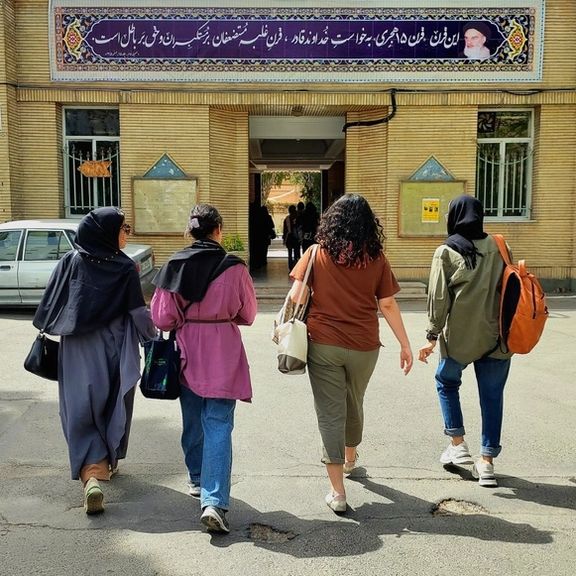
Several university students without mandatory hijab in the capital Tehran
The Public and Revolutionary Prosecutor of a province in Iran says people should report their neighbors to the police if they see them not wearing hijab.
Ali Nesaei also said managers in both public and private sector are responsible for enforcing the hijab rules in the workplace. “If this happens in parks it is the municipality that is responsible. The same applies to universities,” he said at a press briefing while holding the police responsible for controlling the streets and businesses.
Nesaei added that civil servants will be referred to disciplinary committees even if they shed the hijab outside work and that in accordance with article 638 of the Islamic Penal Code they will initially have to pay a cash fine of over 10m rials ($20 or one fifth of minimum wage) for the first time they are charged with violating the hijab law. Vehicles could also be impounded from one to twenty days, if occupants are seen violating the dress code, he said.
Further infringements will entail more cash fines and deprivation from certain “privileges”, he said, referring to threats of seizing drivers’ licenses, passports, etc.
Khamenei has dubbed the long black veil (chador) as “the best form of hijab”.
On Friday chief of Iran's law enforcement, Ahmadreza Radan, said that from April 15 police will use CCTV and facial recognition technology to document violation of hijab rules and provide the evidence to the judiciary for legal action against violators.
Radan said after only one warning, vehicles of those who remove their hijab in their vehicles will be “electronically impounded”, clamped on the street, or taken to a parking, while businesses, including restaurants, malls and catering halls will be shut down.
Hardliners keep insisting that most Iranians agree with hijab rules. “It’s good to [announce that] the hijabless will be photographed and that eventually they will be deprived of the privileges they have in the country…and punishments will be meted out to them. They cannot complain in the future because they have been warned,” said lawmaker Ahmad Karimi-Esfahani Monday while claiming that 90 percent of Iranian agree with hijab rules.
Encouraged by some clerics such as Ahmad Alamolhoda, Supreme Leader Ali Khamenei’s representative in Khorasan-e Razavi Province, vigilantes have been attacking hijabless women. Earlier this month, a video of a man pouring a tub of yogurt on the head of a woman in Mashhad went viral on social media and outraged many. Another video has emerged that shows a man, accompanied by several other men and women, beating a woman with his prayer beads.
A man beating a hijabless woman with his prayer beads, apparently after a quarrel over hijab.
“The whistle warning has been blown about the consequences of polarizing [the society over hijab] and pitching people against each other, but hardliners are still not listening,” reformist Shargh Daily said in a commentary Monday.
It appears that conservatives are also aware of the consequences but have been unable to prevent hardliner regime loyalists from going too far to avoid instances such as those seen in the videos of physical assaults that could be embarrassing and backfire against the regime.
In a commentary Saturday, the Basirat weekly of Khamenei’s political representative in the Revolutionary Guards (IRGC) admitted that too much emphasis on the issue could potentially cause people’s confrontation with the regime while accusing the opposition and its media of using hijab controversies to polarize the society and create unrest.
Reza Shah with unveiled schoolgirls
Hijab has been a very controversial issue in Iran for nearly ninety years. The founder of Iran's Pahlavi dynasty, Reza Shah, banned the hijab in January 1939 despite the strong opposition by clerics but a few years later under his son Mohammad Reza Shah Pahlavi the ban fell into oblivion.
Only five months after the Islamic Revolution of 1979, then leader of Iran Ayatollah Ruhollah Khomeini banned hijablessness in government offices. The ban gradually spread to the entire society within the next two years.
A group of prominent Iranian filmmakers with the family of detained rapper Toomaj Salehi on April 10, 2023
A group of prominent Iranian filmmakers Monday met with the family and lawyer of detained rapper Toomaj Salehi, to express solidarity with him.
According to reports on social media, Fatemeh Motamed-Arya, Jafar Panahi, and Mohammad Rasoulof also inquired about Salehi's health condition during their visit.
The meeting comes as concerns are mounting over the rapper’s condition in prison with human rights organizations demanding his immediate access to medical treatment.
Salehi, 33, an artist mostly known for his protest songs about Iran's social issues and injustice by the government, was arrested in October after joining street protests that had erupted across the country in September after the death in custody of Mahsa Amini.
His arrest came shortly after his interview with the Canadian Broadcasting Corporation, calling the regime “a mafia that is ready to kill the entire nation... in order to keep its power, money and weapons”.
The Center for Human Rights in Iran (CHRI) says the detained rapper needs urgent treatment, which cannot be provided in prison.
On Sunday, Iranian activists living in Montreal, Canada held a rally calling for support for the imprisoned protesters in Iran, including Toomaj Salehi.
The 33-year-old metalworker from Esfahan is one of dozens of members of the artistic and entertainment community who have been arrested since the protests began as the regime struggles to contain widespread discontent in the country.
Nurses and paramedical workers during a rally in the city of Mashhad
A group of nurses in Iran’s city of Qazvin gathered in front of the governor's office on Monday to protest inattention to their demands.
This protest rally was staged two days after a group of medical staff in the northeastern religious city of Mashhad also held a gathering to protest their poor living condition chanting, "We fought against Corona, we didn't get any support".
According to the Free Union of Iranian Workers the staff of Mashhad Medical Emergency also gathered in front of the Razavi Khorasan Governorate.
On the same day, Mashhad taxi drivers also protested outside the Taxi Organization, while news from the central city of Esfahan said farmers held a rally in front of the Water Department due to not receiving their water share.
On April 4, two hospitals in Babol in the north and central city of Arak witnessed a protest gathering of nurses who were angry about unpaid salaries.
Earlier, Secretary General of the Nursing Home announced in an interview with Didehban website that every month about 200 nurses emigrate from Iran.
Rising prices and economic hardship have led to repeated labor strikes and nationwide protests in the past few days.
The national currency has halved in value since September pushing prices for food and other necessities higher on top of 40-50-percent inflation in the past three years.
A website in Tehran says that former nuclear negotiator Saeed Jalili, and his brother who is programming chief at state TV plan to win control of the next parliament.
Khabar Online, wrote in an April 9 reportthat the Jalili brothers are determined to go from where they are in positions of power to the Iranian parliament (Majles) next year. Khabar Online added that all those who were in charge of the state television before were also political activists linked to major political groups.
The state television's current chief, Payman Jebelli appointed Vahid Jalilias his acting deputy during the first days after he got his mandate from Supreme Leader Ali Khamenei who supervises the organization and keeps an eye on the hiring and firing of key officials of the Islamic Republic of Iran Broadcasting (IRIB), which is the main tool for propagating his hardline ideas.
Saeed Jalili is a key figure in the ultra-conservative Paydari Party, which has a solid majority in the current parliament, but does not control the Speaker’s seat, which is occupied by Mohammad Bagher Ghalibaf (Qalibaf), a relative of Supreme Leader Ali Khamenei.
Vahid Jalili (R) with state TV chief Payman Jebelli. Undated
According to Khabar Online, it is not simply a matter of winning a majority in parliament, but Jalilis could be eying the Speaker's seat at the Majles, with the elder brother Saeed hoping to knock Ghalibaf out of the much-coveted seat.
Jalili, who had a dismal record as nuclear negotiator more than a decade ago, is squarely opposed to reviving the JCPOA nuclear deal with the West.
If they ever win the Majles, they would be determined to unseat nearly all of Iran's traditional conservativesfrom their positions of power and create some sort of monopoly for their likeminded ultraconservatives. In the process, it is clear that they would do their best to block any reformist or independent from getting elected.
Since several years before his appointment Vahid Jalili, better known as a vigilante group leader, tried to make his political views known by writing open letters to the heads of the IRIB and its political director Hossein Mohammadi, a confidant of Ayatollah Khamenei.
Saeed Jalili meeting with Fidel Castro in Havana as deputy foreign minister in 2005
In those letters, the young Jalili often criticized the state media's behavior and suggested more hardline policies to govern media outlets, particularly TV channels.
Saeed Jalili, is thought to be steering the Raisi administration from the passenger seat, while avoiding the driver's seat and the responsibilities that comes with it, not only has planted his brother as the IRIB's acting deputy chief, his niece Alireza Khodabakhshi, is IRIB's point of person for everything relating to elections.
This gives Jalili a unique opportunity to determine who is to be groomed and promoted on the national TV and who is to be introduced to the nation as a black sheep through public opinion engineering and news manipulation.
Saeed Jalili with President Ebrahim Raisi in 2022
Thanks to Jalili's lack of expertise, the IRIB has lost a lot of its audience during the past two years as Jebelli has admitted in his recent interviews. However, this does not affect Jalilis and likeminded politicians' electability because the minority who watch IRIB's political preaching are the same minority that have taken part in extremely low-turnout elections in 2020 and 2021, which brought an inefficient parliament and notoriously incompetent President Ebrahim Raisi to power.
The majority of Iranians who are not represented among the hand-picked candidates are unlikely to take part in any election. Even the power-hungry reformists have said that they would not take part if their conditions, including due representation, are not met.
Saeed Jalili is rumored to be running his shadow government, which is now mainly based at the IRIB and is determined to use the platform to catapult himself, his brother, and their political allies to take full control of the parliament (Majles) next March.
Khabar Online, opined that the Jalilis' upper hand at the state TV violates the rights of other likely election candidates and further narrows the voters' choices. However, the nation has made its choice during the 2022 nationwide protests and that is: Going their own separate ways and defying the rules of the game as defined by Iran's hardliners.
Parents gather at one of the schools targeted by poisonous gas attack on April 10, 2023.
While gassing continued in Iran’s schools Monday, Iranians want answers as to who is responsible.
Moineddin Saeedi, a member of the Iranian Parliament from Chabahar in Sistan and Baluchistan Province, criticized the police’s move to use traffic cameras to identify women removing hijab. He said, "If these cameras can detect crimes to such an extent, why are we currently facing the poisoning of girls?"
He added that the use of modern technological capabilities should be prioritized on issues such as delinquency, theft, pickpocketing, extortion and poisoning of female students.
Multiple girls’ schools in the capital Tehran, Karaj, Khoy and Orumiyeh (Urmia) in the West Azarbaijan province, and Sanandaj in Kordestan province were attacked by poisonous chemicals Monday, a week after the schools reopened following New Year holidays.
On Sunday, people in the Kurdish majority city of Saqqez -- the hometown of Mahsa Amini whose death in the hands of hijab enforcers ignited the current uprising – held a rally with security forces reportedly opening fire to disperse the protesters.
The demonstrations occurred after at least six girls’ schools in the city were attacked by the mysterious gas. On Monday, shop owners refused to open their businesses in protest against the regime’s inaction or possible involvement in the poisonings.
Closed shops in the city of Saqqez on April 10, 2023
Since last week, scores of schoolgirls have been taken to hospital with symptoms of gas poisoning, such as difficulty in breathing, nausea, headache and muscle cramps.
Shocked by the news of the death of a Kurdish teenager, Karo Pashabadi, who died as a result of an attack on a Tehran school, innumerable social media users have started asking questions about the fate of those who are being hospitalized due to the phenomena.
Sixteen-year-old Karo, from the city of Kamyaran in Kordestan province, was laid to rest in Pashavah village about a month after inhaling poisonous gas in a chemical attack on a school in Tehran, where he was living.
At least one other child, 11-year-old Fatemeh Razaei, has died in the attacks which began on November 30 and have taken place in hundreds of schools nationwide.
Close to 300 schools were targeted in the past Iranian year ending on March 20 without any apparent effort by the government to seriously pursue the perpetrators or explain to terrified parents and students what was happening in so many schools. Thousands of students have been affected, mostly girls, with hundreds more hospitalized with symptoms including respiratory distress, numbness in their limbs, heart palpitations, headaches, nausea, and vomiting.
Ordinary Iranians have been suspicious of the involvement of the regime itself, or religious extremists protected by the regime, calling the attacks “state terrorism,” although the regime has denied responsibility and even staged arrests of suspects after widespread protests. Popular belief is that such large-scale and coordinated attacks cannot happen without the green light of the regime’s authorities.
Rasool Nafisi, a professor of sociology of development at Strayer University in Virginia, told Iran International on Sunday that the hardliners of the regime are the ones who benefit from the spread of such attacks as an intimidation tactic. "The government intends to use chemical attacks in the future to quash the uprising of the people, especially women and girls," he added.
Referring to a burglary case in which the CCTV cameras captured the faces of the thieves, Mahmoud Sadeghi, a reformist politician and former lawmaker, said in a tweet on Sunday that "It’s more than two years that they (police) have taken the complete video of the theft from the apartment, in which the faces of the thieves can be clearly identified from several angles. They have not yet provided any information about the burglars or the lost property. Now they want to use smart equipment to file legal cases for people in the streets and alleys.”
Secretary of Iran's Supreme National Security Council Ali Shamkhani (L) and his Armenian counterpart, Armen Grigoryan, in Tehran on April 9, 2023
Amid tensions between Iran and Azerbaijan, security officials from Armenia and Iran held talks in Tehran.
National security chief Ali Shamkhani met with his Armenian counterpart, Armen Grigoryan on Sunday.
Ali Shamkhani called the situation in the Caucasus region "sensitive" urging the two warring nations to "manage and resolve tensions with restraint".
“Tension and conflict in the Caucasus region is not in the interest of any country”, he said, critical strategic borders and the flow of trade vital for Iran with both nations.
Armenians are the largest Christian community in Iran, and relations between the two countries have been growing as Iran plays power games across critical borders. Last year, Iran opened a consulate in Kapan, making Iran the first country to establish a diplomatic mission in the province that is sought by both Baku and Ankara.
The meeting with Azerbaijan’s archrival comes amidst a tense few months between Tehran and Baku, with relations souring following an armed attack on Azerbaijan’s embassy in Tehran in January.
Just last week, Azerbaijan expelled four Iranian diplomats over “provocative actions” which have yet to become clear, with Iran vowing to do the same. Six Azerbaijanis were arrested hours earlier accused of a Shi’ite coup plot, believed to have been led by Tehran.
After Iran called on Azerbaijan to show “Islamic solidarity” against Israeli actions in Al Aqsa Mosque last week, its foreign ministry spokesperson Aykhan Hajizada, highlighted Iranian hypocrisy in its failure to condemn what it calls occupation by Armenia. He said Iran “did not protest against the occupation of the lands of the Republic of Azerbaijan by Armenia for 30 years”.