• العربية
  • فارسی
Brand
  • Iran Insight
  • Politics
  • Economy
  • Analysis
  • Special Report
  • Opinion
  • Podcast
  • Iran Insight
  • Politics
  • Economy
  • Analysis
  • Special Report
  • Opinion
  • Podcast
  • Theme
  • Language
    • العربية
    • فارسی
  • Iran Insight
  • Politics
  • Economy
  • Analysis
  • Special Report
  • Opinion
  • Podcast
All rights reserved for Volant Media UK Limited
volant media logo

School Attacks In Iran Continue As Regime Focuses On Hijab Enforcement
Iran International Newsroom
Apr 10, 2023, 16:31 GMT+1Updated: 17:29 GMT+1
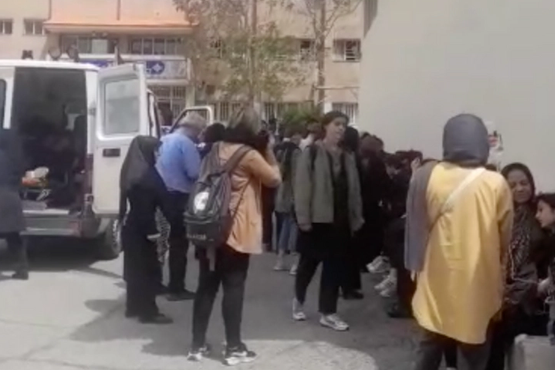
Parents gather at one of the schools targeted by poisonous gas attack on April 10, 2023.

While gassing continued in Iran’s schools Monday, Iranians want answers as to who is responsible.

Moineddin Saeedi, a member of the Iranian Parliament from Chabahar in Sistan and Baluchistan Province, criticized the police’s move to use traffic cameras to identify women removing hijab. He said, "If these cameras can detect crimes to such an extent, why are we currently facing the poisoning of girls?"

He added that the use of modern technological capabilities should be prioritized on issues such as delinquency, theft, pickpocketing, extortion and poisoning of female students.

Multiple girls’ schools in the capital Tehran, Karaj, Khoy and Orumiyeh (Urmia) in the West Azarbaijan province, and Sanandaj in Kordestan province were attacked by poisonous chemicals Monday, a week after the schools reopened following New Year holidays.

On Sunday, people in the Kurdish majority city of Saqqez -- the hometown of Mahsa Amini whose death in the hands of hijab enforcers ignited the current uprising – held a rally with security forces reportedly opening fire to disperse the protesters.

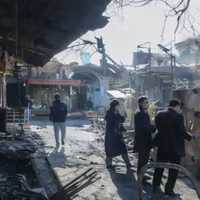
The demonstrations occurred after at least six girls’ schools in the city were attacked by the mysterious gas. On Monday, shop owners refused to open their businesses in protest against the regime’s inaction or possible involvement in the poisonings.

Closed shops in the city of Saqqez on April 10, 2023
100%
Closed shops in the city of Saqqez on April 10, 2023

Since last week, scores of schoolgirls have been taken to hospital with symptoms of gas poisoning, such as difficulty in breathing, nausea, headache and muscle cramps.

Shocked by the news of the death of a Kurdish teenager, Karo Pashabadi, who died as a result of an attack on a Tehran school, innumerable social media users have started asking questions about the fate of those who are being hospitalized due to the phenomena.

Sixteen-year-old Karo, from the city of Kamyaran in Kordestan province, was laid to rest in Pashavah village about a month after inhaling poisonous gas in a chemical attack on a school in Tehran, where he was living.

At least one other child, 11-year-old Fatemeh Razaei, has died in the attacks which began on November 30 and have taken place in hundreds of schools nationwide.

Close to 300 schools were targeted in the past Iranian year ending on March 20 without any apparent effort by the government to seriously pursue the perpetrators or explain to terrified parents and students what was happening in so many schools. Thousands of students have been affected, mostly girls, with hundreds more hospitalized with symptoms including respiratory distress, numbness in their limbs, heart palpitations, headaches, nausea, and vomiting.

Ordinary Iranians have been suspicious of the involvement of the regime itself, or religious extremists protected by the regime, calling the attacks “state terrorism,” although the regime has denied responsibility and even staged arrests of suspects after widespread protests. Popular belief is that such large-scale and coordinated attacks cannot happen without the green light of the regime’s authorities.

Rasool Nafisi, a professor of sociology of development at Strayer University in Virginia, told Iran International on Sunday that the hardliners of the regime are the ones who benefit from the spread of such attacks as an intimidation tactic. "The government intends to use chemical attacks in the future to quash the uprising of the people, especially women and girls," he added.

Referring to a burglary case in which the CCTV cameras captured the faces of the thieves, Mahmoud Sadeghi, a reformist politician and former lawmaker, said in a tweet on Sunday that "It’s more than two years that they (police) have taken the complete video of the theft from the apartment, in which the faces of the thieves can be clearly identified from several angles. They have not yet provided any information about the burglars or the lost property. Now they want to use smart equipment to file legal cases for people in the streets and alleys.” 

Most Viewed

Ideology may be fading in Iran, but not in Kashmir's ‘Mini Iran'
1
INSIGHT

Ideology may be fading in Iran, but not in Kashmir's ‘Mini Iran'

2
INSIGHT

Hardliners push Hormuz ‘red line’ as US blockade tests Iran’s leverage

3
VOICES FROM IRAN

Hope and anger in Iran as fragile ceasefire persists

4

Iran International says it won’t be silenced after London arson attack

5

US sanctions oil network tied to Iranian tycoon Shamkhani

Banner
Banner

Spotlight

  • Hardliners push Hormuz ‘red line’ as US blockade tests Iran’s leverage
    INSIGHT

    Hardliners push Hormuz ‘red line’ as US blockade tests Iran’s leverage

  • Ideology may be fading in Iran, but not in Kashmir's ‘Mini Iran'
    INSIGHT

    Ideology may be fading in Iran, but not in Kashmir's ‘Mini Iran'

  • War damage amounts to $3,000 per Iranian, with blockade set to add to losses
    INSIGHT

    War damage amounts to $3,000 per Iranian, with blockade set to add to losses

  • Why the $100 billion Hormuz toll revenue is a myth
    ANALYSIS

    Why the $100 billion Hormuz toll revenue is a myth

  • US blockade targets Iran oil boom amid regional disruption
    ANALYSIS

    US blockade targets Iran oil boom amid regional disruption

  • Iran's digital economy battered by prolonged blackout
    INSIGHT

    Iran's digital economy battered by prolonged blackout

Tweet unavailable

Tweet unavailable

Tweet unavailable

•
•
•

More Stories

Another Iranian Teacher Transferred To Prison To Serve His Term

Apr 10, 2023, 09:46 GMT+1

Amid the chemical attacks on schools in Iran, another teacher has been transferred to prison to serve a one-year sentence.

Omid Shah-Mohammadi, from the city of Divandarreh in Kordestan province and a member of Kordestan Teachers Association, was reportedly transferred to Bijar prison on Saturday.

The arrest of teachers and transferring them to jail in different cities has escalated after they protested to condemn chemical attack on schools and poisoning of female students, as well as the non-payment of salaries and arrears.

Omid Shah-Mohammadi was detained along with three other teachers on June 15, 2022, for participation in the teachers' association sit-in.

They were temporarily released after 76 days of detention in Sanandaj each on a bail of 15 billion rials (30,000 USD).

Shah Mohammadi was then sentenced to five years in prison by a Revolutionary Court in Sanandaj on charge of "action against national security"; however, his term was decreased to 16 months suspended imprisonment in the Court of Appeal of Kordestan province.

Meanwhile, three other teachers in the northern province of Gilan were summoned and arrested on Saturday and sent to Lakan prison in Rasht to serve a one-year term.

On Thursday, teachers in several cities held peaceful rallies and chanted their demands including the release of Mohammad Habibi, spokesperson of Iranian Teachers Trade Association as well as their long-held grievances over paygrades and low salaries.

Teachers have threatened to stage street protests in May if their demands are not met.

In Battle To Enforce Hijab, Iran’s Police Announce Increased Surveillance

Apr 10, 2023, 06:47 GMT+1
•
Iran International Newsroom

While countless Iranian women are appearing in public without hijab, the Islamic Republic is installing cameras around cities to rein in the growing act of civil disobedience.

The head of the traffic police of the capital, Tehran, said on Sunday that "cameras installed for recording traffic violations also record cases of women removing hijab.”

Second brigadier general Mohammad-Hossein Hamidi told Tasnim news agency, affiliated with the Revolutionary Guards, that "all the (surveillance) systems across the city have multi-purpose operations and store all kinds of information”.

He did not provide details about the data recorded by the cameras but said that although the surveillance cameras have been installed by the municipality, they have different data banks from which any government office or organization can extract information relevant to them.

A CCTV camera is seen in a street in Tehran, Iran, April 9, 2023.
100%
A CCTV camera is seen in a street in Tehran, Iran, April 9, 2023.

“The traffic police use the traffic data from these cameras, and other departments collect the information they need," he said, without elaborating to which institutions and organizations these departments belong.

However, last year, hacktivist group Black Reward found access to databanks of Fars News Agency, another media outlet affiliated with the IRGC. The hack revealed that the regime has begun collecting information about street protests from footage of CCTV cameras installed throughout the country.

Several lawmakers and hijab enforcement officials had talked about the use of cameras in public places and thoroughfares to identify and penalize unveiled women, but this is the first time a police commander has admitted that traffic cameras are recording other sorts of data on people.

An Iranian woman unveiling in public  (undated)
100%
An Iranian woman unveiling in public

According to a Saturday statement by the police, the move is aimed at “preventing resistance against the hijab law,” adding that such resistance against the regime’s strict Islamic dress code tarnishes Iran's “spiritual image” and spreads insecurity.

Meanwhile, Ahmad-Reza Radan, the chief commander of Iran’s police forces, said that the forces under his command will use advanced technology and equipment to identify people who do not observe the mandatory hijab in public places as of next Saturday. Women and girls who do not wear scarves in "public places, cars or commercial centers" will be prosecuted, he added.

The uprising that was sparked by the death in police custody of 22-year-old Mahsa Amini has made it increasingly difficult to enforce the mandatory Islamic dress code. Appearing in public without a full veil has become a common sight even in small and more conservative towns. Since the beginning of the ‘Women, Life, Liberty’ movement in September last year, thousands of girls and women have set fire to their headscarves in a symbolic move and voiced opposition to compulsory hijab.

Iranian women unveiling in public  (undated)
100%

Earlier in April, Iran’s ruler Ali Khamenei threw his weight behind the hardliners who have been pushing for new measures to enforce the mandatory hijab laws, saying that “hijab is a restriction based on Sharia (Islamic law) and the constitution.” Khamenei’s assertion that flouting hijab is “religiously and politically haram” has emboldened officials for stricter measures. In a bid to deter the droves of women rebelling against hijab, the regime has also embarked on public humiliation tactics, such as placing officers in Tehran subway to prevent women without the hijab from entering.

It has not only emboldened officials but triggered a wave of civilian actions as the public takes the law into their own hands, seen last week when a mother and daughter were attacked with yogurt while out shopping.

The Islamic Republic, founded in 1979, is the only Muslim country other than Taliban ruled Afghanistan with such a strict interpretation of hijab and nationwide coercive measures for its observance, while Islam is the official religion in 26 countries in Asia, sub-Saharan Africa, North Africa, and the Middle East.

On Sunday, firebrand mouthpiece of the Supreme Leader, Hossein Shariatmadari, the editor of the flagship hardliner newspaper Kayhan, compared hijabless women to "drug addicts and drug dealers" who should be "seriously dealt with”.


As School Attacks Resurge, Mahsa Amini’s Hometown Ablaze With Protests

Apr 9, 2023, 18:12 GMT+1
•
Iran International Newsroom

Amid intensified measures to enforce hijab laws, Iran's regime is facing a renewed wave of protests over chemical attacks on schoolgirls and economic woes.

According to videos sent to Iran International, people in the Kurdish majority city of Saqqez -- the hometown of Mahsa Amini whose death in the hands of hijab enforcers ignited the current uprising – held a rally with security forces reportedly opening fire to disperse the protesters.

Hengaw, a Norway-based rights group which monitors abuses and violations in Iran’s Kurdish regions, reported that at least six girls’ schools in Saqqez were attacked by the mysterious gas on Sunday, igniting renewed protests against the regime’s inaction or possible involvement in the poisonings. An unknown number of students were sent to hospital following the attacks.

Protesters pulled down the Islamic Republic flag from the top of a school, likely to have been one of the places targeted by the chemical attack. The situation in the city is still tense as protesters have set up bonfires on streets and scores of anti-riot forces have been dispatched throughout the city.

There are also reports of another chemical attack at a girls' school in the central city of Esfahan (Isfahan) on Sunday.

On Saturday, 12 schools were targeted in the Kurdish city of Naqadeh, the city of Orumiyeh (Urmia), the city of Ardabil, Haftkal city of southern Khuzestan province, and the city of Pardis in Tehran province. Last week on Monday and Tuesday, at least five girls’ schools were targeted across the country, with reports of hospitalizations.

The attacks coincided with the funeral of a Kurdish child from the city of Kamyaran who was laid to rest in Pashavah village in Kordestan province. The 16-year-old boy, Karo Pashabadi, had been taken to hospital for treatment on March 15 after inhaling poisonous gas after a chemical attack on a school in Tehran, where he was living. At least one other child, 11-year-old Fatemeh Razaei, has died in the attacks which began on November 30 and have taken place in hundreds of schools nationwide. 

Close to 300 schools were targeted in the past Iranian year ending in March 20 without any apparent effort by the government to seriously pursue the perpetrators or explain to terrified parents and students what was happening in so many schools. Thousands of students have been affected, mostly girls, with hundreds more hospitalized with symptoms including respiratory distress, numbness in their limbs, heart palpitations, headaches, nausea, and vomiting. 

Ordinary Iranians have been suspicious of the involvement of the regime itself, or religious extremists protected by the regime, calling the attacks “state terrorism,” although the regime has denied responsibility and even staged arrests of suspects after widespread protests. Popular belief is that such large-scale and coordinated attacks cannot happen without the green light of the regime’s authorities.

International reaction has demanded answers to the mystery poisonings including a spokesperson for the UN Human Rights Council in Geneva calling for a transparent investigation along with the White House, which demanded accountability for those responsible.

Decrying the attacks, several opposition figures, including Nobel Peace Prize winner and human rights lawyer Shirin Ebadi, exiled prince Reza Pahlavi have emphasized the role of the regime and urged the international community to pressure the regime to provide access for investigations on-the-ground in Iran.

Aftermath of a chemical attack at a school in Ardabil on April 8, 2023
100%
Aftermath of a chemical attack at a school in Ardabil on April 8, 2023


Kurdish Student Dies After Chemical Attack On Tehran School

Apr 9, 2023, 14:02 GMT+1

A Kurdish child from the city of Kamyaran, hospitalized after a chemical attack on a school in Tehran last month, has tragically died in hospital.

Hengaw Human Rights Organization reported Sunday that Karo Pashabadi, a 16-year-old boy living in Tehran, died three weeks after a chemical attack. The teenager was taken to hospital for treatment on March 15 after inhaling the poisonous gas used in the attack.

His body was laid to rest in Pashavah village of Kamyaran city in Kordestan Province on Saturday. At least one other child, 11-year-old Fatemeh Razaei, has died in the attacks which began on November 30 and have taken place in hundreds of schools nationwide.

Thousands of pupils have been affected, mostly girls, with hundreds more hospitalized with symptoms including respiratory distress, numbness in their limbs, heart palpitations, headaches, nausea, and vomiting.

Meanwhile, Hengaw also reported that the students of three high schools in the Kurdish city of Saqqez were poisoned and taken to medical centers on Sunday as the wave of poisonings blighting children across Iran appear to have returned after a short respite for Nowruz holidays.

Countless ordinary Iranians have been suspicious of the regime’s involvement, though the regime has denied responsibility and even staged arrests of suspects after protests against the poisonings added further fuel to the regime’s burning fire of unrest.

International reaction has demanded answers to the mystery poisonings including a spokesperson for the UN Human Rights Council in Geneva calling for a transparent investigation along with the White House, which demanded accountability for those responsible.


Officers Prevent Iranian Women Without Hijab From Entering Subway

Apr 9, 2023, 10:21 GMT+1

In a bid to deter the droves of women rebelling against mandatory hijab, the regime in turning to new forms of surveillance and public humiliation tactics.

Iran’s state TV published a video in which Tehran subway officers do not allow women without the mandatory hijab to enter.

After the statements by Supreme Leader Ali Khamenei about the mandatory hijab on Tuesday, a new round of the regime confrontation with those who do not want to wear hijab has begun.

Social media users have reported that some officers tasked with threatening those without hijab are stationed in metro wagons and the entries to the subway.

Meanwhile, police in Iran announced on Saturday that it is going to use "smart" technology in public places to identify and then punish women who do not wear hijab.

In a statement, police threatened that they would take action to identify those breaching the regime laws by using tools and smart cameras in public places and thoroughfares.

Islamic Republic's Police Chief Ahmad-Reza Radan confirmed in an interview with state TV: “From next Saturday, people who remove their veil will be identified by using smart equipment.”

Warnings will be issued before women are called to court.

Hundreds of women have been seen unveiled in public places since the death of Mahsa Amini in police custody for ‘improper’ wearing of her hijab. Others have been seen burning their veils in defiance, and cutting hair, in a rejection of the regime’s tough Islamic laws.

Although there is no accurate count but over the past four decades hundreds of thousands of these women have been arrested, fined, or jailed by authorities.