• العربية
  • فارسی
Brand
  • Iran Insight
  • Politics
  • Economy
  • Analysis
  • Special Report
  • Opinion
  • Podcast
  • Iran Insight
  • Politics
  • Economy
  • Analysis
  • Special Report
  • Opinion
  • Podcast
  • Theme
  • Language
    • العربية
    • فارسی
  • Iran Insight
  • Politics
  • Economy
  • Analysis
  • Special Report
  • Opinion
  • Podcast
All rights reserved for Volant Media UK Limited
volant media logo

Iran's Khamenei Silent On Foreign Policy In Nowruz Message
Iran International Newsroom
Mar 21, 2023, 08:41 GMT+0Updated: 18:01 GMT+1
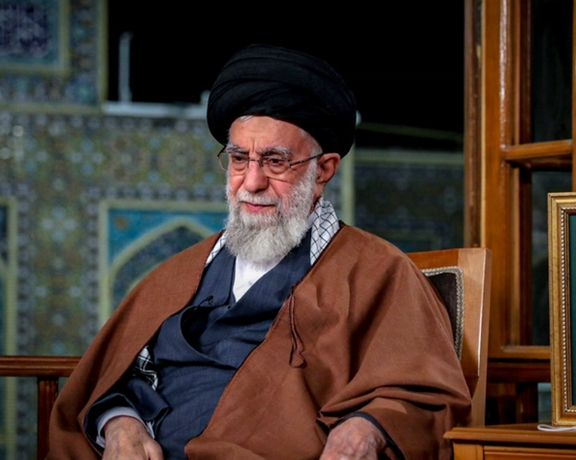
Iran's Supreme Leader Ali Khamenei

In his Nowruz New Year message to the nation Monday, Iran’s Supreme Leader Ali Khamenei did not mention foreign relations and focused on economic difficulties.

He acknowledged that there are “political problems” but did not directly mention six months of antigovernment protests, arguing that the economic problems the country faces are the main reason for all other problems.

Despite putting emphasis on the economic crisis, mainly because of its confrontational foreign policy, he did not mention the stalled nuclear negotiations with the West, nor the agreement reached earlier this month to restore ties with regional rival Saudi Arabia – a point that he could have mentioned as a positive accomplishment amid a grim reality in the country.

A positive reference to the deal with Riyadh would have gone a long way to reinforce statements by other officials that Iran is bent on improving relations with regional Arab countries and perhaps ending the war in Yemen, where Tehran has rendered military support to Houthis fighting a Saudi coalition.

Khamenei has been a steadfast opponent of the Saudi government and has labelled the country a lackey of the United States, an epitome of “corruption”, meaning un-Islamic and an enemy of Muslim unity. His followers have equated Saudi Arabia with “Zionists”, the worst possible insult in the regime’s lexicon.

Having decided to restore diplomatic relations with Riyadh, Khamenei is perhaps finding it hard to walk back his long-held views. The decision to restore relations was made amid international isolation, economic crisis and the threat of an Israeli attack on its nuclear installations.

However, it was clear that that the decision was his, since he sent his trusted man in the national security council, Ali Shamkhani, to Beijing to sign the agreement on March 10.

Speaking about multiple difficulties Iran faces, Khamenei tried to indirectly imply that the population has no political demands and all problems stem from a weak economy. “The most important problem for the Iranian nation [in the past year] was the problem of the country’s economy, which impacts people’s livelihood,” he said.

However, months of nationwide protests showed that a significant part of the population, especially the youth, reject the Islamic Republic regime altogether and want a secular, democratic political system.

Although he acknowledged the seriousness of economic problems, he did not mention sanctions imposed by the United States, which he and his subordinates have often cited as the reason for a 50-percent annual inflation rate, high unemployment and increasing poverty. It seemed that Khamenei simply decided not to speak about any foreign policy issue.

Having chosen to focus on economic problems, Khamenei tried to “put it in perspective” as he put it.

“Economic difficulties are not unique to us…all countries have some sort of peculiar economic problem, even rich countries,” he said, and went a step further claiming that some “are in much worse situation than we are.”

Iran’s national currency, the rial, has fallen by more than 50 percent since September, pushing food prices higher between 70-100 percent, on top of similar price hikes in the past five years since the imposition of US sanctions. Tens of millions of working and even middle class people have fallen into poverty, not able to afford basic necessities.

The 83-year-old authoritarian ruler proclaimed the new year as the year to fix the economy, increase production and control inflation, slogans often repeated in the past decade.


Most Viewed

Iran negotiators ordered to return after internal rift over Islamabad talks
1
EXCLUSIVE

Iran negotiators ordered to return after internal rift over Islamabad talks

2
ANALYSIS

US blockade enters murky phase as tankers spoof signals and buyers hesitate

3

US tightens financial squeeze on Iran, warns banks over oil money flows

4
INSIGHT

Ideology may be fading in Iran, but not in Kashmir's ‘Mini Iran'

5
INSIGHT

Hardliners push Hormuz ‘red line’ as US blockade tests Iran’s leverage

Banner
Banner

Spotlight

  • Hardliners push Hormuz ‘red line’ as US blockade tests Iran’s leverage
    INSIGHT

    Hardliners push Hormuz ‘red line’ as US blockade tests Iran’s leverage

  • Ideology may be fading in Iran, but not in Kashmir's ‘Mini Iran'
    INSIGHT

    Ideology may be fading in Iran, but not in Kashmir's ‘Mini Iran'

  • War damage amounts to $3,000 per Iranian, with blockade set to add to losses
    INSIGHT

    War damage amounts to $3,000 per Iranian, with blockade set to add to losses

  • Why the $100 billion Hormuz toll revenue is a myth
    ANALYSIS

    Why the $100 billion Hormuz toll revenue is a myth

  • US blockade targets Iran oil boom amid regional disruption
    ANALYSIS

    US blockade targets Iran oil boom amid regional disruption

  • Iran's digital economy battered by prolonged blackout
    INSIGHT

    Iran's digital economy battered by prolonged blackout

•
•
•

More Stories

Iranians Celebrate Ancient Nowruz As Spring Brings New Year

Mar 20, 2023, 21:46 GMT+0
•
Maryam Sinaiee

Iranians, and millions in other countries, celebrate the ancient Nowruz, or New Year on March 21, and begin the year 1402 in the Persian calendar.

Exactly at 54 minutes, 28 seconds past midnight Tehran time on March 21, the ancient Nowruz festivities began with family members assembled around a spread called ‘haftseen’ exchanging holiday greetings and gifts.

The spread, on the floor or on a table, is laden with flowers and sprouted greens, which celebrate the coming of spring, symbols of wealth (coins), fertility (painted eggs), life (goldfish), apples, a mirror, candles, sweets, nuts, a pudding made with wheat germ, and a holy book such as the Quran or a tome of the nationally revered poetry of Hafiz Shirazi.

The names of at least seven of the many items on the spread must begin with the Persian letter ‘sin’, probably the short form of sini (tray) as the custom was to display such items on seven trays.

Nowruz celebrations form an integral part of the Iranian identity. Despite Iran's Islamification fourteen centuries ago, and the Islamic Revolution of 1979, the celebration of Nowruz has endured not only in Iran but also in many of its neighboring countries such as Afghanistan, Turkmenistan, Azerbaijan, and among Kurds in Turkey and Iraq.

History and Origins

Nowruz has been celebrated by Iranians since Achaemenid times (550-330 BC). The word Nowruz, which derives from Old Persian nava sarda (new year) is only attested in Middle Persian. The feast itself has its roots in ancient agricultural festivals which centered around the cycle of nature. Some scholars believe ancient Persians were inspired by the splendor of Babylonian spring festival of Akitu developed their own Nowruz festival.

Some historians also believe that the magnificent Persepolis complex in southern Iran built by Achaemenid kings, or at least parts of the complex such as the Apadana Palace, and the Hundred Columns Hall, were specifically built for celebrating the New Year.

Lydians bearing gifts for the Achaemenid king, Apadana Palace at Persepolis
100%
Lydians bearing gifts for the Achaemenid king, Apadana Palace at Persepolis

The bas-relief at the Apadana Palace which shows representatives of the nations under the Achaemenid Empire bearing gifts for the King of Kings may be a portrayal of the Nowruz celebration at the heart of the empire.

The Islamic Republic rulers have never embraced the pre-Islamic Nowruz, but they have also not dared to ban it.

Nowruz, Celebration of Spring Equinox

The exact moment of the beginning of the new year, which varies from year to year and was calculated by astronomers since ancient times, marks the Spring Equinox in the northern hemisphere. Accordingly, the turn of the year may fall anytime from the evening of March 20 to the evening of the next day.

Unlike the lunar calendar prevalent in other Muslim countries in which it is the year 1444 now, the new year will be 1402 in the solar Jalali calendar, Iran's unique calendar introduced in 1079 AD.

Like many things in the Iranian history, the calendar seamlessly combines Islamic and ancient Iranian elements. The first year of the calendar is Prophet Muhammad’s hijra from Mecca to Medina but each of its twelve months is dedicated to an ancient Iranian deity.

The Foods Of Nowruz

On the eve, or the day of Nowruz, Iranians make special foods with seasonal and symbolic significance. In the 20th century, rice mixed with lots of green herbs (dill, coriander, fenugreek greens, wet garlic) and served with pan-fried ‘mahi sefid’ fish (Caspian kutum) or other fishes has become highly representative of the food for Nowruz.

Other green food, to celebrate the end of winter and arrival of spring, such as a very green, thick omelet made with the same type of herbs (kuku sabzi) and served with green or plain rice are also very popular.

Apadana, one of the oldest halls of the complex dating to the first half of the 6th century BC, was where the king would hold audience with his subjects, with great pomp on special occasions such as the New Year.

100%

Many families, particularly in central areas where fish was very hard to come by before modern times, make a dish of rice mixed with noodles and served with chicken, dried apricots, and dates instead of the green rice and fish. A stew-like soup with green herbs, legumes and noodles (ash-e reshteh) is also among holiday season foods. Noodles in these dishes symbolize longevity.

During the holiday season, which culminates in the all-important ‘sizdeh be dar’ picnic on the 13th of the first month, Farvardin, people visit family, relatives and friends. Guests are welcomed with sweets, nuts and fruits.

100%

Most Iranian Lawmakers Cannot Get Re-elected, Pundit Says

Mar 20, 2023, 19:24 GMT+0
•
Iran International Newsroom

An umbrella organization monitoring political parties in Iran has said that two-thirds of current lawmakers are unlikely to make it to the next parliament.

The Chairman of the Research Center of House of Parties, Mehdi Arab-Sadeq in an interview with moderate-conservative Khabar Online website said that "Some of these lawmakers need to apologize to the Iranian nation" for what they have and have not done at the Majles (parliament).

However, he said that the unpleasant situation is likely to continue as long as political parties are not there to serve the nation's interests, a reference to the fact that these groups are tightly controlled by the core of the regime and become active only weeks before choreographed elections.

Arab-Sadeq also criticized the government for "behaving in a way that the people laugh when officials put forward a new promise or fire off a new slogan." The government has remained inefficient in solving multiple crises, yet it is planning to win the next parliament in the 2024 elections.

Khabar Online presenting the interview described the Iranian year that ended March 20 as "a politically turbulent year" and recalled that this was a year in which 200 of parliament's 290 members who had called on Ebrahim Raisi to run for President in 2021, wrote to him that they regretted their decision. Despite this regret, lawmakers did not act to impeach ministers that they kept criticizing throughout the year.

Parliament speaker Mohammad Bagher Ghalibaf arguing with lawmakers in Oct. 2021
100%
Parliament speaker Mohammad Bagher Ghalibaf arguing with lawmakers in Oct. 2021

The website added that some top government officials and several members of parliament have been setting up political parties or organizations during the past weeks apparently in preparation for next year’s elections.

Sadeq-Arab in his interview also noted that political parties allowed to exist did not lift a finger during months of widespread antigovernment protests.

He added that given the political and economic situation, at least two third of the 290 lawmakers cannot win enough votes to enter the next parliament.

Iranian lawmaker Ahmad Alirezabeigi said in an interview with ILNA website in Tehran, that the government does not listen to lawmakers' advice. "We told the government over and over that its economic vehicle is broken, but the only thing it did was changing the driver," he said, alluding to the change of the governor of the central bank and the ministers of labor and housing during the past year.

Alirezabeigi attributed most of the country's current economic chaos to the government's manipulation of foreign currency market, where the Iranian rial has seen its steepest fall in recent months. He argued that government intervention cannot solve the problem as it did not do so under previous governments. He charged that successive administrations have poured some $280 billion dollars of hard currency into the market since the 1990s to support the rial, without success. The currency has fallen almost 50-fold in the past 25 years.

Meanwhile, criticizing the government's inefficiency, Alirezabeigi said all of the current economic problems could have been predicted and prevented if officials were real experts. He further charged that the current government has totally lost the ability to control the supply and prices of essential commodities. As a result, industries and those involved in entrepreneurship in the centrally controlled economy have lost their hope and do not know how to survive.

Former Israeli Official Warns That Judicial Changes Undercut Fight Against Iran

Mar 20, 2023, 15:55 GMT+0

The former chief of Israel's Atomic Energy Commission has warned Benjamin Netanyahu that his judicial changes will weaken Israel's position in confronting Iran.

According to the Ynet news, Zeev Snir, a Netanyahu appointee who led the atomic commission from 2015-2022, sent a letter to the Prime Minister on Sunday, expressing his concerns.

Benjamin Netanyahu has started his sixth term as prime minister by forming a coalition of right-wing religious extremists who intend to change the country's judicial rules.

Opponents of the government, who believe that the process will lead their country to a religious dictatorship, call the changes in the judiciary a "government coup" and warn against the "collapse" of democratic foundations in Israel.

In his letter, Snir said focusing on advancing the far-reaching changes to the judiciary would undercut Netanyahu’s ability to obtain the key aims he laid out, particularly in terms of countering Iran.

“Strategic competition with Iran requires enlisting all of the State of Israel’s resources and cultivating its power militarily, economically, diplomatically and socially. Iran is strengthening its position and capabilities in terms of its nuclear [program], ties with Russia and China, dealing with sanctions, and more,” he said. “All this as the West, led by the US, is busy with competing with China, the war in Europe, the fight with Russia and the energy crisis.”

Before Snir, a number of former senior officials, who were appointees of Benjamin Netanyahu, have warned about the security, economic and diplomatic consequences of judicial changes.

IRGC Losing Edge In Iran And Region – Leaked Document

Mar 20, 2023, 15:49 GMT+0
•
Iran International Newsroom

Members of IRGC’s Quds Force are weary of the fight with Israeli forces at Golan Heights and are selling military intel to Israel, a recently-leaked document shows.

Minutes of a meeting of senior clerics and Revolutionary Guard commanders with Supreme Leader Ali Khamenei, leaked to media last week, suggest that the economic and political situation in Iran has made the Islamic Republic’s forces sell information about Quds Force operations to Israel, and that more and more elements are seeking to leave the battlefield in Syria and get jobs and positions inside the country.

The 44-page document contains citations of remarks by 45 IRGC commanders and clerics at a meeting at Khamenei’s office on January 3 on the anniversary of the death of Quds Force commander, Qassem Soleimani, who was killed by the US three years ago.

Almost all the participants spoke about the current wave of antiregime protests that has engulfed the country since September last year. The meeting, held more than three months into the protests, focused on the negative impact of the protests on the morale of forces under the command of the IRGC and their burn-out, with several offering anecdotal accounts of insubordination.

The document indicates that officials are shocked by the large scale and duration of the protests and admit that they do not have the means to quell the uprising. The participants also acknowledged massive defections and desertions among the military forces and clerics, mainly due to the unrelenting economic woes as well as in protest to the heavy-handed crackdown by security forces and harsh sentences by the judiciary.

IRGC Commander Rahim No’i Aghdam (right) and former Quds Force commander Qassem Soleimani  (undated)
100%
IRGC Commander Rahim No’i Aghdam (right) and former Quds Force commander Qassem Soleimani

Rahim No’i Aghdam, who served as the commander of IRGC’s Zeynab operational headquarters in Syria, said during the meeting that the Quds Force "faces many problems" in the border areas of Israel and the Golan Heights. He mentioned Israel's "non-stop" bombings and "inability of quick access to the supplies of Iran's allied forces in this region" as some of the problems, adding that economic hardships and the ongoing protests have also led to "ideological issues and family problems" among the ranks of the forces.

He said that "leaks of operational plans” has reduced the edge of Iranian forces against Israelis, adding that "pre-emptive attacks by Israeli forces in five operations showed us that the issue of infiltration... and the forces’ unwillingness to remain at Israel's borders” have made them do “unimaginable” things, such as selling military intel.

No’i Aghdam added that if the Islamic Republic loses the areas that it has gained "with years of effort" outside its borders, "a practical threat to the Islamic Republic regime will not be unimaginable."

Other attendees also talked about the desertions and disobedience within their forces, with Abdollah Haji-Sadeghi, Khamenei’s representative in the IRGC, saying that “there is no doubt about desertions.” He said that different security organizations of the country have reported varying figures, from 12 percent to 68 percent of desertions.

Khodarahm Sarani, the IRGC’s commander in the city of Zahedan -- the provincial capital of Sistan-Baluchestan province that is home to Iran's Sunni Baluch minority of up to two million – said the demands of the people there are basic such as water and basic necessities. He added that remarks by their Sunni leader Mowlavi Abdolahamid have united the residents, making them leave aside their sectarian differences and focus on popular demands.

A sample page of the leaked document  (March 2023)
100%
A sample page of the leaked document

Sarani then made a direct attack on the secretary of Iran’s security council Ali Shamkhani who was present at the meeting. “When an officer under my command comes to my office and shows the watch worn by Mr. Shamkhani's son and tells me that the price of this watch is equal to four years of my service in the armed forces, how can I answer?”

“We cannot always blame the problems on the enemy, yes, we are under sanctions, but the country's income is not low. If there are problems in the country, then how come these problems do not show themselves at the level of military commanders,” he added.

Iran Claims Successes In Regional Diplomacy Following Saudi Deal

Mar 20, 2023, 11:12 GMT+0
•
Iran International Newsroom

It has been a busy few days for Iran’s national security chief as he flies round the region trying to mend ties with Arab neighbors.

Instead of the country’s foreign minister, Hossein-Amir Abdollahian, it is Ali Shamkhani who has become the diplomatic face of the regime on visits spanning some of the key regional countries.

Since Shamkhani signed an agreement with Saudi Arabia in Beijing on March 10 to restore ties with Riyadh, he has embarked on regional trips to improve strained relations with Arab neighbors. A visit to the UAE and then Iraq were part of the effort to continue the momentum.

Bolstering economic ties is of course the underlying goal but it is an important message that it should be an official trusted by Iran's ruler Ali Khamenei who is the messenger on this important diplomatic tour de force.

During his Sunday meetings in Iraq, agreements were reached for the repayment of Iraqi debts by imports of goods, Shamkhani claimed. He tried to be the bearer of good news for the Iranian people as the country struggles to even get hold of basic food items amidst this great sanction-burdened economic crisis.

Shamkhani told the official government news agency IRNA Monday that his one-day trip was “productive”, hot on the heels of his visit to the United Arab Emirates a few days earlier.

Iraq owes well-over $10 billion to Iran – by some estimates almost $20 billion – for imports and natural gas and electricity. However, due to US banking sanctions on Iran, Iraq cannot pay cash dollars to Tehran.

A mechanism exists for sending essential goods, such as food and medicine in exchange for the Iraqi debt. Shamkhani said that he and the delegation accompanying him held talks with Iraqi officials to facilitate this mechanism, but he was careful in his wording not to hint at any cash transfers.

Shamkhani told IRNA: “Another step was to determine mechanisms for using resources related to Iran’s financial receivables from Iraq to purchase essential goods and to resolve currency issues related to [bilateral] trade.”

Iranian officials said that Shamkhani has also agreed on a deal with the UAE on using dirhams for bilateral transactions, although the UAE has not confirmed any such agreements. It too, must watch its step as it remains on the Financial Act Task Force gray list, which it will not want to worsen by anything less than above board in its business ties to Iran.

Over the weekend, officials in Tehran even claimed that after the deal they injected hundreds of millions of UAE dirhams into the local forex market to support the battered Iranian rial. Contrary to the claim, the rial fell on Sunday and was trading at 490,000 to the US dollar on Monday, down from 460,000 on Friday.

Iraq may yet be more of a diplomatic ally than a financial one. Since the US invasion in 2003, Iraq’s foreign currency reserves have been held by the US Federal Reserve, giving Washington significant control over Iraq’s dollar transfers.

The Central Bank of Iraq requests dollars from the Fed and then sells them to commercial banks and exchange houses at the official exchange rate through a mechanism known as the “dollar auction.”

Reports earlier this year indicated that the United States restricted dollar transfers to Iraq because of suspicions of Iranian money laundering and dollar transfers to Tehran.

These restrictions even led to a dollar scarcity on the local market in Iraq and the fall of the Iraqi dinar. Subsequently, Baghdad sent a high-level delegation to Washington in February to resolve the issue and they discussed banking and money laundering issues related to Iran.

In its desperation amid a serious financial crunch due to continuing US sanctions, the Islamic Republic hopes that better ties with Persian Gulf Arab countries can help reduce the pressure. But these countries are well aware of US sanctions and it is not clear how far they would go in accommodating the Iranian regime’s needs for an economic lifeline.

The financial pressure is also needed to convince Tehran to abide by promises it apparently made to Saudi Arabia. Chief among them is ending its military support for Yemen’s Houthis who have been fighting a Saudi coalition for eight years. This, remains to be seen.