• العربية
  • فارسی
Brand
  • Iran Insight
  • Politics
  • Economy
  • Analysis
  • Special Report
  • Opinion
  • Podcast
  • Iran Insight
  • Politics
  • Economy
  • Analysis
  • Special Report
  • Opinion
  • Podcast
  • Theme
  • Language
    • العربية
    • فارسی
  • Iran Insight
  • Politics
  • Economy
  • Analysis
  • Special Report
  • Opinion
  • Podcast
All rights reserved for Volant Media UK Limited
volant media logo

Iran Politician Suggests Former Nuclear Negotiator Should Be Reinstated
Iran International Newsroom
Mar 15, 2023, 16:25 GMT+0Updated: 17:44 GMT+1
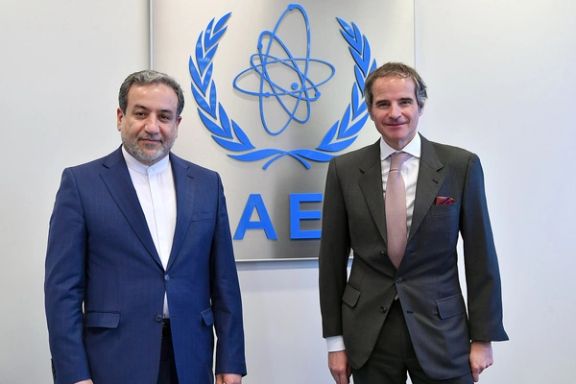
IAEA Director General Rafael Mariano Grossi during a meeting with former Deputy Foreign Minister for Political Affairs of Iran Abbas Araqchi (Araghchi) at the nuclear watchdog’s headquarters in Vienna, Austria, on April 8, 2021

An Iranian politician has suggested to reinstate former chief nuclear negotiator Abbas Araqchi to discuss the revival of the 2015 nuclear deal with the United States.

Mansoor Haqiqatpoor also suggested that "radical elements" should no longer be on the negotiating team. "I hope the radicals' power in Iran will be reduced. I guess [President Ebrahim] Raisi has realized how radicals can do harm to Iran's foreign policy. They have prevented the talks from being fruitful."

Speaking to conservative Nameh News website, Haqiqatpoor said, "I hope the officials have realized that radicals should not be put in charge of decision-making as they will push Iran into international isolation."

He added that the negotiations can lead to positive results if Iran’s team changes its approach. I suggest that even if Araqchi is not put in charge of the negotiating team, he should at least be an adviser to the team."

Araqchi was Former Foreign Minister Javad Zarif's deputy, and he led Iran's nuclear negotiators under the Rouhani administration until mid-2021.

While some say that talks in the first half of 2021 under Araqchi were yielding results, the hardliner team under Raisi, who assumed office in August of that year, dragged out talks with the West until the diplomatic effort reached an impasse last September.

Meanwhile, in an interview with centrist Agahi-ye No magazine, former moderate vice President Es'haq Jahangiri said that former US President Donald Trump withdrawal from the 2015 nuclear deal known as the JCPOA and reimposition of sanctions dealt a hard blow to Iran's economy.

He said when Trump decision pushed “all our friends in various countries” to distance themselves from Iran. China which was cooperating with Iran on the Tehran-Mashhad rail line, was the first country to stop its projects and pull out of Iran. Then, the French energy company Total said they cannot continue working with Iran. China was Total's trade partner, and the Chinese should have continued working, but they too said they cannot go on with projects to expand the Persian Gulf gas fields.

"From 2018, under the circumstances we changed tracks from the country's development to helping with the people's livelihood. All we wanted to do was protect the people and help them to survive. I was one of the biggest defenders of domestic production, but I knew that without international trade we could not succeed," Jahangiri said.

Head of Iran's Atomic Energy Organization Mohammad Eslami and International Atomic Energy Agency (IAEA) Director General Rafael Grossi arrive at a news conference, in Tehran, March 4, 2023
100%
Head of Iran's Atomic Energy Organization Mohammad Eslami and International Atomic Energy Agency (IAEA) Director General Rafael Grossi arrive at a news conference, in Tehran, March 4, 2023

At the same time, while many politicians in Iran have pinned their hopes on a possible breakthrough after IAEA chief Rafael Grossi's visit to Iran in early March, Behrouz Kamalvandi, the spokesperson for the Iranian Atomic Energy Organization told the press on Tuesday that he is neither optimistic nor pessimistic about the future.

He said the IAEA was supposed to investigate nuclear traces in Marivan area where Uranium-236 has been traced. Kamalvandi said the trace dates to old activities by Russians in the area. But instead of looking for answers for their original questions, the IAEA inspectors raised new questions.

He charged that world powers do not want Iran to gain nuclear power and benefit from its economic, industrial and technological aspects. However, he did not say that Europe and the United States, as well as Iran's neighbors in the region are scared by the possibility of Iran developing nuclear weapons.

He also ignored the fact that Iran’s uranium enrichment closer to weapons grade has led to more international concerns. He also acknowledged that resources spent on the nuclear program have adversely affected Iran's economy.



Most Viewed

Iran International says it won’t be silenced after London arson attack
1

Iran International says it won’t be silenced after London arson attack

2
VOICES FROM IRAN

Hope and anger in Iran as fragile ceasefire persists

3

Iran halts petrochemical exports to supply domestic market

4
INSIGHT

How Tehran bends its own red lines to boost state rallies

5

US arrests Iranian national over alleged Basij-linked visa fraud

Banner
Banner

Spotlight

  • Hardliners push Hormuz ‘red line’ as US blockade tests Iran’s leverage
    INSIGHT

    Hardliners push Hormuz ‘red line’ as US blockade tests Iran’s leverage

  • Ideology may be fading in Iran, but not in Kashmir's ‘Mini Iran'
    INSIGHT

    Ideology may be fading in Iran, but not in Kashmir's ‘Mini Iran'

  • War damage amounts to $3,000 per Iranian, with blockade set to add to losses
    INSIGHT

    War damage amounts to $3,000 per Iranian, with blockade set to add to losses

  • Why the $100 billion Hormuz toll revenue is a myth
    ANALYSIS

    Why the $100 billion Hormuz toll revenue is a myth

  • US blockade targets Iran oil boom amid regional disruption
    ANALYSIS

    US blockade targets Iran oil boom amid regional disruption

  • Iran's digital economy battered by prolonged blackout
    INSIGHT

    Iran's digital economy battered by prolonged blackout

•
•
•

More Stories

Pahlavi Calls For 'Maximum Support' By US And EU For Secular Rule In Iran

Mar 15, 2023, 13:12 GMT+0
•
Iran International Newsroom

Iran’s exiled Prince Reza Pahlavi addressed lobbyists in the US this week calling for bipartisan support in the US and Europe to achieve a secular Iran.

Speaking at an event held by the National Union for Democracy in Iran (NUFDI) trying to engage “maximum support” for the anti-regime protests in Iran, he criticized current US foreign policy.

All measures, he said, including sanctions, taken to contain the Islamic regime in Iran “is based on a false premise and expectation which was behavior change.”

“Expecting them to change their behavior is such a waste of time,” he added.

Pahlavi reiterated that talks and deals with the Islamic Republic are fruitless because “this regime has proven that its DNA, its reason to exist has nothing to do with the national interests of the country and its people; they’re there only to export their ideology at the expense of the Iranian people.” “For them to succeed, the rest of the world has to fail,” he said, explaining the mentality of the regime.

“It’s zero-sum; they [Iran] cannot have an actual coexistence with a world that is democratic and where human rights are the basis of laws and rules,” he said. He echoed the NUFDI’s call for the annulment of any talks to revive the 2015 nuclear deal with the regime, saying that the world assumes that the deal – known as the JCPOA – would work as a safety catch but a cheating regime can uncheck the safety mechanism if it wants to pull the trigger.

The NUFDI unveiled a 15-point document consisting of action plans and strategic tools for the provision of maximum support as a complement to the US policy of “maximum pressure”, which holds the promise of creating a more complete framework for US-Iran policy.

The booklets that NUFDI distributed during the event elaborating the policy of “Maximum Support” (March 2023)
100%
The booklets that NUFDI distributed during the event elaborating the policy of “Maximum Support”

It calls for a mechanism to hold the Islamic Republic accountable through economic and diplomatic isolation, which also engages, elevates and empowers the Iranian people through the provision of much-needed moral, logistical and financial support. The two strategies work hand-in hand as the pressure on the Islamic Republic weakens the regime in the face of a growing democratic movement and strengthens the Iranian people relative to their oppressors. 

In the opening speech of the event, NUFDI Policy Director Cameron Khansarinia said, “We believe that maximum pressure on the Islamic Republic is necessary; holding the regime accountable for crimes against the Iranian people is not only a movement for freedom, it’s absolutely necessary. Pressure on the Islamic Republic is a form of support of the Iranian people because it comparably weakens the regime and maximum support for the Iranian people is a form of pressure on the regime because it empowers, emboldens, and strengthens the people vis-a-vis the Islamic Republic.”

“First the US must announce a strategic policy shift in its Iran policy,” he said, adding that “the president should publicly address the American people in support of the Iranian people’s movement for a secular democracy.” “Maximum support begins with a formal strategic realignment of US policy and the president coming out formally in support of the Iranian people's right to determine their future and right to a secular democracy” he noted. 

Several pundits from different think tanks, such as the Middle East Institute, American Progress and Carnegie Endowment for International Peace, as well as Member of Canada’s House of Commons Ali Ehsassi and Member of the Belgian Parliament Darya Safai were among the other participants of the event.

A popular voice for the revolutionary movement, Pahlavi said that it is futile to negotiate with the regime because only eradicating the regime can lead to true change. “Secular opposition has the answers,” he said, calling such an action “a controlled implosion” of the regime and not the “anarchy,” which many believe is making the Western powers hesitant to put more weight behind the protesters.

Pahlavi said that “the regime change is not a bad concept” only because it was mishandled somewhere else such as Iraq, emphasizing that it is futile to negotiate with the regime about the solutions for the country “because they’re part of the problem, and the secular opposition has the answers.” 

Pahlavi noted that one of the most important mechanisms for the transition to a democratic Iran is using Tehran’s frozen funds in foreign countries to support strikes by workers in the oil, gas and transportation sectors.

He said one of the most significant elements that put pressure on the previous regime leading to the 1979 revolution, through which his father was overthrown, was financial support for the striking workers of the oil industry.

He underlined that the amount of money needed to support the striking workers is way lower than the funds blocked in other countries due to the US sanctions, saying that supporting workers, who would normally earn around $300 per month, for a few months would offer a manageable solution.

He called for bipartisan support in the US – and in other European countries for that matter, saying that politicians from across the spectrum should support a secular Iran and engage in dialogue with the united front of democratic opposition. "We should take a book out of the experiences that the Israelis have had,” he said, adding that “when it comes to Israel, we expect bipartisan support” from the US regardless of party affiliation. “We don’t expect anything short of bipartisan support when it comes to Iran and our freedom and human rights.”

He described supporting the protesters in Iran as a win-win situation for the world, especially the European countries. He said the immediate tangible benefits would be supplying the energy needs of Europe through Iran’s gas reserves and the stop of the flow of immigrants fleeing from the conflicts in the region to Europe, which is saturated by the number of migrants.

Deal With KSA May Facilitate Return To Nuclear Deal, Iran Media Say

Mar 14, 2023, 17:40 GMT+0
•
Iran International Newsroom

Abolqasem Delfi, a former Iranian ambassador to France, says the deal to restore ties with Saudi Arabia marks the return of Iran's foreign policy to rationality.

However, Delfi pointed out in an interview with Rouydad24 news website in Tehran on Monday, that the agreement with Riyadh to restore diplomatic ties cannot substitute Iran's nuclear agreement with world powers (JCPOA). But he added that the agreement may signal other upcoming breakthroughs in Iran's foreign relations.

Meanwhile, Iranian diplomat Kourosh Ahmadi said in an interview with Etemad Online that Europe and the United States probably welcome the breakthrough because it makes it less likely for Iran to disrupt the flow of oil from the Persian Gulf in case of an Israeli attack on its nuclear installations.

He added that the agreement between Tehran and Riyadh will lead to a reduction in urgency for the US to supply arms to Persian Gulf Arab states as they would be now less concerned about possible threats from Iran.

In another development, Iranian official news agency IRNA quoted former US official and a current senior director at Rafik Hariri Center and Middle East Programs at the Atlantic Council William Wechsler as saying that it will be no surprise if the next news about Iran turns out to be the revival of the nuclear agreement (JCPOA) based on a deal brokered with China.

In yet another development Monday, the IRGC's Javan newspaper in Tehran wrote: "The agreement with Saudi Arabia might pave the way for resolving the deadlock over the revival of the Joint Comprehensive Plan of Action (JCPOA)."

Javan argued that the agreement with Riyadh to some extent meets the US demand about considering the interests of Washington's Arab allies in a deal with Tehran. Javan claimed the Saudi agreement came at a time when efforts have been redoubled to return the United States to the negotiating table with Iran.

Despite Javan's optimism, the Biden administration continues to insist that restoring the JCPOA is no longer a priority. It should be noted that Iranian media increasingly reflect a sense of frustration on the part of hardliners who now seem eager to resume talks with Washington.

The daily further opined that the deal with Saudi Arabi will reassure the United States that Iran will not destabilize the Persian Gulf region. The article in Javan went as far as saying that Riyadh may also encourage the West to make an agreement with Iran.

Centrist daily Ham Mihan was so upbeat about the agreement with Riyadh that suggested now that Iran has come to terms with Saudi Arabia, perhaps it is also time for Tehran to take constructive decisions about the JCPOA, joining the FATF and changing its positions about Russia's war in Ukraine.

Ham Mihan wrote that this will also help solve Iran's domestic problems as without tackling international problems, it would be difficult to address the economic crisis and social problems in Iran.

Dancing Is The New Protest In Iran

Mar 14, 2023, 14:13 GMT+0
•
Iran International Newsroom

The Islamic Republic has always frowned upon dance but recently even a simple choreographed or ‘synchronized movement’ – as the regime calls it – has become an act of protest.

Last week on International Women’s Day, a 40-second video of five young women in loose clothing and without the mandatory headscarf dancing in Tehran’s Ekbatan neighborhood to the song “Calm Down” by Selena Gomez and Nigerian singer Rema went viral, prompting the regime’s security forces to start a hunt for the teen girls. 

The video was published on Instagram by the trainer of the troupe, who was the first victim to be identified and forced to remove the video and deactivate her page. The following day, Shahrak Ekbatan Twitter account, which covers news about the neighborhood, warned that police were looking for the teenagers. The neighborhood has been an epicenter of ongoing protests ignited by the death of Mahsa Amini, the 22-year-old woman who died in September 2022 while in police custody following her arrest for not wearing her headscarf “properly.”

"They looked for CCTV footage of Block 13 [apartment building] to identify the girls who were only dancing and were not involved in any political activity. Police were seen checking the footage and questioning the guards," it said. 

The account later reported that the five girls were initially summoned and received a warning, and later, called in again and detained for two days before being pressured into making a video of forced confessions and expressing remorse.

A shot from the video of forced confessions by teenage girls who had danced in public (March 2023)
100%
A shot from the video of forced confessions by teenage girls who had danced in public

After news of the manhunt for the teenagers broke out, people from Iran and other countries started releasing videos of themselves dancing to the same tune to express solidarity and support for the Iranian girls.

Prominent Iranian human rights defender and currently a political prisoner, Narges Mohammadi, republished the video of the dance on social media on Tuesday, saying women's singing and dancing is a form of feminine presence in the streets. This is a right which should not be suppressed, she noted. Earlier in the week, actor-cum-activist Golshifteh Farahani also published the video of the dance, with the caption, "Nothing can stop the freedom of Iranian women. Nothing can stop the freedom of all human beings."

The simple act of dancing on streets is construed as “defiance” against the Islamic Republic, so are many other simple things in Iran since the regime tends to label anything it deems “critical” or “improper” as a security threat. 

The five teenagers are not the only victims of the Islamic Republic’s opposition to dancing and singing. Islamic laws in Iran forbid dancing, although many people dance during family gatherings in their homes. Even using the word “dance” is forbidden in all media platforms and publications in all sorts in Iran. A state-TV host was banned in 2021 after a guest on her program mentioned the word “dancing.” Several Iranian university professors were sacked late in 2022 over participating in the graduation ceremony of their students because some people danced in the celebrations. And most recently, a court sentenced two bloggers to ten and a half years in prison each for dancing in the streets. They were charged with “encouraging corruption and public prostitution”.

The Academy of Persian Language and Literature, the regulatory body for the Persian language currently led by hardliner politician Gholam-Ali Haddad-Adel, has proposed the word “synchronized movements” as a replacement for “dance” in all the literature published in Iran. Ironically, the regime is also against any synchronized movement by the people as it views any form of popular unity as an existential threat.

However, people in Iran are in sync more than ever to defy the regime. Iranians inside and outside the country keep singing the Grammy Award-winning protest song “Baraye” in their rallies and events. Shervin Hajipour’s revolution song, which is composed of a collection of tweets by Iranians bemoaning the situation in their country and has become the unofficial anthem of the women-led uprising in Iran, opens with “For dancing in the streets.”

In the past six months, many parts of Iran witnessed the largest protests since the 1979 revolution. More than 520 people have been killed.

An artwork created in support of the dancers  (March 2023)
100%
An artwork created in support of the dancers

Iran Witnessed Unprecedented Inflation In Past Nine Months: Statistics

Mar 14, 2023, 11:12 GMT+0

Official figures show there was a sharp increase in food prices in Iran in the past nine months and most items witnessed a more-than 50 price inflation.

The Islamic Republic has been struggling with high inflation since 2019, but the raging inflation in the past Iranian year which ends on March 20, was seriously different from previous years.

Last May the government eliminated an annual food import subsidy of at least $10 billion, that immediately led to steep price increases. This was followed by a fall in the value of the national currency, making imports more expensive for the population.

According to Dideban website, the Raisi administration's refusal to provide cheap dollars for food imports had a serious impact, while the country was already witnessing an annual inflation rate above 40%.

However, the authorities emphasized that part of the galloping inflation was due to the subsidy that was a strain on government subsidies.

The government called its decision to scrap the food subsidy “economic surgery,” but it had no other plans to control prices.

Immediately following the announcement food prices jumped, with some items doubling or tripling in a matter of hours. Pasta is 137 percent more expensive than 12 months ago, while meat prices went up by 76 percent and milk by 80 percent.

Food prices continue to climb as the national currency declined by 50 percent in the past six months. According to the report of Statistical Center of Iran (SCI), in some months, the food and beverages inflation hit 87%.

US Pursues Diplomacy With Iran But Not On Restoring Nuclear Deal

Mar 14, 2023, 09:25 GMT+0
•
Iran International Newsroom

US State Department refused Monday to comment on the possible release of Iran’s frozen funds in exchange for three Americans held by Iran.

The State Department’s outgoing spokesperson Ned Price however, signaled that efforts are underway for their release. He also sounded positive about a deal last week between Iran and Saudi Arabia to restore relations, brokered by China.

There have long been signs that a US agreement to free $7 billion frozen by South Korean banks would be the price to pay for the release of three dual-nationals considered in effect hostages held by Iran. But after Iran’s deadly crackdown on popular protests and its supply of weapons to Russia, the proposition has become politically costly for the Biden administration.

At the same time, Price once again reiterated that restoring the 2015 nuclear deal (JCPOA) with Iran “is not on the agenda.” He said the Biden administration thought it was “on the precipice of it, only for the Iranians to once again prove that their word was unreliable and to pull back what they had agreed to.”

Talks that began in April 2021 reached a deadlock in early September 2022 when Washington blamed Tehran for presenting “extraneous demands.”

“So that’s not on the agenda. What is always going to be on our agenda as a first resort is diplomacy. We continue to believe that diplomacy is the only permanent, durable, verifiable means by which to address Iran’s nuclear program. We’re not giving up our ambitions and our hope on that, even as we’re preparing for all potential contingencies,” Price said.

It is not clear if JCPOA talks are not on the agenda then what is US diplomacy pursuing? In the past months, both Washington and the European powers involved in talks with Tehran have raised the issue of Iranian weapons supplies to Russia and its gross violations of human rights.

It seems that the West is pursuing either a more comprehensive deal beyond the nuclear issue or perhaps piecemeal agreements on specific issues.

An Iranian analyst in Tehran told ILNA news website Tuesday that the US might be pursuing a limited and temporary agreement to address some dangerous aspects of Iran’s nuclear program. Khosrow Shahin said that Washington might also be aiming for partial agreements on various issues, such as the release of prisoners to reduce the final cost of a full nuclear deal.

Some reprieve from oil sanctions could be one of the incentives for a cap on Iran’s uranium enrichment, similar to the 1990s Iraqi ‘oil for food’ UN program, although Iran needs hard currencies to deal with its worsening economic situation. In February NBC News reported that if Iran’s frozen funds are released in exchange for prisoners, limitations on how to spend the money might apply.

Regarding the Chinese brokered agreement between Riyadh and Tehran, Price said the United States supports “dialogue, we support direct diplomacy, we support anything that would serve to de-escalate tensions in the region and potentially help to prevent conflict.”

Price also tried to dismiss suggestions that China can supplant the US role in the region, emphasizing that the Biden administration has accomplished a lot in enhancing cooperation between regional countries.

“So, I think in any way you look at it, America is deeply engaged with the Middle East. We have, I think, demonstrated results in those efforts to leave a region that is more stable, is more integrated, is more prosperous. We have a long way to go…,” Price, who will soon be leaving as spokesman said.