• العربية
  • فارسی
Brand
  • Iran Insight
  • Politics
  • Economy
  • Analysis
  • Special Report
  • Opinion
  • Podcast
  • Iran Insight
  • Politics
  • Economy
  • Analysis
  • Special Report
  • Opinion
  • Podcast
  • Theme
  • Language
    • العربية
    • فارسی
  • Iran Insight
  • Politics
  • Economy
  • Analysis
  • Special Report
  • Opinion
  • Podcast
All rights reserved for Volant Media UK Limited
volant media logo

Pahlavi Calls For 'Maximum Support' By US And EU For Secular Rule In Iran
Iran International Newsroom
Mar 15, 2023, 13:12 GMT+0Updated: 17:43 GMT+1
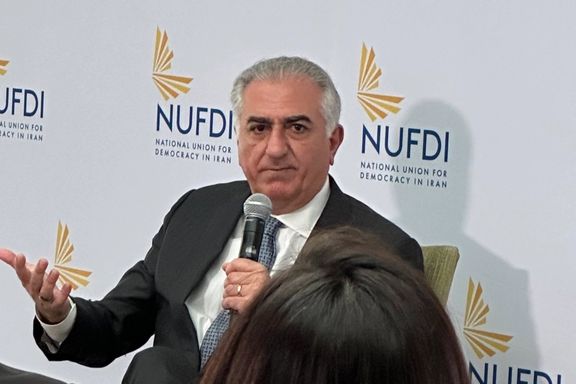
Iran’s exiled Prince Reza Pahlavi speaking at an event held by the National Union for Democracy in Iran (NUFDI) on March 13, 2023

Iran’s exiled Prince Reza Pahlavi addressed lobbyists in the US this week calling for bipartisan support in the US and Europe to achieve a secular Iran.

Speaking at an event held by the National Union for Democracy in Iran (NUFDI) trying to engage “maximum support” for the anti-regime protests in Iran, he criticized current US foreign policy.

All measures, he said, including sanctions, taken to contain the Islamic regime in Iran “is based on a false premise and expectation which was behavior change.”

“Expecting them to change their behavior is such a waste of time,” he added.

Pahlavi reiterated that talks and deals with the Islamic Republic are fruitless because “this regime has proven that its DNA, its reason to exist has nothing to do with the national interests of the country and its people; they’re there only to export their ideology at the expense of the Iranian people.” “For them to succeed, the rest of the world has to fail,” he said, explaining the mentality of the regime.

“It’s zero-sum; they [Iran] cannot have an actual coexistence with a world that is democratic and where human rights are the basis of laws and rules,” he said. He echoed the NUFDI’s call for the annulment of any talks to revive the 2015 nuclear deal with the regime, saying that the world assumes that the deal – known as the JCPOA – would work as a safety catch but a cheating regime can uncheck the safety mechanism if it wants to pull the trigger.

The NUFDI unveiled a 15-point document consisting of action plans and strategic tools for the provision of maximum support as a complement to the US policy of “maximum pressure”, which holds the promise of creating a more complete framework for US-Iran policy.

The booklets that NUFDI distributed during the event elaborating the policy of “Maximum Support” (March 2023)
100%
The booklets that NUFDI distributed during the event elaborating the policy of “Maximum Support”

It calls for a mechanism to hold the Islamic Republic accountable through economic and diplomatic isolation, which also engages, elevates and empowers the Iranian people through the provision of much-needed moral, logistical and financial support. The two strategies work hand-in hand as the pressure on the Islamic Republic weakens the regime in the face of a growing democratic movement and strengthens the Iranian people relative to their oppressors. 

In the opening speech of the event, NUFDI Policy Director Cameron Khansarinia said, “We believe that maximum pressure on the Islamic Republic is necessary; holding the regime accountable for crimes against the Iranian people is not only a movement for freedom, it’s absolutely necessary. Pressure on the Islamic Republic is a form of support of the Iranian people because it comparably weakens the regime and maximum support for the Iranian people is a form of pressure on the regime because it empowers, emboldens, and strengthens the people vis-a-vis the Islamic Republic.”

“First the US must announce a strategic policy shift in its Iran policy,” he said, adding that “the president should publicly address the American people in support of the Iranian people’s movement for a secular democracy.” “Maximum support begins with a formal strategic realignment of US policy and the president coming out formally in support of the Iranian people's right to determine their future and right to a secular democracy” he noted. 

Several pundits from different think tanks, such as the Middle East Institute, American Progress and Carnegie Endowment for International Peace, as well as Member of Canada’s House of Commons Ali Ehsassi and Member of the Belgian Parliament Darya Safai were among the other participants of the event.

A popular voice for the revolutionary movement, Pahlavi said that it is futile to negotiate with the regime because only eradicating the regime can lead to true change. “Secular opposition has the answers,” he said, calling such an action “a controlled implosion” of the regime and not the “anarchy,” which many believe is making the Western powers hesitant to put more weight behind the protesters.

Pahlavi said that “the regime change is not a bad concept” only because it was mishandled somewhere else such as Iraq, emphasizing that it is futile to negotiate with the regime about the solutions for the country “because they’re part of the problem, and the secular opposition has the answers.” 

Pahlavi noted that one of the most important mechanisms for the transition to a democratic Iran is using Tehran’s frozen funds in foreign countries to support strikes by workers in the oil, gas and transportation sectors.

He said one of the most significant elements that put pressure on the previous regime leading to the 1979 revolution, through which his father was overthrown, was financial support for the striking workers of the oil industry.

He underlined that the amount of money needed to support the striking workers is way lower than the funds blocked in other countries due to the US sanctions, saying that supporting workers, who would normally earn around $300 per month, for a few months would offer a manageable solution.

He called for bipartisan support in the US – and in other European countries for that matter, saying that politicians from across the spectrum should support a secular Iran and engage in dialogue with the united front of democratic opposition. "We should take a book out of the experiences that the Israelis have had,” he said, adding that “when it comes to Israel, we expect bipartisan support” from the US regardless of party affiliation. “We don’t expect anything short of bipartisan support when it comes to Iran and our freedom and human rights.”

He described supporting the protesters in Iran as a win-win situation for the world, especially the European countries. He said the immediate tangible benefits would be supplying the energy needs of Europe through Iran’s gas reserves and the stop of the flow of immigrants fleeing from the conflicts in the region to Europe, which is saturated by the number of migrants.


Most Viewed

Iran International says it won’t be silenced after London arson attack
1

Iran International says it won’t be silenced after London arson attack

2
VOICES FROM IRAN

Hope and anger in Iran as fragile ceasefire persists

3

US sanctions oil network tied to Iranian tycoon Shamkhani

4

Iran halts petrochemical exports to supply domestic market

5
INSIGHT

How Tehran bends its own red lines to boost state rallies

Banner
Banner

Spotlight

  • Hardliners push Hormuz ‘red line’ as US blockade tests Iran’s leverage
    INSIGHT

    Hardliners push Hormuz ‘red line’ as US blockade tests Iran’s leverage

  • Ideology may be fading in Iran, but not in Kashmir's ‘Mini Iran'
    INSIGHT

    Ideology may be fading in Iran, but not in Kashmir's ‘Mini Iran'

  • War damage amounts to $3,000 per Iranian, with blockade set to add to losses
    INSIGHT

    War damage amounts to $3,000 per Iranian, with blockade set to add to losses

  • Why the $100 billion Hormuz toll revenue is a myth
    ANALYSIS

    Why the $100 billion Hormuz toll revenue is a myth

  • US blockade targets Iran oil boom amid regional disruption
    ANALYSIS

    US blockade targets Iran oil boom amid regional disruption

  • Iran's digital economy battered by prolonged blackout
    INSIGHT

    Iran's digital economy battered by prolonged blackout

•
•
•

More Stories

Iranian MP Urges Govt. To Bring Perpetrators Of ‘Bloody Friday’ To Justice

Mar 15, 2023, 11:28 GMT+0

An Iranian lawmaker has called for justice for the victims of Bloody Friday, a deadly massacre killing 93 civilians in September.

The deadly day, in Zahedan, the provincial capital of Sistan and Baluchestan and home to a large Kurdish population, took place when security forces brutally suppressed demonstrators gathered in front of a police station to protest the killing of Mahsa Amini and the rape of a 15-year-old Baloch girl by the police chief of Chabahar.

Security forces controlled by the Revolutionary Guard, under the Commandership of the Supreme Leader, killing dozens, including 18 children, 300 more seriously injured.

Mowlavi Abdolhamid, the religious leader of Iran’s largely Sunni Baluch population called the massacre "Bloody Friday" and held Supreme Leader Ali Khamenei directly responsible for the massacre.

Moineddin Saeedi, representative of Chabahar city, on Tuesday warned President Ebrahim Raisi that the issue should be handled “with special attention”.

Abdolhamid said in his recent Friday prayer sermons that he is still following up on the rights of the victims of Bloody Friday emphasizing that the measures taken so far are “inadequate”.

The government has failed to conduct a transparent investigation or hold any security officials responsible for the deaths.

“Eighty people are still in hospitals and 17 were shot in the eyes and blinded," added Abdolhamid.

Since Bloody Friday, the people of Zahedan have held their weekly protests pouring into streets for twenty-three consecutive weeks. The protesters have vowed to continue their street demonstrations until the punishment of all the leaders and perpetrators of the massacre.

Europeans Boycott Academic Ties With Iran: Official

Mar 15, 2023, 10:30 GMT+0

A high-ranking official of Iran's Ministry of Science says Europeans have restricted their academic ties with the Islamic Republic.

Germany has also closed the office of the German Academic Exchange Service (DAAD) in the country.

Vahid Haddadi-Asl, the deputy minister in international affairs told state-run ISNA news agency that the European countries are not interested in academic collaboration with Iran.

"We have no limits on scientific cooperation with the countries of the world except with the Zionist regime, but the Europeans restricted their ties and Germany closed the office of the German Academic Exchange Service (DAAD) in Iran,” he said, DAAD academic, and should not be politicized.

However, in his statements, Haddadi did not mention the extensive pressure on students and declined to explain why a number of Iranian or foreign academic figures are arrested in Iran on the charge of espionage.

Students have been under pressure for years, and in recent protests following the death of Mahsa Amini in September a large number of them were detained and beaten up by security agents, even inside campuses.

However, Haddadi claimed the Islamic Republic had "good academic activities" in the neighboring countries, and "some good agreements were signed with them” namely Iraq, Pakistan, Tajikistan, and Uzbekis

Iran-Saudi-Chinese Deal Can Encroach On US Regional Policy

Mar 15, 2023, 09:38 GMT+0
•
Mardo Soghom

China, Russia and Iran have started maritime drills in the Gulf of Oman, less than a week after Tehran and Riyadh agreed to restore ties with Chinese mediation.

China’s defense ministry announced Wednesday that the drills will last from March 15-19 and “deepen practical cooperation among the navies of participating countries.”

Although it is not the first time the three countries hold joint naval drills in the Gulf of Oman and the Indian Ocean, the announcement coming on the heals of the Saudi-Iranian rapprochement might be a signal by Beijing about its intentions to expand influence in the region.

The drills also coincide with reports that China intends to hold a summit of Arab countries and Iran later this year. The Wall Street Journal quoted diplomatic sources that when Chinese President Xi Jinping visited Saudi Arabia for a regional summit with Persian Gulf Arab states in December, he proposed a high-level gathering of the Gulf Cooperation Council members and Iran in Beijing in 2023.

Most analysts agree that restoration of diplomatic ties between Iran and Saudi Arabia does not mean an overnight resolution to serious differences in their complicated relations. US officials have been quoted as being skeptical about Tehran delivering on what it has promised Riyadh, which is probably pursuing limited goals of reducing tensions rather than forging close relations with Tehran.

But most interestingly, Reuters briefly quoted the Saudi finance minister Wednesday as saying that there are a lot of opportunities for investments in Iran and he does not see an impediment as long as terms of agreements are respected by Tehran.

Russia, Iran, China naval drills in February 2021
100%
Russia, Iran, China naval drills in February 2021

This is going much farther than a cordial resumption of diplomatic ties, and it would mean that the Saudis are willing to throw a lifeline to the beleaguered clerical rulers in Tehran who face a bankrupted economy.

Any Saudi economic dealing with Iran would also directly undercut US sanctions imposed to pressure Tehran, if not violating them outright. But dangling the prospect of foreign investment that Iran has no chance of securing in the current situation, might be a powerful tool.

There have been speculations that Beijing might try to solve the issue of Iran’s nuclear program that has extremely worried the Saudis, and eluded the Americans. In such a scenario, when tens of billion of dollars in Iranian assets are blocked worldwide, the prospect of Saudi investments could be a powerful lever to cajole Tehran to agree to a Chinese brokered agreement limiting its nuclear program.

Nevertheless, at this juncture, a regional rapprochement seems to be moving ahead fast. Nour News, a website in Tehran close to the national security council reported Wednesday that Iran's Supreme National Security Council secretary Ali Shamkhani will visit the United Arab Emirates on Thursday.

"Shamkhani will travel to Abu Dhabi on Thursday in response to an official invitation by his Emirati counterpart Sheikh Tahnoun bin Zayed Al Nahyan to discuss bilateral, regional, and international issues," Nour News said.

"Top economic, banking and security officials will accompany the Supreme National Security Council secretary to the UAE," it added.

Improvement of not only diplomatic but economic relations between GCC members and Iran could be a signal that plans to expand and strengthen the Abraham Accords between Israel, the United States and Arab countries will take the back seat.

This would also be a serious blow to US ‘maximum pressure’ strategy against Iran to push it toward a nuclear agreement that would perhaps include other provisions to limit Iran’s damaging activities in the region. If Saudis can tame Tehran with their own methods, the US role will be diminished as a security guarantor for the Kingdom.

Iran Prosecutes Celebrities For ‘Lies And Rumors’ About School Poisonings

Mar 15, 2023, 04:51 GMT+0
•
Maryam Sinaiee

Iran's judiciary has indicted dozens of artists, reformist politicians, and journalists for “spreading rumors and lies” in media and social media about gas attacks on girls’ schools.

Judiciary Spokesman Masoud Setayeshi said Tuesday at a press briefing that around thirty celebrities have been indicted by courts, and he threatened them with harsh repercussions if they continued such activities.

The interior ministry said Saturday that over 100 people in eleven provinces were arrested in connection with the poisonings that started in the religious city of Qom in central Iran in late November and spread to dozens of schools across the country. The accused, authorities claim, were connected to “terrorist groups” and foreign governments.

The government, however, has not revealed any details about these alleged arrests, as the public remains skeptical about the government’s role in the attacks.

Among the celebrities indicted for his social media posts about the spate of attacks is popular actor Reza Kianian. In a recent Instagram post Kianian shared a poster showing two men in black balaclavas and combat uniform holding up a little girl with a gas mask on her face fearlessly flashing a victory sign at one of the two men.

Kianian came under immense attack from hardliners on social media for the post that suggested security forces’ involvement in the poisonings, and demanded that authorities take legal action against him for defaming security forces.

Like Kianian, many ordinary Iranians have been suspicious of involvement of the regime itself, or religious extremists protected by the regime, in the school attacks and call the acts “state terrorism”.

Instagram post by actor Reza Kianian 

Authorities have revealed very little about the alleged perpetrators, the nature of the attacks, and the chemicals used to poison the children. The state television, nevertheless, aired the so-called ‘confessions’ last week of a man and his daughter arrested and accused of attacking schools with N2 gas canisters.

One of the accused said in the video that they lit “wicks” attached to the canisters before throwing them in the courtyards of seven schools in Larestan, a city in southern Iran. Experts say N2 is neither poisonous nor flammable to require a flame to explode and spread.

Several celebrity actors and other artists who supported the Mahsa protest movement by criticizing the regime or releasing ‘hijabless’ photos of themselves on social media, such as popular actress Taraneh Alidousti, were arrested in the past six months.

In defiance of the compulsory hijab, Alidousti appeared ‘hijabless’ in the photos taken outside Tehran’s Evin prison with her colleagues and supporters upon her release on a large bail in January after nearly three weeks of imprisonment.

Actress Taraneh Alidousti after being released on bail outside the prison

The harsh legal action against celebrities follows threats of "severe punishment” by Chief Justice Gholam-Hossein Mohseni-Ejei against those criticizing the authorities for the gas attacks that have sent hundreds of schoolgirls to hospitals.

The judiciary spokesman also said Tuesday that the charges have been brought against three newspaper editors, academic and reformist political activist Sadegh Zibakalam, and Secretary General of Unity of the Nation Party Azar Mansouri for “spreading rumors and lies.”

Around sixty journalists have been arrested since September in connection with the protests ignited by the death of the 22-year-old Mahsa Amini who died in the custody of the morality police after being arrested on the street for not wearing her hijab ‘properly’. Two female reporters, Elaheh Mohammadi and Niloufar Hamedi, who were arrested in October for their reporting on Mahsa’s death, are still in prison.

War Veterans In Iran Protest Hardship Amid Very High Inflation

Mar 14, 2023, 22:22 GMT+0

A group of Iranian war veterans have once again staged a rally in Tehran to protest hardship amid a minimum 70-percent food price inflation and their inadequate pensions.

According to a video received by Iran International, one of the people who suffered injuries during Iran-Iraq war said Monday that government officials keep repeating that “you went to war for the sake of God.”

This is not the first time the war veterans protest against their poor living conditions.

In the past years, they gathered many times in front of the parliament urging lawmakers to resolve their issues.

In August, Iran's Council of Retirees reported that one of the veterans wounded in the Iran-Iraq war, named Khosro Yavari, set himself on fire and died in Songhor city of Kermanshah province due to financial hardship.

Meanwhile, Iran’s Parliament Speaker Mohammad Bagher Ghalibaf admitted in a televised speech Monday that the Islamic Republic has failed to resolve economic problems and control inflation. He said the regime has not been able to help people in covering their daily life expenses.

He once again claimed the government intends to compensate for this to some extent "with policies such as tax exemptions and direct subsidies".

These remarks come at a time when inflation has increased sharply this year and MPs have warned against another wave of inflation in the coming year beginning March 21.