• العربية
  • فارسی
Brand
  • Iran Insight
  • Politics
  • Economy
  • Analysis
  • Special Report
  • Opinion
  • Podcast
  • Iran Insight
  • Politics
  • Economy
  • Analysis
  • Special Report
  • Opinion
  • Podcast
  • Theme
  • Language
    • العربية
    • فارسی
  • Iran Insight
  • Politics
  • Economy
  • Analysis
  • Special Report
  • Opinion
  • Podcast
All rights reserved for Volant Media UK Limited
volant media logo

Rial Bounces Back After Intervention And Hopes On JCPOA
Iran International Newsroom
Mar 2, 2023, 22:02 GMT+0Updated: 17:44 GMT+1
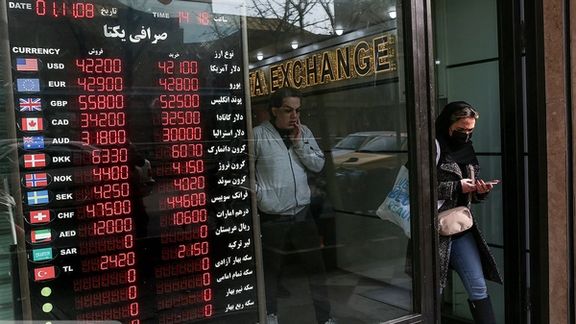
A woman walking out of an exchange office in Iran

Iran’s national currency has bounced back in the past three days, regaining about 10 percent of its lost value since a historic low four days ago, leaving pundits wondering about the reason. 

The exchange rate of the dollar touched over 600,000 rials earlier on Sunday but the Iranian currency began to rise to close at about 540,000 against the dollar on Thursday, which is the last weekday in Iran. 

Despite the rebound, the rial is still down 100 percent compared to six months ago.

Iranian media is replete with different scenarios for the rebound, but the most plausible explanation still seems to have been the injection of a large amount of foreign currency into the market by the Central Bank of Iran. 

Another reason mentioned in Tehran media is a bit far-fetched guesswork that the country's foreign minister's trip to Geneva during the week and the possibility of resuming negotiations to revive the 2015 nuclear deal injected some optimist into the market.

In an article earlier in the week, Jomhouri-e Eslami newspaper argued that fluctuations in the market are out of the hands of the government as the country’s economy is tied to the fate of Iran’s nuclear deal and its relations with the other countries. The paper and other media outlets speculated that foreign minister Hossein Amir-Abdollahian’s trip to attend a United Nations human rights meeting might also re-open the door to nuclear talks resulting in the lifting of US sanctions.

The paper described the extreme rise and fall of the dollar in only a few days as a lesson for the authorities, highlighting that the country can survive the current critical period through reviving the JCPOA and declaration of neutrality in the Russian invasion of Ukraine as well as a practical approach to a balanced policy in international relations.

Reports about the imminent visit by the head of the International Atomic Energy Agency (IAEA) Rafael Grossi to Iran for high-level meetings, purportedly slated for Friday, was another reason mentioned by the country’s media. The visit comes amid discussions with Tehran on the origin of uranium particles enriched to up to 83.7% purity, very close to weapons grade, at its Fordow enrichment plant. 

 CIA Director William Burns (file photo)
100%
CIA Director William Burns

Remarks by CIA Director William Burns about Islamic Republic not pursuing an atomic bomb was also mentioned as being behind the halt in the devaluation of the rial. "We don't believe that the Supreme Leader in Iran has yet made a decision to resume the weaponization program that we judge that they suspended or stopped at the end of 2003," Burns said. 

While merchants told Iran International earlier in the week that trading in Tehran markets had largely come to a halt as the rial was near its all-time low, the local media confirmed reports that the Central Bank of Iran intervened in the currency market to stop the freefall of the rial. On Sunday, the bank injected $700 million in UAE dirhams and the rial began to rise from its all-time low of 600,000 against dollar.

The rial’s plunge to 575,000 Saturday, February 25, exacerbated chaos in several of Iran's major markets and brought many businesses to near standstill. The rial fell from 35,000 to more than 600,000 against the US dollar in exactly five years. This led to very high inflation, officially at more than 50 percent, which has impoverished tens of millions of Iranians. An Iranian economist says the role of US sanctions in causing economic chaos in Iran has been significant.

All in all, the Islamic Republic seems incapable of major changes in the market as it is strapped for cash with some reports saying the government does not allow ATM machines to give cash more than the current limit of 2,000,000 rials – about $4, which barely can buy a hamburger today in the capital.


Most Viewed

State media slam Araghchi's Hormuz tweet, say it let Trump claim victory
1

State media slam Araghchi's Hormuz tweet, say it let Trump claim victory

2

Iran International says it won’t be silenced after London arson attack

3
INSIGHT

How Tehran bends its own red lines to boost state rallies

4

Iran halts petrochemical exports to supply domestic market

5
OPINION

The Hormuz get out of jail card turned to a grave

Banner
Banner

Spotlight

  • Too early to tell who is winning Iran war, experts say
    PODCAST

    Too early to tell who is winning Iran war, experts say

  • How Tehran bends its own red lines to boost state rallies
    INSIGHT

    How Tehran bends its own red lines to boost state rallies

  • Iran blackout cripples freelancer, small business incomes
    VOICES FROM IRAN

    Iran blackout cripples freelancer, small business incomes

  • Ideology may be fading in Iran, but not in Kashmir's ‘Mini Iran'
    INSIGHT

    Ideology may be fading in Iran, but not in Kashmir's ‘Mini Iran'

  • US blockade enters murky phase as tankers spoof signals and buyers hesitate
    ANALYSIS

    US blockade enters murky phase as tankers spoof signals and buyers hesitate

  • Why the $100 billion Hormuz toll revenue is a myth
    ANALYSIS

    Why the $100 billion Hormuz toll revenue is a myth

•
•
•

More Stories

Jailed Iranian Rights Activists Ready To Testify Against FM Claims

Mar 2, 2023, 15:19 GMT+0

In response to Iran's foreign minister’s denials of rape in prisons, an imprisoned female activist announced she is ready to testify against the government.

In a letter sent to Radio Farda, the Persian Service of Radio Free Europe in Prague, Narges Mohammadi wrote: "In the past few months, detainees have been brought to the women's ward of Evin prison, and … subjected to sexual assault and physical torture. We have witnessed the traces left on their bodies.”

The civil activist, who has been in prison since 2016, also referred to the case of the elderly Baha'i poet and writer, Mahvash Shahriari, who has served 10 years in prison, and was recently arrested without any legal documents against her.

“She spent five months in solitary confinement [and] has suffered mental and physical torture,” emphasized Mohammadi.

She further expressed readiness "to testify in any place" as a "witness" regarding sexual assault and physical torture in prisons.

Amid the mass arrest of protesters within the past five months, numerous reports have been published regarding rape and assault on both men and women by regime officials in prisons, the first report published by CNN in November.

In response to the investigation, the foreign minister, Hossein Amir-Abdollahian, described the reports as "biased and false".

British Navy Seizes Smuggled Iranian Weapons In Gulf Of Oman

Mar 2, 2023, 13:40 GMT+0

Britain's Royal Navy said Thursday it had seized Iranian weapons, including anti-tank guided missiles, last month from a smuggler’s vessel in the Gulf of Oman.

Britain said the vessel was detected travelling south from Iran at high speed during the hours of darkness by an unmanned US intelligence surveillance and reconnaissance plane in international waters, and was also tracked by a British helicopter.

When hailed by the Royal Navy, the vessel initially attempted to navigate to Iranian territorial waters but was stopped by a team of Royal Marines, who then boarded the small boat and recovered the suspicious packages, Britain's Ministry of Defense said.

"This seizure by HMS Lancaster and the permanent presence of the Royal Navy in the Gulf region supports our commitment to uphold international law and tackle activity that threatens peace and security around the world," British Defense Secretary Ben Wallace said in a statement.

Initial inspection suggested the packages included Iranian anti-tank guided missiles and medium-range ballistic missile components, Britain said, adding that it had informed the United Nations about the seizure.

It follows two previous Royal Navy seizures of Iranian weapons in the region early last year and several seizures by the US Navy or in joint operations since November.

UN experts have in the past made a determination that some weapons used by the Houthi forces in Yemen had Iranian origin.

Tehran has been supporting the Houthis at least for the past 8 years against Yemen's government and its backer Saudi Arabia.

With reporting by Reuters

US Denounces Poisoning Of Schoolgirls In Iran, Demands Action

Mar 2, 2023, 09:27 GMT+0

After the worst single day of gas poisonings in Iranian girls' schools, Washington has declared the issue “abhorrent" and called on authorities to put an end to the horror.

On Wednesday, almost 30 schools around the country saw hundreds of schoolgirls become the latest victims of an unknown gas being used in schools apparently to suppress support for the revolution.

In a briefing on Wednesday, State Department Spokesman Ned Price said the reports on the poisonings are both “disturbing” and “concerning”.

Hundreds of schoolgirls - who have been at the forefront of anti-regime protests - have been hospitalized in various cities across the country since November 30 when the first case of a mysterious poisoning was reported in the religious city of Qom.

Price called on the Iranian authorities to thoroughly investigate the poisonings. “It is incumbent on Iranian authorities to respond … [and] put an end to these reported attacks … [and] to hold accountable those who may be perpetrating this,” added Price.

He added: “Women and girls everywhere have an innate right to an education, and education is a universal human right. It is a right that women and girls in Iran should have … It is essential to advancing women’s economic security and to realizing gender equality.”

Interior Minister Ahmad Vahidi, a man wanted by Interpol for the bombing of a Jewish cultural center in Buenos Aires in 1994, said Wednesday that no chemical agent responsible for the poisonings has been found, and the culprits are yet to be apprehended.

He failed to address claims on social media that women dressed in strange attire had been seen walking into school campuses, suggesting a clear campaign to target the schools coming from regime officials.

Chemical Attacks On Girls’ Schools In Iran Go Unpunished

Mar 1, 2023, 21:31 GMT+0
•
Maryam Sinaiee

No one has been arrested three months after the first chemical attack on a girls’ school in Iran, amid a new spate of attacks affecting at least 26 schools Wednesday.

Interior Minister Ahmad Vahidi said at a press briefing Wednesday afternoon that so far no one has been arrested for the mysterious poisoning of girls at schools across the country and no chemical agent responsible for the poisonings has yet been found.

The IRGC-linked Fars News Agency had reported the arrest of three individuals earlier on Wednesday.

Vahidi who was assigned by President Ebrahim Raisi at the cabinet meeting Wednesday morning to urgently investigate the incidents also denied that the poisonings, apparently by toxic gases, have caused paralysis in any of the students. He claimed that the symptoms in over 90 percent of the students were induced by stress.

An artwork about the poisoning of schoolgirls
100%
An artwork about the poisoning of schoolgirls

On Wednesday at least 26 more schools were attacked including over a dozen in the capital Tehran, six in Ardabil, two in Kermanshah, and one in Esfahan. In several cases security forces and police used violence against outraged parents who chanted slogans against authorities outside schools.

It is shocking for the public that the government has so far made no arrests or identified suspects, as well as providing extra security around schools. Later on on Wednesday, the United States urged Iran to investigate the poison attacks, a US State Department spokesperson said.

In a tweet Wednesday, prominent journalist Abbas Abdi said the attacks would have already ended if authorities had been as vehement to catch those responsible for the attacks as they are in silencing the poisoned girls’ families.

Children’s parents shouting “Death to the child-killing regime” and “Death to the Dictator” outside a girls’ school in Tehransar in a western suburb of Tehran.

Hundreds of schoolgirls have been hospitalized in various cities across the country since November 30 when the first case of a mysterious poisoning was reported in the religious city of Qom. Attacks have been widespread in Qom and Boroujerd in western Iran so far where tens of schools have been affected. The first attack in Tehran was reported Tuesday. Boys’ schools were attacked only in a few rare cases, including a primary school in Parand Town in the south of the capital, on Wednesday.

Authorities who at first dismissed the reports of poisonings in Qom and attributed the incidents to “children’s pranks” or other reasons including faulty heating, have now admitted that at least 1,200 students were affected by the mysterious fumes.

As many Iranians have said on social media that the attacks are the work of religious zealots who want to prevent girls from attending school, hardliners have tried to blame regime opponents.

Tehran municipality’s Hamshahri newspaper, a hardliner mouthpiece, dubbed the poisoning incidents “A Poisonous Project” and suggestively printed images of opposition figures including the former crown prince Reza Pahlavi, Mujahedin-e Khalq (MEK) leader Maryam Rajavi, and activist Masih Alinejad on its frontpage Wednesday. “By using the students’ poisonings, anti-revolutionaries are trying to cause anxiety among people,” the newspaper wrote.

Schoolgirls at a Tehran hospital Wednesday suffering from short breath and other symptoms including lethargy.

Prince Reza Pahlavi in a tweet Tuesday accused the regime of responsibility for systematic attacks on girls’ schools. Alinejad has also accused the regime and said it is taking revenge on schoolgirls for their participation in the Woman, Life, Freedom protests.

Many parents say on social media that they will not send their girls to school to keep them out of harm’s way but Alinejad has called on male students to boycott classes in their schools and universities on Saturday in support of schoolgirls.

State media and hardliners blame the MEK, which has a long record of terrorist attacks in Iran in the 1980s, more often than anyone else. “I have no doubt that the MEK or other hostile and anti-revolutionary groups are involved [in the poisonings],” lawmaker Ahmad Rastineh said Wednesday.

Another lawmaker, Mohammad-Tala Mazloumi, also blamed the MEK and similar groups, which he said aim to disgrace the Islamic Republic and its educational system, while also pointing a finger at Israel.

Iran Approves Law To Allow Armed Forces To Sell 3 Billion Euros Of Oil

Mar 1, 2023, 18:06 GMT+0

Iran’s parliament has approved legislation to allow the government to allocate 3 billion euros to the Armed Forces “to strengthen the country's defense infrastructure”.

Based on the legislation approved on Wednesday, the General Staff of the Armed Forces is allowed to export three billion euros worth of crude oil and oil products through small private refineries after the approval of the country's budget organization.

In the budget bill for the next Iranian year, starting March 21, the government had granted new permits to some departments such as the General Staff of the Armed Forces of the Islamic Republic to sell oil on behalf of the government and earn some of the income.

According to the Note 1 of the bill – titled “Oil and its relations with the government” -- the National Iranian Oil Company is obligated to deliver “crude oil and gas condensates” to entities introduced by the executive bodies. It means that the Armed forces can give crude oil to refineries and receive products that should be exported.

Iran, which is under US oil export sanctions has used this method before to make illicit oil shipments. However, in the past this has led to large corruption cases.

According to legal experts, this method of allocating money to government entities violates the constitution.

It remains unclear who and under what conditions will export the oil amid US sanctions. Many members of Iran's hardliner dominated parliament are former members of the IRGC.