• العربية
  • فارسی
Brand
  • Iran Insight
  • Politics
  • Economy
  • Analysis
  • Special Report
  • Opinion
  • Podcast
  • Iran Insight
  • Politics
  • Economy
  • Analysis
  • Special Report
  • Opinion
  • Podcast
  • Theme
  • Language
    • العربية
    • فارسی
  • Iran Insight
  • Politics
  • Economy
  • Analysis
  • Special Report
  • Opinion
  • Podcast
All rights reserved for Volant Media UK Limited
volant media logo

Government Is At An Impasse, Iranian Politicians Say
Iran International Newsroom
Feb 23, 2023, 18:10 GMT+0Updated: 17:40 GMT+1
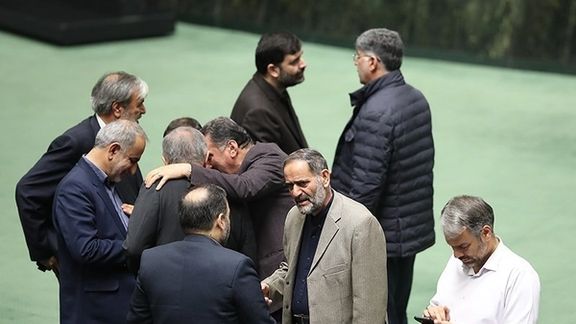
Iranian lawmakers during a special closed-door session on February 20, 2023

Reports in the Iranian media show that an increasing number of politicians believe the government’s inaction in the face of serious economic crisis cannot continue.

This week has been the most challenging for the government of President Ebrahim Raisi as the national currency is in freefall against the US dollar and the government seems just bewildered and confused.

A seasoned politician and political analyst has asserted that President Raisi’s administration is simply incapable of solving the country’s problems, and it is best for everyone that he resigns.

Former lawmakers Gholam Ali Jafarzadeh Imanabadi has said in an interview with Rouydad24 news website that Raisi should resign his post before he discredits himself even more than the credibility he has already lost. Imanabadi further charged that Raisi understands neither politics nor the economy.

“What he says about his ‘popular government’ insults the nation’s intelligence,” the politician said, adding that Raisi’s performance has even discredited his father-in-law Ahmad Alamolhoda, a firebrand cleric, who is Ali Khamenei’s representative in Khorasan Province.

He said the Raisi administration has imposed a huge cost on the nation by doing nothing and simply chanting slogans. Imanabadi added: “The best thing he can do is to resign at once and disband the government.” At the same time, he said, the Guardian Council should allow more popular candidates such as former Presidents Mohammad Khatami and Mahmoud Ahmadinejad and former Majles Speaker Ali Larijani to run for president.

An undated photo of politician and commentator Imanabadi
100%
An undated photo of politician and commentator Imanabadi

Imanabadi claimed that while Khamenei had allowed negotiations with the West, Raisi and his team refused to make an agreement to revive the nuclear deal and imposed a high cost on the nation. He also criticized Raisi for going to China this month, while the Chinese President has not apologized for making a comment that undermined Iran’s territorial integrity.

Imanabadi predicted that because of Raisi’s performance, protests will start once again in the spring when angry people take to the street against the government.

Meanwhile, Khabar Online wrote on Wednesday, February 22, that before February, Iranian lawmakers often talked about questioning the government about its economic policy, but now the situation is so serious that no one at the parliament wants anything less than impeaching the ministers and the President. Khabar Online quoted lawmaker Mahmoud Abbaszadeh Meshkini as having said: “Majles [parliament] can impeach the ministers and the government. The situation is worse than ever.”

Mahmoud Abbaszadeh Meshkini. File photo
100%
Mahmoud Abbaszadeh Meshkini

Meshkini said that the Majles is planning to impeach up to 9 of Raisi’s cabinet ministers. The president’s economic team is incompetent although some of Iran’s problems are the result of its foreign policy and flaws in the country’s political structure.

He added that the Majles held a two-hour long closed-door session on Monday during which lawmakers resolved to hold the government accountable and he reiterated that the current situation cannot continue any further.

Meshkini explained that some lawmakers believe impeachment is a time consuming process and maintain that a better solution is to convince Raisi to change his cabinet altogether. On the other hand, some lawmakers prefer to keep silent to ensure their electability next year by remaining loyal to the hardliner camp.

In another development, prominent reformist analyst Abbas Abdi wrote in Etemad newspaper that Raisi is not fit for the presidency.

He said one month after Raisi promised to the parliament that the rial will regain value, we have seen a 15 percent rise for the dollar. Abdi charged that the government has no economic plan and measures such as replacing the Central Bank governor will not solve the problem.

Unfortunately, this government cannot stand up to the job of solving the country’s problems and no positive change can be expected. Iran is going to miss opportunities and even positive measures such as releasing political prisoners cannot bring back people’s trust, Abdi said.


Most Viewed

State media slam Araghchi's Hormuz tweet, say it let Trump claim victory
1

State media slam Araghchi's Hormuz tweet, say it let Trump claim victory

2
OPINION

The Hormuz get out of jail card turned to a grave

3

Iran International says it won’t be silenced after London arson attack

4
INSIGHT

How Tehran bends its own red lines to boost state rallies

5

Iran halts petrochemical exports to supply domestic market

Banner
Banner

Spotlight

  • Too early to tell who is winning Iran war, experts say
    PODCAST

    Too early to tell who is winning Iran war, experts say

  • How Tehran bends its own red lines to boost state rallies
    INSIGHT

    How Tehran bends its own red lines to boost state rallies

  • Iran blackout cripples freelancer, small business incomes
    VOICES FROM IRAN

    Iran blackout cripples freelancer, small business incomes

  • Ideology may be fading in Iran, but not in Kashmir's ‘Mini Iran'
    INSIGHT

    Ideology may be fading in Iran, but not in Kashmir's ‘Mini Iran'

  • US blockade enters murky phase as tankers spoof signals and buyers hesitate
    ANALYSIS

    US blockade enters murky phase as tankers spoof signals and buyers hesitate

  • Why the $100 billion Hormuz toll revenue is a myth
    ANALYSIS

    Why the $100 billion Hormuz toll revenue is a myth

•
•
•

More Stories

Iran’s Assembly of Experts Renews Allegiance To Khamenei

Feb 23, 2023, 13:48 GMT+0
•
Iran International Newsroom

The Islamic Republic’s Assembly of Experts, the deliberative body empowered to appoint the Supreme Leader, has renewed its loyalty to Iran’s ruler Ali Khamenei. 

The Secretariat of the Assembly -- also translated as the Assembly of Experts of the Leadership or as the Council of Experts – issued a statement on Wednesday, reiterating obsequious remarks about Khamenei. 

In their statement, the members of the assembly described Khamenei as a force of “solidarity and national unity," and decried the slogans and slurs that are chanted against him during popular protests for over five months. 

Members of the Assembly are elected from the inner circle of the regime and people very close to the Khamenei, which explains their full loyalty. The assembly – which is in charge of supervising, dismissing and electing the Supreme Leader – can run for election after being vetted by the Guardian Council, whose members are, in turn, appointed either directly or indirectly by the Supreme Leader.

The Guardian Council is composed of six Islamic law experts, selected by the Supreme Leader, and six jurists, nominated by the Chief Justice, who in turn, is also appointed by the Supreme Leader. Therefore, it is a self-serving closed-circuit system that ensures all key constitutional position are occupied by loyalists.

Interestingly enough, the head of both bodies is hardliner cleric Ahmad Jannati, who turned 96 on Wednesday, a day after he was re-elected as the chairman of the Assembly of Experts for another two years. First Deputy Chairman of the assembly is President Ebrahim Raisi.

Ahmad Jannati, the chairman of the Assembly of Experts and the Guardian Council (file photo)
100%
Ahmad Jannati, the chairman of the Assembly of Experts and the Guardian Council

The assembly’s statement repeatedly glorified Khamenei, claiming that the "unprecedented large volume of propaganda and insults" against him indicates that the enemy understands his important role in “guidance and management of society.” 

The statement also reiterated calls for the preservation of "hijab" -- or Islamic dress code -- as a clear message of the Islamic revolution and one of the "elements of the identity of the Islamic Republic of Iran". The current wave of protests, the boldest the regime has ever faced in the 43 years of its existence, was ignited when hijab enforcement patrols arrested Mahsa Amini violently that led to her death at hospital due to severe trauma on her head. 

Iran’s ruler Ali Khamenei speaking to some members of the Assembly of Experts in Tehran on February 23, 2023
100%
Iran’s ruler Ali Khamenei speaking to some members of the Assembly of Experts in Tehran on February 23, 2023

In a meeting with the chairman and some members of the Assembly of Experts in Tehran on Thursday, Khamenei said that the Islamic establishment “opposes those who believe in the Western secularism and opposes the leaders of liberal democracy, who have hatched a plot to dominate over and plunder the world’s resources behind the false flag of freedom and democracy,” he said.

According to a confidential letter obtained by Iran International in recent days, the Revolutionary Guard (IRGC) has asked the government not to disclose the budget of institutions such as the Hijab police, which are criticized by the people.

The regime has heavy-handedly suppressed protesters, executing four young men, killing well over 500, including more than 70 children, and arresting around 20,000 in the past five months. 

On Monday, an estimated crowd of about 20 to 30 thousand people held a rally in Brussels outside the European Council to call on EU countries to designate Iran’s Revolutionary Guard as a terrorist organization. Thousands of Iranians from all over Europe held a massive rally in Strasbourg in January for the same purpose. Also on Monday, the EU sanctioned 32 Islamic Republic officials, including culture and education ministers, deputy IRGC commander, and several MPs. The move can be seen as a measure to justify the fact that the EU is not yet ready to designate the entirety of the IRGC.

Iran's Hardline Daily Calls For Prosecution Of German Embassy Staff

Feb 23, 2023, 10:53 GMT+0

A hardliner newspaper in Tehran has demanded that German embassy staff be banned from leaving Iran in response to expulsion of two Iranian diplomats from Berlin.

The editor and representative of Supreme Leader Ali Khamenei in Kayhan Daily, Hossein Shariatmadari also called for the prosecution of a person he called an "intelligence officer stationed at the German embassy".

Shariatmadari’s demand is reminiscent of the takeover of the US embassy by radicals in Tehran after the 1979 revolution when dozens of embassy staff were held hostage for 444 days.

This hardliner editor, who is said to be one of the interrogators of political prisoners, added that "The next step should be filing a complaint against the German government at the International Criminal Court for sending terrorists to Iran to massacre the oppressed people of the country."

Iran's judiciary sentenced Iranian-German national Jamshid Sharmahd to death on security charges February 20.

Sharmahd, who is also a US resident, is accused by Tehran of heading a pro-monarchist group blamed by the government for a deadly 2008 bombing and planning other attacks in the country.

In response, Germany declared two employees of the Iranian embassy personae non gratae and ordered them to leave the country on Wednesday.

However, Shariatmadari claimed, "Sharmahd has been tasked with carrying out terrorist operations by the German government, and the action of the German Ministry of Foreign Affairs in summoning the Iranian ambassador and expelling two employees of Iran’s embassy is a type of deception operation to wipe off the traces of the German government’s involvement in this terrorist operation.”

Iranians Outraged By Swiss Ambassador’s Black Veil In Shrine Visit

Feb 23, 2023, 03:25 GMT+0
•
Maryam Sinaiee

Iranians opposing compulsory hijab are outraged by the Swiss envoy’s decision to wear a long black veil during a shrine visit which a hardliner website has described as “dazzling”.

Photos of Nadine Olivieri Lozano wearing a long black veil that covers the head and the whole body during a visit to Qom were widely published by hardliner media with headlines such as “Swiss Ambassador in Iran Wears Chador” by Hamshahri Online and “Swiss Ambassador’s Visit To Our Lady Masoumeh’s Shrine in Dazzling Hijab” by Arsheh Online.

In the photos, Lozano is seen with several clerics at the shrine and receiving a gift, a religious book, from one of the shrine’s caretakers.

These media outlets said Lozano had traveled to Qom, about 120 km to the south of Tehran, to familiarize herself with Islamic culture and art and the architecture of the shrine. Qom is Iran's second most important religious city, after Mashhad and is home to biggest and most prestigious of Iran's Shiite seminaries.

“Instead of reacting to the atrocities of the regime against women for flouting their hijab or visiting the graves of women and girls who were innocently killed, the Swiss ambassador, who is a woman herself, dons a chador and visits the Shrine of Masoumeh in Qom alongside their killers,” one of the critics, Sarbaz-e Vatan (Soldier of the Motherland), twitted with a photo showing the Swiss ambassador walking with a cleric in the courtyard of the shrine.

Mehdi Hassanpour, another critic, argued in his tweet that the Swiss ambassador’s wearing of the black veil was an insult to both Iranian and Swiss women and demanded her resignation.

Others pointed out that by visiting the shrine and wearing a chador, the Swiss ambassador had provided the “oppressors” of the Iranian women with an opportunity for good publicity at a time when Iranian women were fighting for freedom from compulsory hijab.

Federica Mogherini Former High Representative of the European Union for Foreign Affairs and Security in 2015.

Wearing a chador is required at Shia shrines which often provide them to women who visit. Chadors, however, do not have to be black. The black chador which the Swiss ambassador was wearing during her visit is lauded by the religious establishment as the ‘ultimate hijab’. Visiting female foreign dignitaries are also always required to wear a long headscarf but not a chador during their visit.

Hardliners and clerics of Qom often complain about women in their city not observing the hijab rules “appropriately” and demand its stricter enforcement by the authorities.

According to a commentary by the Revolutionary Guards (IRGC) linked Fars news agency two years ago, the number of women who traditionally wore the black chador was dropping by the day in Qom.

Some of the top clerics in Qom and religious hardliners have repeatedly demanded from the authorities to enforce the hijab rules in their religious city more strictly and to put an end to what they believe are signs of moral depravity among its citizens.

There has been a spate of mysterious poisonings in girls’ schools in Qom since November 30. On Wednesday, three other schools in Qom were attacked and fifteen girls were hospitalized with various symptoms of poisoning.

Some officials have also said that the poisonings could be “deliberate”. In a letter to the prosecutor of Qom Public and Revolutionary Courts Monday, Prosecutor General Mohammad-Jafar Montazeri said “deliberate criminal activity” was suspected in the school poisonings.

Many say on social media that the poisonings that have affected at least 400 girls so far are the work of an extremist group that wants to force girls give up their education by acts of terror.

Iran Welcomes Resumption Of Ties With Saudi Arabia: FM

Feb 22, 2023, 22:14 GMT+0

While Tehran has not changed its policies in the region, Foreign Minister Hossein Amir-Abdollahian claimed the Islamic Republic would welcome the resumption of ties with Saudi Arabia.

According to AFP, Amir-Abdollahian made the comments in his visit to Baghdad on Wednesday during talks with his Iraqi counterpart about the stalled negotiations between Tehran and Riyadh, which were held with the mediation of Baghdad.

Baghdad plays the role of a mediator in the talks between Tehran and Riyadh, which have been cut off since about seven years ago.

These negotiations started two years ago in Iraq and have been halted for more than a year now.

At a joint press conference with Iraqi Foreign Minister Fuad Hussein, Amir-Abdollahian said Tehran welcomes the Iraqi government's "efforts to strengthen dialogue and cooperation between Saudi Arabia and Iran."

He also referred to a similar mediation by Baghdad in talks between Tehran and Cairo to warm their relations.

The statements by Amir-Abdollahian come while a few months ago, Mohammed bin Salman, the Crown Prince of Saudi Arabia, and Abdel Fattah El-Sisi, the President of Egypt emphasized the necessity of preventing Iran from acquiring nuclear weapons.

After a meeting in Cairo in June, bin Salman and Sisi stressed his support for international efforts to prevent Tehran from developing nuclear weapons and to create a zone free of weapons of mass destruction in the Middle East.

Key To Solving Iran’s Economic Crisis Is A Nuclear Deal - Expert

Feb 22, 2023, 17:49 GMT+0
•
Iran International Newsroom

While some in Iran criticize the government for rising prices, a prominent economist says it is highly unlikely to control inflation without lifting US sanctions.

As the national currency dropped to historic lows this week, conservative lawmaker Javad Nikbin said that President Ebrahim Raisi should be accountable for the chaotic situation and the parliament should put questioning the President on its agenda. He said the Raisi and his economic team are responsible and they should not blame others or the previous government for the country's economic crisis.

Meanwhile, Kamal Hosseinpour, a lawmaker from Piranshahr, who also criticized Raisi and his government for "simply watching the situation rather than trying to solve the problem," warned that a new wave of inflation is on its way.

Hosseinpour charged that the government's economic team has given up trying to solve the country's economic crisis as the national currency is in a downward spiral, triggering higher inflation.

It is not clear why the government has not changed its inefficient economic team, he complained, and introduced new officials who would know how to tackle the problem. He added that while the government is turning a blind eye, the automobile industry’s “mafia” is increasing car prices and has an insatiable appetite for money.

President Raisi addressing the parliament in 2022
100%
President Raisi addressing the parliament in 2022

The car manufacturing industry is largely owned by the state and inefficient managers have plunged companies into debt and keep increasing car prices.

On Monday, the government banned a leading newspaper for reporting the rising price of meat in Iran and saying that government policies have deprived both the middle and working classes of meat. On Tuesday the government acknowledged a shortage of red and poultry meat.

Iranian journalist Ali Mojtahedzadeh wrote in an article in Etemad newspaper that "it is not the media's fault that prices in Iran have reached a record high under the Raisi administration." He pointed out that by banning a newspaper for reporting the problem, the government is fighting the truth. He added that last year, even before the first anniversary of Raisi’s presidency, the prosecutor of Tehran reported a more than 50 percent rise in the number of complaints made against the media by the government.

He pointed out that the media should not be punished for publishing reports that politicians do not like. The problem of rising prices is the politicians' fault, and they should be criticized by the media, he said.

In another development, prominent economist Morteza Afghah said in an interview with Didban Iran website that it is highly unlikely the government can control the markets before reaching a nuclear agreement that would lead to the lifting of US and international sanctions against Iran. Even then, he said, Iran should accept the terms of the FATF, an international financial watchdog, to facilitate international trade without causing any concern about money laundering or international terrorism.

Afghah added that rising liquidity and the government's attempts to make up for its budget deficit are the main causes of rising inflation. Referring to rial’s fall, Afghah said that some economist believe the government benefits from it by selling its foreign currencies at a higher rate.

He also pointed out that the most important problems that lead to rising prices in Iran are sanctions and Iran's international isolation. He added that because of these problems Iran is currently selling oil at a discounted price and takes huge losses to repatriate the revenue.