• العربية
  • فارسی
Brand
  • Iran Insight
  • Politics
  • Economy
  • Analysis
  • Special Report
  • Opinion
  • Podcast
  • Iran Insight
  • Politics
  • Economy
  • Analysis
  • Special Report
  • Opinion
  • Podcast
  • Theme
  • Language
    • العربية
    • فارسی
  • Iran Insight
  • Politics
  • Economy
  • Analysis
  • Special Report
  • Opinion
  • Podcast
All rights reserved for Volant Media UK Limited
volant media logo

Exclusive: Iran Printing Money Backed By Frozen Funds Abroad
Iran International Newsroom
Feb 16, 2023, 01:51 GMT+0Updated: 18:00 GMT+1
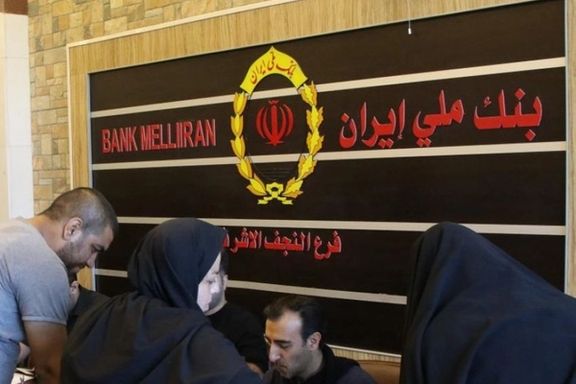
An Iranian Bank Melli branch in Iraq

Iran International has obtained information that the Islamic Republic is suffering from heavy financial losses because a huge amount of its money is blocked in Iraq. 

According to a confidential letter addressed to First Vice-President Mohammad Mokhber by his advisor, Iran has $8.5 billion in funds from exports of gas and electricity that is frozen in Iraq as a result of US sanctions. 

In the letter, issued in early-February, the advisor, named Alavi, claimed that Iran is losing $5 million per month due to the “Negative Interest Rate.” He also added that the funds that are kept in Iraqi currency dinar are also losing their value. 

The letter also reveals that the Central Bank of Iran is printing money on the basis of the frozen funds without being able to receive the money to add it to its reserves. It means that the printed money has no real back-up and aggravates inflation and leads to the devaluation of the rial, which hit new lows almost every day this week. According to the letter, Iran is printing one million rials for each dollar blocked in Iraqi banks, although the real exchange rate of dollar in Tehran is about 470,000 rials. 

The biggest immediate reason for printing money is government borrowing from the Central Bank of Iran (CBI) to bridge its budget deficit estimated to be 50 percent. But the CBI has little gold or foreign currency reserves to back the rial banknotes it prints. The rial is not a fungible currency like the US dollar and no one invests in buying excess rials, the same way hard currencies function and maintain their value.

The letter obtained by Iran International  (February 2023)
100%
The letter obtained by Iran International

As Iran’s economic situation worsens, the Islamic Republic is printing money without backing and adds it to the money supply. Iran has been lavishly printing more money since 2018 when the United States imposed economic sanctions after it withdrew from the Obama-era nuclear accord known as the JCPOA.

The advisor also warned Mokhber about the funds that are spent on essential goods, which are not included in the US sanctions, saying that the money should be spent on other goods. He also said that some of the money is spent through trust funds that are under the audit by the US Office of Foreign Assets Control, and therefore can be tracked by the OFAC and put under further restrictions. 

Iraq is seeking accession to the Paris-based Financial Action Task Force (FATF), the money-laundering watchdog that has blacklisted Iran. The FATF blacklist carries with it no formal sanctions, but financial institutions shift their resources and services away from blacklisted countries so as not to risk legal complications. The leaked letter can be an indication that the Islamic Republic has to find new ways to transfer money across the region, especially to fund its proxy forces. 

On Saturday, February 11, Iraqi Foreign Minister Fuad Hussein -- accompanied by Central Bank of Iraq Governor Ali al-Allaq -- met with Secretary of State Antony Blinken, Deputy Secretary of the Treasury Wally Adeyemo, and other US officials and business leaders in Washington to discuss a host of economic issues. But an urgent issue was how to prevent Iran from using Iraq’s banking ties with the United States to launder US dollars and circumvent Washington’s sanctions.

In early February, Iran International obtained information that revealed some details about the inner workings of a Revolutionary Guard’s Quds force unit tasked with smuggling money from Iraq to Iran. According to the information, the IRGC and the Islamic Republic’s embassy in Iraq are involved in the money laundering operations that aim to funnel the regime’s revenues from oil and gas exports back to Iran. As per a repeatedly extended sanctions’ waiver by Washington, Tehran is only allowed to import medicine and some essential goods in exchange for its exports of gas and electricity to its neighboring country.

Earlier in the month, Abdol-Amir Rabihavi, the business adviser of the Islamic Republic in Iraq, claimed Iran’s exports to Iraq are on the rise approaching $10 billion despite pressure by the United States on Baghdad to stop the IRGC’s money smuggling from the Arab country.

According to an article by Forbes, Iran is thought to have well over $100 billion in funds trapped in banks in Iraq, South Korea, Japan, Canada and elsewhere.

Most Viewed

Iran diplomacy wobbles as factions compete to avoid looking soft on US
1
INSIGHT

Iran diplomacy wobbles as factions compete to avoid looking soft on US

2
ANALYSIS

The politics of pink: how Iran uses cuteness to rebrand violence

3

Scam messages seek crypto for ships’ safe passage through Hormuz, firm warns

4
EXCLUSIVE

Family told missing teen was alive, then received his body 60 days later

5
TEHRAN INSIDER

The future has been switched off here

Banner
Banner

Spotlight

  • Diplomacy tolls at Hormuz as conflict returns to its doorstep
    OPINION

    Diplomacy tolls at Hormuz as conflict returns to its doorstep

  • Opposition to US talks grows in Tehran as ceasefire deadline nears
    INSIGHT

    Opposition to US talks grows in Tehran as ceasefire deadline nears

  • Tehran moderates see ‘no deal–no war’ limbo as worst outcome
    INSIGHT

    Tehran moderates see ‘no deal–no war’ limbo as worst outcome

  • The future has been switched off here
    TEHRAN INSIDER

    The future has been switched off here

  • Lights out, then gunfire: Witnesses recount Mashhad protest crackdown
    VOICES FROM IRAN

    Lights out, then gunfire: Witnesses recount Mashhad protest crackdown

  • Is Iran entering its Gorbachev moment?
    INSIGHT

    Is Iran entering its Gorbachev moment?

•
•
•

More Stories

Iranian Businessmen In Canada Wanted By FBI For Alleged Links With Tehran: CBC

Feb 15, 2023, 20:43 GMT+0

Canada's CBC news channel says its investigation shows that three businessmen accused of cooperating with the Islamic Republic of Iran live in Canada.

These people are accused of hiding hundreds of millions of dollars in aid to the Islamic Republic to bypass US sanctions.

CBC News has introduced them as active businessmen in Canada who promote themselves as leaders in the world of real estate.

Salim Henareh promotes himself on his personal website as the CEO of a private mortgage corporation in Toronto and a “top name in his industry.”

Khalil Henareh, whose relationship to Salim has not been clarified, has identified himself on social media as a real estate broker based in Thornhill, Ontario.

The third one, Saeed (Sam) Tarab Abtahi, has been introduced on the company's website as the vice president of a private lending company tied to Salim Henareh.

“They are not accused of violating sanctions in Canada or of any illegal acts here. But all three men face felony charges in the US and up to 20 years in prison if they’re convicted,” wrote CBC News.

But Garry Clement, a former Royal Canadian Mounted Police superintendent said it appears to be a “classic example” of Canada acting as a “safe haven.”

Prime Minister Justin Trudeau has promised that Canada will no longer be a safe haven for people benefiting from “the corrupt and horrific regime in Iran.”

Chinese Are No Longer Willing To Work On Iran Oil Projects

Feb 15, 2023, 17:40 GMT+0
•
Iran International Newsroom

Iran has decided to develop its unfinished oil projects as Chinese companies are unwilling to continue joint plans, Iran’s oil ministry website reported Tuesday.

SHANA, the oil ministry’s news service quoted the director of Yadavarn Development Plan in southwest Iran as saying that “the development of the Yadavaran joint oilfield is expected to resume [by Iranian experts] in the next Iranian year (March 2023-24) with a credit line of $400 million.”

Mojtaba Moradi, an official, told SHANA that “the project seeks to increase the production capacity of the field by 42,000 barrels per day.”

“After about a six-year hiatus in development activities, the implementation of the project to increase the field’s output will begin,” he underlined.

“The development project will be carried out by Iranian experts and engineers, using domestically made parts and equipment,” he noted.

The development comes as President Ebrahim Raisi in is Beijing this week on an official visit discussing the implementation of a 25-year cooperation pact signed in 2021 as a general outline, but details have not been worked out.

However, according to moderate news website Rouydad 24, Moradi did not mention why the project is now being carried out by Iranian experts.

The Yadavaran hydrocarbon deposit shared with Iraq is located 70 kilometers west of the city of Ahvaz in Khuzestan Province near the Iraqi border.

Based on studies, the field's crude reserve is more than 34 billion barrels. The reserve's recovery rate for light and heavy crude oil stands at 15% and 7% respectively. Around 83,000 barrels of Yadavaran production are a blend of light crude and the rest is heavy crude.

Rouydad 24 quoted informed sources as saying that after the unofficial withdrawal of the Chinese company Sinopec, the National Iranian Oil Company has decided to continue the development of this field on its own.

“It is quite clear that the National Iranian Oil Company has reached a dead end in the negotiations with the Chinese and now decided to implement the second phase itself,” added Rouydad 24.

The Chinese have not yet reacted to the announcement, but according to the contract signed by the Ahmadinejad administration with Sinopec in 2007, the Chinese company developed the first phase, and the second phase was also supposed to be carried out by the same company. Sinopec started negotiations for the second phase in 2016, but so far there has been no result.

According to the deal Sinopec had a 51-percent share in the oil field, but it appears Beijing has been wary of violating US sanctions on Iranian oil exports, although it buys illicit shipments of crude from Iran.

The Chinese have said that the imposition of US sanctions against Iran in 2018 has hampered the process and that they should wait.

“When the Raisi administration took power, they were optimistic that the Chinese would invest in this field, but Beijing, for the time being, has no intention of investing there,” stressed Rouydad 24.

“In the past two years, the Chinese have increased their investment in countries like Saudi Arabia, the UAE, Kuwait, Iraq, and even Afghanistan, and have removed Iran from list of their priorities for the time being,” Rouydad 24 went on to say.

EU To Sanction Iran Entities Helping Russian War In Ukraine

Feb 15, 2023, 11:00 GMT+0

European Commission President Ursula von der Leyen says the EU will propose sanctions targeting for the first time Iranian economic operators involved in the Russian war in Ukraine.

"For the first time we are also proposing to sanction Iranian entities including those linked to Iran's Revolutionary Guard," Von der Leyen told European lawmakers in Strasbourg on Wednesday.

Von der Leyen said the 10th package of sanctions, worth a total of 11 billion euros ($11.79 billion), would target new trade bans and technology export controls, including drones, helicopters and missiles.

Iran has been supplying Shahed kamikaze drones to Russia since mid-2022 that have been used in large numbers against Ukrainian infrastructure targets and also to swamp air defenses during massive Russian missile strikes.

At the same time, the brutal suppression of protesters in Iran has angered European politicians, who are contemplating to list the Revolutionary Guard as a terrorist organization.

There are also reports that the Islamic Republic might export ballistic missiles to Russia to make up for a shortfall Moscow faces as it has used hundreds in its stockpile against Ukraine.

Iran initially denied supplying drones to Russia, but as physical evidence of their use in Ukraine built up foreign minister Hossein Amir-Abdollahian admitted the transfer, claiming that drones were sent before the Ukraine war.

With reporting by Reuters

Washington Hopes China Will Contain Iran, While It Violates US Sanctions

Feb 15, 2023, 10:55 GMT+0
•
Iran International Newsroom

The US believes China has a role to play in telling Iran to end its “destabilizing activities,” the State Department said as Iran’s president visited Beijing.

The department spokesperson Ned Price was asked on Tuesday to comment on Chinese President XI Jinping’s remark earlier in the day that the Iranian nuclear issue should be resolved as soon as possible.

In response he said that the United States has engaged with China and other global stakeholders to encourage them to counter Iran’s policies “that destabilize the region and threaten our partners and our allies. Iran’s nuclear program, its ballistic missile program, its other malign activities and influence, are profoundly destabilizing in the region.”

Ned Price drew attention to Chinese cooperation in pressuring Iran in the early 2010s regarding its nuclear program. Presumably, he said, that’s why “the PRC came together with us the better part of a decade ago by now in the original configuration of the P5+1 to work with us to ultimately negotiate what became known as the Joint Comprehensive Plan of Action [JCPOA].”

However, China has been violating US oil export sanctions imposed on Iran on a large scale since the Biden administration came into office. Industry observers believe that Beijing is allowing at least 700,000 barrels of Iranian crude oil to be imported by its refineries, which provides a financial lifeline to the regime in Tehran.

But Price also reiterated the administration’s new policy of not pursuing the nuclear talks unless Tehran meets a number of demands. The spokesman said, “the JCPOA has not been on the agenda for some time. We continue to discount, if not dismiss repeated claims from Iranian officials that we are eager to go back to the JCPOA, we’re calling for a return to JCPOA negotiations. We’re not. We’re sending very clear messages to the Iranian regime. Those messages are: Stop killing your own people, stop sending UAV technology to Russia, and free those wrongfully detained American citizens.”

Critics have repeatedly accused the administration of not sufficiently enforcing sanctions the US imposed in 2018, when former President Donald Trump withdrew from the JCPOA. The main loophole is the oil exports to China that can generate more than $20 billion a year for the Islamic Republic.

Price continued the administration’s rhetoric demanding that Beijing should act responsibly. “My point is that the PRC has a role to play in very clearly signaling to Iran that its destabilizing activities, that its brinksmanship is not going to be rewarded. It’s not going to be countenanced. It is not something that the international community is prepared to sit idly by and watch.”

Not only China supports the Islamic Republic by buying its illicit oil shipments, but inviting Raisi at a time when the regime stands accused of gross human rights violations against protesters, is a clear attempt to support the rulers in Tehran.

The Islamic Republic is facing isolation also because of its drone deliveries to Russia and Beijing’s invitation to Raisi partially mollifies that isolation.

Judging from numerous social media posts by Iranian critics of the regime, it appears that their anti-China sentiment has increased because of this latest lifeline thrown to the Islamic Republic.

Major Quakes In Iran Might Kill Hundreds Of Thousands: Officials

Feb 15, 2023, 08:10 GMT+0

Iranian officials say there are 166,000 hectares of worn-out structures across the country which means a major earthquake like in Turkey and Syria might result in “hundreds of thousands of deaths.”

Farzaneh Sadegh Malvajerd, a Deputy at the Ministry of Roads and Urban Development announced Tuesday that about 1.4 million unstable units are built in urban parts of these areas.

Earlier, officials had estimated that the total area of worn-out and ineffective structures in Iran's metropolises is more than 166,000 hectares, with a total of 22,500,000 people living there.

Many of these areas are located on active earthquake faults.

In January, Mehdi Pirhadi, a member of Tehran Council also emphasized the need to renovate these buildings in Tehran to deal with earthquakes, warning that over 7 magnitude quakes could lead to hundreds of thousands of deaths.

Some experts had predicted that at least one and a half million people would die in case of an earthquake with a magnitude of 7 in Tehran.

However, it is not only the capital that is facing such a potential risk. There are active faults from Hamedan in west to Gilan in north that may cause a deadly earthquake at any moment.

Iran is crisscrossed by major geological fault lines and is one of the most earthquake-prone countries in the world because it is located where the Arabian, Indian, and Eurasian tectonic plates meet.