• العربية
  • فارسی
Brand
  • Iran Insight
  • Politics
  • Economy
  • Analysis
  • Special Report
  • Opinion
  • Podcast
  • Iran Insight
  • Politics
  • Economy
  • Analysis
  • Special Report
  • Opinion
  • Podcast
  • Theme
  • Language
    • العربية
    • فارسی
  • Iran Insight
  • Politics
  • Economy
  • Analysis
  • Special Report
  • Opinion
  • Podcast
All rights reserved for Volant Media UK Limited
volant media logo

Iran Would Welcome Iraqi Mediation To Kickstart Nuclear Talks
Iran International Newsroom
Feb 13, 2023, 18:07 GMT+0Updated: 18:12 GMT+1
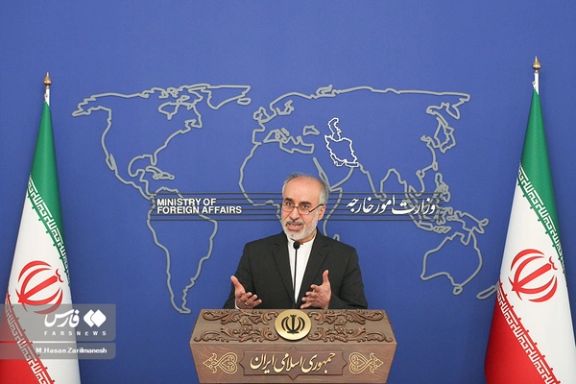
Iran’s Foreign Ministry spokesman Nasser Kanaani during his weekly press conference on February 13, 2023

Iran’s Foreign Ministry says it will make the best use of Iraq’s relations with the United States for the resumption of talks to revive the 2015 nuclear deal. 

During his weekly press conference on Monday, Foreign Ministry spokesman Nasser Kanaani referred to a meeting with Iraqi Foreign Minister Fuad Hussein and United States Special Envoy for Iran Robert Malley, and said Tehran uses all diplomatic capacities to realize the Islamic Republic’s national interests.

“Some governments have already played a role in this regard in good faith. Some governments are interested in using the capacity of their relations with both sides, and we will always welcome these joint efforts in good faith,” he added. “If the Iraqi government wants to play a role in this area, we take it seriously as the country is our friend, neighbor and brother, and we will use the capacities of the Iraqi government.”

Tehran, facing serious economic and political challenges insists that there is still a chance to restore the Joint Comprehensive Plan of Action, the JCPOA, while the US, which withdrew from the original deal under former US president Donald Trump, has repeatedly announced that it is no longer focused on the deal.

Iranian Foreign Minister Hossein Amir-Abdollahian held a phone call with his Iraqi counterpart on Friday, a day before the Iraqi foreign minister met with Malley. According to the official readout of the meeting by the Iraqi foreign ministry, Hussein and Malley discussed the Iran nuclear talks and the European's attitude toward suspending them. Malley praised Iraq's diplomatic role and the initiatives it launched to ease the tension in the region, the statement added.

Iraqi Foreign Minister Fuad Hussein (left) and Iranian Foreign Minister Hossein Amir-Abdollahian (file photo)
100%
Iraqi Foreign Minister Fuad Hussein (left) and Iranian Foreign Minister Hossein Amir-Abdollahian

Since the current wave of antigovernment protests engulfed Iran in September, the Biden administration has announced that talks to revive the nuclear deal are not their priority anymore. Considering the international outcry over the Islamic Republic’s crackdown on dissent and human rights violations as well as the growing military ties between Tehran and Moscow, including from the US Congress, the prospects of saving the JCPOA is dimmer than ever.

Moreover, Kanaani expressed Iran’s readiness to exchange prisoners with the US in an “unconditional” manner without linking the swap to other issues, complaining that despite Iran’s goodwill, Washington has not taken an encouraging measure in this regard.

On Saturday, Hussein -- accompanied by Central Bank of Iraq Governor Ali al-Allaq -- met with Secretary of State Antony Blinken, Deputy Secretary of the Treasury Wally Adeyemo, and many other US officials and business leaders to discuss a host of economic issues. But an urgent issue was how to prevent Iran from using Iraq’s banking ties with the United States to launder US dollars and circumvent Washington’s sanctions. 

In an interview with Al-Monitor in Washington on Sunday, Hussein said that "It’s no secret that I am in touch with both Iranian and American officials,” adding that “Both sides trust us, and that’s a good thing... It’s in Iraq’s interest that there be less tension between Washington and Tehran."

“I will continue these contacts,” said Hussein. “The US is an important ally, and Iran is an important neighbor, with whom we share many common interests, including a border, religion, culture, economics and trade. I hope both sides will start talking to each other again, but that’s their decision,” he added.

Elsewhere in his remarks, Kanaani touched on the issue of relations between Tehran and Riyadh, stressing the need for diplomacy to return the ties between Saudi Arabia and Iran back on track. Tehran welcomes any mediation by the Iraqi government and hopes that the efforts would improve relations between Saudi Arabia and Iran, he said. 

Most Viewed

Ideology may be fading in Iran, but not in Kashmir's ‘Mini Iran'
1
INSIGHT

Ideology may be fading in Iran, but not in Kashmir's ‘Mini Iran'

2
INSIGHT

Hardliners push Hormuz ‘red line’ as US blockade tests Iran’s leverage

3
VOICES FROM IRAN

Hope and anger in Iran as fragile ceasefire persists

4

US sanctions oil network tied to Iranian tycoon Shamkhani

5

Iran International says it won’t be silenced after London arson attack

Banner
Banner

Spotlight

  • Hardliners push Hormuz ‘red line’ as US blockade tests Iran’s leverage
    INSIGHT

    Hardliners push Hormuz ‘red line’ as US blockade tests Iran’s leverage

  • Ideology may be fading in Iran, but not in Kashmir's ‘Mini Iran'
    INSIGHT

    Ideology may be fading in Iran, but not in Kashmir's ‘Mini Iran'

  • War damage amounts to $3,000 per Iranian, with blockade set to add to losses
    INSIGHT

    War damage amounts to $3,000 per Iranian, with blockade set to add to losses

  • Why the $100 billion Hormuz toll revenue is a myth
    ANALYSIS

    Why the $100 billion Hormuz toll revenue is a myth

  • US blockade targets Iran oil boom amid regional disruption
    ANALYSIS

    US blockade targets Iran oil boom amid regional disruption

  • Iran's digital economy battered by prolonged blackout
    INSIGHT

    Iran's digital economy battered by prolonged blackout

•
•
•

More Stories

Raisi Set For His First State Visit To China Amid Domestic Challenges

Feb 13, 2023, 13:55 GMT+0
•
Iran International Newsroom

The Iranian president met with the Supreme Leader Monday, a day before his first state visit to China meant to consolidate ties after recent tensions due to Beijing’s close Arab ties. 

During a media briefing earlier on Monday, Iran’s Foreign Ministry spokesman Nasser Kanaani highlighted the importance of Ebrahim Raisi’s trip on the development of Tehran-Beijing bilateral ties, saying, “The visit will be made upon an official invitation by the Chinese President Xi Jinping. 

“The visit is particularly important from a political perspective. It indicates the existence of a proper political atmosphere in relations and emphasizes the highest political will from the leaders of the two countries to expand bilateral ties based on mutual interests,” he noted. 

China’s Xi visited Saudi Arabia in December and also met members of the Gulf Cooperation Council, followed by a joint statement in which the issue of three Iranian islands in the Persian Gulf was mentioned as a claim pursued by the United Arab Emirates.

The Iranian public showed a strong reaction once the joint statement was reported by Persian media, accusing the Islamic Republic authorities of being so weak that its ally China was subtly endorsing the UAE claim.

Kanaani described the deal signed between Iran and China in March 2021 as “a roadmap that outlines the general path and long-term horizon of cooperation between the two countries.” He added that there was a 43-percent growth in Iran-China economic and commercial relations last year, with China being Iran’s first export destination and the second source of imports.

However, there have been other reports in Iranian media saying that trade has declined since mid-2022.

During the meeting with Khamenei, Raisi gave a report on the agenda of the trip and the planned meetings. The readout of the meeting was not released to the media. 

 Supreme Leader ALi Khamenei (left) and President Ebrahim Raisi (file photo)
100%
Supreme Leader ALi Khamenei (left) and President Ebrahim Raisi

There are reports that Raisi will follow up on the so-called the 25-year comprehensive strategic partnership agreement, which so far has been nothing more than a wish list without a practical implementation plan.

The Islamic Republic is not only facing a strong challenge by dissidents and opponents at home, but also grapples with a serious economic crisis.

In January, a former Iranian ambassador to China said Tehran-Beijing ties are overestimated and only worked as a bargaining chip for China to secure deals with Saudi Arabia. Mohammad-Hossein Malaek, who served as Tehran’s envoy for four years under former president Mohammad Khatami, added that the agreement is a document without any value, especially following the visit by Xi to Saudi Arabia in December, when the two sides agreed “on the need to strengthen cooperation to ensure the peaceful nature of Iran’s nuclear program,” calling on Tehran to cooperate with the International Atomic Energy Agency (IAEA) and to “maintain the non-proliferation regime.”

Raisi himself also penned an op-ed article published in the People’s Daily, the official newspaper of the Central Committee of the Chinese Communist Party (CCP), emphasizing that “As two living and dynamic human civilizations, Iran and China were connected to each other via the historic Silk Road, and ascertained the fact that prosperity and happiness as desirable popular goals can only be achieved through interaction and cooperation.”

About the 25-year agreement, he claimed that the deal was signed to develop mutual cooperation in various fields because both Tehran and Beijing pursue similar approaches vis-à-vis international developments and are opposed to imperialism as well as unilateralism – a clear reference to the United States. 

Wang Wenbin, the spokesman of the Chinese Ministry of Foreign Affairs, said Monday that "This is President Raisi's first visit to China in office. During the visit, President Xi Jinping will hold talks with President Raisi to jointly chart the course for and steer the future development of China-Iran relations, and have in-depth exchange of views on regional and international issues of common concern."

He also echoed sentiments similar to those of Raisi about traditional friendship, saying that “To consolidate and develop China-Iran relations are their joint strategic choice.”

Chinese President Xi Jinping meets his Iranian counterpart Ebrahim Raisi in Samarkand, Uzbekistan, in September 2022.
100%
Chinese President Xi Jinping meets his Iranian counterpart Ebrahim Raisi in Samarkand, Uzbekistan, in September 2022.

“In recent years, under the guidance of President Xi and President Raisi, the China-Iran relations have maintained a sound momentum of development, with political mutual trust consolidated continuously and practical cooperation in various fields making steady progress,” he added. 

The Chinese spokesman also talked about the so-called strategic agreement, noting that “Taking this visit as an opportunity, China looks forward to working with Iran to further advance China-Iran comprehensive strategic partnership and playing a constructive role in enhancing unity and cooperation among countries in the Middle East and promoting regional security and stability.” 

Iranian state media reported that during Raisi’s three-day visit, mechanisms to make the deal operational will be finalized. In a televised interview Sunday night, the political affairs deputy head of President's Office, Mohammad Jamshidi, said, "We are after establishing broad-scale economic cooperation with China, whose framework is the comprehensive Iran-China cooperation document." “We have advanced the mechanisms for implementing the comprehensive agreement between Iran and China, which was a deal on paper at the beginning of this administration. The agreement’s finalization will be followed up during this trip.”

Many Iranians have expressed resentment over the 25-year cooperation agreement with China and a proposed 20-year deal with Russia, saying it is a sell-out. Although Iran has not revealed the details of the agreement with China and what it will entail in political, economic and military terms, some social media users go as far as claiming that the Islamic Republic is "selling out the country and its people" to China and Russia.

Iran has once and again indicated its intention to rely more on Asian countries, particularly China for trade relations as talks with the United States and Europe to resolve differences over Tehran’s nuclear program have not succeeded so far and US sanctions remain in place. However, Beijing has so far has not seriously challenged US sanctions, as it has cultivated closer ties with the Persian Gulf Arab countries and Israel.

‘Putin’s Brain’ Participates In Islamic Republic Anniversary Celebration

Feb 12, 2023, 16:06 GMT+0

Alexander Dugin, the Russian ultra-nationalist philosopher, has participated in a ceremony commemorating the 44th anniversary of the establishment of the Islamic regime in Moscow.

Dugin, known as Putin's brain, is a philosopher and extremist nationalist who advocates the creation of a new Russian empire and is also a supporter of the military attack on Ukraine.

Some analysts believe that the 60-year-old theorist has a lot of influence on Russian President Vladimir Putin.

In recent years, Dugin has been invited to visit Iran regularly, usually by hardliners and entities associated with the Revolutionary Guard.

During a visit to the religious city of Qom in 2015, Dugin referred to modernity as “Satan”, the West as “the hereditary house of Satan,” and Iran as “the main base of war against modernity.”

Dugin believes that Ayatollah Khamenei is the “best solution” for confronting the West. “If he helps to defeat the West I am sure we will emerge from this arena victorious and proud,” he said, because “in the center of the Guardianship of [the Islamic] Jurist, God’s will is at work.”

But while he wants Ali Khamenei’s help in defeating the West, Dugin concedes that he has not been successful in bringing Iran and Russia closer. “Young Iranians are not very interested in getting to know Russia. Perhaps we should search for a key to open this door between the two countries,” he said.

Iranian President To Visit China Next Week

Feb 12, 2023, 11:19 GMT+0

Two months after a controversial statement by China and the Arab countries of the Persian Gulf about three Iranian islands, to which Tehran protested, Ebrahim Raisi will visit Beijing.

The Ministry of Foreign Affairs of China announced Sunday that Iran’s president will visit next Tuesday upon the invitation of Chinese President Xi Jinping.

The state news agency IRNA also reported that during the trip, "cooperation documents" will be signed between the two countries, and Ebrahim Raisi will participate in a joint meeting of Iranian and Chinese businesses.

In recent years, especially after the withdrawal of the United States from the 2015 nuclear agreement, the Islamic Republic has tried to get closer to China and Russia.

In addition to the controversial 25-year-old agreement between the two countries, the Islamic Republic considers it very important to join the Shanghai Cooperation Organization led by China and Russia.

Citing the statements of some government officials, Iranian state media say the Chinese are not willing to invest in Iran.

The head of the joint chamber of Iran and China earlier confirmed reports of a decrease in Chinese investment in Iran stressing that one of the reasons is the inclination of some officials of the Islamic Republic towards the west.

Two months ago, a joint statement by China and six Arab countries about the three islands of Greater and Lesser Tunbs and Abu Musa provoked Iran's reaction.

Iran's Nuclear Negotiator Says Messages Being Exchanged With US

Feb 12, 2023, 09:16 GMT+0
•
Iran International Newsroom

Iran’s chief nuclear negotiator, Ali Bagheri-Kani, says “negotiations in the framework of exchanging indirect messages between the two sides continue.”

The government’s official news website IRNA Sunday published an interview Bagheri had with Al Manar TV in Lebanon, where he tried to reassure the public that the chance to revive the 2015 nuclear agreement is not lost and talks are taking place.

The Islamic Republic faces multiple economic and political crises that have deepened in the past six months, as 18 months of indirect talks with the United States failed to produce a result and popular protests dealt a further blow to Tehran’s political standing.

The Biden Administration announced in October that its focus has shifted from the nuclear issue to supporting the rights of Iranian protesters and increasingly a negative mood emerged about the chances of any new talks.

“In the past year and a half when talks were taking place, the speed of negotiations might have increased and decreased at times but there was a continuity. Now also [talks] are taking place in the framework of exchanging messages between the two sides,” Bagheri said.

The Biden Administration has not explicitly denied exchange of messages with Tehran.

Iran International reported in January that the State Department did not deny information obtained by the network that US Iran Envoy Robert Malley had held meeting in New York with Tehran’s UN ambassador.

In response to questions submitted by Iran International on January 17, State Department spokesperson Ned Price said, “We have the means to deliver specific and firm messages to Iran when it is in America’s interest to do so.”

The contents of Malley’s meetings with the Iranians remain unclear, but the issue of Americans held hostage in Tehran or regional issues are all intertwined with the nuclear negotiations.

In early November, President Joe Biden told a citizen who asked him about the nuclear talks during an election campaign event that the “JCPOA is dead.” Bagheri commented about this and said that later US officials spoke about this – referring to comments that diplomacy will continue – and “in practice messages are being exchanged.”

Bagheri also did not deny that Qatar is playing a mediating role

There was little else new in what Iran’s chief negotiator had to say about the nuclear talks or the increasingly tense relations with the West. He repeated Supreme Leader Ali Khamenei’s accusation that the West instigated the protests in Iran.

He also reiterated that Iran’s most important “red line is the issue of guarantees”, that in case of a deal “the other party discharges its commitments.” Throughout the talks Tehran has been insisting on receiving guarantees from the United States that it will not pull out of an agreement, similar to President Donald Trump’s decision in 2018. Tehran is also insisting that it should receive the economic benefits once sanctions are lifted.

The US has said that it cannot guarantee an accord, which is not a treaty, beyond the term of the current administration.

However, on the issue of sanctions, Bagheri appeared to demand that only economic sanctions imposed by the Trump administration, not mentioning many new sanctions imposed by the current administration on companies and individuals.

Facing a worsening economic crisis and a popular revolt, Tehran wants to exhibit an aura of normalcy and hope. The target of positive statements about the chances of talks with the West is more the domestic audience that fast is losing hope in the future.

European Countries Boycott Islamic Revolution Day

Feb 10, 2023, 14:03 GMT+0
•
Iran International Newsroom

As the Islamic Republic is set for state-sponsored events for the 44th anniversary of its establishment on Saturday, European countries are calling for the boycott of the events. 

In a statement on Thursday, members of several groups in the European Parliament and national parliaments called on European countries to boycott the ceremonies, and stand in solidarity with “the Iranian people who are fighting for their rights.”

Weeks before the anniversary of Islamic Republic’s establishment, a campaign was launched to boycott the regime’s ceremonies over the violent crackdown on nationwide protests sparked by the death in custody of Iranian Kurdish 22-year-old woman Mahsa Amini. 

“We, cross-party Members of the European Parliament and Members of national parliaments, are urging the governments of the EU member states and the European External Action Service to boycott tomorrow's ceremony in Tehran for the anniversary of the Islamic revolution that brought this brutal regime to power. Likewise, EU officials ought to stay away from any such regime celebrations in Iranian embassies abroad,” read the statement. 

The Islamic Republic government organizes 10 days of celebrations known as Fajr – literally meaning dawn – but the final day, February 11, is the most important one, in which the regime heavily invests. It already held an event on Thursday with a group of foreign ambassadors to the Islamic Republic with President Ebrahim Raisi in attendance. The government did not release the list of the participants but according to some reports envoys from European countries did not participate in the event – except for Hungary and Poland. 

Some of the foreign envoys who participated in the government’s event to mark the 44th anniversary of the establishment of the Islamic Republic on February 9, 2023
100%
Some of the foreign envoys who participated in the government’s event to mark the 44th anniversary of the establishment of the Islamic Republic on February 9, 2023

Dismayed by a lack of participation of Western envoys, Raisi said during the event that “The US and the three European countries [that are signatories to the 2015 nuclear deal] were caught up in a state of delusion and made miscalculations” by “meddling in Iran’s domestic affairs,” referring to the ongoing uprising. 

Hailing the unanimity of European countries, US Senator Bob Menendez, Chairman of the Senate Foreign Relations Committee, tweeted, “Glad to see broad EU consensus against Islamic Revolution Day in Tehran, except from Orban’s Hungary, which all too regularly embraces autocrats, and Poland, whose silence is disappointing.”

“Nobody should be celebrating a regime with this much blood on its hands,” he added. 

The statement by the MEPs added that “Over the past 44 years, the Islamic Republic has murdered tens of thousands of Iranians and has spread terror, misery and war throughout the region and beyond. Together with the Assad regime and Russia, the regime in Iran has carried out horrific war crimes in a conflict that has killed over 500,000 Syrians.”

The statement drew attention to the fact that hundreds of protesters have been killed, “for the 'crime' of demanding freedom, democracy and dignity and above all equal rights for women. Women and even young girls are being harassed, arrested, tortured, raped and murdered for simply refusing to wear the hijab or just for not fully covering their hair. At least 100 Iranians are facing the death penalty over their participation in protests following sham trials where the accused had just 15 minutes to defend themselves.” 

Touching upon the growing military ties between Iran and Russia, the statement warned that “Tehran is now intensifying its growing alliance with Russia by supplying Moscow with Kamikaze drones designed to terrorize the Ukrainian people and to destroy their critical infrastructure.”

The MEPs said that celebrating “the rise to power of this odious regime” by European politicians and ambassadors -- even low-ranking diplomats -- would be “an inexcusable violation of our own values and a betrayal of the Iranian people as well as the regime's countless victims in the region and in Ukraine. 

“Any official European participation in these celebrations would play into the hands of the Islamic Republic,” they said, adding that the mullahs would like nothing more than to demonstrate that despite their repression of the protests, it is "back to business as usual" with the EU.