• العربية
  • فارسی
Brand
  • Iran Insight
  • Politics
  • Economy
  • Analysis
  • Special Report
  • Opinion
  • Podcast
  • Iran Insight
  • Politics
  • Economy
  • Analysis
  • Special Report
  • Opinion
  • Podcast
  • Theme
  • Language
    • العربية
    • فارسی
  • Iran Insight
  • Politics
  • Economy
  • Analysis
  • Special Report
  • Opinion
  • Podcast
All rights reserved for Volant Media UK Limited
volant media logo

European Countries Boycott Islamic Revolution Day
Iran International Newsroom
Feb 10, 2023, 14:03 GMT+0Updated: 17:42 GMT+1
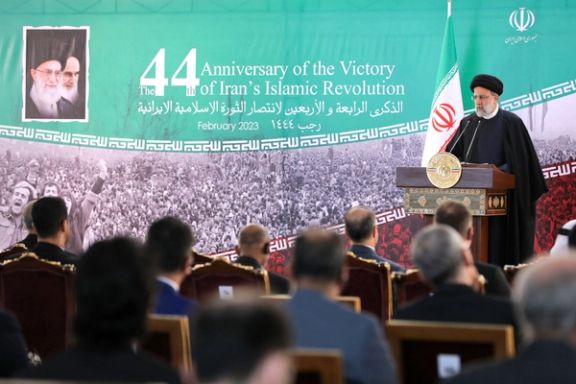
Iranian President Ebrahim Raisi speaks at a meeting with a group of foreign ambassadors to the Islamic Republic in Tehran on February 9, 2023, on the occasion of the 44th anniversary of the Islamic Revolution.

As the Islamic Republic is set for state-sponsored events for the 44th anniversary of its establishment on Saturday, European countries are calling for the boycott of the events. 

In a statement on Thursday, members of several groups in the European Parliament and national parliaments called on European countries to boycott the ceremonies, and stand in solidarity with “the Iranian people who are fighting for their rights.”

Weeks before the anniversary of Islamic Republic’s establishment, a campaign was launched to boycott the regime’s ceremonies over the violent crackdown on nationwide protests sparked by the death in custody of Iranian Kurdish 22-year-old woman Mahsa Amini. 

“We, cross-party Members of the European Parliament and Members of national parliaments, are urging the governments of the EU member states and the European External Action Service to boycott tomorrow's ceremony in Tehran for the anniversary of the Islamic revolution that brought this brutal regime to power. Likewise, EU officials ought to stay away from any such regime celebrations in Iranian embassies abroad,” read the statement. 

The Islamic Republic government organizes 10 days of celebrations known as Fajr – literally meaning dawn – but the final day, February 11, is the most important one, in which the regime heavily invests. It already held an event on Thursday with a group of foreign ambassadors to the Islamic Republic with President Ebrahim Raisi in attendance. The government did not release the list of the participants but according to some reports envoys from European countries did not participate in the event – except for Hungary and Poland. 

Some of the foreign envoys who participated in the government’s event to mark the 44th anniversary of the establishment of the Islamic Republic on February 9, 2023
100%
Some of the foreign envoys who participated in the government’s event to mark the 44th anniversary of the establishment of the Islamic Republic on February 9, 2023

Dismayed by a lack of participation of Western envoys, Raisi said during the event that “The US and the three European countries [that are signatories to the 2015 nuclear deal] were caught up in a state of delusion and made miscalculations” by “meddling in Iran’s domestic affairs,” referring to the ongoing uprising. 

Hailing the unanimity of European countries, US Senator Bob Menendez, Chairman of the Senate Foreign Relations Committee, tweeted, “Glad to see broad EU consensus against Islamic Revolution Day in Tehran, except from Orban’s Hungary, which all too regularly embraces autocrats, and Poland, whose silence is disappointing.”

“Nobody should be celebrating a regime with this much blood on its hands,” he added. 

The statement by the MEPs added that “Over the past 44 years, the Islamic Republic has murdered tens of thousands of Iranians and has spread terror, misery and war throughout the region and beyond. Together with the Assad regime and Russia, the regime in Iran has carried out horrific war crimes in a conflict that has killed over 500,000 Syrians.”

The statement drew attention to the fact that hundreds of protesters have been killed, “for the 'crime' of demanding freedom, democracy and dignity and above all equal rights for women. Women and even young girls are being harassed, arrested, tortured, raped and murdered for simply refusing to wear the hijab or just for not fully covering their hair. At least 100 Iranians are facing the death penalty over their participation in protests following sham trials where the accused had just 15 minutes to defend themselves.” 

Touching upon the growing military ties between Iran and Russia, the statement warned that “Tehran is now intensifying its growing alliance with Russia by supplying Moscow with Kamikaze drones designed to terrorize the Ukrainian people and to destroy their critical infrastructure.”

The MEPs said that celebrating “the rise to power of this odious regime” by European politicians and ambassadors -- even low-ranking diplomats -- would be “an inexcusable violation of our own values and a betrayal of the Iranian people as well as the regime's countless victims in the region and in Ukraine. 

“Any official European participation in these celebrations would play into the hands of the Islamic Republic,” they said, adding that the mullahs would like nothing more than to demonstrate that despite their repression of the protests, it is "back to business as usual" with the EU.


Most Viewed

Iran International says it won’t be silenced after London arson attack
1

Iran International says it won’t be silenced after London arson attack

2
INSIGHT

Hardliners push Hormuz ‘red line’ as US blockade tests Iran’s leverage

3
VOICES FROM IRAN

Hope and anger in Iran as fragile ceasefire persists

4

US sanctions oil network tied to Iranian tycoon Shamkhani

5

Iran halts petrochemical exports to supply domestic market

Banner
Banner

Spotlight

  • Hardliners push Hormuz ‘red line’ as US blockade tests Iran’s leverage
    INSIGHT

    Hardliners push Hormuz ‘red line’ as US blockade tests Iran’s leverage

  • Ideology may be fading in Iran, but not in Kashmir's ‘Mini Iran'
    INSIGHT

    Ideology may be fading in Iran, but not in Kashmir's ‘Mini Iran'

  • War damage amounts to $3,000 per Iranian, with blockade set to add to losses
    INSIGHT

    War damage amounts to $3,000 per Iranian, with blockade set to add to losses

  • Why the $100 billion Hormuz toll revenue is a myth
    ANALYSIS

    Why the $100 billion Hormuz toll revenue is a myth

  • US blockade targets Iran oil boom amid regional disruption
    ANALYSIS

    US blockade targets Iran oil boom amid regional disruption

  • Iran's digital economy battered by prolonged blackout
    INSIGHT

    Iran's digital economy battered by prolonged blackout

•
•
•

More Stories

Under US Pressure, Lula Delays Brazil Docking Of Iran Warships -Reuters

Feb 10, 2023, 08:12 GMT+0

Brazil postponed the request of two Iranian warships to dock in Rio de Janeiro in January, under pressure from Washington, Reuters has said in an exclusive report.

The decision came at a time when Brazilian President Luiz Inacio Lula da Silva was planning his trip to Washington to meet President Joe Biden, sources told Reuters.

On January 13, Brazil granted permission for the IRIS Makran & IRIS Dena ships to dock in Rio's port during January 23-30, according to a post in the official government gazette.

That window has been scrapped, with the ships now authorized to dock between February 26 and March 3, the Brazil's foreign ministry said.

In the meantime, Iranian state media was presenting the scheduled docking of the two ships as a sign of Islamic Republic’s power and influence in America’s backyard.

A US official with direct knowledge of the situation said the prospect of Iranian warships in Rio ahead of Lula's meeting with Biden on Friday "was something unpleasant we wanted to avoid."

"There were a lot of behind-the-scenes conversations about this at many different levels," the official said, adding it was good news that the dates would no longer coincide.

A Brazilian military source confirmed that the federal government, via the foreign ministry, had shifted the dates and blocked the Iranian ships from docking.

"It's true that there was a veto (from the government)," said the source, speaking on condition of anonymity. "The Iranian ships could not come during this period."

Diplomacy with Iran was one of the policies of Lula's previous presidential mandate, and he has declared neutrality in the Ukraine conflict.

US House Members Write To Biden Over Iranian Drones With US Parts

Feb 9, 2023, 19:04 GMT+0
•
Iran International Newsroom

Dozens of US lawmakers have written to President Joe Biden to express concerns about reports that Iranian-made drones recovered in Ukraine contain parts manufactured in the United States. 

In addition to President Biden, the letter was also addressed to Secretary of State Antony Blinken, Treasury Secretary Janet Yellen, and Secretary of Commerce Gina Raimondo and was signed by about 60 members of the US House of Representatives. 

The letter is in line with earlier efforts by Western countries seeking to restrict the Islamic Republic’s access to parts used in building drones that Russia uses to attack Ukraine. 

Voicing their deep concern, the lawmakers urge the Biden administration “to develop a coordinated, whole-of-government approach to interrupt Iran’s supply chains, shut down shell companies used by adversaries to evade sanctions, and pressure allies to crack down on unscrupulous distributors in Europe and Asia.” 

They also called for “a timely briefing on any progress that has been made and plans going forward” about Washington’s efforts to curb the supply of drone parts. 

“Iran has provided hundreds of drones to Russia since August 2022. The Shahed-136 and Shahed-131, one-way attack unmanned aerial vehicles also known as “suicide drones,” have terrorized Ukrainian civilians since their introduction into the conflict. Iran has also delivered to Russia the Mohajer-6, a surveillance drone capable of conducting precision air-to-ground strikes,” the letter read. 

Conflict Armament Research investigations revealed that processors built by Dallas-based technology company Texas Instruments as well as engines made by Austrian firm owned by Canada’s Bombardier Recreational Products have been used in the drones.

Many parts are considered dual-use components and relatively easy to buy, without any approval needed.

An Iranian Shahed-136 drone used as suicide weapons by Russia against Ukrainian civilian targets
100%
An Iranian Shahed-136 drone used as suicide weapons by Russia against Ukrainian civilian targets

The representatives referred to the report by Conflict Armament Research that studied more than 500 components from Iranian-made drones and unexploded precision-guided munitions that were recovered in Ukraine, determining that “82 percent of their parts were manufactured by companies based in the United States.” Ukrainian intelligence services have estimated that 75 percent of the components of Iranian-made drones deployed in the conflict are US-made. 

The signatories also mentioned the punitive measures taken by the Office of Foreign Assets Control on firms involved in the production and delivery of Iranian drones to Russia, describing the sanctions as “a small but promising first step in what must become a concentrated, sustained effort.”

“Just as the United States and its international allies rallied to implement a comprehensive sanctions regime to combat Iran’s ballistic missile program, it must do the same to degrade the regime’s precision-strike capabilities,” they urged. 

They said Tehran’s fleet of drones have far-reaching implications beyond the war against Ukraine as such weapons “provide Iran and its proxies with yet another tool to project power in the region, threatening our troops, key allies, and freedom of navigation.”

Stressing the necessity of immediate action, they said the US should move not only to disrupt Iran’s burgeoning relationship with Russia, but also to blunt Iran’s ability to undermine international law, project power across the Middle East, and threaten US servicemembers.

Since December, Biden has launched a task force – comprised of different departments including Justice, Treasury, Defense, Commerce and State are involved in the task force -- to see how US and western components are ending up in Iranian drones. 

In January, the Quebec-based company Bombardier Recreational Products (BRP), best known for water-skis and snowmobiles, passed to the Canadian government its internal report on how its engines ended up in Iranian-made drones used by Russia in Ukraine. The BRP said it has established through a “thorough investigation” that an engine found in a downed Mohajer-6 drone had not been sold directly to either Iran or Russia. Bombardier ended supplies of the engines to Iran in 2019, although the Mahtabal company in Tehran still markets itself as official representative for Rotax engines. 

Earlier in the day, the adviser to Iran’s minister of intelligence claimed that 90 countries are "customers" of Iranian drones, and China is in the "queue" to receive 15,000 of these drones. The Wall Street Journal recently reported that an Iranian delegation has travelled to Russia to build a factory capable of producing six thousand UAVs designed by Tehran to be used in the war against Ukraine.

Washington Imposes New Sanctions On Firms Smuggling Iranian Oil

Feb 9, 2023, 15:08 GMT+0
•
Iran International Newsroom

The United States imposed sanctions Thursday on companies it said that play a critical role in the production, sale and export of Iranian oil and petrochemicals.

Based on a new policy of increasing pressure on Tehran to reduce its illicit oil trade with China, the new sanctions targeted shipments to Asia.

The US Treasury Department in a statement said it imposed sanctions on six Iran-based petrochemical manufacturers or their subsidiaries and three firms in Malaysia and Singapore over the production, sale and shipment of hundreds of millions of dollars worth of Iranian petrochemicals and petroleum.

The latest US move against Iranian oil smuggling comes as efforts to revive Iran's 2015 nuclear deal have stalled and ties between the Islamic Republic and the West are increasingly strained as Iranians keep up anti-government protests.

Washington has announced a series of new sanctions since October.

"Iran is increasingly turning to buyers in East Asia to sell its petrochemical and petroleum products, in violation of U.S. sanctions," Treasury Under Secretary for Terrorism and Financial Intelligence Brian Nelson said in the statement.

"The United States remains focused on targeting Tehran’s sources of illicit revenue and will continue to enforce its sanctions against those who wittingly facilitate this trade," Nelson said.

China has been the main buyer of illicit Iranian oil since full sanctions were imposed by the Trump administration in May 2019.

The tougher approach by Washington is also motivated by Iran’s decision to supply military drones to Russia that are being used to target Ukraine’s civilian infrastructure.

The Biden Administration’s 18-month-long indirect talks with Iran to revive the 2015 nuclear deal (JCPOA) failed to produce a result at a time when popular protests broke out against the Islamic Republic and the use of its kamikaze drones by Russia was revealed in late September 2022. These three factors pushed the administration to say in October that it was no longer focused on reviving the JCPOA and its priority was supporting the rights of protesters in Iran.

Thursday's move targeted firms the Treasury accused of being involved in facilitating the sale and shipment of petroleum and petrochemicals on behalf of Triliance Petrochemical Co. Ltd., which was hit with sanctions by Washington in 2020.

Among the Iranian companies targeted were petrochemical producer Amir Kabir Petrochemical Co. (AKPC), its subsidiary Simorgh Petrochemical Co. and four subsidiaries of previously sanctioned Marun Petrochemical Co.

Treasury said Triliance has purchased millions of dollars worth of low-density polyethylene produced by AKPC for shipment to buyers in China.

Treasury accused Singapore-based Asia Fuel PTE. Ltd., which was also targeted, of facilitating the shipment of petroleum products worth millions of dollars to customers in East Asia.

Sense Shipping and Trading SDN. BHD. in Malaysia and Singapore-based Unicious Energy PTE. Ltd. were also hit with sanctions.

The action freezes any US assets of those hit with sanctions and generally bars Americans from dealing with them. Those that engage in certain transactions with the companies also risk being hit with sanctions.

With reporting by Reuters

Draft Resolution In Congress Voices Support For Secular, Democratic Iran

Feb 8, 2023, 21:23 GMT+0
•
Iran International Newsroom

A large group of US Congresspeople have expressed support for a democratic, secular, and non-nuclear “Republic of Iran,” in a draft resolution that comes after five months of antigovernment protests.

Condemning violations of human rights and state-sponsored terrorism by the Iranian Government, the bipartisan group of Representatives submitted a resolution on Tuesday, which was referred to the Committee on Foreign Affairs. The motion was introduced by California's Republican lawmaker Tom McClintock and is cosponsored by 165 other representatives. 

The resolution “calls on relevant United States Government agencies to work with European allies, including those in the Balkans where Iran has expanded its presence, to hold Iran accountable for breaching diplomatic privileges, and to call on nations to prevent the malign activities of the Iranian regime’s diplomatic missions, with the goal of closing them down and expelling its agents." 

It also emphasizes that Washington “stands with the people of Iran who are legitimately defending their rights for freedom against repression, and condemns the brutal killing of Iranian protesters by the Iranian regime; and recognizes the rights of the Iranian people and their struggle to establish a democratic, secular, and nonnuclear Republic of Iran.”

The resolution mentions the popular antigovernment protests in 2017, which resulted in at least 25 deaths and 4,000 arrests, and the protests in November 2019, when about 1,500 people were killed during less than two weeks of unrest, as well as the current wave of protests ignited by the death of Mahsa Amini, a 22-year-old Kurdish Iranian woman who was arrested in mid-September 2022 by the morality police that enforce the regime’s mandatory dress code laws. 

Noting that women and youth have led the 2022 protests in Iran to demand social freedom and political change, the resolution describes the uprising as “rooted in the more than four decades of organized resistance against the Iranian dictatorship.” The ongoing unrest have been most recently led by women who have endured torture, sexual and gender-based violence, and death. 

It also mentions executions and death sentences in recent months and calls for measures to force the government to cease such repression.

In the 116th Congress, the House of Representatives passed House Resolution 752, "Supporting the rights of the people of Iran to free expression, condemning the Iranian regime for its crackdown on legitimate protests, and for other purposes,” it adds, urging the Administration to work to convene emergency sessions of the United Nations Security Council and to work with United States partners and allies to condemn the ongoing human rights violations perpetrated by the Iranian regime and establish a mechanism by which the United Nations Security Council can monitor such violations. 

Iranian protests (file photo)
100%
Iranian protests

The resolution also mentions efforts by the international community against the crackdown on dissent in Iran, saying that on November 24, 2022, the United Nations Human Rights Council established a fact-finding mission to conduct an independent investigation into the ongoing deadly violence related to the protests in Iran that began on September 16, 2022. It also mentioned the resolution adopted by United Nations Economic and Social Council (ECOSOC) on December 14, 2022, to expel Iran from the Commission on the Status of Women (CSW) for the remainder of its 4-year term ending in 2026. 

Enumerating other actions by the US against the human rights violations by the clerical regime, the House resolution referred to the Department of State’s 2021 Country Reports on Human Rights Practices, released on April 13, 2022, which cites that “Iran’s government and its agents reportedly committed arbitrary or unlawful killings, most commonly executions for crimes not meeting the international legal standard of ‘most serious crimes’ or for crimes committed by juvenile offenders, as well as executions after trials without due process.”

“On October 25, 2021, the United Nations Special Rapporteur (UNSR) on the situation of human rights in the Islamic Republic of Iran, Javaid Rehman, told the United Nations General Assembly that almost all executions in the country constituted an arbitrary deprivation of life, noting the extensive, vague and arbitrary grounds in Iran for imposing the death sentence, which quickly can turn this punishment into a political tool,” read the resolution. 

The resolution also condemns the Iranian regime’s arbitrary and brutal suppression of “ethnic and religious minorities, including Iranian Kurds, Baluchis, Arabs, Christians, Jews, Baha’is, Zoroastrians, and even Sunni Muslims,” noting that it deprived them of their basic human rights, and has in many cases executed them. 

Iran’s Nuclear Issue Simmering In The Background

Feb 8, 2023, 17:37 GMT+0
•
Iran International Newsroom

Amid pressures over its human rights violations and crackdown on dissent, the Islamic Republic faces isolation and a serious economic crisis without a nuclear deal with the West. 

Following about five months of constant antigovernment protests and several rounds of global sanctions, the situation has changed for Iran since negotiations to restore the JCPOA broke down in September. The Biden administration and its European allies have put the talks on the backburner and even President Joe Biden said in early November that “JCPOA is dead.” But what is the alternative for a world fraught with the threat of a nuclear Iran? Many US officials – democrats in particular – believe the Islamic Republic is bad but a nuclear Islamic Republic is even worse. 

The head of the UN’s nuclear watchdog, the IAEA, has suggested an alternative agreement to the landmark accord 2015 JCPOA could break the deadlock in talks between Tehran and world powers.

Warning against adopting a defeatist approach to the signatories’ halfhearted efforts to revive the Joint Comprehensive Plan of Action at Chatham House in London on Tuesday, Rafael Grossi, director general of the International Atomic Energy Agency, said the coming weeks and months would be crucial in determining the direction the talks take.

 Rafael Grossi, director general of the International Atomic Energy Agency (file photo)
100%
Rafael Grossi, director general of the International Atomic Energy Agency

“There has been a modification that should have been reported. You cannot go back and right this wrong. The thing is that, of course, with this modification, the facility has new capabilities so we have to inspect more,” he said referring to Fordow nuclear plant, which IAEA says requires increased inspections.

“Europe has been a very strong advocate of JCPOA... Of course, the geostrategic factors are weighing because it's not so far away and the Middle East consideration that we were mentioning is very important. I think in the case of Europe, it is very important that they continue to support us in trying to find a viable way forward — JCPOA or no JCPOA," he said. 

“What we need to make sure is that we have the necessary elements to make sure that there is no proliferation, that this [nuclear] program does not cross a line. And that might be through something like the JCPOA or something else. On this I’m neutral,” he said, suggesting that he would be supporting any viable alternative to the deal. “It is the gap that worries me at this point in time because we are losing the visibility and the program continues to work. This is why I need to go to Tehran. We need to talk and we need to do it soon.”

In his State of the Union Address on Tuesday, Biden did not mention Iran; not acknowledging the Iranians demonstrating for an end to the Islamic Republic, neither mentioning the nuclear program, perhaps because the JCPOA policy has failed, and Washington has no idea for a new policy. An article in The Hill on Tuesday called on Biden to pressure US allies “to help them find the nerve and resolve to hold the regime accountable” and “to deploy the measures necessary to shake the Iranian regime.” “Efforts to isolate and punish the regime have been too slow, too weak and too disjointed to stop the carnage,” read the article. 

In an opinion piece on Tuesday, Republican representative for Texas Pat Fallon denounced Biden’s Iran strategy that has been centered on reviving the nuclear deal “that enriches a murderous regime” calling it “a strategic folly.” “It is high time for an alternative strategy that takes advantage of the regime’s domestic vulnerabilities to advance US interests and to help quench the thirst of freedom for the Iranian people,” he said. “The Islamic Republic has cast a murderous shadow across the Middle East, and beyond, for decades. Even more recently, thousands of rockets with Iranian origins have rained down on Israeli civilians, with over 100,000 more waiting in Hezbollah’s arsenal. Fanning the flames of civil wars in Syria and Yemen, Iran has established a ring of fire around US partners in the Middle East. Today, the same Iranian weapons used in the Middle East directly threaten European security,” Fallon wrote. 

Iranian Australia-based academic Alam Saleh believes that the alternative for a deal with Iran is war and an atomic Iran. He told Etemad daily in Tehran that any agreement is better than no agreement, although even in case of reaching a deal, major Western companies might hesitate to enter the Iranian market as investment would be a risky proposition. "Neither Iran, nor the United States have a plan B that would replace an agreement. An all-out war is the only thing that can replace an agreement and a war is most likely to lead to the emergence of a nuclear Iran." 

Given the status of Iran’s domestic and foreign politics, mired with rising inflation and public uproar, the Islamic Republic may give up some of its demands and sit at the negotiation table with a more cooperative spirit this time around.