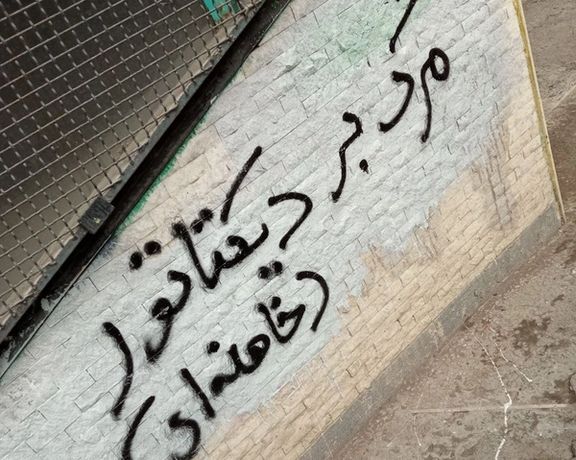
A slogan written on a wall says, "Death to the dictator, Khamenei"
Groups of Iranian reformist politicians and activists have come out in support of their top dissident figure against the Islamic Republic, demanding a referendum.
Over 400 political activists and journalists have signed a statement in support of Green Movement leader Mir-Hossein Mousavi’s call to end clerical rule in Iran.
“With the current social awakening, and the society’s disillusionment with reforms within the current [political] structure, there is no other way than allowing the people to decide their own destiny,” the statement said while expressing its support of Mousavi’s three-stage proposal and a “peaceful and non-violent transition” to a democratic government and the “Woman, Life, Freedom” Movement.
Mousavi, who was a presidential candidate in 2009 and has been under house arrest since 2011, said in a statement on February 4 that fundamental change was required to “save Iran” and proposed elections to appoint a constitutional assembly to write a new constitution and a referendum on the new constitution and its proposed form of government.
The statement which was released Sunday said the outcome of a political structure based on the rule of Islamic clerics, after four decades is corruption and injustice, a government that is structurally incapable of dealing with an array of crises, and social and political freedoms that have been suppressed.
In another statement, 112 reformists who are mostly former government officials, issued a similar statement Sunday admitting the goals of the 1979 revolution to have justice and democracy in Iran have failed, and voiced support for Mousavi’s demands.
Mousavi and his wife Rahnavard casting ballots in the 2009 presidential election
In the current atmosphere the support for Mousavi and his demand for transition from the Islamic Republic could entail serious repercussions for its signatories, who had so far remained loyal to the Islamic Republic.
It can also be a serious set back for the regime, as its opponents have begun uniting and organizing in the diaspora, while it is losing its traditional power base.
In 2009 Mousavi’s refusal to accept the results of the election sparked widespread protests that were brutally suppressed after Supreme Leader Ali Khamenei accused him of “sedition” along with former parliament speaker Mehdi Karrubi, another candidate in the same elections, and former president Mohammad Khatami.
The signatories of the statement include many of Mousavi’s former supporters and other reformists including Hashem Aghajari, a reformist politician who in 2000 was sentenced to death (later commuted) for “disrespecting Islam and Islamic sanctities” in a speech, and politicians such as Abolfazl Ghadyani who has been a harsh critic of Khamenei in the past decade.
Former revolutionary and now strong critic of Khamenei, Abolfazl Ghadyani
Among the signatories there are also women’s rights activists such as Noushin Ahmadi-Khorasani who was among the founding members of the One Million Signatures campaign, former student activists such as Abdollah Momeni who has been jailed several times in the past two decades, and veteran journalists such as Mashallah Shamsolvaezin who founded several popular reformist newspapers including Jame’e (Society) from 1998 onward.
Mousavi’s proposal has found support with some others including the prominent Baluch cleric Mowlavi Abdolhamid Esmail-Zehi, and leading reformist politicians Mostafa Tajzadeh and Faezeh Hashemi, the daughter of Iran’s former president Akbar Hashemi-Rafsanjani, both of whom are behind bars.
In a statement issued with five other political prisoners last week, Tajzadeh and Hashemi said “the only way out of the impasse for the government is to surrender to the right of the people to determine their own destiny.”
Tens of expatriate “Republican” figures and activists in a separate statement on Friday called Mousavi’s proposal “a positive and forward-looking proposal towards strengthening solidarity among the rainbow political atmosphere of Iranians seeking a transition from the Islamic Republic”.
Iran newspaper, the mouthpiece of the government, on Sunday mocked Mousavi’s proposed elections and referendum and said his record already included “insurgency against the republic during the 2009 sedition” while the semi-official Mehr News Agency in a commentary on the same day claimed that his statement proved again his “hostility” at a time when unrest in the country has subsided.
Karrubi has so far not made any comments about transition from the Islamic Republic but Khatami in a statement last week, a day after Mousavi’s declaration, called on the government to meet the people's demands and prevent a revolutionary change.
The United Nations Special Rapporteur on the human rights in Iran, Javaid Rehman (left) during an event held by the International Organization to Preserve Human Rights (IOPHR) at the UK’s House of Commons on February 8, 2023
The United Nations Special Rapporteur on human rights in Iran has called for tangible measures to hold the Islamic Republic accountable for its violations.
Javaid Rehman made the remarks during an event held by the International Organization to Preserve Human Rights (IOPHR), a London-based think tank which promotes equality, inclusivity and social development and is currently focusing on the Islamic Republic. The meeting, titled “How to stop the global threat of the Iranian regime,” was held at the UK’s House of Commons on February 8, in which participants discussed how the UK government could support anti-regime protesters.
Rehman, who has repeatedly condemned the Islamic Republic over its rights violations, has intensified his rhetoric and tone about holding Tehran accountable over its violent crackdown on protests that have convulsed the country since mid-September. The clerical regime has killed over 500 people to say that it did not kill 22-year-old Mahsa Amini who was fatally injured after being arrested by the notorious ‘hijab police’.
In a strongly worded speech, Rehman called for the international community to take more action against Iranian officials through available legal means in order to bring them to account and condemned the brutality of the Iranian state, which he described as “a threat to regional and international security.”
He said that “the manner in which the Iranian regime handled these protests is heart-wrenching and painful to elaborate,” adding “I am horrified, shocked and outraged.”
Despite all the international measures and calls for restraint, “the Iranian authorities have thus far executed at least four persons associated with the protests. They’ve been tried arbitrarily, summarily and through sham trials which violate the right to fair trials and due process,” he noted.
Calling Iran’s level of executions and its use against minorities “deplorable,” he said, “These executions are used as a tool of repression to instill fear, and these are symbols of Iranian state brutality.” These executions are” a tool that the regime adopts in order to terrorize its own people as well as foreign and dual nationals.”
Iranian protesters who were executed by the Islamic Republic (from left to right) Mohammad Hosseini, Mohammad-Mehdi Karami, Mohsen Shekari, Majid-Reza Rahnavard
Calling Iran’s level of executions and its use against minorities “deplorable,” he said, “These executions are used as a tool of repression to instill fear, and these are symbols of Iranian state brutality.” These executions are” a tool that the regime adopts in order to terrorize its own people as well as foreign and dual nationals.”
Answering a question from Iran International’s Adam Baillie about measures against the IRGC, Prof. Rehman said that for him the big question was holding the IRGC accountable for crimes it may have committed, such as the shooting down of a Ukrainian airline in January 2020.
Rehman also decried the regime’s hostage-taking policy, noting that “such instrumentalization of individuals amounts to hostage taking and must be recognized as such. And all those involved in acts of hostage taking must be held accountable.”
He argued that there are legal means to prosecute Iranian individuals incriminated in human rights abuses over and above sanctions, pointing out that many Iranian officials who are human rights violators are at liberty in London while persecuting their countrymen at home. “What we see is that there are many human rights violators roaming around London without accountability, they have assets which they use, they have families which enjoy those benefits and yet they cherish, see and enjoy targeting and victimizing people back home, which should not happen.”
He also expressed abhorrence of Tehran’s threats and harassment of journalists abroad and called for technology companies to make online communication tools available to the Iranian people. “In order to achieve its agenda of threats and generating fear, the Iranian regime actively blocks information,” he said, slamming severe internet disruption and censorship of social media platforms.
Noting that the Iranian regime violates human dignity and respect for women with impunity, he said that “the law of enforcement of hijab and the manner of its enforcement by state authorities is emblematic of violence, brutality and violations of the fundamental human rights.”
“The international community and the United Kingdom cannot engage with a state which continues to violate the dignity and fundamental rights of its own people, in particular its children,” Rehman underlined.
He added, “I believe there are so many avenues...it may not be obvious to us, but we have to find ways to hold individuals accountable, including people right at the top. And this must be done to ensure justice. And while I appreciate all the efforts being done, including sanctions, I think ultimately accountability would mean a lot more to the people of Iran.”
Iran’s exiled Prince Reza Pahlavi on the sidelines of the rally in Los Angeles on February 11, 2023
Prominent dissident figures participated in mass rallies of the Iranian diaspora in the US cities of Washington DC and Los Angeles on Saturday, calling for the downfall of the clerical regime.
During a large gathering in Los Angeles, Iran’s exiled Prince Reza Pahlavi hailed Iranian women as “the first victims of the Islamic revolution in the last forty years."
He added that "Today, we are not just witnessing a 44-year-old resistance. Today in Iran, we are witnessing the first women's revolution in the world. Iranian women are not alone in their revolution and all men support them,” noting that Iranian women have always been in the vanguard of the fight against the regime.
On the sidelines of an anti-regime rally, Pahlavi told Iran International that “we all know we agree on basic principles, otherwise there will be no understanding in practice.” Emphasizing the need to support civil activists and political prisoners in Iran, he said "Iran's Charter of Solidarity and Freedom", which is being finalized, includes the minimum principles of agreement for the majority of secular democratic forces.
Eight prominent opposition figures held a joint forum in Washington DC on February 10, signaling the emergence of a leadership council in the diaspora to campaign for international support in favor of Iran’s protest movement.
Calling for equal rights for all political and sexual orientations, he said the Iranian society is beautifully diverse with various ethnicities, languages and dialects, religions, sects, and opinions. “We should have such an intellectual plurality and challenge each other. Even if we compete with each other, competition does not mean enmity."
He also praised Sunni religious leader Mowlavi Abdolhamid for his remarks about Iran’s territorial integrity and the equality of all Iranians.
"We tell political prisoners and imprisoned protesters that they are not alone. We are your voice in the world. The world should support the people of Iran. The world should not insist on negotiating with a regime, which is rotten to the core in order to keep it alive, especially when the nation is chanting death to the dictator,” Pahlavi said, calling on international community to support the rights of the Iranian nations to choose their destiny.
In a massive demonstration in Washington DC, other dissident figures, such as rights activists Masih Alinejad, Nazanin Boniadi and Hamed Esmaeilion and popular Iranian stars, including Faramarz Aslani, Googoosh, and Shahin Najafi, also delivered speeches about the Islamic Republic’s atrocities and expressed hope for an end to the regime.
Alinejad spoke about the regime’s discrimination and persecution of the LGBTQ community, heralding a new Iran where all have equal rights. She said that the day of celebration for the Iranian nation is when they are at the ballot box to decide the fate of their country.
Esmaeilion, a Canadian Iranian protest leader talked of the crimes committed by the Islamic Republic, saying women of the country paid a heavy price for their basic freedoms.
He added that the people of Iran should be ready for the next waves of protests, which will be stronger and bigger.
Boniadi also called on other countries to sever their ties with the regime in Iran, saying, "We don't want any Western country to talk with the Iranian regime."
Iranians staged mass rallies in dozens of cities across the world calling for the overthrow of the Islamic Republic on Saturday, concurrent with the regime-sponsored events inside Iran on the occasion of the 44th anniversary of the establishment of the Islamic Republic in 1979.
Canada-based activist Hamed Esmaeilion speaking during the rally Washington DC
Iranians from various European cities traveled to the French capital Paris to express their anger at the brutalities of Iran’s rulers against unarmed civilian protesters. Iranians living in London also held a gathering and chanted slogans in support of the move to designate the IRGC as a terrorist organization. Similar protests were held in Oslo, Bologna, Berlin, Dusseldorf, Hamburg, Nicosia, Copenhagen, Aarhus, Vienna, Sofia, Madrid, Istanbul, Sydney, Melbourne, Adelaide, Perth, Brisbane, Auckland, Stockholm, and Gutenberg.
This representative of young Iranians who have become full-fledged European citizens and politicians added, "We will be in Brussels on February 20." Alireza Akhundi, a member of the Swedish parliament, also spoke at the Paris rally, saying, "44 years ago a bitter incident happened in this city, and today we are all together and united for the revolution of the brave people of Iran."
In their historic joint event in Washington, the eight leading Iranian opposition figures called for support from democratic countries to change the regime in Iran and establish democracy.
Speaking at Georgetown University's Institute for Women, Peace and Security, Pahlavi, Esmaeilion, Alinejad, and Boniadi as well as Nobel laureate Shirin Ebadi, actress Golshifteh Farahani, former captain of Iran’s national soccer team Ali Karimi and Secretary General of Komala Iranian Kurdish party Abdullah Mohtadi made a speech.
President Ebrahim Raisi during the regime-sponsored event for the anniversary of the establishment of the Islamic Republic
Finding itself under pressure, the Islamic Republic may be ready to make some concessions to protesters at home and to Western countries whose citizens are held hostage in Tehran.
Reports from Tehran say that French-Iranian dual national academic Fariba Adelkhah has been released from jail. Adelkhah was sentenced to five years in 2020 on national security charges that she denied. Reports say that there are still several other French nationals in jail in Iran who are in essence Iran's hostages.
For decades, the Islamic Republic has been arresting foreigners and dual nationals on vague and trumped-up charges, keeping them in prison until it can make a deal with Western countries either for money, diplomatic concessions or freeing its agents convicted abroad.
Speaking on the anniversary of the 1979 Islamic revolution Foreign Minister Hossein Amir-Abdollahian told an NPR correspondent that an agreement to swap dual national prisoners with the United States is on the table.
He said that releasing Iranian-American Siamak Namazi is pending some technical measures on the part of the United States. However, he did not elaborate on the nature of those measures.
Amir-Abdollahian also tried to sound optimistic on the nuclear issue, as Iran finds itself under more isolation and the pressure of sanctions. He said that there is still a window of opportunity for all sides to return to the JCPOA.
Meanwhile, the violation of human rights by the Iranian regime during recent protests, and Tehran's involvement in Moscow's war against Ukraine have made the situation more complicated, making it difficult for the United States and Europe to make a deal with Iran.
On the domestic front, while according to political activists only around 150 of the prisoners "pardoned" by Supreme Leader Ali Khamenei were actually released from jail until Friday, reports came in Saturday morning about more political prisoners being released from detention.
Political activist Farhad Meysami
One of them was Farhad Meysami, whose heart-wrenching pictures were released last week following a long hunger strike. Meysami who was sentenced to five years in jail, was freed only four months before the end of his sentence.
While reports in Tehran indicated that President Ebrahim Raisi was going to make a “very important” announcement in his revolution anniversary speech on Saturday, his remarks contained nothing other than the usual unfounded claims about the Islamic Republic being the top power in the region, having achieved great success in many areas.
After the speech however, Iranian media sources quoted Raisi as having said that all students, cultural and athletic figures and media activists in jail are also going to be pardoned. Raisi tried to portray the amnesty as a measure championed by his government rather than the Iranian Judiciary Chief, Gholam-Hossein Mohseni Ejei, who had called for a partial amnesty.
More than 90 Iranian journalists and a dozen athletes are said to have been detained during the protests since September, and many have already been released.
It is still not clear how many of the "tens of thousands" of prisoners who were to be freed based on Ejei's request are still remaining in jail and how many have been released.
Raisi’s promise to release more detainees was also vague. He did not mention how many prisoners would be included in the amnesty. However, he said the "fatherly amnesty" is a measure to confront the enemies who sow discord in Iran.
He also promised that the government is planning to facilitate the return of Iranians living abroad including those who have possibly acted against the law, but declined to elaborate. He only said that people will be notified of the measures "soon".
Iran’s exiled Prince Reza Pahlavi says the charter of solidarity and freedom of Iran creates the basis of cooperation among opposition forces to oust the Islamic Republic.
However, it is important that “we all know we agree on basic principles, otherwise there will be no understanding in practice,” Reza Pahlavi told Iran International on the sidelines of an anti-regime rally in Los Angeles on Saturday.
Emphasizing the need to support civil activists and political prisoners in Iran, he said "Iran's Charter of Solidarity and Freedom", which is being finalized, includes the minimum principles of agreement for the majority of secular democratic forces.
He also touched upon the need to continue the demonstrations abroad saying that this will make the Iranian people and activists gain energy and continue the movement with more strength.
In a historic event on Friday, eight leading Iranian opposition figures called for support from democratic countries to change the regime in Iran and establish democracy.
At an event at Georgetown University's Institute for Women, Peace and Security, exiled Prince Reza Pahlavi, Nobel laureate Shirin Ebadi and Canada-based activist Hamed Esmaeilion, as well as US-based journalist Masih Alinejad, actresses and activists Nazanin Boniadi and Golshifteh Farahani, former captain of Iran’s national soccer team Ali Karimi and Secretary General of Komala Iranian Kurdish party Abdullah Mohtadi made a speech.
Iranian diaspora protest leaders, from L-R, Prince Reza Pahlavi, Nazanin Boniadi, Masih Alinejad and Hamed Esmaeilion meeting in Washington DC, February 10, 2023
Five months into Iran's protest movement, an important question is whether the opposition in Iran and in the diaspora can unite to oust the Islamic Republic.
In the past few months, protesters on the streets have been looking up to some leading opposition figures abroad, particularly the exiled Prince Reza Pahlavi whose father was ousted by the Islamic Revolution of 1979 when he was still a teenager.
Many have hoped that the exiled prince and others, mainly activists and celebrities who have been campaigning against the regime, would form a united front, coordinate moves against the regime, lobby with western powers, and eventually assume the leadership of the revolution when the time comes.
Having to look up to the diaspora is in fact a situation imposed by the Islamic Republic which has practically eliminated, or forced into silence, any strong opposition figure or group inside Iran that could pose a danger to its existence.
Five months after the death in custody of Mahsa Amini sparked widespread protests in Iran, the opposition in diaspora seems to have come to an agreement to work together. Leading opposition figures – including exiled Prince Reza Pahlavi and seven others at an event Friday in Washington DC expressed their views and their vision of the future and said they are drawing up a manifesto for the revolution.
Meanwhile, Mir-Hossein Mousavi, who was a presidential candidate in 2009 and has been under house arrest since 2011, said in a statement a week earlierthat fundamental change was required to “save Iran” and proposed elections to appoint a constitutional assembly to decide the future form of government and a referendum on the new constitution.
Mir-Hossein Mousavi and his wife casting ballots in the 2009 presidential election
Mousavi’s rejection of the reform option in the Islamic Republic which puts him in the same boat as the diaspora figures has been met with admiration and antipathy alike. Many agree that declaring that the Islamic Republic is no longer reformable was a brave move on the part of Mousavi, a staunch believer in the Islamic Republic who served as its prime minister in the 1980s.
When asked by BBC Persian about the possibility of collaboration with Mousavi at the event Friday, Prince Reza Pahlavi said the diaspora opposition aims at “maximum participation” in the struggle against the regime and welcomes anyone who wants a secular Iran, not a reformed Islamic Republic.
“Reza Pahlavi’s response about Mousavi’s statement was diplomatic. In a way, he tried not to cause animosity…I hope his supporters will agree that Iranian politics is multi-faceted,” Mojtaba Najafi, a France-based academic tweetedreferring to the many Pahlavi supporters’ strong objection to Mousavi and other reformists.
The former crown prince and the former prime minister in the Islamic Republic say the future form of the government should be decided by the people of Iran through the free election of a constitutional assembly and referendum.
In his short statement, Mousavi also called for cooperation among all political forces and figures who believe in preserving the country’s “territorial integrity” and “non-violence” to decide the transition from the Islamic Republic.
But differences between the political views of Pahlavi, other activists and Mousavi also run very deep, probably on many issues, as long as the former official has not acknowledged his responsibility in the misdeeds of the regime in the 1980s.
At the event, for instance, Prince Reza Pahlavi brought up an issue which could potentially be divisive: Relations with Israel.
When speaking about water crisis as one of Iran's major problems, he said Iran could seek assistance from “the best of Israeli experts”. He also referred to the former President Mahmoud Ahmadinejad who “wanted Israel not to exist at all” which implied he favors normal relations with Israel.
Mousavi and his supporters are now in agreement with the diaspora opposition that the people should decide the future form of government through a free vote, but although they may not call for Israel’s annihilation like Ahmadinejad and Khamenei, they are more likely to champion the Palestinian cause and be opposed to recognizing Israel.
However, Mousavi is not the leader of the young protesters in the streets, who seem to oppose a revolutionary foreign policy and favor good relations with regional countries.