• العربية
  • فارسی
Brand
  • Iran Insight
  • Politics
  • Economy
  • Analysis
  • Special Report
  • Opinion
  • Podcast
  • Iran Insight
  • Politics
  • Economy
  • Analysis
  • Special Report
  • Opinion
  • Podcast
  • Theme
  • Language
    • العربية
    • فارسی
  • Iran Insight
  • Politics
  • Economy
  • Analysis
  • Special Report
  • Opinion
  • Podcast
All rights reserved for Volant Media UK Limited
volant media logo

Can Opposition Forces In Iran And Diaspora Create A United Front?

Maryam Sinaiee
Maryam Sinaiee

Iran International

Feb 12, 2023, 01:50 GMT+0Updated: 18:01 GMT+1
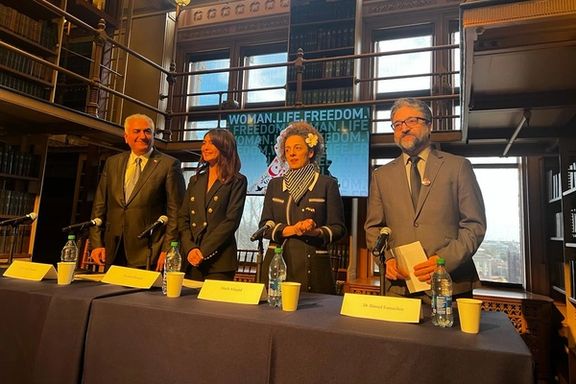
Iranian diaspora protest leaders, from L-R, Prince Reza Pahlavi, Nazanin Boniadi, Masih Alinejad and Hamed Esmaeilion meeting in Washington DC, February 10, 2023

Five months into Iran's protest movement, an important question is whether the opposition in Iran and in the diaspora can unite to oust the Islamic Republic.

In the past few months, protesters on the streets have been looking up to some leading opposition figures abroad, particularly the exiled Prince Reza Pahlavi whose father was ousted by the Islamic Revolution of 1979 when he was still a teenager.

Many have hoped that the exiled prince and others, mainly activists and celebrities who have been campaigning against the regime, would form a united front, coordinate moves against the regime, lobby with western powers, and eventually assume the leadership of the revolution when the time comes.

Having to look up to the diaspora is in fact a situation imposed by the Islamic Republic which has practically eliminated, or forced into silence, any strong opposition figure or group inside Iran that could pose a danger to its existence.

Five months after the death in custody of Mahsa Amini sparked widespread protests in Iran, the opposition in diaspora seems to have come to an agreement to work together. Leading opposition figures – including exiled Prince Reza Pahlavi and seven others at an event Friday in Washington DC expressed their views and their vision of the future and said they are drawing up a manifesto for the revolution.

Meanwhile, Mir-Hossein Mousavi, who was a presidential candidate in 2009 and has been under house arrest since 2011, said in a statement a week earlier that fundamental change was required to “save Iran” and proposed elections to appoint a constitutional assembly to decide the future form of government and a referendum on the new constitution.

Mir-Hossein Mousavi and his wife casting ballots in the 2009 presidential election
100%
Mir-Hossein Mousavi and his wife casting ballots in the 2009 presidential election

Mousavi’s rejection of the reform option in the Islamic Republic which puts him in the same boat as the diaspora figures has been met with admiration and antipathy alike. Many agree that declaring that the Islamic Republic is no longer reformable was a brave move on the part of Mousavi, a staunch believer in the Islamic Republic who served as its prime minister in the 1980s.

When asked by BBC Persian about the possibility of collaboration with Mousavi at the event Friday, Prince Reza Pahlavi said the diaspora opposition aims at “maximum participation” in the struggle against the regime and welcomes anyone who wants a secular Iran, not a reformed Islamic Republic.

“Reza Pahlavi’s response about Mousavi’s statement was diplomatic. In a way, he tried not to cause animosity…I hope his supporters will agree that Iranian politics is multi-faceted,” Mojtaba Najafi, a France-based academic tweeted referring to the many Pahlavi supporters’ strong objection to Mousavi and other reformists.

The former crown prince and the former prime minister in the Islamic Republic say the future form of the government should be decided by the people of Iran through the free election of a constitutional assembly and referendum.

In his short statement, Mousavi also called for cooperation among all political forces and figures who believe in preserving the country’s “territorial integrity” and “non-violence” to decide the transition from the Islamic Republic.

But differences between the political views of Pahlavi, other activists and Mousavi also run very deep, probably on many issues, as long as the former official has not acknowledged his responsibility in the misdeeds of the regime in the 1980s.

At the event, for instance, Prince Reza Pahlavi brought up an issue which could potentially be divisive: Relations with Israel.

When speaking about water crisis as one of Iran's major problems, he said Iran could seek assistance from “the best of Israeli experts”. He also referred to the former President Mahmoud Ahmadinejad who “wanted Israel not to exist at all” which implied he favors normal relations with Israel.

Mousavi and his supporters are now in agreement with the diaspora opposition that the people should decide the future form of government through a free vote, but although they may not call for Israel’s annihilation like Ahmadinejad and Khamenei, they are more likely to champion the Palestinian cause and be opposed to recognizing Israel.

However, Mousavi is not the leader of the young protesters in the streets, who seem to oppose a revolutionary foreign policy and favor good relations with regional countries.

Most Viewed

Ideology may be fading in Iran, but not in Kashmir's ‘Mini Iran'
1
INSIGHT

Ideology may be fading in Iran, but not in Kashmir's ‘Mini Iran'

2
INSIGHT

Hardliners push Hormuz ‘red line’ as US blockade tests Iran’s leverage

3
VOICES FROM IRAN

Hope and anger in Iran as fragile ceasefire persists

4

Iran International says it won’t be silenced after London arson attack

5

US sanctions oil network tied to Iranian tycoon Shamkhani

Banner
Banner

Spotlight

  • Hardliners push Hormuz ‘red line’ as US blockade tests Iran’s leverage
    INSIGHT

    Hardliners push Hormuz ‘red line’ as US blockade tests Iran’s leverage

  • Ideology may be fading in Iran, but not in Kashmir's ‘Mini Iran'
    INSIGHT

    Ideology may be fading in Iran, but not in Kashmir's ‘Mini Iran'

  • War damage amounts to $3,000 per Iranian, with blockade set to add to losses
    INSIGHT

    War damage amounts to $3,000 per Iranian, with blockade set to add to losses

  • Why the $100 billion Hormuz toll revenue is a myth
    ANALYSIS

    Why the $100 billion Hormuz toll revenue is a myth

  • US blockade targets Iran oil boom amid regional disruption
    ANALYSIS

    US blockade targets Iran oil boom amid regional disruption

  • Iran's digital economy battered by prolonged blackout
    INSIGHT

    Iran's digital economy battered by prolonged blackout

•
•
•

More Stories

Iranians Rally Across The World Calling For End To Islamic Republic

Feb 11, 2023, 21:13 GMT+0
•
Iran International Newsroom

Iranians have once again staged mass rallies in dozens of cities across the world calling for the overthrow of the Islamic Republic.

Pursuant to calls to hold a global rally against the Islamic Republic on Saturday, which coincided with the anniversary of the establishment of the Islamic Republic in 1979, dozens of cities around the world witnessed protests against the regime.

Iranians from various European cities traveled to the French capital Paris to express their anger at the brutalities of Iran’s rulers against unarmed civilian protesters.

A number of politicians, artists and family members of people killed by the Islamic Republic, participated in the gathering.

Danial Ilkhanipour, a German-Iranian member of the Hamburg city parliament, said, "We are here today to announce that the last five months were just the beginning and it was the beginning of the end of the Islamic Republic."

This representative of young Iranians who have become full-fledged European citizens and politicians added, "We will be in Brussels on February 20."

Alireza Akhundi, a member of the Swedish parliament, also spoke at the Paris rally, saying, "44 years ago a bitter incident happened in this city, and today we are all together and united for the revolution of the brave people of Iran."

He was referring to Ayatollah Ruhollah Khomeini’s return to Iran from Paris, where he had found refuge after leaving Iraq. Days after Khomeini’s return his followers took over the government.

"Until the victory, the brave people of Iran will stand without fear,” he added.

Ramin Seyed-Emami a musician and composer known by the stage name "King Raam", performed a song at the gathering of Iranians in Paris.

His father Kavous Seyed-Emami was an Iranian-Canadian academic and conservationist. He ran the Persian Wildlife Heritage Foundation (PWHF) and was a sociology professor. In February 2018, he died days after being arrested by the IRGC intelligence. Iran's judiciary said that he killed himself in Tehran’s Evin Prison because of the evidence against him in a spying case. This claim, including the alleged suicide, has been rejected by his family.

The ministry of intelligence later said that there was no evidence against him and several other environmentalists arrested in January 2018.

Ramtin Fatehi, son of Ramin Fatehi, who was killed during the anti-regime protests following the death of Mahsa Amini in police custody, also spoke about the necessity of filing a lawsuit against the Islamic Republic for its brutality.

Niaz Zam, daughter of Ruhollah Zam, who was kidnapped and killed by the regime said, "We only want one thing, and that is the end of the Islamic Republic, which calls itself a republic but is actually a dictatorship."

Best known for operating a Telegram channel named 'Amadnews', which he founded in 2015, Ruhollah Zam played a high-profile role in the 2017–2018 Iranian protests. He was kidnapped while visiting Iraq and taken to Iran where he was sentenced to death and was executed on 12 December 2020.

Iranians living in London also held a gathering and chanted slogans in support of the move to designate the IRGC as a terrorist organization.

A large protest was also held in Washington DC.

Similar protests were held in Oslo, Bologna, Berlin, Dusseldorf, Hamburg, Nicosia, Copenhagen, Aarhus, Vienna, Sofia, Madrid, Istanbul, Sydney, Melbourne, Adelaid, Perth, Brisbane, Auckland, Stockholm, and Gutenberg.

In the past days, activists called on diaspora Iranians to participate in the anti-regime protests on Saturday. Dozens of Iranian artists living abroad also stated that they would take part in these gatherings with the slogan of overthrowing the Islamic Republic.

Exiled Prince Reza Pahlavi also called on all his compatriots to make this event "the most glorious day in the calendar of the Iranian national uprising" with showing solidarity and unity.

‘Iran's On Fire’, Says Centrist Politician

Feb 11, 2023, 14:04 GMT+0
•
Iran International Newsroom

Reformist politicians as well as some conservatives in Iran continue to warn about the serious economic and political crises the Islamic Republic faces in 2023.

Hossein Marashi, the Secretary General of centrist Executives of Construction Party says: "I can say that Iran is on fire, and that this fire will not be extinguished unless various government institutions and their critics move in the direction of serving the country's national interests."

Speaking in an interview with Khabar Online, Marashi maintained that there is no way out of Iran's current crisis other than drafting a "collective national document" upon which everyone can agree. To this end, he said, wise people should be brought back to the country's management and the role of radicals should be limited to the scope of their social influence.

Marashi reiterated that Iran is in an extremely difficult and critical situation. He added that in such a situation, all those who believe in correcting the government's performance based on the existing Constitution and those with higher goals, including the ones who no longer believe in the Islamic Republic are part and parcel of this nation and should be respected.

His remarks follow a statement recently issued by opposition figure and former prime minister Mir-Hossein Mousavi, who demanded to hold a referendum for a new constitution.

Marashi said the amnesty granted to some protesters was a first step toward this goal. This comes while some activists have said although the government has spoken about pardoning tens of thousands of inmates, only less than 150 of those who have been released as of February 9 were jailed protesters.

Hossein Marashi, the leader of Executives of Construction Party. Undated
100%
Hossein Marashi, the leader of Executives of Construction Party

Meanwhile, Marashi said that the government should stop making decisions by individual players or in small groups of politicians who represent only a minority. All individuals, political parties, and private and public sector activists need to get together to save the country out of trouble.

He summarized some of Iran's problems pointing to a 52-percent inflation rate, an increasing budget deficit, and poor performance of the banks. He said it is a shame that an oil-rich country, which has the world's largest natural gas reserves is selling its properties to maintain the government's operations. This means, he said, that Iran's status has been downgraded.

The party leader added that hardliners pose the most serious threats to Iran. "They are a minoritythat wants Iran to be in constant conflict with the rest of the world while its people are suffering from poverty and sanctions. They do not have any solution for the country's problems and are not entitled to speak for everyone in Iran and their power should be limited to the extent of their real influence in the society. "

Meanwhile, conservative commentator Mohammad Mohajeri has told Nameh News that even some of Iran's hardliner conservatives who previously supported the government of President Ebrahim Raisi no longer want to be associated with it and share the responsibility for its economic, political, social, cultural and foreign policy failures particularly following the current wave of protests in Iran. These conservative supporters have chosen to go their separate ways to ensure their own political survival.

In another development, lawmaker Gholamreza Nouri Ghezelche has predicted that Iranians are likely experience more hardship in the coming months as the government seems to have given up the idea of solving the country's problems. This, he said, was evident in the budget bill the government presented to the parliament.

Ghezelche added that after one and half years in office, Raisi has yet to present a clear roadmap to the parliament, and no one knows where his government is headed. "He made so many promises in the areas of housing, economic growth, employment, fighting corruption and controlling inflation, but none of those promises have been met," he said.

Hackers Interrupt Raisi's Revolution Day Speech On State TV

Feb 11, 2023, 09:59 GMT+0
•
Iran International Newsroom

While Iran’s President Ebrahim Raisi was delivering his speech during the government organized revolution day ceremonies, hackers interrupted the broadcast.

Raisi was speaking in Tehran’s Azadi square where people were gathered to mark the 44th anniversary of the Islamic Republic, an occasion when the regime was determined to show that it still enjoys popularity.

The hacktivist group Ali’s Justice (Edalat-e Ali) hacked the broadcast from the state TV and aired the slogan “Death to Khamenei”. It also called on the people to withdraw their money from government banks and called on the people to take part in antigovernment protests on February 16.

The regime had forced students, millions of public sector employees and soldiers to take part in the gathering and parades in different cities, together with its own base of support among families of regime loyalists, clerics and the paramilitary Basij organization.

A Twitter user posted a comment that “Well, somehow you did accomplish your [revolution day] march, by threatening school children with reducing their grades, government employees with financial penalties…my question is: Did you solve our problems?”

Raisi in his speech said the regime will embrace those “who were deceived during riots”, referring to last year’s popular protests and welcome them back “into the embrace of the nation.” He spoke of Supreme Leader Ali Khamenei’s “fatherly love” and his magnanimity in pardoning detained protesters.

President Ebrahim Raisi speaking on Saturday, February 11, 2023
100%
President Ebrahim Raisi speaking on Saturday, February 11, 2023

The president went on repeating the official propaganda line that foreigners instigated the protests to “destroy Iran”. The regime is adept at trying to equate itself with the country and its vital interests when it faces a serious challenge.

These remarks reveal that the hardliner core of the regime headed by Khamenei is in no mood to start some sort of dialogue, at least with former regime loyalists to somewhat pacify the anti-regime mood in the country.

However, former President Hassan Rouhani told local reporters during the ceremonies that “We should not allow a power-hungry minority to push the majority aside,” adding that this “would be the end of the [Islamic] revolution.”

He was clearly referring to hardliners and ultra-conservatives who have taken over both the legislature and the presidency with Khamenei’s support in the past three years.

The Islamic government should listen to diverse ideas and the people’s voice to guarantee the survival of the revolution, he added.

Regime officials use the term revolution as a synonym for the Islamic Republic.

In recent days, prominent former officials have demanded a revision of the constitution or a new one by forming a constituent assembly and holding referendums.

Former prime minister and leader of the reformist Green Movement, Mir-Hossein Mousavi in a statement issued earlier this month said the reform movement has failed and it is time to make “fundamental changes.” Mousavi’s call is tantamount to a regime change if people are allowed to freely vote for a new form of government.

Former President Mohammad Khatami also called for serious changes, although he stopped short of saying the Islamic Republic must go.

Meanwhile, eight prominent exiled activists, including Prince Reza Pahlavi and Nobel laureate Shirin Ebadi, held a joint forum in Washington DC on Friday signaling the launce of a united protest leadership in the diaspora.

Kurdish Teachers In Iran Call For Release Of Sunni Clerics

Feb 11, 2023, 09:10 GMT+0

A group of teachers’ organizations in Iran’s Kordestan province have expressed concern about the situation of Sunni clerics (Mamoustas) arrested for supporting popular protests.

In a statement, "Working and Retired Teachers Association of Kordestan" stated that after the popular uprising against the regime following the death of Mahsa Amini, “a large number of the Mamoustas stood by the people and on the right side of history with brave stances, statements and participation in protests.”

The statement, published on Friday, stated that "Mamousta Loqman Amini, Seifollah Hosseini, Ebrahim Karimi and dozens of other Sunni clerics" from Kordestan are "influential figures" who supported the protests and must be released.

“The intelligence and security organizations imprisoned them, but they don’t know that by imprisoning each fighter, thousands of other fighters are born,” added the statement.

The statement also calls for the “quick and unconditional” release of all protesters.

The Kurdish teachers also warned the government that “no amount repression” will stop the people, stressing that “torture and prison will no longer work.”

In November, a group of Sunni religious leaders and Friday prayer Imams in Kordestan called for a referendum under the supervision of international bodies in the country.

Earlier, Molavi Abdolhamid, the top Sunni cleric of Zahedan in the southeast had also called for an internationally monitored referendum, saying by killing and suppressing protesters the government cannot push back a nation.

Students, Teachers, Civil Servants In Iran Forced To Join Revolution Parade

Feb 11, 2023, 00:26 GMT+0
•
Maryam Sinaiee

Iran’s regime is forcing students and civil servants to participate in the revolution anniversary parade to show it is more popular than the protest movement.

The state television reported Friday that seventy foreign journalists are visiting the country to report the celebrations of Ten Days of Dawn. “Apparently this year they have issued visas to more foreign journalists to report the end of the protests as well as the freeing of the prisoners, and may be other things that could be announced in the next few days,” Hossein Derakhshan, a journalist and former political prisoner said in a tweet Tuesday.

The ten days starting on the first of February mark the period between the arrival of Ayatollah Ruhollah Khomeini, founder of the revolution, in Tehran from Paris in 1979 and the victory of the revolution on February 11th.

Street protests have ebbed in the past month, but the Youth of Tehran, an underground protester group, in a recent statement urged the residents of the capital to shout anti-regime slogans every night from their rooftops and windows during the ten-day period including the slogan “We swear on the blood of our fallen ones to endure till the end.

Expatriates are planning their own show of strength through protest rallies on the day of the anniversary in many cities around the world. Iran's exiled crown prince, Reza Pahlavi, has urged all Iranians abroad to participate in the rallies against the Islamic Republic.

Those opposed to the regime often mockingly refer to the Ten Days of Dawn as Ten Days of Torment (zajr) and in the past few days have burned or destroyed many of the banners and other decorations put up in the streets by the state propaganda apparatus.

According to social media reports, education departments in many places have not only issued directives to schools demanding full participation of students, teachers and other staff but also threatened that not attending could negatively affect their chances of getting into higher education or promotion in their jobs.

Mohammad Renani, a professor of theology at Esfahan University and a cleric, said on Twitter a few days ago that his daughter’s class have been promised extra points would be added to their grades if they participated in the parade and that students were even asked to take pictures at the parade as evidence.

Renani called such directives “ethically and politically corrupt” and shared a screenshot of a directive sent by the education department of a small town in West Azarbaijan Province to schools that clearly stated that the attendance of teachers and other employees would be recorded and be the “basis of [future] rating and evaluation.”

Others say protesters who have recently been freed from prison on bail have been forced to give written guarantee that they would take part in the march Saturday.

“Do you think it’s an important occurrence if a total of two million people attend the state-sponsored march out of the eighty-five million population of Iran, by forcing students, civil servants, and mobilizing the armed forces?” London-based journalist Dariush Memar asked other twitterati Wednesday.

“Yes, it is important because the regime is investing in it. What the regime hugely needs now is gaining legitimacy through a massive march to tell the world that those who support it outnumber its opposition. The Islamic Republic needs to rebuild its lost dignity,” one of the respondents to Memar’s question wrote.




