• العربية
  • فارسی
Brand
  • Iran Insight
  • Politics
  • Economy
  • Analysis
  • Special Report
  • Opinion
  • Podcast
  • Iran Insight
  • Politics
  • Economy
  • Analysis
  • Special Report
  • Opinion
  • Podcast
  • Theme
  • Language
    • العربية
    • فارسی
  • Iran Insight
  • Politics
  • Economy
  • Analysis
  • Special Report
  • Opinion
  • Podcast
All rights reserved for Volant Media UK Limited
volant media logo

Iran Lawmakers Cautiously Hope To Summon Raisi For Questioning
Iran International Newsroom
Feb 3, 2023, 11:20 GMT+0Updated: 17:45 GMT+1
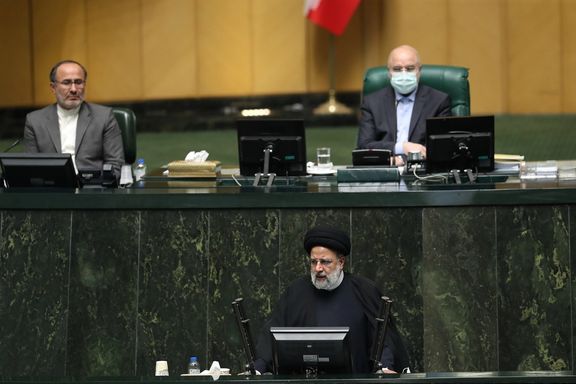
President Ebrahim Raisi at the parliament

Iranian media say several lawmakers are mulling the idea of questioning President Ebrahim Raisi at the parliament amid the country’s political and economic crises.

Moderate Aftab News website reported that the lawmakers were going around in the parliament (Majles) on January 31, gathering signatures in support of the motion. However, those who support the idea do their best to conceal their identity before the motion is tabled at the Majles.

The website said that the lawmakers appear to fear reactions by Raisi and other ultraconservatives to what they are doing. Nonetheless, their names cannot be kept a secret for long. Aftab News said that they even refused to talk to reporters about the motion that signifies their dissatisfaction about Raisi's performance.

Others at the Majles, including hardliner Mohsen Pirhadi told Aftab News that questioning the president about his performance is not wrong and is part of the parliament's supervisory mandate.

Lawmaker Mohsen Pirhadi (file photo)
100%
Lawmaker Mohsen Pirhadi

It appears that some cabinet ministers' manoeuvres to evade impeachment pushed the President into the questioning trap. After all, Raisi was the one who did his best to prevent the impeachments regardless of lawmakers' complaints about several cabinet ministers' inefficiency, wrote Aftab News.

Although lawmakers appear to be more determined this time to question Raisi, the website said that it is unlikely most deputies would vote for the motion. Meanwhile, Lawmaker Ahmad Alireza Beigi said he does not believe that Majles would take such a step. However, he said that first, cabinet ministers should be impeached and then if the plan for impeachment does not go ahead smoothly, the lawmakers can question Raisi.

Meanwhile, a Khabar Online website report on February 1 said lawmakers are planning to question Raisi on 6 grounds. According to the website, this is the second call for questioning Raisi during the past 8 months. The first time, only two lawmakers signed the motion. According to the law, at least a quarter of the 290 lawmakers at the Majles need to sign a questioning motion if it is going to go any further.

The Islamic Republic’s parliament  (January 2023)
100%
The Islamic Republic’s parliament

According to Khabar Online, if the motion progresses this time, the lawmakers will ask questions about "the chaotic situation of the forex market and failing to issue electronic coupons to provide essential commodities to the nation."

Khabar Online quoted one of the unnamed lawmakers who was collecting signatures in support of the motion as having said some of his peers have welcomed the idea of questioning the President, but some others are too scared to sign the request for the motion."

In April last year, Lawmaker Mostafa Hosseini Ghotbabadi had even said that lawmakers have called for designating the president as incompetent, a motion that kicked out Iran's first President Abolhassan Banisadr in June 1981.

Raisi has been most recently criticized for feeding the nation with false information and fabricated statistics about his achievements during a televised interview earlier this week. During the past months the figures he presented about inflation, employment and economic growth were seriously challenged by the media and even by hardliner newspapers published by the IRGC.

The media have been questioning Raisi's performance in the areas of housing, employment and controlling prices. The most important point made against Raisi's figures is that while the official inflation rate in January was 51 percent, He still insists that it is no higher than 40 percent.

Iran’s currency, rial has fallen to 450,000 to the US dollar speeding up inflation that is expected soon to surpass the official rate of 51 percent. All government attempts to manipulate the forex market have so far failed.



Most Viewed

100 days after carnage: Iran economy reels from war, inflation, unemployment
1
INSIGHT

100 days after carnage: Iran economy reels from war, inflation, unemployment

2
INSIGHT

Ghalibaf defends Iran-US talks amid hardline backlash

3
INSIGHT

A nation in limbo: 100 days after the massacre, has the world moved on?

4
ANALYSIS

From instability to influence: Pakistan’s pivotal role in US-Iran diplomacy

5
ANALYSIS

100 days on: why Iran’s January protests spread across social classes

Banner
Banner

Spotlight

  • War-hit homeowners feel abandoned as Iran’s reconstruction aid fades

    War-hit homeowners feel abandoned as Iran’s reconstruction aid fades

  • 100 days on: the anatomy of Iran’s January crackdown
    INSIGHT

    100 days on: the anatomy of Iran’s January crackdown

  • Ghalibaf defends Iran-US talks amid hardline backlash
    INSIGHT

    Ghalibaf defends Iran-US talks amid hardline backlash

  • 100 days on: why Iran’s January protests spread across social classes
    ANALYSIS

    100 days on: why Iran’s January protests spread across social classes

  • From instability to influence: Pakistan’s pivotal role in US-Iran diplomacy
    ANALYSIS

    From instability to influence: Pakistan’s pivotal role in US-Iran diplomacy

  • A nation in limbo: 100 days after the massacre, has the world moved on?
    INSIGHT

    A nation in limbo: 100 days after the massacre, has the world moved on?

•
•
•

More Stories

Ultra-Hardliners Push For More Restrictions In Iran

Feb 3, 2023, 06:58 GMT+0
•
Maryam Sinaiee

Emboldened by less street protests in January, Iran's ultra-hardliners have been pushing for further restrictions on social freedoms and freedom of expression.

Commenting on the issue of hijab, lawmaker Hossein-Ali Haji-Deligani said in an interview with Entekhab news website recently that he believes the country should have an entity dedicated to “promotion of virtue and prevention of vice” as a completely independent organization to enforce hijab. “Our society and religion do not accept today’s kind of [lenient] hijab,” he said.

Haji-Deligani who is also a member of the parliament’s presidium had said a day earlier that lawmakers, including him, had submitted a new motion to prevent celebrities and those with political, social, military or cultural influence, from “making irrelevant and inexpert statements” on the country’s affairs.

“Unrestricted expression of views is not permissible,” he said when announcing the motion’s submission.

If parliament passes the proposed law, any person of influence could be charged with ‘corruption on earth’ for making “untrue” remarks on matters requiring official clarification provided that their statements cause “serious disruption of public order, insecurity, or major physical damage to individuals, public or private property, or promote moral corruption.

‘Corruption on earth’ is punishable by death in Iran's Sharia-based laws.

The law not only will silence even insiders from criticizing a shortcoming but will eliminate whatever limited criticism appears in media. Journalists will be the top targets of such a law. Already dozens are under arrest or have face political charges.

“This means, in simple terms, that no one is allowed express any beliefs, view or even analysis [over a subject] before authorities make an official statement,” Fararu website wrote about the controversial motion. “Expressing views [over a matter] is criminal if there are rumors going around town about it, even if the rumors are true but different from the official account.”

“The problem is that lawmakers and some decisionmakers think that the events of the past few months resulted from expression of views in social media and the media. They don’t have a proper, logical and clear view of the causes of protests and think they can prevent them from happening again if they shut the mouths of critics and experts,” Nemat Ahmadi, a prominent lawyer and commentator based in Iran, told Fararu.

“As a matter of fact, I believe that this motion is not meant to prevent rumors and lies. If it turns into law, it should be called ‘The Shutting of Mouths Act’,” he added.

Haji-Deligani is a member of the parliament’s totalitarian Paydari faction which consists of members of the small but very influential Islamic Revolution Endurance Front. The party represents the most extreme right end of the conservative-hardliner spectrum collectively known as Principlists.

Supreme Leader Ali Khamenei has on many occasions eulogized the group’s mentor, Ayatollah Mohammad-Taghi Mesbah-Yazdi, who passed away two years ago.

Mesbah-Yazdi famously once said Khamenei’s rule was superior to that of the Islamic Revolution’s founder Ayatollah Ruhollah Khomeini. He also preached that Khamenei is the representative of the twelfth Shiite Imam Mahdi whose reappearance from occultation will set the day of final judgment in motion.

The faction gained dozens of seats in the current parliament in the 2020 elections with the help of the Khamenei-appointed Guardian Council which disqualified not only reformists but many of Paydari candidate’s conservative rivals.

Hossein-Ali Haji-Deligani, a member of the parliament’s totalitarian Paydari faction (file photo)
100%
Hossein-Ali Haji-Deligani, a member of the parliament’s totalitarian Paydari faction

Conservative politician Mansour Haghighatpour, a former Principlist lawmaker, also criticized Paydari’s new attempt to restrict freedom of expression. “The problem is that after the last election a radical, extremist group has taken control of the parliament that does not want to hear [other] voices, views, or criticism. I mean the same group that is controlling the administration,” Haghighatpour told Fararu.

He added that this extremist group is responsible for “the majority of costs” that the Islamic Republic is now paying domestically and at the international level.

Hossein Kanaani-Moghadam, another former lawmaker and secretary general of the Principlist Green Party, also criticized Haji-Deligani’s recent remarks. “I believe such attempts would not have any outcome other than more corruption, anger, and dissatisfaction in the country.”

Next Months Critical For Ukraine As Iran Is Busy With Internal Affairs - CIA

Feb 2, 2023, 23:13 GMT+0

The CIA says the next six months will be "critical" for the Russian invasion of Ukraine especially as the Iranian government is busy with its domestic issues.

CIA Director William Burns said on Thursday the intelligence agency assesses that the next six months will be "critical" for Ukraine in its fight against Russia's invasion.

Speaking at a foreign policy event at Georgetown University in Washington, D.C., Burns also said Iran's government was increasingly unsettled by affairs within the country, citing the courage of what he described as "fed up" Iranian women.

Burns also said he was concerned about prospects for greater violence between Israelis and Palestinians

Tehran has supplied hundreds of drones to Russia since mid-2022 that have been used during missile attacks to inflict more damage or to swamp Ukrainian air defenses. The United States and Europe have imposed new sanctions on Tehran for its expanded military ties with Moscow and also its deadly crackdown on protests since last September.

Iran has denied supplying weapons to Russia for its war in Ukraine, but foreign minister Hossein Amir-Abdollahian after earlier denials acknowledged in early November that Tehran had supplied drones to Moscow “months before” the Ukraine war, leaving it vague if these were used in the war.

The United States and its European allies have strongly objected to Iranian drones for Russia, imposing sanctions move, and keeping nuclear talks with Tehran dormant.

An Anti-Hijab Prisoner In Iran Seriously Ill After Hunger Strike

Feb 2, 2023, 22:15 GMT+0
•
Iran International Newsroom

The health of long-time Iranian political prisoner, Farhad Meysami, who has lost a lot of weight due to his hunger strike, has deteriorated.

A photo of Meysami along with a letter from Rajaei-Shahr prison in Karaj were published on social media Thursday, showing him in a horrible condition after losing weight.

However, the political activist wrote in the letter to prison officials that “I will still insist on my three demands of stopping the execution of protesters, releasing six political prisoners, and stopping mandatory hijab.”

The title of political activist's letter is "For the days of suffering and suffering and suffering".

Farhad Meysami, who has been behind bars since August 2018 was arrested and sentenced to six years in jail for his activism against mandatory hijab.

Last month, in a message from Rajaei-shahr prison, he demanded the immediate release of several civil and political activists.

Meysami also went on a hunger strike in May in protest to the possible execution of Ahmadreza Jalali, a Swedish-Iranian dual national scientist taken hostage since 2016 was under the threat of execution last year.

Farhad Meysami before his arrest in 2018
100%
Farhad Meysami before his arrest in 2018

Meysami later announced that he has ended his two-week hunger strike as Ahmadreza Jalali was not executed. Before the end of that hunger strike, his physical condition was so critical that he was transferred to hospital.

Meysami, a doctor and teacher, said in a message last year that he had met Djalali at Tehran's Evin prison over three years earlier. "He had been on hunger strike in protest to repeated threats of his execution and the effects of which on his body and soul were clearly visible," he wrote.

"Imagine subjecting a human being to this repeatedly. Not once, not twice… Is there any torture worse than this?" Meysami said about repeated threats of execution made against Djalali.

"I don't want to just oppose Dr Djalali's execution, I want to draw attention to something much more important, to draw attention to the fact that they send a man to his death many times and bring him back," he wrote. "Regular and intentional torture like this is definitely crime against humanity."

Meanwhile, famous Iranian filmmaker Jafar Panahi has also gone on a hunger strike to protest his detention in Tehran while his sentence has been declared void by the country’s Supreme Court.

“I firmly declare that in protest against the illegal and inhumane behavior of the judicial and security apparatus and their hostage-taking, I have started a hunger strike since the morning of February 1… I will refuse to eat and drink any food and take medicine until the time of my release,” read a statement he sent to his wife.

Iran has been the scene of nationwide protests against the clerical regime after the death in custody of Mahsa Amini in mid-September.

Authorities have not released any information on the number of detainees, those injured and killed in the protests that began nearly three weeks ago following the death in custody of Mahsa Amini who was arrested for not wearing her hijab “properly”.

Human rights organizations says that nearly 520 protesters, including children, have been killed by security forces during the protests.

Saudi Arabia, Iraq To Boost Ties To Counter Iran’s Influence

Feb 2, 2023, 20:13 GMT+0
•
Iran International Newsroom

Regional and Western countries are moving to build closer cooperation with Iraq as a measure to curb the influence of the Islamic Republic in economy and politics of its neighboring country. 

On Thursday, Saudi Arabia’s foreign minister, Prince Faisal bin Farhan al Saud, visited Iraq, affirming that economic relations with Iraq were developing significantly. Bin Farhan made the statement during a joint press conference held in Iraq with the country’s Foreign Minister Fuad Hussein.

Hussein said, "security cooperation continues with Saudi Arabia" and added they were “working to reduce tensions in the region,” highlighting the depth of relations with Iraq, which he stated had "witnessed great momentum recently.”

“We support the Iraqi government’s effort to enhance stability,” he said, adding that stability was crucial in order for opportunities for prosperity to rise.

Prince Faisal added that economic ties with Iraq have also “greatly improved,” noting that “The region cannot prosper without stability.” 

Hussein also highlighted relations with Saudi Arabia, saying “security cooperation” is ongoing with Riyadh and added that “[We] are working on easing tensions in the region.”

Saudi Arabia's Foreign Minister Prince Faisal bin Farhan Al Saud and Iraqi Foreign Minister Fuad Hussein shake hands, at the Ministry of Foreign Affairs in Baghdad, Iraq February 2, 2023.
100%
Saudi Arabia's Foreign Minister Prince Faisal bin Farhan Al Saud and Iraqi Foreign Minister Fuad Hussein shake hands, at the Ministry of Foreign Affairs in Baghdad, Iraq February 2, 2023.

Earlier in the week, French President Emmanuel Macron met with Iraq Prime Minister Mohammed Shia Al-Sudani, in which the two signed a set of strategic agreements meant to boost Iraq’s economic cooperation with the European country. In the meeting, France and Iraq signed a treaty that seeks to strengthen bilateral relations in anti-corruption, security, renewable energy and culture, the Elysee Palace said on Friday. 

Macron launched the Baghdad Conference for Cooperation and Partnership in 2021, which aims at strengthening regional stability by involving Iraq and enhancing its role. 

Prince Faisal is expected to meet with President Abdul Latif Rashid, Prime Minister Mohammed Shia al-Sudani and Parliament Speaker Mohammed al-Halbous.

"This important visit comes at a time marked by great challenges, so it is essential to talk and discuss these challenges which affect the region as a whole," Hussein said, alongside Prince Faisal.

“We will not achieve these goals without a secure and stable region, and here is where Iraq plays an essential and important role in enhancing this stability. We will work together to advance the stability process in the region through dialogue, promoting common interests, and addressing any disagreements,” said the Saudi foreign minister.

Hussein hailed "total cooperation" with Saudi Arabia on oil, particularly within the OPEC cartel. Iraq's foreign minister said Riyadh was ready to back Saudi companies investing in Iraq, and welcomed it. "We hope Iraq will be supplied with electricity, either via the Saudi network or that in the Gulf," he said.

Despite being oil-rich, Iraq suffers from insufficient infrastructure and public services, after decades of conflict and endemic corruption. Baghdad is currently heavily dependent on the Islamic Republic for its electricity and gas, and has sought to diversify its energy sources. Iraq suffers from chronic electricity shortages, especially felt when summer temperatures reach scorching levels of over 50 degrees Celsius. The high temperatures subsequently push citizens to consume very high amounts of power.

Baghdad has taken a role as a mediator between the regional rivals Iran and Saudi Arabia, after diplomatic relations between Riyadh and Tehran froze in 2016. Since April 2021, Iraq has hosted a series of meetings between the two sides, but no talks have been publicly announced since April 2022.

Israeli PM To Hold Talks With Macron Over Iran In Elysée

Feb 2, 2023, 15:54 GMT+0

Israeli Prime Minister Benjamin Netanyahu will discuss Iran with French President Emmanuel Macron in Paris during his first foreign trip after regaining office.

The Israeli Embassy in Paris announced Netanyahu will be in Paris on Thursday, February 2, and an order of priority he first will discuss with Macron the international efforts to stop the nuclear program of the Islamic Republic.

Macron and Netanyahu last met and talked three years ago in Jerusalem.

According to the Israeli embassy, the prime minister will also meet with French businessmen as well as the leaders of the French Jewish community.

The AFP reported that Israel hopes to encourage France to intensify pressure on the Iranian regime during the trip.

France agrees that "firmness" is needed in dealings with Iran, a diplomatic source told AFP, calling its nuclear program "dangerous" and highlighting its role in the Ukraine war.

Referring to Netanyahu's recent statements, AFP said that there seems to be a significant change in Israel's position regarding the war in Ukraine and that Jerusalem is now ready to consider the issue of providing arms to Ukraine.

So far, Israel has been cautious and has preferred to remain neutral in the Ukraine war due to the presence of the Russian army in Syria.

Israel has been able to continue its military air operations over Syria without facing a military response from Russia.