• العربية
  • فارسی
Brand
  • Iran Insight
  • Politics
  • Economy
  • Analysis
  • Special Report
  • Opinion
  • Podcast
  • Iran Insight
  • Politics
  • Economy
  • Analysis
  • Special Report
  • Opinion
  • Podcast
  • Theme
  • Language
    • العربية
    • فارسی
  • Iran Insight
  • Politics
  • Economy
  • Analysis
  • Special Report
  • Opinion
  • Podcast
All rights reserved for Volant Media UK Limited
volant media logo

Ultra-Hardliners Push For More Restrictions In Iran

Maryam Sinaiee
Maryam Sinaiee

Iran International

Feb 3, 2023, 06:58 GMT+0Updated: 17:37 GMT+1
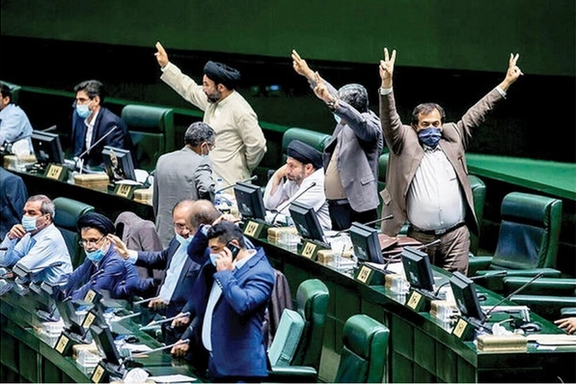
Lawmakers in the Iranian parliament

Emboldened by less street protests in January, Iran's ultra-hardliners have been pushing for further restrictions on social freedoms and freedom of expression.

Commenting on the issue of hijab, lawmaker Hossein-Ali Haji-Deligani said in an interview with Entekhab news website recently that he believes the country should have an entity dedicated to “promotion of virtue and prevention of vice” as a completely independent organization to enforce hijab. “Our society and religion do not accept today’s kind of [lenient] hijab,” he said.

Haji-Deligani who is also a member of the parliament’s presidium had said a day earlier that lawmakers, including him, had submitted a new motion to prevent celebrities and those with political, social, military or cultural influence, from “making irrelevant and inexpert statements” on the country’s affairs.

“Unrestricted expression of views is not permissible,” he said when announcing the motion’s submission.

If parliament passes the proposed law, any person of influence could be charged with ‘corruption on earth’ for making “untrue” remarks on matters requiring official clarification provided that their statements cause “serious disruption of public order, insecurity, or major physical damage to individuals, public or private property, or promote moral corruption.

‘Corruption on earth’ is punishable by death in Iran's Sharia-based laws.

The law not only will silence even insiders from criticizing a shortcoming but will eliminate whatever limited criticism appears in media. Journalists will be the top targets of such a law. Already dozens are under arrest or have face political charges.

“This means, in simple terms, that no one is allowed express any beliefs, view or even analysis [over a subject] before authorities make an official statement,” Fararu website wrote about the controversial motion. “Expressing views [over a matter] is criminal if there are rumors going around town about it, even if the rumors are true but different from the official account.”

“The problem is that lawmakers and some decisionmakers think that the events of the past few months resulted from expression of views in social media and the media. They don’t have a proper, logical and clear view of the causes of protests and think they can prevent them from happening again if they shut the mouths of critics and experts,” Nemat Ahmadi, a prominent lawyer and commentator based in Iran, told Fararu.

“As a matter of fact, I believe that this motion is not meant to prevent rumors and lies. If it turns into law, it should be called ‘The Shutting of Mouths Act’,” he added.

Haji-Deligani is a member of the parliament’s totalitarian Paydari faction which consists of members of the small but very influential Islamic Revolution Endurance Front. The party represents the most extreme right end of the conservative-hardliner spectrum collectively known as Principlists.

Supreme Leader Ali Khamenei has on many occasions eulogized the group’s mentor, Ayatollah Mohammad-Taghi Mesbah-Yazdi, who passed away two years ago.

Mesbah-Yazdi famously once said Khamenei’s rule was superior to that of the Islamic Revolution’s founder Ayatollah Ruhollah Khomeini. He also preached that Khamenei is the representative of the twelfth Shiite Imam Mahdi whose reappearance from occultation will set the day of final judgment in motion.

The faction gained dozens of seats in the current parliament in the 2020 elections with the help of the Khamenei-appointed Guardian Council which disqualified not only reformists but many of Paydari candidate’s conservative rivals.

Hossein-Ali Haji-Deligani, a member of the parliament’s totalitarian Paydari faction (file photo)
100%
Hossein-Ali Haji-Deligani, a member of the parliament’s totalitarian Paydari faction

Conservative politician Mansour Haghighatpour, a former Principlist lawmaker, also criticized Paydari’s new attempt to restrict freedom of expression. “The problem is that after the last election a radical, extremist group has taken control of the parliament that does not want to hear [other] voices, views, or criticism. I mean the same group that is controlling the administration,” Haghighatpour told Fararu.

He added that this extremist group is responsible for “the majority of costs” that the Islamic Republic is now paying domestically and at the international level.

Hossein Kanaani-Moghadam, another former lawmaker and secretary general of the Principlist Green Party, also criticized Haji-Deligani’s recent remarks. “I believe such attempts would not have any outcome other than more corruption, anger, and dissatisfaction in the country.”

Most Viewed

Ghalibaf defends Iran-US talks amid hardline backlash
1
INSIGHT

Ghalibaf defends Iran-US talks amid hardline backlash

2
ANALYSIS

From instability to influence: Pakistan’s pivotal role in US-Iran diplomacy

3
VOICES FROM IRAN

Bread shortages, soaring prices strain households in Iran, residents say

4
ANALYSIS

100 days on: why Iran’s January protests spread across social classes

5

War-hit homeowners feel abandoned as Iran’s reconstruction aid fades

Banner
Banner

Spotlight

  • Iran diplomacy wobbles as factions compete to avoid looking soft on US
    INSIGHT

    Iran diplomacy wobbles as factions compete to avoid looking soft on US

  • The politics of pink: how Iran uses cuteness to rebrand violence
    ANALYSIS

    The politics of pink: how Iran uses cuteness to rebrand violence

  • Bread shortages, soaring prices strain households in Iran, residents say
    VOICES FROM IRAN

    Bread shortages, soaring prices strain households in Iran, residents say

  • 100 days on: the anatomy of Iran’s January crackdown
    INSIGHT

    100 days on: the anatomy of Iran’s January crackdown

  • Ghalibaf defends Iran-US talks amid hardline backlash
    INSIGHT

    Ghalibaf defends Iran-US talks amid hardline backlash

  • From instability to influence: Pakistan’s pivotal role in US-Iran diplomacy
    ANALYSIS

    From instability to influence: Pakistan’s pivotal role in US-Iran diplomacy

•
•
•

More Stories

Prominent Intl. Figures Urge Unstinting, Practical Support For Iran Protests

Feb 2, 2023, 16:02 GMT+0
•
Iran International Newsroom

Hundreds of well-known international figures, from Nobel prize winners to movie actors, have called for support for Iranian protesters against bloody suppression.

In a petition organized by the non-profit Washington-based organization Freedom House, the signatories said that “the triumph of freedom in Iran could renew the global tide of democratization that was so strong in the latter twentieth century but has ebbed in the face of authoritarian counterattack.” “The end of the Islamic Republic’s system of misogyny would constitute a global landmark in the long march toward a world in which women are treated equally.”

The signatories include Nobel prize laureates, heads of states or government officials, members of parliaments, international organizations, as well as numerous public figures from around the world. Former UN Secretary General Ban Ki-moon; former prime ministers of Canada Stephen J. Harper, Kim Campbell and Charles Joseph Clark; and former US Secretary of State Hillary Rodham Clinton are a few of the prominent figures. 

Women’s rights activists Masih Alinejad, Nazanin Boniadi, Shirin Ebadi, Azar Nafisi, Roya and Ladan Boroumand from the Boroumand Center for Human Rights in Iran, sportsman-cum- civil rights activist Ali Karimi, and Khalid Aziz from Democratic Party of Iranian Kurdistan as well as exiled prince Reza Pahlavi are some of the Iranian signatories of the petition. 

They appreciated the Iranians who have taken to the streets in rebellion, noting that “the vanguard are young women, but they have been joined by men and people of all ages. With breathtaking courage and unarmed, they have kept coming, even as the regime has shot, hanged, tortured, blinded, raped, beaten, and arrested many thousands.”

Emphasizing that the Iranian people “deserve unstinting support from freedom-loving people around the world,” they called on governments, civic associations, and individuals to speak loudly and more often in support of the protestors and in condemnation of the regime’s repressive actions. 

They also urged legislators to “adopt” individual arrestees, especially those facing execution, and spotlight their plight, and called on governments to “take diplomatic, economic, and symbolic measures to punish the regime and bolster the protestors.”

“All officials involved in the repression, from Supreme Leader Khamenei down to local Basij commanders, should be sanctioned," read their statement, stressing the necessity for the Revolutionary Guard (IRGC) to be added to terrorism lists. 

They also asked high level officials of democratic governments to receive leaders of the opposition, in publicly-announced meetings, highlighting that accurate, reliable, fact-based reporting via international radio, television, and social media reaching Iran should be enhanced, as should assistance to private Iranian exile broadcasting. 

Calling for more tangible measures, they said, “Technical assistance, including equipment, should be given to help the demonstrators counteract censorship and surveillance and to communicate despite the regime’s disruption of Internet service and blocking of websites.”

“Labor unions, governments, and others in the international community should express solidarity with Iranian workers, should share the experiences of other labor struggles for worker rights and democracy, and should also seek ways to provide practical assistance, such as VPNs, other means of communication, and contributions to strike funds if safe and effective channels can be found,” they urged. 

Pledging to do all in their power to support the Iranian struggle for freedom, they called upon all people of good will everywhere to join them. 

Referring to over four months of protests, they said, “The spark was mandatory hijab, but the target of the uprising is the whole theocratic system. Their slogan is Woman, Life, Freedom. The goal they chant is 'Azadi, Azadi, A-za-di,' meaning 'Freedom, Freedom, Freedom.’ Their victory would mean deliverance from a regime that denies free elections, free speech, due process of law, and personal autonomy in matters as simple as the choice of clothing.

International expressions of support for the uprising in Iran is growing as the West has stepped up pressure on the Islamic Republic over its crackdown on protests and arms supply for the Russian invasion of Ukraine as the US, European Union and United Kingdom imposed fresh sanctions on Tehran with more sanctions and condemnations being discussed regularly in the international arena. One of the main points of contention is the terrorist designating of the IRGC, which is in control of most of the governing bodies of the regime, is mainly in charge of the crackdown on dissent, and manages the Islamic Republic’s proxy warfare across the region and hostage diplomacy at home.

The crackdown has become especially tense in Kurdish and Baluch majority regions as the regime has arrested at least 182 Kurds and 185 Balochis in January alone. 

Authorities Block Popular Footballer’s Charity Drive For Iran Quake Victims

Feb 2, 2023, 12:29 GMT+0
•
Maryam Sinaiee

The judiciary blocked the bank account of popular footballer Karim Bagheri after he urged Iranians to make donations to the victims of Saturday’s earthquake in Iran.

In an Instagram post Tuesday, Bagheri, a former national team player, announced details of a bank account he had set up for collecting donations for the victims of the magnitude 5.9 earthquake in the city of Khoy which left three dead and injured hundreds. Tens of aftershocks have been registered since Saturday’s earthquake.

Meanwhile thousands of people spent their fifth night in sub-zero temperatures without adequate shelter and supplies as the government has failed to provide sufficient aid.

Mizan news, the news agency of the judiciary, said Wednesday the account was blocked because he had not requested a permit. The judiciary also said celebrities’ charity drives in the past had “resulted in crimes such as fraud”.

The judiciary also said it had banned collection of donations by individuals upon a request by the Red Crescent society. The ban effectively prevents citizens, particularly celebrities known to oppose the regime, and independent charities from collecting any donations during earthquakes and other natural crises.

Victims of the earthquake in the city of Khoy (January 2023)
100%
Victims of the earthquake in the city of Khoy

The only possible explanation is the regime’s disdain for any public initiative outside its structures, which could encourage independent activism in society.

Thousands in Khoy, a city of 200,000, and its surrounding villages who have lost their homes are still sleeping outside in the freezing cold for the fear of further tremors, and power is still out in many places. Government’s earthquake assistance is scarce and there are very long queues where necessities such as tents are distributed.

The government has dispatched security forces to the area in big numbers “to maintain order”. Locals say security forces have blocked the roads leading to Khoy and prevented popular donations from reaching the victims.

Those who take videos are arrested, locals say. A citizen-journalist said in a video taken secretly which he sent to Iran International, that the Basij militia of the Revolutionary Guards (IRGC) treat the victims harshly and do not allow anyone to take videos.

First Vice President Mohammad Mokhber admitted Wednesday, during a visit to the quake-hit Khoy, that the aid sent to the area in the past few days has been far from meeting the immediate demands of the victims.

Mokhber, however, cast the blame on the Red Crescent Society for the shortcomings and accused the secretary general of the Red Crescent, Dr Yaghoub Soleimani, who was accompanying him for “falsely reporting that the conditions in the quake-hit area were satisfactory.

Victims of the earthquake in the city of Khoy (January 2023)
100%
Victims of the earthquake in the city of Khoy

“People say they sleep in the cold [outside] but you claim you have distributed tents. We thought the situation was good based on your report. It’s several days since the quake and some people have neither bread nor water or tents. You should have told us to provide all the necessary items,” Mokhber told Soleimani in front of cameras.

The Iranian Red Crescent Society is only nominally a non-governmental organization. The society is tightly controlled by the government and its head is an appointee of the president.

Announcing the deactivation of his account by the authorities, in another post Wednesday Bagheri apologized to his fans whose attempt to donate had failed. “I hoped substantial donations could be given to our people, but God is my witness that my hands are tied.”

Bagheri had successfully launched a charity drive to help victims of another earthquake in East Azarbaijan Province in in 2012. At the time he said he had handed over the donations to the authorities to use for rebuilding houses destroyed by the quake.

The government similarly blocked the account of former soccer legend Ali Daei in November 2017 when he requested donations to help the quake-hit people of Kermanshah and personally went to the area to deliver the aid consisting of 15 trucks of clothing, food, and blankets. Daei had also raised $1.7 million in cash.

Debris of homes after the earthquake in the city of Khoy (January 2023)
100%
Debris of homes after the earthquake in the city of Khoy

Australian Senate Urges Gov't To Take Firm Actions Against Iran

Feb 2, 2023, 00:59 GMT+0
•
Iran International Newsroom

The Australian senate has called on the government to designate Iran’s Revolutionary Guard as a terrorist organization and impose further sanctions on the regime’s officials. 

In a 128-page report on the current protests across Iran condemning institutionalized oppression of women and the Islamic Republic’s brutal response to quell the uprising, the senate decried the use of live ammunition and indiscriminate force by security agents against civilians. 

The Foreign Affairs, Defense and Trade References Committee, which issued the report, urged the Australian Government to be unequivocal in its response to violence and human rights abuses in Iran, adding that “whilst Iran’s future must ultimately be written by the people of Iran in its own streets, the protection of human rights is a moral obligation and a practical necessity for us all.”

The committee, reporting on behalf of the senate, said that “evidence presented to the committee painfully illustrates the wholesale maltreatment of a nation by the very authorities whose job it is supposed to be to safeguard and protect the Iranian population.” 

“Hundreds have been killed and many thousands wounded. Tens of thousands have been arrested. A number have been sentenced to death—some already executed—without access to a fair trial. Confessions are extracted through torture. Adults and children are subjected to horrific physical and sexual abuse in prison,” read part of the report, titled “Human rights implications of recent violence in Iran.”

Having studied a very large sample of submitted reports and evidence, the report made a series of recommendations designed to hold accountable a regime for abusing its own people, and reduce the Islamic Republic’s ability to violate human rights without consequence. 

The committee recommended that the Australian Government take the necessary steps to formally categorize the IRGC as an organization involved in supporting and facilitating terrorism, also calling for the use of sanctions to target Islamic Republic and IRGC-affiliated individuals and entities responsible for malicious cyber activity against Australia.

It also urged the government “to use the available Magnitsky legislation to expand the list of individuals and entities subject to sanctions in response to human rights abuses in Iran, with particular focus on senior officials responsible for violence, human rights abuses, arbitrary detention and executions without due process.”

Protests in Iran (file photo)
100%
Protests in Iran

The document also called on Canberra to oppose the election of the Islamic Republic to United Nations’ bodies in light of the regime’s clear disregard for human rights, it said, particularly the rights of women and girls. 

The senate also expressed concerns about credible allegations of intimidation and threats against Australian citizens, residents and their families, urging the responsible government ministers to provide an update to the Parliament and the Australian public on the government’s current assessment of whether persons connected to the regime are undertaking such behavior in Australia.

The committee also recommended that Australia should minimize relations with the Islamic Republic to “the greatest extent possible in recognition of the appalling behavior of the regime,” adding that the government should increase transparency and better inform the public about the status of its diplomatic relations with Tehran, as well as the security concerns in relation to the regime’s behavior relating to cybercrime, hostage diplomacy and threats to Australian residents.

“Implementing the committee’s recommendations would place Australia more firmly in the community of nations which have heard the Iranian people cry: Enough,” read the report, acknowledging that “Australia lagged well behind many of our partner Western democracies in taking action to send a clear unambivalent message to the Iranian regime that what they are doing is grossly unacceptable.”

The West has stepped up pressure on Iran over its crackdown on protests and arms supply for the Russian invasion of Ukraine as the US, European Union and United Kingdom imposed fresh sanctions on Tehran.

Earlier in the day, US Special Envoy for Iran Robert Malley said that “all corners of the Biden Administration have worked urgently and powerfully to mobilize the international community and confront the Iranian regime’s human rights abuses.”

On Tuesday, US lawmaker Representative Claudia Tenney (Rep-NY) reiterated, “We must impose the strictest sanctions possible on the leaders of the murderous Iranian regime, which is the world’s leading state sponsor of terrorism.”

Exclusive - Former Official Calls For Limiting Khamenei's Power, Resuming Ties With US

Feb 1, 2023, 20:04 GMT+0
•
Iran International Newsroom

A former presidential aide in Iran has suggested that Supreme Leader Ali Khamenei's executive powers should be reduced to ensure the survival of the regime.

Iran International received an audio recording from a January 30 meeting where Mohammad Reza Salehi, a logistics chief at the Presidential Office under President Hassan Rouhani, spoke bitterly about the current situation in Iran. The meeting took place between former presidential aides and provincial governors with former Vice President Es'haq Jahangiri.

Salehi argued that Khamenei's supervisory role should be emphasized while his executive powers need to be limited in a bid to control his successor's behavior.

He said that as a result of the uprising in Iran, reformists and moderates have four options before them: Hoping for a foreign military attack; joining the protesters and helping t revolution in Iran; doing nothing and hoping that the regime will implode as a result of increasing financial corruption. The fourth and last option is working hard to bring about real and serious reforms in the structure of the regime by reducing the power of non-elected and non-accountable offices and strengthening the political structure's republican nature and restoring the people's right to determine their fate.

Salehi added that the first three options are dangerous for Iran and Iranians and that reformists should choose the fourth option that is pursuing reforms.

Salehi, who appears to be a committed reformist, in fact made some of the same arguments his peers have made for years, but Khamenei has reacted by mostly banning them from state structures with the support of hardliners and the Revolutionary Guard. However, asking to curtail Khamenei's executive powers is a new demand by a reformist.

Rouhani administration official Mohammad Salehi. Undated
100%
Rouhani administration official Mohammad Salehi

Salehi then pointed out that a series of destructive measures have been taken by the government recently including the controversial ‘privatization plan’ announced by the heads of the three powers of the government. The measure, he said, includes putting a couple of major natural gas refineries (Parsian and Jam) at the disposal of the Imam's Executive Headquarters, a subsidiary holding that operates under the aegis of Khamenei's office.

According to Salehi, the other destructive measures being furthered by the government includes a new legislation to restrict freedom of speech by barring everyone including state officials, political activists and the media from commenting on social, economic, cultural and political affairs before the most senior officials make their definitive comments.

A similar measure, Salehi maintained, was legalizing the practice of giving crude oil instead of money to settle government debts to those who have carried out projects. Meanwhile, Salehi criticized the government's financial plans and said that the budget bill for the next Iranian year starting in late March has been drawn in a way that would make Iranians poorer.

He said: "In the budget bill the government's revenue is supposed to increase by 40 percent while taxes are to rise by 60 percent. This comes while the cash handout to the poorer Iranians will not be increased, and public employees will receive just a 20 percent raise. This will only increase poverty in Iran."

Speaking about the recent protests he said, "What took place was a protest not a riot," as state officials insist. He also made it clear that "Those detained were not tried fairly. Hasty trials led to executions which was tantamount to systematic massacre."

Meanwhile, he revealed that former police chief Hossein Ashtari had suggested to go on TV and apologize for the murder of Mahsa Amini in September and remove a few officers involved in the case to calm popular anger, but he was ordered to mightily confront the protesters.

Salehi then asked Jahangiri to brief Khamenei on the country's current situation and convince him to hold free and fair elections, uphold the people's rights, attach more importance to elected bodies and regulate the President's relations with other powers.

He also suggested that as the next Supreme Leader might oppose holding any referendum, Khamenei should be convinced to agree to hold a set of referenda to omit the word "absolute" from the leader’s title. There should also be votes about resuming political ties with the United States, banning military's intervention in political affairs, doing away with the discretionary vetting of presidential and parliamentary election candidates, implementing the nuclear deal (JCPOA) and agreeing to accept the terms of the FATF (Financial Action Task Force, an international watchdog).

Reports Say Iranian Regime Continues Arrests, Torture Of Dissidents

Feb 1, 2023, 16:33 GMT+0
•
Iran International Newsroom

While mass arrests and heavy sentences against protesters continue in Iran, reports say some detainees are being tortured behind bars.

According to information received by Iran International, Ashkan Baluch, a kickboxing athlete, who was sentenced to five years in prison, attempted suicide in a prison in Tehran and been taken to hospital, where he jumped off the third floor in a second attempt to kill himself. He remains in hospital in serious condition.

Jalal Pirdayeh, a master's student at Sharif University, has been sentenced by a revolutionary court to two years of imprisonment, two years of a ban on leaving the country, and two years of ban on activities in cyberspace.

Maryam Shokrani, a journalist at Shargh newspaper, also announced in a tweet Tuesday that after she was charged with "propaganda against the regime" she has been set free on bail, but she received another notice from the revolutionary court that her charge is changed to "acting against national security".

Meanwhile, Hengaw Human Rights Organization said Mohammad Abbaszadeh, an artist from southwestern Ilam province, has received a two-year prison sentence, a two-year ban on leaving the country, and the payment of a fine.

The US-based Human Rights Activists News Agency (HRANA) reported that Saman Seidi, a rapper arrested during recent protests, was transferred from a prison in Karaj to an unknown location on January 28.

A protester hit with 'birdshots' - small shotgun pellets that can injure eyes or even kill
100%
A protester hit with 'birdshots' - small shotgun pellets that can injure eyes or even kill

In the meantime, the case of Shiva Musazadeh, a master's student in dramatic literature at Tehran University of Arts, who was arrested twice during the nationwide uprising has been referred to the Khorramabad Criminal Court.

The campaign of Baluch activists also announced the arrest of eight students of Badr al-Uloom seminary in Zahedan saying that at least six of them are from Afghanistan.

In another development, Abdol-Mahdi Mousavi, the Chief Justice of Markazi Province, said several people have been detained and five others were summoned as they planned to "cut off the Internet and electronic surveillance after obtaining weapons."

Iranian intelligence and security agencies often bring unsubstantiated charges against dissidents, who are then tried behind closed doors without a lawyer.

Information received by Iran International also indicatess that Hawri Qaderi, a 22-year-old from Marivan in Kordestan province, was arrested on January 2 by security agents and taken to an unknown location. Since his arrest, he has talked only once to his family, and efforts to find out his whereabouts have failed.

More details have also emerged about regime security forces resorting to violence against citizens.

Mahmoud Alizadeh Tabatabai, a lawyer, told Jamaran website that "doctors at an eye Hospital in Tehran have said that they had removed several hundred eyeballs."

Security forces use shotguns to fire shells filled with small steel balls at protesters. The shells are known as ‘bird shots’ and are indiscriminate in nature as they spread among a crowd and often injure eyes.

The lawyer added that heavy sentences have also been handed out to teenage students and high school girls.

Furthermore, Ashkan Marovati, an Iranian Kurdish boxer, who was shot during a fight with security agents, told the CNN that there were about 200 birdshots in his body and the officers fired at him from a close range.

The Kurdish boxer also added that the officers took him to the hospital because they were sure he would die.