• العربية
  • فارسی
Brand
  • Iran Insight
  • Politics
  • Economy
  • Analysis
  • Special Report
  • Opinion
  • Podcast
  • Iran Insight
  • Politics
  • Economy
  • Analysis
  • Special Report
  • Opinion
  • Podcast
  • Theme
  • Language
    • العربية
    • فارسی
  • Iran Insight
  • Politics
  • Economy
  • Analysis
  • Special Report
  • Opinion
  • Podcast
All rights reserved for Volant Media UK Limited
volant media logo

World Outraged By Shocking Photos Of Hunger-Striking Political Prisoner
Iran International Newsroom
Feb 3, 2023, 16:22 GMT+0Updated: 17:40 GMT+1
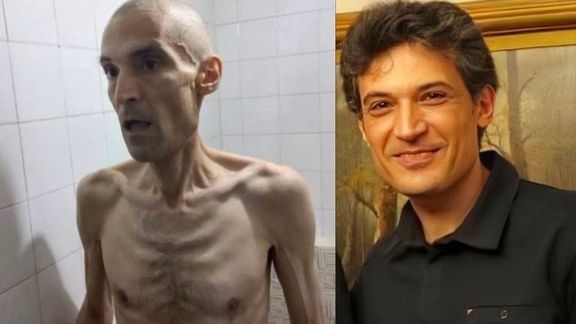
Iranian political prisoner Farhad Meysami

Social media has exploded with concerns about long-time Iranian political prisoner and physician Farhad Meysami, emaciated over long and repeated hunger strikes. 

Many Iranian dissident figures and foreign officials have expressed outrage and concern over his deteriorating health condition. A photo of Meysami along with a letter from Rajaei-Shahr prison in Karaj were published on social media Thursday, showing him in a horrible state after losing weight. 

According to his lawyer, the 53-year-old prisoner of conscience, who has been in jail since 2018 for supporting women activists protesting against the mandatory Islamic dress code – or hijab -- began his hunger strike on October 7 to protest recent government killings of demonstrators. 

"My client Farhad Meysami’s life is in danger,” tweeted lawyer Mohammad Moghimi. "He went on hunger strike to protest the recent government killings in the streets," he said, adding that Meysami had lost 52 kg (115 lb). Images of Meysami show him curled up on what looks like a hospital bed, and another standing, his ribs protruding.

In reaction to the photos, Washington's special envoy for Iran Robert Malley tweeted, "Shocking images of Dr. Farhad Meysami, a brave advocate for women's rights who has been on hunger strike in prison.” "Iran's regime has unjustly denied him and thousands of other political prisoners their rights and their freedom. Now it unjustly threatens his life."

German politician Hannah Neumann, who is serving as a Member of the European Parliament, said, “We have to throw a lifeline to people such as Farhad Meysami, not to the IRGC terrorists or the current regime,” referring to the European Union’s decision not to greenlight a recent resolution by the parliament that has called for the designation of the Revolutionary Guard as a terror outfit. 

Canada-based activist Hamed Esmaeilion who has so far organized several rounds of worldwide protest rallies against the Islamic Republic, said that Meysami and many others do not belong in prison. He added that the regime is responsible for his life. 

Esmaeilion’s wife and daughter were killed in 2020 when Iran’s Revolutionary Guard fired two missiles at a Ukrainian jetliner taking off from Tehran and all 176 people onboard died in the crash.

Women’s rights activists Masih Alinejad highlighted, “To those who think Iran’s uprising is over and Iranians have given up, behold the enormous courage of political prisoner Farhad Meysami. He’s been on a four-month hunger strike against the execution of political prisoners and forced hejab (hijab). Iranians knows that history is one our side.”

Sportsman-cum-civil rights activist Ali Karimi said, "Maysami 's photos are shocking. Images similar to the Nazis' Auschwitz crimes. This is the death camp of the Islamic Republic. Mullah’s regime is a shame for humanity."

Exiled prince Reza Pahlavi also reacted to the photos, saying “The emaciated body of Farhad Meysami is another symbol of the boundless cruelty of the Islamic regime.

He should stay alive and enjoy a free Iran in the future with his skin and flesh; an Iran where no one is imprisoned or forced to go on a hunger strike because of their beliefs and opinions, Pahlavi wrote in a tweet. “I believe that these days, which are more bitter than poison will pass,” he added, alluding to Meysami’s letter. 

In his letter from prison, Maysami announced that he plans to make the water he drinks bitter for the next 10 days as a symbolic move against "these times that are more bitter than poison" that the Iranian government has created for "everyone in all aspects". 

The political activist also wrote that “I will still insist on my three demands of stopping the execution of protesters, releasing six political-civil prisoners, and stopping forced-hijab harassment.” "I will continue my impossible mission in the hope that it may become possible later on with a collective effort,” he wrote. The title of the political activist's letter is "For the days of suffering and suffering and suffering".

Ahmadreza Djalali before his arrest and in prison
100%
Ahmadreza Djalali before his arrest and in prison

Meysami also went on a hunger strike in May in protest to the possible execution of Ahmadreza Jalali (Djalali), a Swedish-Iranian dual national scientist taken hostage since 2016 who was under the threat of execution last year.

Iran has been rocked by nationwide unrest following the death of Iranian Kurdish woman Mahsa Amini on September 16 in hijab police custody, posing one of the strongest challenges to the Islamic Republic since the 1979 revolution. Women have played a prominent role in the uprising, many of them waving or burning their headscarves. Rights groups say more than 500 protesters have been killed and nearly 20,000 arrested. At least four people have been hanged, according to the Iranian judiciary.


Most Viewed

Ideology may be fading in Iran, but not in Kashmir's ‘Mini Iran'
1
INSIGHT

Ideology may be fading in Iran, but not in Kashmir's ‘Mini Iran'

2
INSIGHT

Hardliners push Hormuz ‘red line’ as US blockade tests Iran’s leverage

3
VOICES FROM IRAN

Hope and anger in Iran as fragile ceasefire persists

4

Iran International says it won’t be silenced after London arson attack

5

US sanctions oil network tied to Iranian tycoon Shamkhani

Banner
Banner

Spotlight

  • Hardliners push Hormuz ‘red line’ as US blockade tests Iran’s leverage
    INSIGHT

    Hardliners push Hormuz ‘red line’ as US blockade tests Iran’s leverage

  • Ideology may be fading in Iran, but not in Kashmir's ‘Mini Iran'
    INSIGHT

    Ideology may be fading in Iran, but not in Kashmir's ‘Mini Iran'

  • War damage amounts to $3,000 per Iranian, with blockade set to add to losses
    INSIGHT

    War damage amounts to $3,000 per Iranian, with blockade set to add to losses

  • Why the $100 billion Hormuz toll revenue is a myth
    ANALYSIS

    Why the $100 billion Hormuz toll revenue is a myth

  • US blockade targets Iran oil boom amid regional disruption
    ANALYSIS

    US blockade targets Iran oil boom amid regional disruption

  • Iran's digital economy battered by prolonged blackout
    INSIGHT

    Iran's digital economy battered by prolonged blackout

•
•
•

More Stories

Iran's Sunni Leader Says Secular People Should Be In Government

Feb 3, 2023, 14:06 GMT+0

Outspoken Sunni religious leader Mowlavi Abdolhamid says the Iranian government’s mistreatment of political prisoners and forced confessions are un-Islamic. 

During his Friday prayer sermon, the country’s most influential Sunni cleric criticized the “violent treatment” of prisoners by the regime, emphasizing that prisoners should be respected and beating them, insulting them, or putting pressure on them is 'haram,' an Arabic term meaning 'forbidden' in Islamic law or sharia. 

"Forced confessions are a violation of the prisoner's right," he said, adding that prisoners should not feel that their interrogators are trying to "attack" them or should not feel that they are stuck in the hands of their "enemies."

Abdolhamid also said officials of the country should be selected from among secular people too, noting that not all Iranian people are "religious", and some do not accept religion. “Don't blame me for this view. Some may not accept religion, but the right policy is that if they have merit and conscience, they should be employed," he added.

He also denounced executions of prisoners in the country, including the hangings over drug-related crimes, saying, "I believe that these executions are not beneficial for the society because drugs are still available as ordinary people do not smuggle them into the country.”

Amid nationwide protests in December, the Islamic Republic hanged four young men arrested during the unrest on spurious charges.

A top advisor to Abdolhamid was arrested earlier in the week, leading to more tensions in Zahedan, capital of Iran's southeastern Sistan-Baluchestan.

European Directors Demand Their Films Be Removed From Iranian Film Festival

Feb 3, 2023, 10:28 GMT+0

Belgian directors Jean-Pierre and Luc Dardenne have urged the Islamic Republic to remove their latest feature film "Tori and Lokita" from the poster of the Fajr International Film Festival in Tehran.

“We have just learned that our film Tori and Lokita was included in the selection of the Fajr Festival in Tehran. We demand that our film be withdrawn from the program of this festival which is the showcase of a dictatorial and murderous religious regime that we condemn. We stand in solidarity with those who are fighting against this regime and salute their courage,” said the brother in a post on Instagram.

In their statement Dardenne brothers added they were not aware of the screening of their new film at the Fajr festival in Iran, and they do not know how the Iranian regime got access to this film.

At the same time, the famous Romanian director Cristian Mungiu said he was not aware about the screening of his latest film at Fajr festival. Mungiu said he asked the film distributor to remove his film from Fajr festival immediately.

The move by prominent foreign directors comes at a time when many Iranian artists have also boycotted the festival for the brutality the regime showed in dealing with protests after the death of Mahsa Amini in police custody.


Ultra-Hardliners Push For More Restrictions In Iran

Feb 3, 2023, 06:58 GMT+0
•
Maryam Sinaiee

Emboldened by less street protests in January, Iran's ultra-hardliners have been pushing for further restrictions on social freedoms and freedom of expression.

Commenting on the issue of hijab, lawmaker Hossein-Ali Haji-Deligani said in an interview with Entekhab news website recently that he believes the country should have an entity dedicated to “promotion of virtue and prevention of vice” as a completely independent organization to enforce hijab. “Our society and religion do not accept today’s kind of [lenient] hijab,” he said.

Haji-Deligani who is also a member of the parliament’s presidium had said a day earlier that lawmakers, including him, had submitted a new motion to prevent celebrities and those with political, social, military or cultural influence, from “making irrelevant and inexpert statements” on the country’s affairs.

“Unrestricted expression of views is not permissible,” he said when announcing the motion’s submission.

If parliament passes the proposed law, any person of influence could be charged with ‘corruption on earth’ for making “untrue” remarks on matters requiring official clarification provided that their statements cause “serious disruption of public order, insecurity, or major physical damage to individuals, public or private property, or promote moral corruption.

‘Corruption on earth’ is punishable by death in Iran's Sharia-based laws.

The law not only will silence even insiders from criticizing a shortcoming but will eliminate whatever limited criticism appears in media. Journalists will be the top targets of such a law. Already dozens are under arrest or have face political charges.

“This means, in simple terms, that no one is allowed express any beliefs, view or even analysis [over a subject] before authorities make an official statement,” Fararu website wrote about the controversial motion. “Expressing views [over a matter] is criminal if there are rumors going around town about it, even if the rumors are true but different from the official account.”

“The problem is that lawmakers and some decisionmakers think that the events of the past few months resulted from expression of views in social media and the media. They don’t have a proper, logical and clear view of the causes of protests and think they can prevent them from happening again if they shut the mouths of critics and experts,” Nemat Ahmadi, a prominent lawyer and commentator based in Iran, told Fararu.

“As a matter of fact, I believe that this motion is not meant to prevent rumors and lies. If it turns into law, it should be called ‘The Shutting of Mouths Act’,” he added.

Haji-Deligani is a member of the parliament’s totalitarian Paydari faction which consists of members of the small but very influential Islamic Revolution Endurance Front. The party represents the most extreme right end of the conservative-hardliner spectrum collectively known as Principlists.

Supreme Leader Ali Khamenei has on many occasions eulogized the group’s mentor, Ayatollah Mohammad-Taghi Mesbah-Yazdi, who passed away two years ago.

Mesbah-Yazdi famously once said Khamenei’s rule was superior to that of the Islamic Revolution’s founder Ayatollah Ruhollah Khomeini. He also preached that Khamenei is the representative of the twelfth Shiite Imam Mahdi whose reappearance from occultation will set the day of final judgment in motion.

The faction gained dozens of seats in the current parliament in the 2020 elections with the help of the Khamenei-appointed Guardian Council which disqualified not only reformists but many of Paydari candidate’s conservative rivals.

Hossein-Ali Haji-Deligani, a member of the parliament’s totalitarian Paydari faction (file photo)
100%
Hossein-Ali Haji-Deligani, a member of the parliament’s totalitarian Paydari faction

Conservative politician Mansour Haghighatpour, a former Principlist lawmaker, also criticized Paydari’s new attempt to restrict freedom of expression. “The problem is that after the last election a radical, extremist group has taken control of the parliament that does not want to hear [other] voices, views, or criticism. I mean the same group that is controlling the administration,” Haghighatpour told Fararu.

He added that this extremist group is responsible for “the majority of costs” that the Islamic Republic is now paying domestically and at the international level.

Hossein Kanaani-Moghadam, another former lawmaker and secretary general of the Principlist Green Party, also criticized Haji-Deligani’s recent remarks. “I believe such attempts would not have any outcome other than more corruption, anger, and dissatisfaction in the country.”

An Anti-Hijab Prisoner In Iran Seriously Ill After Hunger Strike

Feb 2, 2023, 22:15 GMT+0
•
Iran International Newsroom

The health of long-time Iranian political prisoner, Farhad Meysami, who has lost a lot of weight due to his hunger strike, has deteriorated.

A photo of Meysami along with a letter from Rajaei-Shahr prison in Karaj were published on social media Thursday, showing him in a horrible condition after losing weight.

However, the political activist wrote in the letter to prison officials that “I will still insist on my three demands of stopping the execution of protesters, releasing six political prisoners, and stopping mandatory hijab.”

The title of political activist's letter is "For the days of suffering and suffering and suffering".

Farhad Meysami, who has been behind bars since August 2018 was arrested and sentenced to six years in jail for his activism against mandatory hijab.

Last month, in a message from Rajaei-shahr prison, he demanded the immediate release of several civil and political activists.

Meysami also went on a hunger strike in May in protest to the possible execution of Ahmadreza Jalali, a Swedish-Iranian dual national scientist taken hostage since 2016 was under the threat of execution last year.

Farhad Meysami before his arrest in 2018
100%
Farhad Meysami before his arrest in 2018

Meysami later announced that he has ended his two-week hunger strike as Ahmadreza Jalali was not executed. Before the end of that hunger strike, his physical condition was so critical that he was transferred to hospital.

Meysami, a doctor and teacher, said in a message last year that he had met Djalali at Tehran's Evin prison over three years earlier. "He had been on hunger strike in protest to repeated threats of his execution and the effects of which on his body and soul were clearly visible," he wrote.

"Imagine subjecting a human being to this repeatedly. Not once, not twice… Is there any torture worse than this?" Meysami said about repeated threats of execution made against Djalali.

"I don't want to just oppose Dr Djalali's execution, I want to draw attention to something much more important, to draw attention to the fact that they send a man to his death many times and bring him back," he wrote. "Regular and intentional torture like this is definitely crime against humanity."

Meanwhile, famous Iranian filmmaker Jafar Panahi has also gone on a hunger strike to protest his detention in Tehran while his sentence has been declared void by the country’s Supreme Court.

“I firmly declare that in protest against the illegal and inhumane behavior of the judicial and security apparatus and their hostage-taking, I have started a hunger strike since the morning of February 1… I will refuse to eat and drink any food and take medicine until the time of my release,” read a statement he sent to his wife.

Iran has been the scene of nationwide protests against the clerical regime after the death in custody of Mahsa Amini in mid-September.

Authorities have not released any information on the number of detainees, those injured and killed in the protests that began nearly three weeks ago following the death in custody of Mahsa Amini who was arrested for not wearing her hijab “properly”.

Human rights organizations says that nearly 520 protesters, including children, have been killed by security forces during the protests.

Prominent Intl. Figures Urge Unstinting, Practical Support For Iran Protests

Feb 2, 2023, 16:02 GMT+0
•
Iran International Newsroom

Hundreds of well-known international figures, from Nobel prize winners to movie actors, have called for support for Iranian protesters against bloody suppression.

In a petition organized by the non-profit Washington-based organization Freedom House, the signatories said that “the triumph of freedom in Iran could renew the global tide of democratization that was so strong in the latter twentieth century but has ebbed in the face of authoritarian counterattack.” “The end of the Islamic Republic’s system of misogyny would constitute a global landmark in the long march toward a world in which women are treated equally.”

The signatories include Nobel prize laureates, heads of states or government officials, members of parliaments, international organizations, as well as numerous public figures from around the world. Former UN Secretary General Ban Ki-moon; former prime ministers of Canada Stephen J. Harper, Kim Campbell and Charles Joseph Clark; and former US Secretary of State Hillary Rodham Clinton are a few of the prominent figures. 

Women’s rights activists Masih Alinejad, Nazanin Boniadi, Shirin Ebadi, Azar Nafisi, Roya and Ladan Boroumand from the Boroumand Center for Human Rights in Iran, sportsman-cum- civil rights activist Ali Karimi, and Khalid Aziz from Democratic Party of Iranian Kurdistan as well as exiled prince Reza Pahlavi are some of the Iranian signatories of the petition. 

They appreciated the Iranians who have taken to the streets in rebellion, noting that “the vanguard are young women, but they have been joined by men and people of all ages. With breathtaking courage and unarmed, they have kept coming, even as the regime has shot, hanged, tortured, blinded, raped, beaten, and arrested many thousands.”

Emphasizing that the Iranian people “deserve unstinting support from freedom-loving people around the world,” they called on governments, civic associations, and individuals to speak loudly and more often in support of the protestors and in condemnation of the regime’s repressive actions. 

They also urged legislators to “adopt” individual arrestees, especially those facing execution, and spotlight their plight, and called on governments to “take diplomatic, economic, and symbolic measures to punish the regime and bolster the protestors.”

“All officials involved in the repression, from Supreme Leader Khamenei down to local Basij commanders, should be sanctioned," read their statement, stressing the necessity for the Revolutionary Guard (IRGC) to be added to terrorism lists. 

They also asked high level officials of democratic governments to receive leaders of the opposition, in publicly-announced meetings, highlighting that accurate, reliable, fact-based reporting via international radio, television, and social media reaching Iran should be enhanced, as should assistance to private Iranian exile broadcasting. 

Calling for more tangible measures, they said, “Technical assistance, including equipment, should be given to help the demonstrators counteract censorship and surveillance and to communicate despite the regime’s disruption of Internet service and blocking of websites.”

“Labor unions, governments, and others in the international community should express solidarity with Iranian workers, should share the experiences of other labor struggles for worker rights and democracy, and should also seek ways to provide practical assistance, such as VPNs, other means of communication, and contributions to strike funds if safe and effective channels can be found,” they urged. 

Pledging to do all in their power to support the Iranian struggle for freedom, they called upon all people of good will everywhere to join them. 

Referring to over four months of protests, they said, “The spark was mandatory hijab, but the target of the uprising is the whole theocratic system. Their slogan is Woman, Life, Freedom. The goal they chant is 'Azadi, Azadi, A-za-di,' meaning 'Freedom, Freedom, Freedom.’ Their victory would mean deliverance from a regime that denies free elections, free speech, due process of law, and personal autonomy in matters as simple as the choice of clothing.

International expressions of support for the uprising in Iran is growing as the West has stepped up pressure on the Islamic Republic over its crackdown on protests and arms supply for the Russian invasion of Ukraine as the US, European Union and United Kingdom imposed fresh sanctions on Tehran with more sanctions and condemnations being discussed regularly in the international arena. One of the main points of contention is the terrorist designating of the IRGC, which is in control of most of the governing bodies of the regime, is mainly in charge of the crackdown on dissent, and manages the Islamic Republic’s proxy warfare across the region and hostage diplomacy at home.

The crackdown has become especially tense in Kurdish and Baluch majority regions as the regime has arrested at least 182 Kurds and 185 Balochis in January alone.