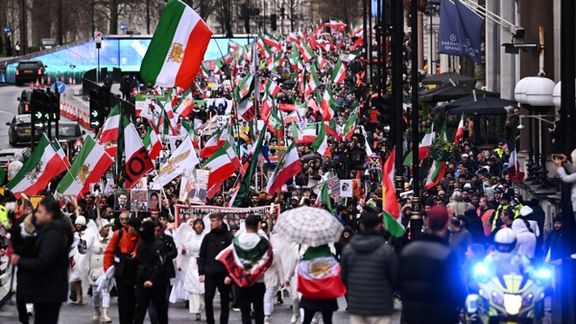
A large Iranian rally in London to demand the listing of IRGC as a terrorist group. January 8, 2023
A leading activist has urged Iranians to unite and put aside disputes over an “unreal” fear of dictatorship or Iran's dismemberment after the fall of the regime.
“Let’s not fear having a dictatorship in the future. Let’s not fear Iran's dismemberment. These fears are not real … Let’s agree on [our] minimum demands and dig the grave of this rotten corpse,” the Canada-based Hamed Esmaeilion wrote in an Instagram post Sunday.
He wrote the comment on the anniversary of Ayatollah Ruhollah Khomeini’s return from exile to Tehran in 1979 and the establishment of the Islamic Republic. The post has been liked by nearly 200,000 so far.
In his long commentary, Esmaeilion urged Iranians both inside the country and abroad to unite, whether republicans or monarchists, belonging to minority religious or ethnic groups, on the right of the political spectrum or on the left.
“Many of the mistakes of the past will not be repeated if we leave political disputes to after the toppling of the descendants of the demon [Khomeini],” he wrote adding that unreasonable arguments would only delay the waves of protests in Iran where people no longer fear fighting the regime.
Hamed Esmaeilion, Iranian activist and a leading opposition figure
Like the exiled prince Reza Pahlavi, activists Masih Alinejad, Nazanin Boniadi, and footballer Ali Karimi, many on social media have expressed support for Esmaeilion’s membership in an opposition council to be formed for transition from the Islamic Republic.
Last week, Prince Reza Pahlavi also urged pro-democracy forces to unite. “I’m extending my hand, once again, for cooperation to all pro-democracy forces, including individuals, parties and groups, to support the Iranian national revolution,” he said in a statement published via his social media accounts.
The exiled prince’s plea came soon after his supporters launched a campaign to endorse him as the trustee of the Iranian people in transition to secular rule. Over 433,000 have so far signed the petition launched in mid-January.
Exiled Prince Reza Pahlavi and former crown prince
Esmaeilion and others have recently been under heavy fire on social media for not having joined the campaign to give power of attorney to the exiled prince. Critics of the campaign say it has played a divisive role, caused rifts among the opposition, and led to the cooling of the revolutionary fervor on the streets in Iran.
In his recent statement, the exiled prince set three preconditions for cooperation with others: Accepting to ensure Iran's territorial integrity and the people’s right to determine the form of the future political system through a free vote as well as belief in human rights-based secular democracy.
Some Kurdish, Baluch, Turkic speaking groups and individuals, and those supporting federalism, argue that the mention of territorial integrity is divisive and is a sign federalism will not be tolerated. Others, particularly supporters of the exiled prince say demanding federalism is only a cover for separatism and dismemberment of Iran.
In the past four months, protesters across the country, particularly in Kurdish and Baluchi cities, have often chanted slogans such as “From Baluchestan (or Kordestan) to Tehran, we sacrifice our lives for Iran” to repudiate claims of separatism and stress the unity of all Iranians against the regime.
Hundreds of thousands of Iranians welcomed a New Year message tweeted by Prince Reza Pahlavi, Alinejad, Karimi, Boniadi, and Esmaeilion as well as actress Golshifteh Farahani on December 31 in which these opposition figures had wished that further solidarity and organizing could make 2023 the last year of the clerical rule in Iran.
Many believed that the tweet heralded the formation of a revolutionary council in exile that could take on the role of leading the Iranian revolution in the absence of strong revolutionary political parties and leaders in the country.
Iran’s hardliner Kayhan newspaper has proposed to form a national ‘soft war’ headquarters to deal with what it called the "hybrid war of the enemy".
According to Kayhan's proposal, the headquarters shall consist of 19 representatives from key ministries and organizations including the intelligence ministry, the Supreme National Security Council as well as the state TV.
The daily run by the hardliner editor Hossein Shariatmadari, who is Supreme Leader Ali Khamenei’s representative at the newspaper, has also suggested that mosques and Basij militia bases be used as the coordination centers for “regional and national action and counteraction against the enemy's soft war.”
In November, Khamenei called the ongoing anti-regime uprising following the death of Mahsa Amini a "hybrid war" led by the “enemies”.
“Enemies” in his view include the United States, Israel, Europeans, regional countries and any Iranian who is not loyal to him.
Following Khamenei’s lead, Iranian officials began to allege that the nationwide protests were instigated by foreign enemies mostly through social media.
Ali Fadavi, the second highest commander in the Revolutionary Guard, also said in October that the country’s ‘enemies’ who used to focus on ‘hard war’ against the Islamic Republic for decades have now adopted a hybrid approach, combined with soft power.
Mohammad Mokhber with President Ebrahim Raisi in August 2021
Iranian media and economic experts are characterizing a privatization plan the officials keep secret as "a plunder of public property" and "economic apartheid."
According to reports, the new privatization plan approved by the heads of the three powers of the government, President Ebrahim Raisi, Majles Speaker Mohammad Bagher Ghalibaf and Judiciary Chief Gholamhossein Mohseni Ejei bars critics of disclosing details of transactions and suspends for two years all legislations that might prevent these transactions.
The government's plan is to make 1,080 trillion rials out of selling public assets presumably to well-connected regime insiders. In current exchange rates the sum is close to $2.7 billion.
Iran's Supreme Leader Ali Khamenei has approved the sales and wants them to be done as soon as possible. The transactions are going to take place under the supervision of Vice President Mohammad Mokhber, Economy Minister Ehsan Khandouzi, Interior Minister Ahmad Vahidi, Roads Minister Mehrdad Bazrpash, Planning and Budget Chief Massoud Mirkazemi, and a representative appointed by the Majles Speaker and Judiciary Chief each.
Mokhber is an influential operator who has held positions in business interests controlled by Khamenei's office. When he was appointed Raisi's top aide in 2021, political analysts saw the move as Khamenei placing his trusted man in control of the new president's office.
Committee members have already received immunity from any prosecution resulting from privatization transactions. Critics say that the secrecy and the immunity will give way to financial corruption. The ratification leaves no room for transparency and accountability.
President Riaisi, the speaker of parliament, the head of the judiciary and Mokhber (L) in a meeting on January 1, 2023
Iranian lawmaker Ahmad Alirezabeigi has said that some members of the parliament have questioned the legitimacy of the action in a letter to Ghalibaf as one of the three officials who have suggested the sale of government properties. Nonetheless, Ghalibaf has not responded to the question yet, Alirezabeigi said.
Referring to the potential financial corruption involved as a result of secrecy, he warned that "This is auctioning public property and reminiscent of what happened in previous privatization measures."
In an interview with Khabar Online website, Pazouki said that it should be made clear where the resulting money is ging to be spent." Pazouki who is a professor of Economics at the Allameh Tabatabai University also said: "Transparent reports about the sales should be put at the nation's disposal." He said privatization is a very good thing, but it is important how it will be done. Pazouki added that the government should spend the resulting money on development plans.
Referring to the fact that during previous privatization projects government assets have been distributed among well-connected individuals, Pazouki said that properties should be sold by tender where everyone can bid to buy them. He added that the Ministry of Defense, the Planning and Budget Organization and local government offices have a large portfolio of real estate in Tehran and other cities which need to be sold within the frameworks of this project.
The Iranian regime continues to issue harsh sentences, including whipping and long-term imprisonment against journalists, students, teachers, lawyers, and other protesters.
Nazila Maroufian, a journalist, was sentenced to two years in prison, fined 15 million tomans (almost 350 USD) and banned from leaving the country for five years on the charge of "propaganda and publishing lies through an interview with Mahsa Amini's father".
Mahsa Amini, a 22-year-old Kurdish woman was killed in police custody for not having proper hijab in mid-September and her death led to weeks of nationwide protests against the Islamic Republic.
Another journalist, Vida Rabbani was sentenced to 11 years behind bars. Her mother wrote a letter to the chief justice saying that “Vida, now at the age of 33 has to spend 11 years of her young age behind bars arbitrarily upon verdicts issued based on bias.”
On the other hand, US-based Human Rights Activists News Agency (HRANA) reported that Zahra Mehrabi, a student of Tehran University and one of the detainees from nationwide protests, has been sentenced to five years of suspended imprisonment by a revolutionary court.
Amnesty International has also warned that Arshiya Takdastan, an 18-year-old protester who was arrested during the protests north of Iran, has been sentenced to a double death sentence on charges of "war against God" and "corruption on earth".
Amnesty also drew attention to the case of Mehdi Mohammadifar, a 19-year-old protester who has also received a double death sentence.
President Ebrahim Raisi visiting an idle textile factory in 2022
Iranian experts and media are criticizing claims by President Ebrahim Raisi that the government has created nearly one million new jobs in the past year.
Presenting the budget bill to the parliament last week, Raisi claimedthere is proof that his administration has succeeded in creating over 900,000 new jobs as he had promised during his campaign.
“This claim is so strange and far from reality that I prefer not to talk about,” Kamal Athari, development researcher and economist told Bahar News Tuesday, adding that such claims are easy to make in the absence of reliable data. “How is it possible for employment to increase when the rate of economic growth has been declining?” he asked.
He also said it is noteworthy that during Raisi’s presidency even the jobs created before the pandemic and when the nuclear deal with world powers, JCPOA, was in effect were lost and inflation and people’s loss of income is threatening others such as the hospitality sector.
Athari also criticized the government for lack of coordination and an overall disorientation. “They have no plans for dealing with inflationary stagnation in the housing sector but they name housing as the engine of growth,” he said.
The claim was repeated by the Minister of Labor Seyed Sowlat Mortazavi Tuesday. “The government has succeeded in creating one million job in one year as it had promised,” he said.
Khorasan newspaper, which supports the Raisi Administration and is linked to the office of Supreme Leader Ali Khamenei, criticized Mortazavi and said the claim was in contradiction with the figures released by the Statistics Center of Iran (SCI) which shows from September 2021 to September 2022 the number of people with employment only rose by 535,000. This meant, Khorasan pointed out, that 465,000 jobs were lost even if one million jobs were created as the government claims.
Figures released by the SCI indicate that over 665,000 new job seekers of fifteen-years-old and above have entered the job market during the same period.
Speaking to Nameh News website Wednesday, Mohammad Mohajeri, a conservative journalist, warned that officials provide “fake statistics” to the president. Their eagerness to create an illusion of “achievements” would have dire consequences for the government, he maintained.
“I don’t know how long this unhelpful attitude of officials has to continue for the government to realize that faking achievements and statistics will cause the downfall of the government,” Mohajeri said, adding that there is also a concern that there may be brave experts in the government whose warnings are being ignored. “This is even a bigger calamity.”
Many on both sides of Iran's political spectrum have criticized Raisi and his government for inefficiency and lack of planning while blaming all shortcomings on previous governments including Raisi’s immediate predecessor Hassan Rouhani.
Rising Inflation and depreciation of the national currency, rial, which have been problems since 2018 when President Donald Trump left the 2015 nuclear deal are now turning into serious crises the government seems unable to address.
The point-to-point inflation rate reported by the Statistical Center of Iran (SCI) for the past Iranian month, which ended on January 20, has surpassed 50 percent, with food inflation hitting an average of over 70 percent.
In its latest report the SCI put overall inflation at 51 percent, taking into account 12 groups of goods and services. The highest jump was reported in the hotel and restaurant sector with 78.5 percent, followed by food.
Senator Bob Menendez making a statement on the Senate floor on Iran's nuclear program. February 1, 2022
Members of the US Congress are ramping up efforts to pass new legislation in support of Iranian protesters and sanctions on top officials for rights violations.
A bipartisan group of Senate Foreign Relations Committee members and others numbering at least 28 Senators are re-introducing legislation in support of protests in Iran.
In a statement issued January 26, US Senators Bob Menendez (D-NJ), Chairman of the Senate Foreign Relations Committee, Marsha Blackburn (R-Tenn.), Chris Coons (D-Del.), Jim Risch (R-Idaho), Ranking Member of the Senate Foreign Relations Committee, and James Lankford (R-Okla.) announced that the resolution will call on the international community “to continue publicly highlight and condemn the Iranian regime’s crackdown since protests began…”
The resolution also urges the Biden administration “to strengthen international efforts to impose additional sanctions on officials and entities responsible for the violent suppression of demonstrations.”
In more than four months of popular protests, Iranian security forces have killed around 500 people, wounded hundreds and arrested up to 20,000 others. The government also executed four detained protesters in December and many more either face the death penalty or charges that could end in death sentences.
On the same day that Senators issued their statementthe House of Representatives overwhelmingly approved a resolutionexpressing solidarity with Iranian protesters.
The 420-1 rare bipartisan vote marked the latest round of international condemnations against Iran’s government, which has deepened its isolation.
“It is vital that we in the US House of Representatives, a body that is among the greatest symbols of freedom and democracy around the world, stand with one voice to affirm our support for the brave Iranian people,” Rep. Claudia Tenney, R-NY, said during floor debate Wednesday.
The Washington Beacon also reported Friday that according to its sources House Republicans and Democrats are joining forces to sanction Iran’s Supreme Leader Ali Khamenei, who is the commander in chief of the armed forces, and other top regime officials for human rights crimes.
The legislation is dubbed the Mahsa Amini Act after the 22-year-old woman who was fatally wounded in hijab police custody in September and died in hospital. Her death triggered the anti-regime uprising by young people and women.
The Biden administration has imposed a series of sanctions on regime officials and entities since September, but sanctioning Khamenei directly for gross human rights violations will be a strong gesture for the international community and most Iranian who see him as the ultimate decider in the country.
It will also make more negotiation to revive the 2015 nuclear deal (JCPOA) more difficult, as Tehran will likely demand these sanctions to be removed before it agrees to curb its nuclear program.
Indirect talks that the Biden administration initiated in April 2021 have failed to revive the Obama-era agreement and some experts believe a new deal must be negotiated.
Republicans oppose resuming any negotiations with the Islamic Republic amid its killing of protesters and provocative moves, including supplying kamikaze drones to Russia for its war in Ukraine.
The Mahsa Amini Act was introduced in the previous Congress, but Democrats did not support the measure. Now, with Republicans in majority, the Washington Beacon says, “Democratic foreign policy leaders are lending their support to the bill.”