• العربية
  • فارسی
Brand
  • Iran Insight
  • Politics
  • Economy
  • Analysis
  • Special Report
  • Opinion
  • Podcast
  • Iran Insight
  • Politics
  • Economy
  • Analysis
  • Special Report
  • Opinion
  • Podcast
  • Theme
  • Language
    • العربية
    • فارسی
  • Iran Insight
  • Politics
  • Economy
  • Analysis
  • Special Report
  • Opinion
  • Podcast
All rights reserved for Volant Media UK Limited
volant media logo

Former Iran Spokesman Says Only Ballot Box Can Save The Country
Iran International Newsroom
Jan 25, 2023, 11:51 GMT+0Updated: 17:37 GMT+1
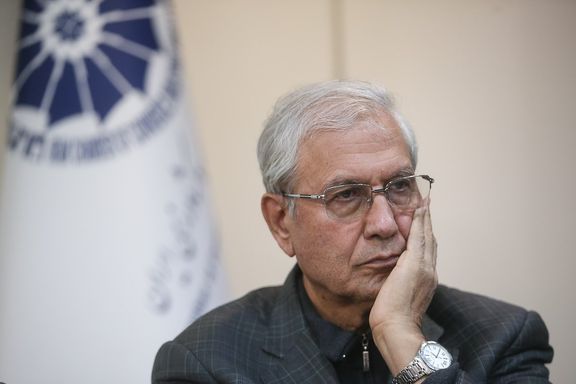
Former Iranian government spokesperson Ali Rabiei. January 24, 2023

Four months after the start of nationwide protests in Iran, politicians and academics have begun probing into the consequences and implications of the movement.

Speaking at a seminar about the protests and their socio-economic and political implications, Former Government Spokesman Ali Rabiei opined that the Iranian government can still prevent an upcoming crises by correcting its policies and reform its domestic politics.

Rabiei, who served under former President Hassan Rouhani, said that recent developments showed that what can save the country from further trouble is the ballot box. He added: "Ballot boxes can turn the outcry in the streets into systematic behavior.

Hardliners in Iran have controlled latest parliamentary and presidential elections tightly, disqualifying so-called reformist from running and establishing full control over the government. Those who were prevented from a share of power, including many from Rouhani administration, blame the current political and economic crisis on this monopoly of power by hardliners.

Rabiei added that reforms also need to be made in the economic, cultural and media policies, stressing that cultural values in Iran should be made consistent with the modern thinking of the young generation.

"Those involved in business have very well realized that the most important impact of recent protests is lack of confidence in the economy and lack of predictability of economic trends. Lack of investment in recent years is an outcome of insecurity. Now it is not only academic and scientific elites that leave the country for good; investors and entrepreneurs are also emigrating," Rabiei said.

Participants at the seminar on protests. January 24, 2023
100%
Participants at the seminar on protests. January 24, 2023

He pointed out that unlike what Iranian hardliners say, sanctions have left a badly hurt the economy and the poor working class in Iran. At the same time, if Iran does not send signals of reform to the outside world, further sanctions will be on their way to exert more pressure on the economy. He urged officials to avoid further tensions in Iran’s foreign policy by refraining from provocative and outlandish analyses."

Meanwhile, prominent sociologist Mohammad Fazeli said at the conference sponsored by Donya-ye Eqtesad daily that "Both sides in the Iranian protests need to make concessions. But this needs to start with the government, although both sides should come forward step by step."

Economist and former Central bank Governor Hossein Abdoh Tabrizi said: "By looking at the protests, one might think initially that they are not predominantly rooted in the economy. Nonetheless, there are massive economic grievances such as the problems of recession, inflation, unemployment, financial corruption, and lack of investment lingering for a long time. Undoubtedly, a majority of the people are concerned about these problems."

He said: "Iranian officials have never looked at economics as a science. So, everyone including officials tend to express opinions without having any expertise.

Meanwhile, Iranian journalist and political analyst Ahmad Zeidabadi, said that during the protests "If the government's instinct for survival gives way to changes, and protesters show some flexibility, then everything will look better. Previous government supporters have now turned into militant elements while former militants have become more violent. This is not in anyone's interest."

Zeidabadi is one of a few people who is not a hardliner but allowed to regularly express opinions in newspapers as long as he does not question Supreme Leader Ali Khamenei and the essence of the regime.

He then expressed concern about a revolution, echoing the regime’s alarmist propaganda to dissuade the people from pursuing a regime change. "My preference is not to choose confrontation and regime change as there is no chance for our victory in the short-run. If the situation becomes too unstable, then there will be a collapse. Then, the masses might follow a Fascist individual and totalitarianism might prevail. The only chance for the government is to show signs of change. We have only these two approaches ahead of us."


Most Viewed

State media slam Araghchi's Hormuz tweet, say it let Trump claim victory
1

State media slam Araghchi's Hormuz tweet, say it let Trump claim victory

2
OPINION

The Hormuz get out of jail card turned to a grave

3

Iran International says it won’t be silenced after London arson attack

4
INSIGHT

How Tehran bends its own red lines to boost state rallies

5

Iran halts petrochemical exports to supply domestic market

Banner
Banner

Spotlight

  • Too early to tell who is winning Iran war, experts say
    PODCAST

    Too early to tell who is winning Iran war, experts say

  • How Tehran bends its own red lines to boost state rallies
    INSIGHT

    How Tehran bends its own red lines to boost state rallies

  • Iran blackout cripples freelancer, small business incomes
    VOICES FROM IRAN

    Iran blackout cripples freelancer, small business incomes

  • Ideology may be fading in Iran, but not in Kashmir's ‘Mini Iran'
    INSIGHT

    Ideology may be fading in Iran, but not in Kashmir's ‘Mini Iran'

  • US blockade enters murky phase as tankers spoof signals and buyers hesitate
    ANALYSIS

    US blockade enters murky phase as tankers spoof signals and buyers hesitate

  • Why the $100 billion Hormuz toll revenue is a myth
    ANALYSIS

    Why the $100 billion Hormuz toll revenue is a myth

•
•
•

More Stories

Ex-Hostages Call On World To Stand Up Against Islamic Republic

Jan 25, 2023, 09:54 GMT+0

Several former foreigners and dual citizens held hostage in Iran as well as their families have launched an online campaign to demand release of Iranian political prisoners. 

Several former foreigners and dual citizens held hostage in Iran as well as their families have launched an online campaign to demand release of Iranian political prisoners. 

British-Iranian businessman Anoosheh Ashoori and his daughter Elika, Kylie Moore-Gilbert, an Australian academic previously jailed in Iran for over two years, Ghazal Sharmand, the daughter of German-Iranian journalist and software engineer Jamshid Sharmahd – facing execution in Iran, and the daughter of Nahid Taghavi, another German-Iranian rights activist sentenced to 10 years in Iran since October 2020 are among the most prominent figures in the campaign. 

Sharmand’s daughter said the campaign is aimed at showing the world “that the Islamic Regime’s terror extends outside of Iran’s borders, and no one is safe until we all stand up.”

Ashoori’s daughter said in a tweet that “The Islamic Republic continues its cruel practice of hostage taking, rape, torture and murder to rule by fear.” 

“We’re merely a handful of families affected by this barbarity. We come together to raise awareness on the issue and appeal to the public to stand up against this regime,” she added. 

Earlier in the week, Siamak Namazi, who has been kept in jail since October 2015 on trumped-up espionage charges, finished a one-week hunger strike. He released a statement saying that the seven-day hunger strike has left his body a bit weaker, but also, thanks to strong support, his spirit is greatly invigorated. 

Inflation Tops 50% As Iran Starts Offering Gold On Stock Market

Jan 25, 2023, 00:58 GMT+0
•
Iran International Newsroom

Despite haphazard state measures such as injecting dollars into the currency market and selling gold on the stock market, inflation is soaring and the rial maintains a downward trend. 

The point-to-point inflation rate reported by the Statistical Center of Iran (SCI) for the past Iranian month, which ended on January 20, has surpassed 50 percent, with food inflation hitting an average of over 70 percent. 

The SCI put overall inflation at 51 percent, taking into account 12 groups of goods and services. The highest jump was reported in the hotel and restaurant sector with 78.5 percent, followed by food. 

The SCI announced food inflation to be over 70 percent, considering the rise in prices of bread and cereals, red meat, dairy products, fruits, etc. The inflation for edible oils and fats was about 248 percent in comparison with the corresponding period of the previous year. Most of the rise was due to the government’s elimination of subsidies for essential goods – factored in the supply chain in the form of cheap dollars for importers. The lowest inflation in the group of food items was reported for tea, coffee, cocoa, soft drinks and fruit juice with an average of 32 percent. 

Medicines and healthcare services recorded a 54-percent increase followed by price increases for transportation and clothing with 46.9 and 45.7, respectively. 

The figures indicated a slower rise in prices as the inflation of food items even reached 100 percent in some provinces in previous months. Most price increases happened since early May when the government scrapped a food import subsidy to save around $15 billion annually. The move immediately triggered a massive rise in prices for basic food staples, such as bread, dairy products, cooking oil and meat. Although the government has repeatedly said its oil exports are steadily increasing despite sanctions by the United States, economic conditions keep deteriorating, with Iran's battered currency, the rial, hitting historic lows in recent months.

The government has taken a slew of measures in the past months to curb inflation and control the freefall of the rial. It replaced the governor of the central bank about a month ago, and has kept injecting dollars into the market to balance out demand. On Tuesday, it started offering gold coins on the stock market and also launched a system for nominally fixed exchange rates for its nosediving currency, which has lost at least 50 percent of its value since mid-2021. 

On Tuesday, one dollar was exchanged for over 440,000 rials to the US dollar, bouncing back from a low of 450,000 in the past couple of days. 

gold-coin-Iran (file photo)
100%

The government started selling gold on the stock market in the form of securities. As per the plan, people can buy up to five gold coins weighing about two grams each (called quarter gold coins in Iran as a full gold coin is about eight grams) at current prices, but they only receive a document for their purchase and will have to wait until the government announces the date when they can receive their coins. People tend to rush for such governmental schemes because by the time they get their coins, the price will be higher as the rial falls, and they can gain a little profit. This way the government gets large amounts of money and only gives people some certificates for their purchase. The government plans to sell 450,000 of these two-gram coins on the stock market in the next 10 days. This will amount to nearly a ton of gold.

Moreover, this week, the government pumped $305 million into the currency market over two days, after rial fell to a historic low of 450,000 against the US dollar.

Earlier in the week, the parliament approved the outlines of the budget bill for the next Iranian year – starting March 21 -- without considering its unrealistic assumptions. The deficit in the current budget that the government admits is about 4,760 trillion rials – more than ten billion dollars. But the real deficit will be perhaps twice as much, with rosy estimates of oil sales and staggering tax collection.

Iranian Security Forces Fired Pellets, Blinding Many Protesters

Jan 24, 2023, 20:11 GMT+0
•
Maryam Sinaiee

Several young Iranians who lost one or both eyes after security forces fired pellets at their faces, say they do not regret having protested against the regime.

“I don’t feel miserable because of what happened. I lost some things but gained many others,” Kowsar (Mahbanou) Khoshnoudi-Kia, a young athlete who was shot in the left eye during an anti-government protest in Kermanshah in western Iran on December 9 said in a video post.

Khoshoudi-Kia, a member of the Iranian women’s archery national team and the runner-up of the Asian Archery Championships in 2021, said despite several operations in the past two months doctors have not been able to restore her eyesight.

The incident happened while Khoshnoudi-Nia and her father participated in a “silent march”. “The anti-riot police shot at us, and we were both wounded. Two pellets hit my father’s left arm. I was hit with three in the left arm and one in the left eye,” she said in the video.

Security forces in Iran use a shotgun shell known as ‘bird shot’ with small metal pellets that is less likely to kill from a distance but can indiscriminately blind people in a crowd. Some protesters who were shot at close range died from the birdshots.

Farideh Salavatipour, another victim who was shot in Sanandaj in west Iran on November 17 has lost both eyes and there is no hope to restore her eyesight. A photo of her showing her injuries with blood trickling down from one of her eyes down her face dotted with at least eighteen birdshots was published on social media because she said she did not want to remain anonymous and be forgotten.

On December 14, the head of the accident and emergency ward of Sina Hospital in Tehran, Hossein Kermanpour, told Ham Mihan newspaper that eye injuries were at the top of all injuries sustained by protesters who were shot with pellets and birdshots.

Kermanpour added that security forces who are not properly trained cause the high number of serious injuries because they shot the victims from close distances. He also pointed out that in some instances the shooting caused injuries in the lungs and in the genital area.

A woman targeted by shotgun 'birdshots' during protests in October
100%
A woman targeted by shotgun 'birdshots' during protests in October

Some of the victims have, however, claimed that they were purposely shot in the face or in the genital area. “Why did you shoot me? Why were you smiling when you did?” Ghazal Ranjkesh who has lost one of her eyes asked her assailant in an Instagram post. A photo she has shared of her face shows injuries from tens of birdshots. Ranjkesh was shot during a protest in Bandar Abbas in southern Iran.

According to Kermanpour, some of the victims fearing arrest if they’d sought treatment in hospitals, sometimes only did so several days after the injury and when infection had set in.

The number of protesters who were wounded in the eye during the recent protests is not known but is estimated to amount to hundreds of cases.

A group of ophthalmology professors and doctors in November warned about the high number of eye injuries caused by pellets, birdshots and paintball guns during the protests that started four months ago, and said in many cases the injuries had led to the loss of one or both eyes.

During protests in November 2021 in Esfahan in central Iran tens of protesters were also shot in the eyes. A medical official told Iranian state television at the time that 40 people had been treated for eye injuries sustained during the protests, with 19 hospitalized. An injured eye became a social-media symbol for the suppression of the protests, with many activists posting images of bloody eyes or people holding bandage to an eye

New Data Suggest More People Died In Iran During Protests

Jan 24, 2023, 16:16 GMT+0
•
Iran International Newsroom

Official data show a surge of about 5,000 deaths in the Iranian month of Aban, which corresponds with days the regime intensified its crackdown on nationwide protests. 

Iranian Journalist Amir-Hadi Anvari cited the data released by Iran’s National Organization for Civil Registration that shows the number of deaths registered in the country from October 23 to November 21 was around 5,000 more than in the previous month. 

This can be an indication that security forces killed many more people than what human rights groups estimated, that total 500 civilian casualties in four months. Moreover the October-November period was when the regime used more deadly violence against protesters, compared with the previous month of Mehr and the following month of Azar. 

According to official numbers in the civil registry, the total number of deaths recorded in the month of Aban that ended at the peak of the ongoing protests in the country was 37,488, while this number was 32,455 in the previous Iranian month and 35,564 in the month before.

In 2021, the month of Aban had fewer deaths than the preceding 30-day period, which makes the jump in 2022 more strange.

The number of deaths categorized by provinces indicates that the two provinces of Sistan-Baluchistan and Kordestan had the highest increase in the number of deaths in the mentioned timespan. The regime has confirmed that the Revolutionary Guard’s Ground Forces have been deployed to Kurdish areas to crack down on protesters, and numbers published by human rights organization also show that the highest number of protesters killed were in these two regions.

The crackdown in the Sunni majority province of Sistan-Baluchestan was especially harsh during the month of Aban. The crackdown on protesters in Zahedan, the provincial capital of Sistan-Baluchestan, known as Bloody Friday, occurred September 30, when security forces killed more than 80 people, including women and children. Sistan-Baluchestan is the country’s second largest but least developed province, and the Baluch Sunni minority is among the most persecuted in Iran. 

The current wave of antigovernment protests started across the country in mid-September, following the death in custody of 22-year-old Mahsa Amini, and the regime’s crackdown got deadlier as the rallies continued. 

The US-based Human Rights Activists News Agency (HRANA), one of the groups that monitors and publishes daily statistics about the protests, said Tuesday that 525 protesters have been killed from September 17 to January 23, including 71 children. The number of the arrested protesters is nearly 20,000 while the regime has so far executed four people and dozens are sentenced to ‘moharebeh’ -- meaning “fighting God” in the lexicon of the Iranian regime -- and ‘corruption on earth’ that carry the death penalty. The Islamic Republic applies the charge based on vague Islamic-Arabic terms to people who might get into a confrontation with security forces during protests. 

Many people have speculated that the number of the deaths in the crackdown is way higher, but the families of the victims are threatened not to talk to the media and bury their loved ones without large funeral services or mourning ceremonies. 

Although there is no possibility at this point to scientifically study the trend in the number of deaths and address all possible explanations, the 5,000 jump in one month is a cause of concern that needs further in-depth analysis.

Protests in Iran in 2019
100%
Protests in Iran in 2019

In November 2019, a series of protests in Iran, sometimes known as Bloody November, took place throughout the country. Initially triggered by a 50 to 200-percent increase in fuel prices, the demonstrations quickly turned into calls for the overthrow of the government and Supreme Leader Ali Khamenei. According to a report by a rights group, at least 3,000 protesters were killed by the Islamic Republic security forces from November 15 to 17, and nearly 20,000 arrested. Reuters at the time reported 1,500 deaths, while the official figure announced by the regime is about 300. 

In March 2022, the annual number of deaths in Iran since Covid-19 began was also reported to be 300,000 higher than previous years. The official figure that the Islamic Republic has reported is 145,000 deaths from Covid since the beginning of the pandemic, the Middle East’s highest official level - leaving 160,000 more deaths unexplained.

The data from Iran’s national organization for civil registration had put the average number of deaths at 370,000 per year for four years up to March 20, 2020, when the pandemic began. In the first year (ending March 20, 2021) deaths rose to 510,000 and in the second year to 530,000. 

Turnout In 2024 Iranian Elections May Be As Low As 15 Percent

Jan 24, 2023, 12:37 GMT+0
•
Iran International Newsroom

A regime insider close to Iran's ruling circles says turnout in the next parliamentary election is likely to be as low as 15 percent in the capital Tehran.

Reza Nili, the editor of Nemayandegan website, which covers news and analysis about the Iranian parliament (Majles) says the prediction which is based on the latest polls in Tehran indicates that such a low-turnout election will produce an "undesirable" parliament.

The turnout in the latest round of parliamentary elections in 2020 was just over 26 percent in Tehran, which was the lowest ever. However, the government announced the general turnout as over 42 percent.

Reports in the Iranian media in recent weeks said that most lawmakers are currently either working hard to garner support for the next election in early 2024 or trying to appease the hardliner government to give them a job in case they are not re-elected.

According to semi-official news agency ISNA, the next parliamentary election in Iran is likely to be overshadowed by the ongoing protests and the uprising that started in September following the death in custody of the young woman Mahsa Amini.

ISNA added that Iran's reformist parties whose candidates were barred from taking part in the previous election by the Guardian Council have not started any campaigning or planning for the next election.

Hardliners, having the support of Supreme Leader Ali Khamenei, used the Guardian Council that vets candidates to disqualify the great majority of reformists in 2020. They are now probably looking for some kind of assurance from before they begin to think of taking part in the election. This comes while less than 11 months remain before registration for the next election starts.

President Ebrahim Raisi among fellow supporters of Khamenei in Parliament. January 2022
100%
President Ebrahim Raisi among fellow supporters of Khamenei in Parliament. January 2022

It appears that the turbulent months of late summer and autumn and the protests that still continue in the middle of the winter have left no motivation for aspiring candidates to run for the Majles. This could be the first signs to indicate that even regime insiders have their doubts about the regime's legitimacy in the eyes of voters.

According to ISNA, at least part of the Iranian society has still not received a definitive response from the government to its demands. Furthermore, apart from the social and cultural upheaval, concerns about the economy also have their impact as the economic crisis in Iran has impoverished tens of millions of people.

In the meantime, so-called reformist and moderate figures who were barred from taking part in previous election, attribute the country's problems, including the recent protests to the takeover of the entire government by conservatives. There is very little indication that hardliners running the country, particularly Supreme Leader Ali Khamenei who has the final say about everything in Iran, have changed their minds about allowing reformists to run.

It appears that the disillusionment about the election process in Iran is not limited to reformists. Some Conservatives such as former foreign minister Manouchehr Mottaki said his peers will wait until the end of the current Iranian year in late March to make their decision about taking part in the election.

Former interior minister Mostafa Pourmohammadi, the secretary of the right-wing Combatant Clerics Association also said that his group needs assurance from the government before deciding to take part. He pointed out that the regime's legitimacy will increase only if everyone is allowed to run for the parliament.

On Sunday, the Iranian government set March 1, 2024 as the election date, but even the Interior Ministry officials did not look so upbeat about the announcement. One could see in their faces that they look at an unpredictable future when they may not be in their post if nationwide protests gain momentum once again.