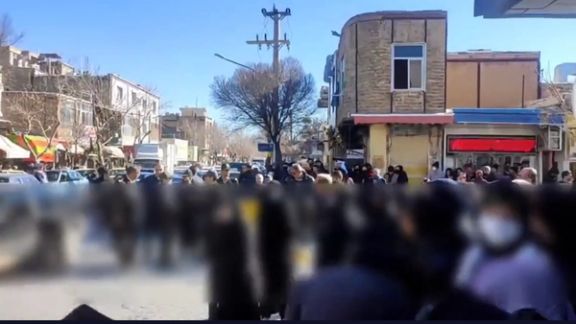
A video grab from protests in Najaf Abad, Esfahan, January 8, 2023
People took to the streets in many Iranian cities Sunday to condemn the execution of two more protesters and mark the anniversary of the downing of Flight PS752.
“We swear on our comrades’ blood, We will stand strong until the end,” in reference to the execution of Mohammad-Mehdi Karami, 22, and Seyyed Mohammad Hosseini, 39, who were hanged Saturday in Karaj, capital of Alborz Province to the west of Tehran, for allegedly killing Ruhollah Ajamian, a Basij militia agent during protests in November.
Karami’s family visited his grave Sunday and also lit candles and laid flowersat the grave of Hosseini who was also hanged. Hosseini who had no immediate family except his brother to receive his body, which was buried near Karami at the same cemetery.
The families of victims of a Ukrainian airliner shot down by two IRGC missiles in January 2020 gathered Sunday at the site of the crash, in Shahriar, southwest of the capital Tehran, while others protested at cemeteries in other cities including Saqqez in Kordestan Province, the Kurdish city of Mahahbad in West Azarbaijan province, and Bandar Anzali in the north to mark the anniversary of the tragedy that claimed the lives of all 176 onboard.
In Bandar Anzali security forces shut the gates of the local cemetery where one of the victims of the recent protests, Mehran Sammak, is buried and fired tear gas to prevent people from protesting there. “Down with the executioner republic”, people chanted in the streets of Bandar Anzali. “We swear on Mehran’s blood, We will not surrender before the end [of the regime]”, they vowed.
In several Kurdish cities such as Saqqez, Bukan and Kermanshah shops did not open Sunday as a gesture of solidarity with the protest movement.
In Tehran those who took to the street in the afternoon in several neighborhoods also chanted against the IRGC and its militia, the Basij, calling them “our Da’ish”, the Arabic acronym for ISIS. The slogan is in response to officials’ claims that Da’ish would have reached Iran from Iraq if it were not for the IRGC and its extraterritorial arm, the Qods Force, led by Qassem Soleimani.
Protesters chanted against Supreme Leader Ali Khamenei as Supreme Leader and in several cities – including various neighborhoods of Tehran, Bandar Anzali, Bandar Abbas, Esfahan, Sanandaj, Mahabad, Qazvin, Mashhad and Karaj – calling him a dictator and his government “child-killer”. “Poverty, corruption, unaffordable prices, We will continue until the toppling [of the regime]”, people chanted in Mashhad.
Protests in Tehran and some other cities continued with chanting from windows and rooftops as night fell.
Protesters Sunday reported extensive presence of “plainclothes” agents from the security and intelligence agencies on the streets who as usual made most of the arrests. Interior minister Ahmad Vahidi, however, on Sunday denied the existence of plainclothesmen and claimed that all police, IRGC and Basij forces on the streets wear in uniform.
In Esfahan, as everywhere else, security forces in plainclothes and in uniform attacked “anyone who was walking about” to prevent people from congregating. “They came into Maryam shopping arcade and beat the security guard, anyone who stepped forward was beaten,” Seda-ye Esfahan (Voice of Esfahan) reported on Twitter.
Protesters in Tehran and other cities also reported extensive use of tear gas and ‘birdshots’ which cause serious injuries. Many people have been blinded and even killed in the past four months by these shotgun shells.
Mohammad Hosseini (left) and Mohammad Mehdi Karami (center) during a court hearing in Tehran
The hanging of two more protesters for their alleged role in the killing of a government agent, has led to yet another global outcry against the Iranian regime.
US State Department spokesman Ned Price said that Washington condemns the Islamic Republic’s “sham trials and execution of Mohammad Mehdi Karami and Mohammad Hosseini in the strongest terms,” noting that “These executions are a key component of the regime's effort to suppress protests.”
Price also added that “We continue to work with partners to pursue accountability for Iran’s brutal crackdown.” His remarks echoed a similar one by US Special Envoy for Iran Rob Malley who said, “Appalled by the regime’s execution of two more young Iranians after sham trials. These executions must stop. We and others across the globe will continue to hold Iran’s leadership accountable.”
Representative Claudia Tenney (R-NY) also condemned the Iranian regime’s brutal and unlawful execution of two innocent young men, saying it “should be a final straw for anyone who still thinks this regime is redeemable. The regime in Iran terrorizes its own people and the world. It should continue to face economic and diplomatic pressure.”
Member of the Belgian Parliament Darya Safai attended a protest rally outside the Islamic Republic’s embassy in Brussels in which she described the regime as the “occupiers of Iran.” She also tweeted about a mourning ceremony by friends of one of the hanged protesters, saying the regime would not let people say goodbye to the bodies of their loved ones. “As inhumane they killed him, they also buried him in an inhumane manner in complete silence,” she said.
Denouncing the execution of protesters in Iran, the Australian Department of Foreign Affairs told Iran International in a statement that Canberra calls on the Islamic Republic to immediately halt all executions and will continue to work through the multilateral system and with partners to hold Iran to account. Australia opposes death penalty... for all people."
French Foreign Minister Catherine Colonna described the executions as “appalling,” adding that France recalls its opposition to the death penalty, in all places and in all circumstances. French Senators have also tabled a resolution calling on the EU for ending nuclear negotiations with Iran, designating the Revolutionary Guards (IRGC) as a terrorist organization, as well as several other measures.
The Swiss Federal Department of Foreign Affairs also condemned the execution and emphasized its opposition to the death penalty everywhere and under any circumstances.
Canadian Foreign Minister Mélanie Joly also denounced the executions, saying that “two more lives lost to senseless executions from the Iranian regime.” Calling on the regime to put an end to such brutal and inhumane sentences, she expressed solidarity with Iranians who have a right to their human rights.
Mohammad Hosseini's grave after his quick burial on January 7, 2023
Golriz Ghahraman, a member of New Zealand’s parliament with Iranian roots, said, “A generation of Iranians is being murdered to protect the power of a self-declared Grand Ayatollah and the stolen wealth of his cronies.”
She addressed Western leaders, saying, “This is a moment in history, Iranians will win, but right now you are not on the side of freedom.”
The European Union in a statement Saturday condemned the execution of Karami and Hosseini and called the executions “yet another sign of the Iranian authorities’ violent repression of civilian demonstrations” and urged Iranian government to “strictly abide by their obligations enshrined in the International Covenant on Civil and Political Rights” to which Iran is a party.
Two other protestors named Mohsen Shekari and Majidreza Rahnavard were executed in Tehran and Mashhad in December.
Following mass arrests of protestors in the last four months and hasty death sentences issued for 11 people in sham trials, human rights activists and some foreign officials have been calling for weeks to hold the Islamic Republic accountable.
Iranian film critic and director, Mohsen Jafari-Rad, who had been arrested during ant-government protests a few weeks ago, committed suicide after being released.
Hoshang Golmakani, director of "Film-e Emrouz" magazine said Sunday that Jafari-Rad took his own life.
Golmakani in an Instagram message said that “Our colleague committed suicide by taking pills on Sunday. He was arrested a few weeks ago during the protests in Karaj [near Tehran], while returning home. After two weeks of incarceration, he could finally prove he was not present in the demonstrations, but…"
The director of "Film-e Emrouz" magazine did not provide any further explanation about the issue, and official news agencies like ISNA only reported his death Sunday morning.
Other reports over the past week have spoken of political prisoners committing suicide after release from detention. Some suspect that strong drugs are being administered to detainees that might be causing suicidal tendencies once they stop using them after their release.
Jafari-Rad, 37, had a master's degree in cinema. He wrote for many years in film magazines, especially "Film-e Emrouz".
At the same time, as a journalist and critic, he collaborated with over 20 other publications and had started making short films and documentaries since 2008.
During the suppression of the anti-government protests, which began on September 16 following the death of 22-year-old Mahsa Amini in police custody, over 500 have been killed and thousands of citizens have also been arrested. There is no accurate information about their whereabouts and fate.
A very different Generation Z leads the protest movement in Iran
Iranian scholars, including those at the Iranian Sociologists Association have been analyzing the ongoing protests and trying to explain the nature of the movement.
Sociologists have also tried to assess the impact of the “Woman, Life Freedom” movement on the Iranian society and government. Some have described it as a women’s movement, a cultural revolution and a struggle against religious fundamentalism.
Others have said that understanding young Iranians is the key to making sense of the ongoing movement. This is a generation that wishes to be independent, individualistic, Internet savvy, and familiar with life on social media. This is in sharp contrast with the previous generation of Iranians.
Meanwhile it is significant that this movement enjoys unprecedented support from the international community and the Iranian diaspora.
According to Iranian sociologist Azam Khatam, her colleagues agree with her that there is a shift in Iran from demands for reform to a call for structural transformation. This is particularly where the Iranian government faces the annoying challenge of the current movement. However, the desire for a full transition among the activists and protesters is not in par with their capability to mobilize all those they want to bring to the streets.
Nika Shakrami, a hip Iranian teenager yearning for a free life who went to a street protest and was allegedly killed by security forces
Khatam introduced a few characteristics of the movement to highlight its points of weakness and strength and show the contrasts between dreams and realities. These characteristics include the movement’s all-encompassing nature and the importance of the number of those who take part in it.
There is also the role of women’s hijab, where a cultural revolution meets a political revolution. There is the absence of mediation mechanisms between the protesters and the government such as political parties and free press, which the Islamic Republic has long destroyed.
Khatam also observed that the presence of various ethnic groups and the practice of civil disobedience has made a return to the pre-September 2022 situation impossible. What happened during the past four months changed political behavior in the streets. At the same time, protests opened a window to the depths of the Iranian society and showed everyone how courageous and unified it is despite its inherent diversity.
The first victims of Iran's protests in September, while by January more than 500 were killed by security forces
Khatam noted that although the number of protesters is a significant factor, yet it cannot determine the fate of the uprising. She estimated that protests have a diverse power base and have brought at least two million Iranians to the streets in over 135 cities.
Nonetheless, as a result of the protests, the patriarchal structure of the Iranian society has become fragile in parts of the country where it is part of core values. She observed that during the first two months of the protests nine provincial capitals, Tehran, Esfahan, Mashad, Tabriz, Shiraz, Karaj, Sanandaj, Rasht and Kermanshah were the epicenters of unrest.
During the protests, streets have become the main venue for political activity where government's rules can be broken. That explains the radical slogans that were not so direct and sharp even in the 2017 and 2019 unrest. Meanwhile, the protesters have learned that they should keep clinging onto minimal achievement such as removing headscarves to make sure that putting any step back can discourage others. In fact, despite bragging by hardliners, the government no longer tries to enforce hijab in the streets although clerics insist that it should be observed in government offices.
The most important prospect of the movement on which many scholars agree is that the society cannot be taken back to pre-September situation. The protests have effectively prevented the regime from ending its international isolation and boosting oil revenues as the West cannot negotiate with Tehran while the protesters are in the streets. This gives some hope to dissidents, who do not want to see the regime prolonging its existence.
Iranians in several countries held protests on Saturday to condemn the illegal acts and rights violations committed by the Islamic Republic in the past 43 years.
Iranians in Paris, London, Berlin, Hamburg, Frankfurt, Bonn, Bremen, Oslo, Vienna, etc. held gatherings to mark the third anniversary of an air disaster when Iran’s Revolutionary Guards shot down a Ukrainian airliner taking off from Tehran in January 2020.
Hearing the news about the execution of two more protesters in Iran, Mohammad Hosseini and Mohammad Mehdi Karami, Iranians living in Germany gathered in front of the Hamburg city hall to voice their condemnation.
In the city of Bonn, many expat Iranians and Germans held a demonstration and march to call for justice for the victims of the Islamic Republic.
The third anniversary of downing of flight PS752 was also held in Oslo, Norway. In the gathering, the statement of the family of the victims of the Ukrainian plane was read out.
The statement stressed on sending the case to the International Court of Justice to launch an investigation into it.
All 176 passengers and crew, including 63 Canadians and 10 from Sweden, as well as 82 Iranian citizens on the plane died in the disaster.
In the past few days, the association of the families of those killed called for demonstrations all over the world to slam the tragic downing of the airliner by the IRGC.
Mohammad Mehdi Karami's grave after his quick burial on January 7, 2023
A host of Western officials have condemned the executions of two protesters in Iran Saturday while French senators urged strong measures against the regime.
“The European Union calls once again on the Iranian authorities to immediately end the strongly condemnable practice of imposing and carrying out death sentences against protesters,” the EU said and called on Tehran to “annul without delay the recent death penalty sentences that were already pronounced in the context of the ongoing protests and to provide due process to all detainees.”
Condemning the executions and calling them “abhorrent”, British foreign minister James Cleverly urged the Islamic Republic to "immediately end the violence against its own people". "The UK is strongly opposed to the death penalty in all circumstances," Cleverly said.
US Special Envoy for Iran Rob Malley tweeted, “Appalled by the regime’s execution of two more young Iranians after sham trials. These executions must stop. We and others across the globe will continue to hold Iran’s leadership accountable.”
French senators have tabled a resolution calling on the EU for ending nuclear negotiations with Iran and designating the Revolutionary Guards (IRGC) as a terrorist organization.
Mohammad Mehdi Karami (L) and Seyyed Mohammad Hosseini in court
“Over 40 senators have supported the motion that requires the European Union to end the talks to restore the 2015 nuclear deal (JCPOA), list the IRGC as a terrorist organization, and shut down Iranian banks in the EU countries and close its airspace to Iranian flights for fundamental human rights violations,” Senator Nathalie Goulet who proposed the motion with her colleagues in the upper house of the French Parliament told Iran International.
The European affairs committee of the Senate will be working on this resolution over the next ten days, she added.
The resolution calls on the Government and the European Union to “consolidate and extend the limitation of access to the primary and secondary capital markets of the Union for Iranian banks, including those established on the territory of the European Union.”
It also calls on the European Union to expel students in the EU who have a family link with Iranian officials on the list of Persons Subject to Restrictive Measures for Serious Human Rights Violations in Iran.
Other European lawmakers, some of whom have accepted the political sponsorship of some of several detained Iranian protesters including those with a death penalty hanging over their heads strongly condemned Saturday’s hangings of, Karami and Hosseini, urging their governments to adopt restrictive measures against Iran for its violation of human rights.
Helge Limburg, the German lawmaker who accepted Karami’s political sponsorship in a tweet said he could not express his deep “sadness and rage” over his execution while French lawmaker Clementine Autain who also sponsored Karami in a tweet strongly criticized the French PresidentEmanuel Macron for his “silence vis-à-vis the [Islamic Republic] regime.”
Norbert Röttgen, member of the German Parliament (Bundestag) in a tweet after the executionssaid Germany and the EU must “finally start taking decisive action to protect the 19k other prisoners” while another German MP, Hannah Neumann, in a tweet saidthe regime “will not stop with more talks and red carpets”. “We need to send a clear signal and treat them as what they are: terrorists,” she added.