• العربية
  • فارسی
Brand
  • Iran Insight
  • Politics
  • Economy
  • Analysis
  • Special Report
  • Opinion
  • Podcast
  • Iran Insight
  • Politics
  • Economy
  • Analysis
  • Special Report
  • Opinion
  • Podcast
  • Theme
  • Language
    • العربية
    • فارسی
  • Iran Insight
  • Politics
  • Economy
  • Analysis
  • Special Report
  • Opinion
  • Podcast
All rights reserved for Volant Media UK Limited
volant media logo

Iran Hardliners Continue Campaign Against Britain, France
Iran International Newsroom
Jan 6, 2023, 11:18 GMT+0Updated: 18:03 GMT+1
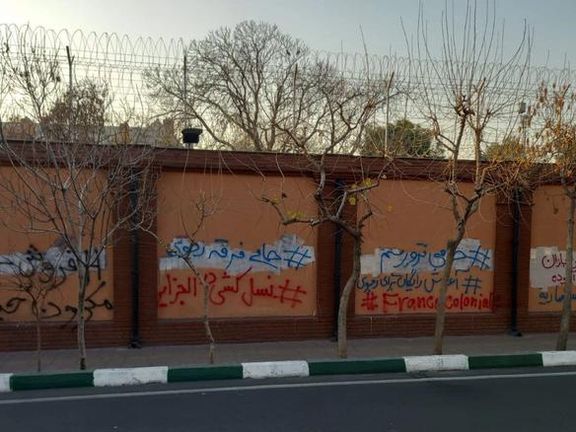
Anti-French graffiti painted on the embassy walls in Tehran on January 5, 2023

An Iranian lawmaker and IRGC officer in December called for the “serious implementation” of a 2011 law to reduce diplomatic relations with the United Kingdom.

At the time the outer walls of the UK embassy in Tehran were defaced by anti-British slogans. This week, hardliner elements did the same to the French embassy after the satirical Paris magazine Charlie Hebdo published a special issue with caricatures of Supreme Leader Ali Khamenei.

The issue of downgrading Tehran's ties with London had also been discussed at the Iranian parliament in 2009 and 2010. In 2010 ultraconservative lawmakers demanded severing ties with London altogether. The motion was sent to the Foreign Relations and National Security Committee of the Majles, but did not go any further.

Esmail Kowsari, an IRGC general who is a member of the parliament (Majles), demanded the implementation of the law against the UK and also called on the government to reconsider its ties with Germany and France.

In 2011, the move was motivated by a set of UK sanctions against Iran and in late 2022 Iranian hardliners began a series of acts of vandalism against the British embassy in Tehran as the United Kingdom, Germany and France took the lead in escalating international actions against Iran's human rights violation and drone deliveries to Russia, as well as passing a resolution at the United Nations to set up a fact-finding committee about Tehran's violations of human rights.

Kowsari told Etemad Online in December that the three European states have sinister ideas about the Iranian nation and their anti-Iranian moves have proven this. Kowsari also said in an interview with the IRGC-linked Fars News Agency: "We wish to expand our diplomatic relations, but we do not want this relation at any price."

Esmail Kowsari in his IRGC uniform. Undated
100%
Esmail Kowsari in his IRGC uniform. Undated

Thursday morning in Tehran, vigilante groups vandalized parts of the French embassy in Tehran in revenge for French satirical publication Charlie Hebdo publishing a special issue on Wednesday with cartoons about Khamenei under the title: "Let's take back the mullahs to where they come from."

The Iranian foreign minister called the cartoons "rude and unethical" and summoned the French ambassador to the Foreign Ministry to hand him a note of protest mindless of the fact that unlike the Islamic Republic, the French government does not intervene in the affairs of independent press. Foreign Minister Hossein Amir-Abdollahian threatened to give a firm and effective response to the satirical weekly. Meanwhile, Iran shut down the French "Iranian Studies Center" in Tehran, a prestigious research center whose works are respected by Iranian and French scholars.

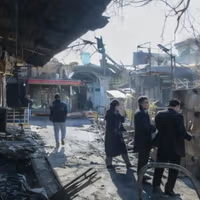
Attack on British embassy in December 2011
100%
Attack on British embassy in December 2011

The 2011 legislation was followed by an arson attack on the British embassy in Tehran by vigilante groups who were characterized by the government-owned press as "students," but independent sources questioned the characterization. Iran's -then- deputy foreign ministers Hassan Ghashghavi and Ali Ahani went to the Majles to convince the lawmakers that cutting ties with London was not in the country's interest. The Majles subsequently added a clause to the legislation which said that ties with the UK could be normalized if the UK changed its policies toward Iran.

In 2017 Ahmadinejad called the legislation and the attack on the British embassy a move that provided pretexts to the United Kingdom to take action against Iran. He also accused the Iranian state television of broadcasting live the attack on the British embassy.

Hardliner members of the parliament prevented -then- UK Foreign Secretary Jack Straw from taking part in Hassan Rouhani's inauguration ceremony in 2013. But eventually, three years later the two countries’ embassies were reopened after a relatively long closure.


Most Viewed

Iran negotiators ordered to return after internal rift over Islamabad talks
1
EXCLUSIVE

Iran negotiators ordered to return after internal rift over Islamabad talks

2
ANALYSIS

US blockade enters murky phase as tankers spoof signals and buyers hesitate

3
ANALYSIS

Why the $100 billion Hormuz toll revenue is a myth

4

US tightens financial squeeze on Iran, warns banks over oil money flows

5
ANALYSIS

US blockade targets Iran oil boom amid regional disruption

Banner
Banner

Spotlight

  • Hardliners push Hormuz ‘red line’ as US blockade tests Iran’s leverage
    INSIGHT

    Hardliners push Hormuz ‘red line’ as US blockade tests Iran’s leverage

  • Ideology may be fading in Iran, but not in Kashmir's ‘Mini Iran'
    INSIGHT

    Ideology may be fading in Iran, but not in Kashmir's ‘Mini Iran'

  • War damage amounts to $3,000 per Iranian, with blockade set to add to losses
    INSIGHT

    War damage amounts to $3,000 per Iranian, with blockade set to add to losses

  • Why the $100 billion Hormuz toll revenue is a myth
    ANALYSIS

    Why the $100 billion Hormuz toll revenue is a myth

  • US blockade targets Iran oil boom amid regional disruption
    ANALYSIS

    US blockade targets Iran oil boom amid regional disruption

  • Iran's digital economy battered by prolonged blackout
    INSIGHT

    Iran's digital economy battered by prolonged blackout

•
•
•

More Stories

Iran's Guards Threaten Further Revenge Attacks Against US

Jan 6, 2023, 08:59 GMT+0

Iran’s Revolutionary Guard (IRGC) says that retaliatory military attacks against US targets for the killing of Qassem Soleimani in 2020 are still viable options.

IRGC spokesman Ramazan Sharif was quoted by Iranian media as saying that “moves such as [the attack on] Ain al-Assad base [in Iraq] are still being considered and “will become operational in due time.”

Five days after Soleimani was killed by a US air strike on January 3, 2020, Iran fired ballistic missiles at the Iraqi base hosting US troops. No Americans were killed but reports at the time spoke of dozens of servicemen receiving concussion because of the strong explosions.

At the time, President Donald trump who ordered the killing said that Soleimani presented an imminent danger to US personnel and interests in the region. He was the commander of Quds Force and Iran's top military and intelligence operative in the Middle East.

Since then, the Islamic Republic has continued threatening revenge for Soleimani, and these threats were repeated during the third anniversary of his killing this week.

Plots were discovered in the United States aimed at assassinating former US National Security Advisor John Bolton and former Secretary of State Mike Pompeo.

Iran International reported in December that based on documents a hactivist group provided, an IRGC envoy went to Washington January 16, 2022, to carry out the plan, but the IRGC was unaware that an individual hired to kill Bolton in exchange for $300,000 was actually an FBI informant.

In August 2022, the US Justice Department charged a member of the IRGC in absentia with planning to assassinate Bolton.

At least 100 Baluch Citizens Arrested By Iran’s Security Forces

Jan 5, 2023, 14:54 GMT+0

The Islamic Republic’s intelligence ministry says as of Wednesday at least 100 people have been arrested in the Sunni-majority southeastern city of Zahedan.

Intelligence ministry directorate in Sistan-Baluchistan announced that at least one hundred people, who it called "criminals", "armed robbers" and "illegal immigrants", were detained with the cooperation of the Islamic Revolutionary Guard Corps and the police.

Using the common rhetoric of the Islamic Republic authorities, the directorate claimed, "the illegal foreign nationals played an effective role in insecurity, creating terror and violent robberies in Zahedan."

Almost three months after the "Bloody Friday of Zahedan" mass arrests of Baluch citizens has begun in the Sunni city.

The Bloody Friday in Zahedan took place September 30, when security forces killed at least 93 people, and injured hundreds more as civilians protested.

On Monday, regime forces arrested at least 40 citizens in a joint operation in the flashpoint city.

Reports say the arrest of Baluch citizens has continued in the past few days, and according to activists at least one hundred citizens, including children with no birth certificates have been detained.

According to Baluch Activists Campaign website, the military commanders have attacked ordinary citizens in public places of Zahedan on the pretext of "arresting criminals and armed robbers".

Among the detainees were seasonal workers who had gathered at a square in downtown Zahedan. Agents have reportedly arrested them while running over them in military vehicles. The report said those who tried to escape to different areas of the city, have been shot.

Erdogan Says Leaders Of Turkey, Syria Could Meet For Peace

Jan 5, 2023, 13:44 GMT+0

Turkish President Tayyip Erdogan said Thursday he may meet Syria's Bashar al-Assad, after their defense ministers met last week in Moscow with Iran absent.

In a speech in Ankara, Erdogan said the next step, following the landmark talks between defense ministers in Moscow, would be a trilateral meeting of the foreign ministers from Turkey, Russia and Syria, to further develop contacts.

"We have launched a process as Russia-Turkey-Syria," Erdogan said. "We will bring our foreign ministers together and then, depending on developments, we will come together as leaders."

Turkey has been the primary backer of Syria's opposition for more than a decade of war, while Russia has backed the Syrian government.

Iran, a major player in the Syrian war since 2011 and a participant in previous diplomatic efforts, was not invited to the meeting in Moscow.

The conflict continues into a second decade, although fighting is at a lower intensity than in earlier years.

With backing from Russia and Iran, Assad's government has recovered most Syrian territory. Turkish-backed opposition fighters still control a pocket in the northwest, and Kurdish fighters backed by the United States also control territory near the Turkish border.

A Turkish official said the Turkish and Syrian defense ministers met in Moscow on December 28., with the topics of migration and Kurdish militants on the agenda.

Turkish-Syrian rapprochement seemed unthinkable earlier in the conflict, and Syria's oppositions has urged Turkey to reaffirm its support.

With reporting by Reuters

Two Rockets Hit Coalition Forces Base In Northeastern Syria: CENTCOM

Jan 5, 2023, 09:32 GMT+0

The United States Central Command says two rockets have targeted coalition forces in northeastern Syria, a day after the 3rd anniversary of Qassem Soleimani's death.

In a statement on Wednesday, CENTCOM announced that two rockets hit coalition forces at Mission Support Site Conoco.

However, it did not give any further details about who was responsible for firing the rockets.

“The attack resulted in no injuries or damage to the base or coalition property,” the statement read, adding that the “Syrian Democratic Forces (SDF) visited the rocket origin site and found a third unfired rocket.”

No individual or group has yet claimed responsibility for this attack, but Rami Abdul Rahman, Head of the Syrian Observatory for Human Rights emphasized that this happened one day after the third death anniversary of former IRGC Quds Force Commander Qassem Soleimani, saying “pro-Iranian groups” have launched the attack.

The Islamic Republic and its proxy militia groups provide military support to Bashar al-Assad's regime in Syria.

After Qassem Soleimani was killed in a US attack in Baghdad, the top Iranian officials repeatedly threatened revenge for his death.

On January 3, 2020, the US military, on the order of President Donald Trump, killed Soleimani in a drone strike near Baghdad International Airport, saying that he had been "actively developing plans to attack American diplomats and service members in Iraq and throughout the region."

Several hundred American soldiers are stationed in the north and east of Syria as part of the international coalition against ISIS.

In recent years, the coalition bases have been sporadically targeted by rockets or drones.

Iran Government To Ban “Unauthorized” Selling Of VPNs

Jan 4, 2023, 16:28 GMT+0

Iran’s government has decided to act against those selling VPNs and circumvention software to people, as a measure to further restrict access to the Internet.

The Judiciary department in collaboration with ministry of communications will take legal action against "unauthorized sellers of the VPNs and circumvention tools," local media reported.

ISNA news website that published the news on Wednesday did not say who made the decision, however; many believe it could have been ordered by the Supreme National Security Council, or one of the intelligence services.

Since the beginning of protests in mid-September, the government has been severely restricting Internet access in general and access to popular social media platforms, such as Instagram, WhatsApp and others.

The government is extremely nervous that people use the Internet and social media to share news and images about protests, possibly motivating a larger segment of the population to join demonstrations.

However, restricting access also hurts internet-based businesses. Reports say up to 10 million people's livelihoods may be adversely affected by government’s Internet access denials and its ban on social media platforms.

This has prevented Internet-based businesses from marketing and selling their products and services. Economists believe it will have alarming repercussions for Iran's economy while the country is suffering from high inflation and a recession.

Officials, including Supreme Leader Ali Khamenei, have repeatedly criticized free access to the internet in recent years, and have been trying to prevent the free flow of information by expanding the "national intranet".