• العربية
  • فارسی
Brand
  • Iran Insight
  • Politics
  • Economy
  • Analysis
  • Special Report
  • Opinion
  • Podcast
  • Iran Insight
  • Politics
  • Economy
  • Analysis
  • Special Report
  • Opinion
  • Podcast
  • Theme
  • Language
    • العربية
    • فارسی
  • Iran Insight
  • Politics
  • Economy
  • Analysis
  • Special Report
  • Opinion
  • Podcast
All rights reserved for Volant Media UK Limited
volant media logo

Iranian Politician Says US Will Return To Nuclear Talks In 2023
Iran International Newsroom
Jan 5, 2023, 08:49 GMT+0Updated: 17:38 GMT+1
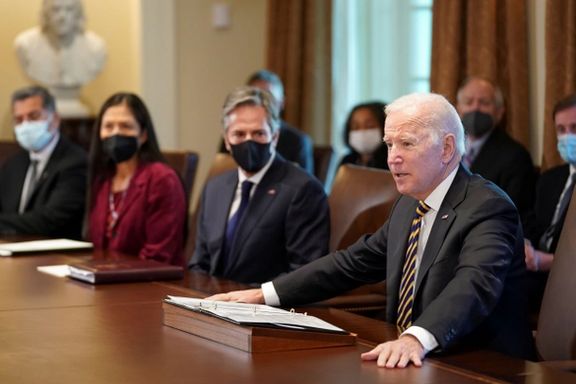
President Joe Biden at a cabinet meeting in 2021

An Iranian foreign policy pundit says the United States will return to the nuclear talks despite current lack of Western desire to continue negotiations.

The former head of parliament’s (Majles) foreign relations and national security committee Heshmatolah Falahatpisheh told Nameh News in Tehran January 3 that "The United States will return to the JCPOA, but first, Iran needs to do four things: Settling domestic differences and reducing tensions, bringing about relative stability to the country's economy, making those who prevented the revival of the deal during the past two years accountable, and sending a new team to continue the negotiations."

Since negotiations to revive the 2015 nuclear deal or JCPOA broke down in September, the Biden administration and its European allies have put the talks on the backburner and even President Joe Biden said in early November that “JCPOA is dead.”

According to Nameh News, Falahatpisheh is one of those politicians who believe diplomacy should be given yet another chance before pronouncing the JCPOA dead. Falahatpisheh reiterated that Europe and the US will certainly return to negotiations in 2023 and Iran should welcome this.

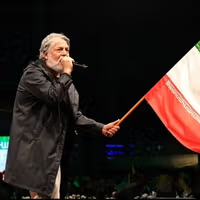
Iranian conservative politician Heshmatollah Falahatpisheh
100%
Iranian conservative politician Heshmatollah Falahatpisheh

Falahatpisheh said whatever that has been done so far to save the JCPOA were tactical moves rather than strategic changes, adding that both the United States and Europe are trying to weaken Iran's bargaining power.

Referring to the ongoing uprising in Iran, Falahatpisheh said, the United States and Europe assume that the protests have weakened Iran's bargaining power. That is why they pretend that they do not need to continue negotiations. On the other hand, the positions of anti-JCPOA political figures in Iran contribute to the Western apathy for more talks.

"Under the current situation, it is better for those who always opposed the JCPOA to stop further weakening Iran's diplomacy by commenting on the issue," Falahatpisheh said. He added that "Iran should change its nuclear negotiators and get rid of those who go to the negotiations to disrupt previous agreements rather than reaching a deal."

Falahatpisheh’s was clearly referring to Ali Bagheri-Kani, the chief Iranian negotiator, who is a protégé of Saeed Jalili, a hardliner anti-West ideologue.

Saeed Jalili with President Ebrahim Raisi in August 2021
100%
Saeed Jalili with President Ebrahim Raisi in August 2021

In another development, Jalili, one of the staunch opponents of an agreement with the United States, has accused former President Hassan Rouhani of “tying Iran economic development to the JCPOA” and contributing to the current crisis. Jalili and other hardliners know that they being blames for the continuation of US sanctions by preventing a nuclear deal and are twisting facts to blame others.

Jalili, who is Supreme Leader Ali Khamenei's representative to Iran's Supreme National Security Council, further charged that "the enemy started instigating major protests in Iran and began to make Iran insecure after it found out that its immense pressure on the country's economy will not work." He called the JCPOA "an imaginary" achievement for the previous government.

Meanwhile, hardline lawmaker Ahmad Rastineh advised Iran's President Ebrahim Raisi to "escape the trap of the JCPOA," and called the 2015 nuclear deal "A deceit by the United States."

Repeating a fallacy Iranian ultraconservatives have been trumpeting about the US allegedly sanctioning the export of medicines to Iran, Rastineh said: "When they sanction medicine sales to Iran, how can we expect them to recognize the rights of this oppressed nation." The lawmaker's comment is contrary to Iranian officials' statements denying US sanctions on medicine.

Rastineh charged, "every time US officials talk about starting or stopping the negotiations, in fact, they wish to disrupt Iran's economy and hurt its currency."

In fact, economists and even many regime insiders say that in the absence of an agreement with the West people are sending tens of billions of dollars abroad and no one is investing in the economy.


Most Viewed

Iran negotiators ordered to return after internal rift over Islamabad talks
1
EXCLUSIVE

Iran negotiators ordered to return after internal rift over Islamabad talks

2
ANALYSIS

US blockade enters murky phase as tankers spoof signals and buyers hesitate

3
ANALYSIS

Why the $100 billion Hormuz toll revenue is a myth

4

US tightens financial squeeze on Iran, warns banks over oil money flows

5
ANALYSIS

US blockade targets Iran oil boom amid regional disruption

Banner
Banner

Spotlight

  • Hardliners push Hormuz ‘red line’ as US blockade tests Iran’s leverage
    INSIGHT

    Hardliners push Hormuz ‘red line’ as US blockade tests Iran’s leverage

  • Ideology may be fading in Iran, but not in Kashmir's ‘Mini Iran'
    INSIGHT

    Ideology may be fading in Iran, but not in Kashmir's ‘Mini Iran'

  • War damage amounts to $3,000 per Iranian, with blockade set to add to losses
    INSIGHT

    War damage amounts to $3,000 per Iranian, with blockade set to add to losses

  • Why the $100 billion Hormuz toll revenue is a myth
    ANALYSIS

    Why the $100 billion Hormuz toll revenue is a myth

  • US blockade targets Iran oil boom amid regional disruption
    ANALYSIS

    US blockade targets Iran oil boom amid regional disruption

  • Iran's digital economy battered by prolonged blackout
    INSIGHT

    Iran's digital economy battered by prolonged blackout

•
•
•

More Stories

US Says 'All Options' On Table As Iran Nuclear Talks Remain Deadlocked

Jan 4, 2023, 11:05 GMT+0
•
Iran International Newsroom

US State Department said Tuesday that nuclear talks with Iran remain dormant and although diplomacy is the preferred approach, other options remain on the table.

Spokesperson Ned Price said the United States has not observed any change from the Iranian side to warrant a resumption of negotiations to revive the 2015 nuclear accord known as the JCPOA. The Biden administration’s 18-month-long diplomatic effort to reach agreement with Tehran arrived at a deadlock in early September.

"We continue to believe that diplomacy is the best way to achieve that goal, but we’ve always been clear we’re not going to remove options from the table, and we’re going to discuss all options with our partners, including, of course, Israel," Price asserted.

Israeli leaders have repeatedly said that they will use any means for stopping Iran from obtaining nuclear weapons.

“The point we’ve made is that the Iranians killed the opportunity for a swift return to mutual compliance with the JCPOA,” he said referring to what the US in September called “extraneous” demands by Tehran.

He also repeated earlier assertions that the Biden administration’s focus is no longer on the nuclear talks, but on the twin issues of protests in Iran and Tehran’s supply of kamikaze drones to Russia, which have been used by hundreds to attack Ukraine’s civilian infrastructure.

“Since September especially, our focus has been on standing up…for the fundamental freedoms of the Iranian people and countering Iran’s deepening military partnership with Russia and its support for Russia’s war in Ukraine,” Price maintained.

Asked if the US has discussed the issue of stopping Iran from supplying UAVs to Russia with Israel, which in the past has been able to sabotage Iran’s nuclear plants, Price said: We have absolutely had discussions with our Israeli partners regarding the threat presented by Iranian UAV technology and the proliferation of Iranian UAV technology to countries around the world, including to Russia.

The Biden administration has been quick in starting discussion with the new Israeli right-wing government headed by Benjamin Netanyahu, a staunch opponent of the JCPOA. Secretary of State Antony Blinken held discussion with the new Israeli foreign minister Elie Cohen in recent days. He told new Israeli Foreign Minister Eli Cohen in a 40-minute phone-call that the JCPOA was finished, and that the US wanted the European Union to step up sanctions against Iran.

Blinken’s reported statement about JCPOA being “finished” echoed President Joe Biden’s remark during an election stomp in early November, when he was heard in a video saying the JCPOA “is dead.”

Biden's remark was welcomed by Israel's former government members who took credit for the failure of the talks. In a tweet on December 20, former prime minister Neftali Bennett said, “Great achievement by our government! Quietly, and through a series of diplomatic and other wise actions, we managed to stop the return to the nuclear deal without confronting the United States.”

Price was also asked during his Tuesday briefing if the administration will support a possible Iranian opposition coalition against the Islamic Republic.

He evaded a direct answer, saying, “first and foremost this is a question for the people of Iran, how or if they want to organize themselves.” But he went on to praise the anti-regime protest movement which “has been sparked and in many ways carried by the women and girls of Iran, but also the fact that it has been organic, it has crossed ethnic lines, it has crossed geographic lines inside of Iran, and it has in a sense been leaderless. That has allowed these protesters to continue and to persist with their efforts in ways that previous movements in Iran have not been able to.”

Price also reaffirmed US support for the movement. “It is our role and responsibility to support their freedom of expression, their freedom of assembly, every single other universal right and freedom that belongs to the Iranian people.”

Netanyahu Says Israel To ‘Work Vigorously’ Against Iran

Jan 3, 2023, 19:31 GMT+0
•
Iran International Newsroom

The “most hawkish” security cabinet Israel has known was announced Tuesday as Benjamin Netanyahu promised a new strategy against Iran.

At the first meeting of the wider, 31-person cabinet, Netanyahu said he would “work more vigorously to prevent Iranian-military entrenchment in Syria and elsewhere” and that he would step up opposition to efforts to revive the 2015 Iran nuclear agreement, the JCPOA (Joint Comprehensive Plan of Action).

Some Israeli media play up a warm relationship between Netanyahu and United States President Biden, arguing the Israeli prime minister has little to fear over JCPOA revival. Israel Hayom, the free Israeli newspaper owned by the family of US Republican Party ‘kingmaker’ Sheldon Adelson, claimed Antony Blinken, the US Secretary of State, told new Israeli Foreign Minister Eli Cohen in a 40-minute phone-call that the JCPOA was finished, and that the US wanted the European Union to step up sanctions against Iran.

A leading member of the 11-member security cabinet – Itamar Ben Gvir, the national security minister and leader of Otzma Yehudi (Jewish Power) – earlier in the day visited the Temple Mount, sparking memories of the September 2000 visit by Ariel Sharon that led to the so-called second Palestinian intifada. The site, which contains both the temple and the al-Aqsa Mosque, has been occupied by Israel since the 1967 war.

European Union foreign policy chief continued efforts in December over the JCPOA, meeting Iranian foreign minister Hossein Amir-Abdollahian in Jordan, and the EU now faces a quandary heightened by several European countries sanctioning Iran over its dealing with current unrest or military links with Russia.

US ‘maximum pressure’ sanctions on Iran were introduced in 2018 when former President Donald outlined a range of demands of Iran, including ending any uranium enrichment and stopping support for militant proxy groups. But while the sanctions badly affected Iran’s economy, Tehran rejected the US demands and has increased its nuclear program beyond JCPOA limits.

‘The sphere of global opinion’

While Europe welcomed Biden’s commitment, on taking office in 2021, to restore the JCPOA, neither multilateral talks with world powers nor bilateral US-Iran contacts have bridged gaps. While Biden has continued the sanctions ostensibly to secure JCPOA revival, it emerged in December that he had in November described the JCPOA as “dead.”

While the latest Israeli military intelligence report favors efforts to reach an international agreement over Tehran’s nuclear program, Netanyahu, who has argued since the 1990s that Iran was close to acquiring a nuclear weapon, told the cabinet Tuesday that Israel would work not only “with leaders behind closed doors but strongly and openly in the sphere of global opinion” to prevent the remaining “possibility” that the JCPOA could be revived. “Global opinion” was “now aware of the true dangers posed by Iran – the Iranian regime that is killing innocent citizens in and outside Iran,” he said.

The Times of Israel reported that even if Likud Party members on the security cabinet “watered down” the influence of Gvir and Bezalel Smotrich, leader of the Religious Zionism Party, this was still “among the most hawkish the country has ever known, reflecting the radical-right makeup of the new government.” During his Knesset tenure Ben Gvir set up an office in Sheikh Jarrah quarter, Jerusalem, where Palestinian Christians are resisting eviction, and has called on Israeli police to open fire on protestors.

While media attention in Israel is focused on Netanyahu’s plans for judicial reform or his promise of a broad front against Iran, Palestinian parties are concerned that the new government will speed up and extend Jewish settlements in the West Bank. United Nations experts in December condemned “rampant Israeli settler violence and excessive use of force by Israeli forces,” and the UN General Assembly last Friday voted to seek an opinion from the International Court of Justice (ICJ), the UN’s highest court, on Israeli occupation of Palestinian land.

Netanyahu Sworn In Pledging To Stop Iran's Nuclear Program

Dec 29, 2022, 20:40 GMT+0

Benjamin Netanyahu was sworn in as Israel's prime minister with a hard-right cabinet promising to thwart Iran's nuclear program and beefing up Israel's military.

Israel’s parliament, or Knesset, passed a vote of confidence in his new government Thursday with 63 voted in favor and 54 votes against.

Outgoing Yair Lapid, who was in the Prime Minister's office for only half a year, said during the swearing -in session that his joint government with Bennett thwarted US President Joe Biden's efforts to revive the 2015 Iranian nuclear deal.

“Contrary to all the rageful predictions and prophecies, our government managed to stop the signing of a revived nuclear agreement with Iran,” Lapid said.

"The Revolutionary Guards were not removed from the list of terrorist organizations and the International Atomic Energy Agency did not close its investigatory files on Iran," he added.

In his parliamentary speeches beforethe swearing in on Thursday, the 73-year-old Netanyahu said his three big missions are stopping Iran’s nuclear program, developing state infrastructure, and restoring internal security and governance to Israel.

Earlier, in an interview with Al-Arabiya Netanyahu reiterated his long-standing opposition to the 2015 Iran nuclear deal and urged Saudi Arabia to ‘normalize’ with Israel.

He called the JCPOA, signed by world powers in 2015, a “horrible agreement because it allowed Iran basically with international approval, to develop a nuclear and basically an atomic arsenal paved with gold, with hundreds of billions of dollars of sanction relief.”

Germany Says Not Interested In Resuming Nuclear Talks With Iran

Dec 29, 2022, 10:24 GMT+0

As the Islamic Republic of Iran seems to be searching for a way to resume suspended nuclear talks, Germany, one of the negotiating sides, is opposed at this time.

German Foreign Ministry spokesman Christofer Burger stated Wednesday that Berlin sees no reason to return to the JCPOA negotiations.

“From our point of view, there are currently no indications or reasons for a resumption of the Iran nuclear negotiations,” said Burger, noting that Berlin is focusing on support for Iranian protesters.

He said Germany wants to be on the side of the people who are in the streets fighting for their freedom and dignity and to increase pressure through sanctions on the regime to stop its repression of the people.

US National Security Council Strategic Communications Coordinator John Kirby also told reporters last week that Washington does not “see a deal coming together anytime soon, while Tehran continues to kill its own citizens and sell UAVs to Russia.”

While Germany says there is no reason to resume the JCPOA talks, Iran's Foreign Minister Hossein Amir-Abdollahian announced during his trip to Oman on the same day that Muscat is “seriously making efforts” to mediate to revive the nuclear deal.

The European parties to the Iran nuclear deal and the United States say they were “very close” to reaching an agreement to revive the 2015 deal a few months ago, but Iran failed to cooperate by suddenly presenting “unacceptable” preconditions.

Israel's Gantz Sees Possible Attack On Iran 'In Two Or Three Years'

Dec 28, 2022, 19:04 GMT+0

Israel could attack Iranian nuclear sites in two or three years, its defense minister said Wednesday, in unusually explicit comments about a possible timeline.

With international efforts to renew the 2015 nuclear deal (JCPOA) having stalled, the Iranians have ramped up uranium enrichment, a process that can eventually yield fuel for nuclear bombs - though they deny having any such design.

Experts say Iran could potentially raise the fissile purity of its uranium to weapons-grade in short order. But building a deliverable warhead would take it years, they say - an estimate echoed by an Israeli military intelligence general this month.

"In two or three years, you may be traversing the skies eastward and taking part in an attack on nuclear sites in Iran," Defense Minister Benny Gantz told graduating air force cadets in a speech.

For more than a decade, Israel has issued veiled threats to attack its arch-enemy's nuclear facilities if it deems world powers' diplomacy with Tehran a dead end. However, some experts doubt Israel has the military clout to deliver lasting damage to Iranian targets that are distant, dispersed and well-defended.

The Israeli military intelligence forecast for 2023 is that Iran "will continue on its current path of slow progress" in the nuclear realm, according to Israel Hayom newspaper on Sunday.

"Iran will only change its policies if extreme sanctions are imposed on it; then it could decide to accelerate enrichment to military grade," said the report, which a military spokesperson confirmed as citing genuine intelligence assessments.