• العربية
  • فارسی
Brand
  • Iran Insight
  • Politics
  • Economy
  • Analysis
  • Special Report
  • Opinion
  • Podcast
  • Iran Insight
  • Politics
  • Economy
  • Analysis
  • Special Report
  • Opinion
  • Podcast
  • Theme
  • Language
    • العربية
    • فارسی
  • Iran Insight
  • Politics
  • Economy
  • Analysis
  • Special Report
  • Opinion
  • Podcast
All rights reserved for Volant Media UK Limited
volant media logo

Rejecting JCPOA, Netanyahu Rules Out A Peace Agreement With Iran
Iran International Newsroom
Dec 15, 2022, 23:17 GMT+0Updated: 17:25 GMT+1
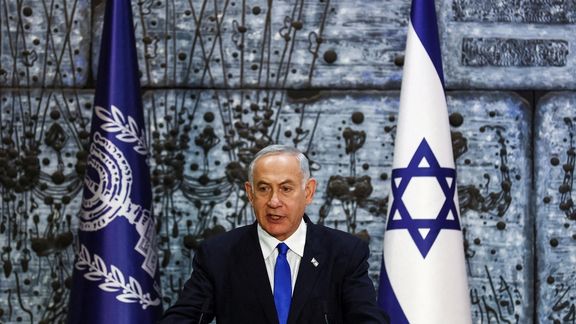
Benjamin Netanyahu speaking in Jerusalem on November 13, 2022

In an interview with al-Arabiya, Benjamin Netanyahu has reiterated opposition to the 2015 Iran nuclear deal and urged Saudi Arabia to ‘normalize’ with Israel.

Netanyahu, who is working for a government with militant settler and Otzma Yehudit party leader Itamar Ben-Gvir as security minister, praised the Middle policies of former US President Donald Trump.

Israel’s US-sponsored 2020 ‘normalization’ agreement with the United Arab Emirates, Bahrain, Morocco and Sudan had broken with an “old groove” and the “same rabbit holes” represented by the 2002 Saudi-drafted Arab Peace Initiative (API), Netanyahu said. The API, which remains Arab League and Saudi policy, made recognition of Israel dependent on a viable Palestinian state in the Israeli-occupied West Bank and Gaza.

Netanyahu, however, urged the United States to reaffirm its commitment to Saudi Arabia and pledged to pursue formal Israeli ties with Riyadh for a "quantum leap" in peace.

"The traditional (US) alliance with Saudi Arabia and other countries, has to be reaffirmed. There should not be periodic swings, or even wild swings in this relationship, because I think that the alliance...is the anchor of stability in our region," he said.

‘Atomic arsenal paved with gold’

Netanyahu called the JCPOA (Joint Comprehensive Plan of Action), signed by world powers in 2015, a “horrible agreement because it allowed Iran basically with international approval, to develop a nuclear and basically an atomic arsenal paved with gold, with hundreds of billions of dollars of sanction relief.”

Before Trump withdrew the US from the JCPOA in 2018, the International Atomic Energy Agency had extensive inspection powers that it used to verify Tehran’s compliance with strict nuclear limits. Iran has since 2019 responded to US ‘maximum pressure’ sanctions by boosting the nuclear program far beyond JCPOA limits.

However, the JCPOA had sunset clauses that over time would end many restrictions imposed on Iran’s nuclear program.

Netanyahu made clear his opposition to any agreement with Iran. “Who cares what they sign? It doesn’t mean anything. They sign and they violate, they cheat as fast as they sign. And you certainly shouldn't make agreements with them that are bad if they keep the agreement, which is what I think the JCPOA was.”

But the development of the Iranian nuclear program since 2019 has left Israel with little choice, the prime minister designate said, while a change of mood in Washington with the current unrest in Iran had made JCPOA renewal less likely.

Lebanon maritime agreement ‘tactical’

“A lot of people now across the board in many lands say: ‘You really cannot go back to the JCPOA and we have to do everything in our power to stop Iran from having a nuclear arsenal.’” Israel was prepared to take military action, with or without US support, to stop the Iran nuclear program, Netanyahu insisted.

He also ruled out agreement with Iranian “proxies,” calling “tactical” the October 27 US-brokered maritime agreement with Lebanon that designated sea areas to enable offshore gas exploration. Hezbollah, the Iran-allied Shia party, ruled in Lebanon, Netanyahu insisted: “Let’s be open about that. But without Iranian support, they’d collapse overnight.”

Netanyahu, whose Likud Party famously in 2019 raised a banner of him with President Vladimir Putin on its Tel Aviv headquarters, defended Israel’s relationship with Russia, emphasizing the need for intelligence cooperation with both states flying jets in Syria. He said he would “look into” Ukraine’s request for weapons from Israel once he took office.


Most Viewed

Ghalibaf defends Iran-US talks amid hardline backlash
1
INSIGHT

Ghalibaf defends Iran-US talks amid hardline backlash

2
ANALYSIS

From instability to influence: Pakistan’s pivotal role in US-Iran diplomacy

3
ANALYSIS

100 days on: why Iran’s January protests spread across social classes

4

War-hit homeowners feel abandoned as Iran’s reconstruction aid fades

5
INSIGHT

100 days on: the anatomy of Iran’s January crackdown

Banner
Banner

Spotlight

  • Bread shortages, soaring prices strain households in Iran, residents say
    VOICES FROM IRAN

    Bread shortages, soaring prices strain households in Iran, residents say

  • War-hit homeowners feel abandoned as Iran’s reconstruction aid fades

    War-hit homeowners feel abandoned as Iran’s reconstruction aid fades

  • 100 days on: the anatomy of Iran’s January crackdown
    INSIGHT

    100 days on: the anatomy of Iran’s January crackdown

  • Ghalibaf defends Iran-US talks amid hardline backlash
    INSIGHT

    Ghalibaf defends Iran-US talks amid hardline backlash

  • 100 days on: why Iran’s January protests spread across social classes
    ANALYSIS

    100 days on: why Iran’s January protests spread across social classes

  • From instability to influence: Pakistan’s pivotal role in US-Iran diplomacy
    ANALYSIS

    From instability to influence: Pakistan’s pivotal role in US-Iran diplomacy

•
•
•

More Stories

Despite Bans, Mahan Air Transferring Arms To Iran’s Regional Proxies

Dec 15, 2022, 20:30 GMT+0
•
Iran International Newsroom

While Israel attacks shipments of Iranian arms to Syria and Lebanon, new information indicates that Mahan Air, a sanctioned airline continues transferring weapons across the region. 

While Israel attacks shipments of Iranian arms to Syria and Lebanon, new information indicates that Mahan Air, a sanctioned airline continues transferring weapons across the region. 

According to a report by Israeli daily Yedioth Ahronoth on Wednesday, the airline is pursuing its activities under cover of a travel agency with normal tickets. It presents itself as a privately-owned airline, established in 1991 by the son of then-Iranian President Akbar Rafsanjani and is headquartered at Tehran’s Imam Khomeini International Airport. 

The company was sanctioned by the US in 2008 for links to the Quds (Qods) Force of Iran’s Revolutionary Guard, but that does not prevent it from flying to multiple countries around the world, including frequent and worrisome flights from Iran to Syria and Lebanon. It is barred entry by the United States, Saudi Arabia, Israel, Canada, Japan, Germany and France, but it continues to fly to countries outside of the Middle East, including China.

Data disclosed by the Alma Research and Education Center, an Israeli defense watchdog that specializes in threats from Lebanon and Syria, indicate that Mahan Air serves as the Islamic Republic’s main cover for transporting sizeable quantities of weapons to its proxies across the region. 

“Ostensibly, Mahan Air transports passengers and cargo, and is the largest Iranian private airline. It operates under an umbrella organization, the supposedly civilian Mullah El Muvaadin Charity,” Tal Beeri of the Alma Center told Jewish News Syndicate on Wednesday. 

“The charity is in fact an economic mask for the Islamic Revolutionary Guards Corps (IRGC), allowing it to operate legally and conduct its financial operations,” he said, adding that “Mahan Air operates as a civilian business, which is in actuality working as a full surrogate for Quds Force."

mahan-AIr-IRGC-Alma
100%

The Alma report also includes a list of the 63 Mahan Air pilots allegedly involved in the smuggling of weapons. “These pilots are not officially affiliated with the IRGC. However, it is highly likely that some of these are IRGC pilots that were loaned to the company. Other pilots who may not be of the IRGC are simply turning a blind eye,” said Beeri. 

According to Beeri, the company works closely with Quds Force Unit 190 -- assigned to the mission of arming Iran’s proxies -- with fake passenger names to Syria and Lebanon. “As of now, so far this year, Mahan Air flew to Damascus International Airport at least 110 times, and 39 times to Beirut’s Rafiq Hariri Airport. It flew at least 12 times to Syria’s Aleppo Airport,” he said.

Mahan Air has direct connections to two Iranian travel agencies, the main being known as Hamrah and the second as Utab Gasat, Beeri said, adding, “Between 2018 and 2021, some 60,000 plane tickets were booked with Mahan, with many of these tickets going to Hamrah. A look at passenger names reveals that despite tens of thousands of tickets being booked, there are no more than nine names that appear and reappear on the passenger list. Out of 2,000 tickets, just 15 passenger phone numbers appear.”

The Alma report concludes that “From this, it can be understood that Hamrah is, in fact, an executive body of the IRGC whose task is to coordinate and organize the transportation of equipment, weapons and operatives.” 

Also on Wednesday, Israel’s military chief of staff strongly suggested that Israel was behind a strike on a truck convoy in Syria last month, a rare glimpse into Israel’s shadow war against Iran and its proxies across the region. Lt. Gen. Aviv Kochavi said Israeli military and intelligence capabilities made it possible to strike specific targets that pose a threat. 

“We could have not known a few weeks ago about the Syrian convoy passing from Iraq to Syria. We could have not known what was in it, and we could have not known that out of 25 trucks, that was the truck. Truck No. 8 is the truck with the weapons,” he told a conference at a university north of Tel Aviv. 

Earlier in the month, Israel threatened to bomb Beirut’s airport if it is used by the Iranian regime to smuggle weapons. London-based Asharq Al-Awsat quoted on Saturday some political sources in Tel Aviv as saying that Israel will not be lenient with the transport of Iranian weapons through Beirut airport, warning to launch military strikes if the airport is used for Iranian ammo deliveries. Last week, Al-Arabiya reported that Iran’s Meraj Airlines had begun conducting direct flights from Iran to the Lebanese capital of Beirut.

Israel, Abraham Acord Countries To Build Cyber Iron-Dome Against Iran

Dec 15, 2022, 18:03 GMT+0

Israel along with the UAE, Bahrain, and Morocco intend to build a “Cyber-Dome” defense system to fend off digital attacks presumably from Iran.

According to the Jerusalem Post quoting a statement by the Israeli government Wednesday, the four countries held a series of meetings to discuss the issue at a conference in Bahrain on December 7.

The Times of Israel also said Wednesday that the meeting comes amid increased threats from Iranian hackers.

Based on the Jerusalem Post’s report, the statement said cyber chiefs from Oman and Kuwait also attended the same conference.

“There is life-saving value to the cyber defense dialogue, and in any case, the key is always to communicate, and to open different channels for joint research and reciprocal assistance,” reads the statement.

Meanwhile, Gaby Portnoy, the head of the Israel National Cyber Directorate told Kan public broadcaster, that “This is a historic meeting [in which] a statement by the parties [issued] regarding cooperation in the cyber field against common enemies.”

Earlier at a conference in Israel November 27 Portnoy noted that the cyber-style “Iron Dome” could employ using a mix of physical sensors with digital capabilities to “bring an awareness of the big picture to deal with our enemies and our attackers, using all of our assets and figuring out how to protect them.”

Earlier this month Human Rights Watch announced that hackers backed by the Iranian regime targeted activists, journalists, researchers, academics, diplomats, and politicians working on Middle East issues in a phishing cyber-attack.

Iran’s Oil Minister Hospitalized After Heart Attack

Dec 15, 2022, 16:14 GMT+0

Iranian state media report that the country’s Oil minister Javad Owji has been taken to hospital after suffering a heart attack.

The emergency happened when Owji was attending a meeting to draft next year’s budget bill.

A source at Iran’s Oil Ministry said Owji has been under great pressure during this period to increase oil sales.

As the country is facing natural gas shortages amid the winter cold snap, Javad Owji has been at a dispatching center himself on Thursday to monitor the situation, the source has been quoted as saying.

Owji is currently under treatment at a hospital and according to the Oil Ministry-affiliated website SHANA, he is in a stable condition.

With cold weather gripping Iran in recent days and a surge in demand, shortages of natural gas have become acute.

ILNA news website reported Monday that Iran’s Oil Ministry has released the list of petrochemical units that must stop or reduce their gas consumption. In this letter, petrochemicals producers in Masjid-i Suleiman, Zagros, Shiraz, Bandar Imam, and several others must reduce their consumption.

Iran has the second largest reserves of natural gas in the world but is barely able to satisfy domestic demand as production steadily declines because of lack of investments in the oil and gas sector.

Iran's Central Bank Printing More Money Amid Crisis

Dec 15, 2022, 14:23 GMT+0
•
Mardo Soghom

As Iran’s economic situation worsens, Tehran media report that in the past seven months more than 1,000 trillion rials were printed and added to the money supply.

Taking an average of the US dollar exchange rate, the amount comes close to just $4 billion, but Iran has been lavishly printing more money since 2018 when the United States imposed economic sanction after it withdrew from the Obama-era nuclear accord known as the JCPOA.

The astronomical amount in rials constitutes 18 percent of the money supply in this period. In August the money supply had reached 50 quadrillion rials. That is 50 with fifteen zeros.

Mahmoud Jamsaz, an economist in Tehran told Khabar Online news website in July that in the past Iranian year, from March 2021-to March 2022, the government was printing the equivalent of $15 million a day to finance its budgetary shortfall. That is 3.8 trillion rials every day.

The accumulated weight of the money in circulation has effectively devalued the currency, rial, by more than tenfold since early 2018. Money changers in Tehran on Thursday were selling one US dollar for 384,000 rials, a jump of more than 30 percent in one year.

US oil export sanctions have cut Iran’s shipments in half, which mostly go to China, but according to the desperate government in Tehran, all exports are up, and the picture is rosy. However, talking up the rial is not an effective strategy any longer, because few people believe the president, much less other officials.

In order to partially slow down the rial’s fall, the central bank injects dollars into the market, as can be detected from daily exchange rate fluctuations in Tehran, but no official information is given out.

Latest reports on social media indicate that the currency’s fall is not viewed as a normal trend anymore and a panic is setting in to buy foreign currencies and gold. This in turn accelerates the crisis, especially in the light of political uncertainty triggered by three months of anti-regime protests.

The biggest immediate reason for printing money is government borrowing from the Central Bank of Iran (CBI) to bridge its budget deficit estimated to be 50 percent. But the CBI has little gold or foreign currency reserves to back the rial banknotes it prints. The rial is not a fungible currency like the US dollar and no one invests in buying excess rials, the same way hard currencies function and better maintain their value.

The printing presses at the CBI were especially working overtime from September 21 to October 20 - the Iranian month of Mehr. This is after it became clear that talks with the United States to revive the JCPOA had hit a snag, and also after popular protests erupted.

This means that pessimism took hold in Tehran and people began hording dollars. In addition, the government was losing on tax collection as unrest closed businesses, while it had to paying extra to tens of thousands of security forces to keep them in the streets against the protesters. The government was perhaps also forced to be more generous with ordinary salaries, making timely payments to prevent more people from joining the unrest.

Another reason mentioned by local media is the scenario whereby government-owned banks began demanding money from the central bank amid their own balance sheet crises. The CBI charges the banks 21 percent interest for loans, which boosts the already 50-percent inflation rate.

Local sources say that bank borrowings from the CBI even accelerated in November and reached 910 trillion rials, which means the central bank has to print even more money in the coming weeks.

Iran Calls Its Removal From UN Women’s Group ‘Politicized’

Dec 15, 2022, 09:09 GMT+0

Iran’s Foreign Ministry spokesman says the move to remove the Islamic Republic from the UN Commission on the Status of Women was a “politicized move” that “lacked any legal validity”.

Naser Kanaani said Thursday that depriving a “legal” member of the United Nations Commission on the Status of Women of membership “discredits” this international organization paving the way for future abuses of international institutions.

As usual he blamed the US saying that Washington tries to destabilize Iran.

“How a country that is itself a major violator of the rights of the Iranian nation and women can support the rights of Iranian women now?” Kanaani addressed the US without providing any proof.

On Wednesday, the Islamic Republic was voted out of the United Nations Commission on the Status of Women (CSW) for policies contrary to the rights of women and girls.

Members of the UN Economic and Social Council (ECOSOC) adopted a US-drafted resolution to “remove with immediate effect the Islamic Republic of Iran from the Commission on the Status of Women for the remainder of its 2022-2026 term” over the regime’s bloody crackdown on protests ignited by the death of a young woman in custody of the so-called ‘morality police.’

The Commission on the Status of Women (CSW) is the principal global intergovernmental body exclusively dedicated to the promotion of gender equality and the empowerment of women.

Out of the 54-member body, 29 members voted in favor of the resolution while eight voted against and 16 countries abstained.