• العربية
  • فارسی
Brand
  • Iran Insight
  • Politics
  • Economy
  • Analysis
  • Special Report
  • Opinion
  • Podcast
  • Iran Insight
  • Politics
  • Economy
  • Analysis
  • Special Report
  • Opinion
  • Podcast
  • Theme
  • Language
    • العربية
    • فارسی
  • Iran Insight
  • Politics
  • Economy
  • Analysis
  • Special Report
  • Opinion
  • Podcast
All rights reserved for Volant Media UK Limited
volant media logo

Iran's Government Plans To Criminalize Sharing Of Information
Iran International Newsroom
Dec 30, 2022, 12:19 GMT+0Updated: 17:46 GMT+1
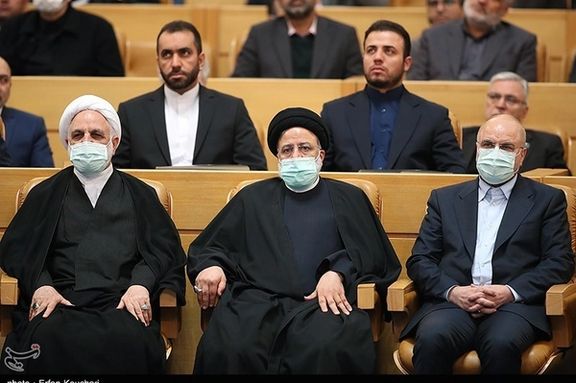
Iran’s President Ebrahim Raisi (center), Parliament Speaker Mohammad-Bagher Ghalibaf (right), and Chief Justice Gholam-Hossein Mohseni-Ejei during a meeting in December, 2022

While the Islamic Republic is issuing harsh sentences for protesters, its government branches are stealthily setting new restrictions on free speech.

The Association of Iranian Journalists expressed concern on Thursday that the administration of President Ebrahim Raisi is coordinating with the parliament to secretly pass bills that would restrict the activities of citizen journalists and criminalize any reporting deemed critical of the regime.

The plan that the members of parliament are pushing forward is cunningly titled “legal and judicial action against the spread of fake news in cyberspace” and the administration is simultaneously devising a bill called “the comprehensive bill of journalism.”

The association claims that they have not released the full texts, noting that by keeping regulations hidden from experts and journalists, they seek to prevent others from critiquing the measures.

Since there is no due process of law in Iranian courts for political trials, the government would be free to categorize even a simple tweet as a criminal act and issue a harsh verdict.

Culture Minister Mohammad Mehdi Esmaeili earlier announced that the bill had been approved by the government's cultural committee and would be sent to the parliament after the cabinet's review.

In its statement, the association of journalists described the measures as “in line with the intensification of restrictions on the flow of information in professional media and cyber sphere,” adding that they violate the rights and freedom of journalists.

The entrance of the Association of Iranian Journalists (file photo)
100%
The entrance of the Association of Iranian Journalists

The parliament is trying to pass the new plan as part of regulations that would enable the authorities to execute anyone who speaks or sends images to foreign media outlets. Since the current wave of protests began following the death in custody of Mahsa Amini, the authorities have been trying to restrict the spread of information both within the country and from inside the country to the international community.

The plan “to intensify the punishment of collaborators with the actions of hostile countries against national security and interests” describes any cooperation with “hostile countries, including the US government” as espionage. It considers any such cooperation as “corruption on earth,” which is punishable by death according to the Islamic Republic's Penal Code.

According to Article 286 of the Constitution, any serious disturbance in the public order, causing insecurity or major damage to people or public and private property, or spread of corruption or prostitution on a large scale, is considered a ‘corruption on earth’ offense and will lead to a death sentence.

Mobile phones and the Internet made it possible for citizens to record acts of violence and brutality by security forces, which was not possible two decades ago. This has exposed violations of citizens’ rights and has worried the Islamic Republic. A committee, comprised of representatives from Intelligence Organization of the Islamic Revolutionary Guard Corps (IRGC), the Intelligence Ministry, Army and parliament’s National Security Committee, is tasked with determining those who are subject to the new law.

When finalized, the legislation would help the hardliner Judiciary to issue death sentences for anyone contacting foreign-based media. Not that the regime does have any reservations about issuing harsh verdicts to the protesters.

The US-based Human Rights Activists News Agency (HRANA) said on Thursday that a court in the North Khorasan province has issued a one-year sentence for 40 people arrested during protests on charges of "propaganda against the regime and spreading lies". According to HRANA, some of the convicted people are juveniles, adding that their average age is between 16 and 20 years old.

The regime has already been describing the realities on the ground as “lies” and “conspiracies” instigated by foreign countries, but the new regulations would give them extra pretexts to prosecute citizens and journalists.


Most Viewed

Hardliners push Hormuz ‘red line’ as US blockade tests Iran’s leverage
1
INSIGHT

Hardliners push Hormuz ‘red line’ as US blockade tests Iran’s leverage

2

Iran International says it won’t be silenced after London arson attack

3
VOICES FROM IRAN

Hope and anger in Iran as fragile ceasefire persists

4

US sanctions oil network tied to Iranian tycoon Shamkhani

5

Iran halts petrochemical exports to supply domestic market

Banner
Banner

Spotlight

  • Hardliners push Hormuz ‘red line’ as US blockade tests Iran’s leverage
    INSIGHT

    Hardliners push Hormuz ‘red line’ as US blockade tests Iran’s leverage

  • Ideology may be fading in Iran, but not in Kashmir's ‘Mini Iran'
    INSIGHT

    Ideology may be fading in Iran, but not in Kashmir's ‘Mini Iran'

  • War damage amounts to $3,000 per Iranian, with blockade set to add to losses
    INSIGHT

    War damage amounts to $3,000 per Iranian, with blockade set to add to losses

  • Why the $100 billion Hormuz toll revenue is a myth
    ANALYSIS

    Why the $100 billion Hormuz toll revenue is a myth

  • US blockade targets Iran oil boom amid regional disruption
    ANALYSIS

    US blockade targets Iran oil boom amid regional disruption

  • Iran's digital economy battered by prolonged blackout
    INSIGHT

    Iran's digital economy battered by prolonged blackout

•
•
•

More Stories

Iranian Officials Failed To See Looming Waves Of Protest

Dec 30, 2022, 08:13 GMT+0
•
Iran International Newsroom

How could Iranian officials miss the clear signs of an impending social explosion, at least since 2017, when the first angry antigovernment protests began?

This was the question Etemad newspaper in Tehran asked its readers on December 28.

"We were all watching everything, and sociologists had warned us of the looming wave of protests. How could we miss such a big event? Etemad asked.

Many analysts as well as ordinary Iranians believe it was Mahsa Amini's death in ‘morality police’ custody that triggered the protests in mid-September, which still continue after three months.

Others, particularly Iranian reformists say the trigger was pulled long before when the firebrand Friday imam in Mashhad escalated his hard-line rhetoric in support of compulsory hijab and charged that those who opposed strict measures against bad-hijab women were fighting the holy prophet.

Alamolhoda was earlier accused of instigating the nationwide protest in December 2017 by provoking the people to stand against then-president Hassan Rouhani's economic policies. That protest went on for a couple of weeks in more than 85 cities, but the wave receded silently to rise once again louder and more widely in November 2019 in more than 100 cities.

Alamolhoda (C) with Supreme Leader Ali Khamenei and Ebrahim Raisi. Undated
100%
Alamolhoda (C) with Supreme Leader Ali Khamenei and Ebrahim Raisi. Undated

Although Mahsa Amini, the young woman who was visiting Tehran where she was arrested, was an ordinary person, and Alamolhoda is one of the most powerful individuals in the ruling circles, observers say both were equally instrumental in bringing about the current wave of protests although they belonged to different extremes in the Iranian society.

Alamolhoda was later questioned by the Supreme Council of National Security for his role in the unrest, but he said he had no intention of provoking the people.

However, there was one sociologist in Iran in addition to dissidents who were predicting large-scale protests to the existing political, social repression and economic hardship.

Angry protesters set fire to a police car in Sanandaj, the native region of Mahsa Amini, on November 16, 2022
100%
Angry protesters set fire to a police car in Sanandaj, the native region of Mahsa Amini, on November 16, 2022

Apparently, no one read Mohsen Goudarzi's Nov. 2020 article, Rebellious Citizen in Andisheh Pouya [Dynamic Thought] magazine. He had referred to continuous small protests by teachers, factory workers and retirees following the 2017 re-election of Rouhani. He argued that protests were taking place particularly in the provinces where the turnout and political participation were at their lowest.

The gunpowder barrel was there and was rolling toward the fire, but no one else saw it. The government, like always, attributed the protests to foreign powers and its only response was a harsh crackdown. In the meantime, reformists did nothing more than teasing the government for failing to keep everyone happy.

Goudarzi's hypothesis that was based on keen observation of political movements in Iran was also valid about 2021 that brought Ebrahim Raisi to power with even a lower turnout in large parts of the country.

The hardliners who won the parliament in a low-turnout election in 2020 and the presidency a year later, just cared about monopolizing power, not political participation.

"Nearly in all of those areas there were accrued dissatisfaction about draught and unemployment among other things to which the government reacted by using violence that often led to protesters' death," observed Goudarzi.

Another Iranian sociologist, Asef Bayat, later observed that a new class of poor people has emerged in Iran, adding that unlike the protests in 2009 that was led by the middle class, the protests in 2018 and 2019 were steered by the poor city dwellers who have been left to their own devices by the government.

The government is still in denial of the protests and calls them riots instigated by foreigners and vows to crash them violently as Raisi said on December 27. No one in the government appears to have listened to Goudarzi and other sociologists, and as Goudarzi has said himself, they refuse to accept that although protests may recede at times, but they will definitely return with a bigger bang.

Iran’s Currency In Freefall Spirals Into Chaos

Dec 29, 2022, 23:27 GMT+0
•
Iran International Newsroom

The Islamic Republic’s currency rial has hit yet another low, sieving through the regime insiders who either remain in denial or blame the West for the catastrophic downfall. 

As the dollar surpassed 430,000 rials , President Ebrahim Raisi replaced the chief of the Central Bank of Iran and ordered his economic team to come up with ideas to support the collapsing rial. 

Raisi appointed Mohammad Reza Farzin as chief banker. Farzin, who has been the CEO of Bank Melli Iran since last year, was also chairman of the board of Karafarin Bank before that. 

During the cabinet meeting where Farzin was appointed, Raisi stressed the importance of controlling the value of foreign currencies, asking central bank chief to “manage” the situation. 

Former (left) and current chiefs of the Central Bank of Iran Ali Salehabadi and Mohammad Reza Farzin (file photo)
100%
Former (left) and current chiefs of the Central Bank of Iran Ali Salehabadi and Mohammad Reza Farzin

Since the current wave of protests began in Iran in mid-September the rial has fallen to record lows, losing more than a third of its value against the dollar, fueling inflation of around well over 50 percent. The rial has now lost about 80 percent of its value compared to mid-2021 and close to 50 percent since December 2021. Inflation is also skyrocketing. Food prices have jumped much faster than the overall inflation, with some items registering 100-percent increase in one year.

The impact of rial’s devaluation is still not fully felt in the market, but Iran faces the danger of hyper inflation in the coming months.

On Wednesday, Khabar Online, an Iranian conservative website published an article that said the historic devaluation has proven to be divisive among the country’s hardliners. Hardliners in parliament and some in the military have begun harshly criticizing the presidential administration that they were praising just recently. 

Numerous officials and insiders, including senior clerics are issuing warnings about the rial’s fall that puts people’s livelihoods in jeopardy, but no one is willing to take responsibility.

Mohammad Eslami, the head of Iran's Atomic Energy Organization, said, "The dollar rise and rial’s fall is one of the plots by the Americans," adding that the US wants people to be fed up with the economic hardships so they took to streets to protest.

He was probably referring to tough sanctions imposed by the United States since 2018, when the Trump administration withdrew from the Obama-era nuclear accord known as the JCPOA. The Biden administration held talks with Iran for 18 months to revive the agreement but the diplomatic effort stalled in late August, because Tehran made unacceptable demands, according to Washington. 

Interior Minister Ahmad Vahidi claimed that "There is plenty of foreign currency in the country," a statement which might anger ordinary people even more, who would blame the government for not supporting the rial. 

Professor of Economics at California Lutheran University Jamshid Damooei, described the situation as an unprecedented “economic storm” whose root cause is the lack of confidence in the government’s economic policies. He told Iran International that the majority of the Islamic Republic’s income has always been from selling oil, which has been impeded due to US sanctions. Rial’s fall will lead to higher inflation, which in turn will drag the currency lower, he argued.

Sunni Youths In Iran Call For Protests On Friday

Dec 29, 2022, 21:48 GMT+0

Following the arrest of a leading Sunni cleric in Taybad, northeastern Iran, a group of Sunni and Shia youths in the city have called for a protest rally on Friday.

Abdolnaser Ghaderi (Qaderi) was arrested Tuesday after being summoned by local intelligence and there is no information about his whereabouts.

In addition to Taybad, a group of Sunni citizens in southeastern city of Zahedan and Golestan province in the north also called for a rally on Friday in support of MowlaviAbdolhamid, the outspoken Imam of Zahedan, as well as MowlaviGargij and Ghaderi.

No details have been published about the reasons behind the arrest of MowlaviAbdolnaser, but some sources have said the Sunni cleric was summoned after apparently organizing the release of a statement last week.

In the statement, a group of religious leaders in Taybad said the uprising of Iranians is due to “tyranny and discrimination, inequality and injustice, embezzlement and overwhelming political and economic pressures at various levels.”

The Sunni religious leaders of Taybad also condemned the suppression and execution of protesters and demanded the release of political prisoners including scholars, journalists, and students.

In the past weeks, several Sunni Imams have been summoned and apprehended by the Shiite clerical regime for expressing support for the people.

On December 12, Saifullah Hosseini, a Sunni cleric and Imam of Javanrud in western Kermanshah province was arrested by the government forces and taken to an unknown location.

Fresh Unrest In Iran As Memorial Gatherings Turn Into Protests

Dec 29, 2022, 18:12 GMT+0
•
Maryam Sinaiee

Memorial services for several protesters killed by security forces turned into new protests in several Iranian cities Thursday, including in the capital Tehran.

“This blossom killed in the bud was an offering to the homeland”, a large crowd of protesters who gathered around Hamidreza Rouhi’s grave at Behesht-e Zahra Cemetery in the south of Tehran chanted Thursday afternoon.

Rouhi, a university student who also had a modeling career since childhood, was shot dead near his home in Shahr-e Ziba neighborhood in the west of the capital on November 18. Thursday was the 40th day after his death, when Iranians hold a memorial.

Later, protesters began chanting against Supreme Leader Ali Khamenei, who they believe has ordered the killing of protesters. “Down with the Dictator”, video footage shows hundreds of protesters chanting. A new slogan was also heard against Khamenei: This homeland will not thrive before he is wrapped in a shroud.

“Poverty, corruption, high cost of living, We will continue until the toppling [of the regime]”, people began chanting as the crowd grew even larger. Security forces used tear gas against the protestersat Behesht-e Zahra, who burned trash cans to neutralize the gas. Government forces also reportedly fired shotgun pellets at them, and shut the gates to prevent more people from joining those already inside.

Behesht-e Zahra, a massive cemetery spread over an area of 1,320 acres, and other cemeteries in Iran are generally very busy on Thursdays as people traditionally visit the graves of their loved ones. Many visitors may have joined in the protest when they heard the chanting.

Several hours later, after darkness fell, people reported on social mediathat protesters were still chanting inside the cemetery and traffic on the road outside had come to a standstill by honking cars.

All this happened in the absence of Hamidreza’s parents who security forces did not allow to leave their home to attend their son’s memorial. Many later went to Hamidreza’s neighborhood as a gesture of support for his parents.

Security forces have repeatedly attacked funerals and memorial services in the past three months, used tear gas, and even fired at participants fatally including on November 20 when they killed Heydar Mahali at the funeral of the 16-year-old Karvan Ghader-Shukri in Piranshahr.

The 40th day after one’s death carries immense religious and cultural significance in Iran where memorials are held on days three, seven, and forty after death. There is also a historical parallel in the events leading to the 1979 revolution when 40th day memorials invigorated the revolutionaries and their protests.

State media initially claimed that Hamidreza was a member of the Basij militia of the Revolutionary Guards, blamed protesters for his killing, and called him a “martyr” as in the case of several other protesters.

They had to admit later that he was a protester after his friends exposed the lie by posting photos of him on social media showing him protesting and chanting.

“They killed Hamidreza and claimed him as a Basiji”, mourners chanted at his memorial service at Behesht-e Zahra three days after his death.

Thousands also attended the 40th day memorials of several other protesters in other cities.

In Samirom in Esfahan Province Thursday, thousands of chanting people marched on a dirt track in the snowy countryside to a cemetery where Ali Abbasi (25) who was shot dead by security forces is buried.

Other memorial services included those of Mohsen Niazi (32) in Dehgolan in Kermanshah Province; Reza Shariati(25), Milad Saeedianjoo (age not known) and Sepehr Maghsoudi (14) in the restive southern city of Izeh in Khuzestan; Arman Emadi (27) in Marvdasht in Fars Province; Javad Mousavi, also a young man, in Khorasgan in Esfahan Province; as well as Atefeh Na’ami (37) in Ahvaz in Khuzestan Province who authorities claim committed suicide in her apartment in Karaj. Participants chanted anti-government slogans at most of these memorial services too. 

With a video showing a large crowd chanting against Khamenei at Rouhi’s memorial, one tweeter user, presumably addressing those who claim that street protests have lost their momentum and will eventually subside, asked: “Who was afraid of this revolution coming to a halt?’

Italian PM Says Repression Of Protesters In Iran ‘Unbearable’

Dec 29, 2022, 15:55 GMT+0

Italy’s prime minister has slammed the repression of protesters in Iran saying that issuing death penalty for demonstrators is “unacceptable and intolerable”.

Prime Minister Giorgia Meloni said Thursday that the events underway in Iran cannot be tolerated by the European country.

“What is happening today in Iran is unacceptable for us, Italy can no longer tolerate it,” she told to an end-of-year press conference.

If the Iranian regime does not change its stance, Rome will consult with its allies to take more effective action against the Islamic Republic, added Meloni.

On Wednesday, Italian Foreign Minister Antonio Tajani summoned the Iranian envoy to Rome urging the regime to stop executions and start a dialogue with protesters.

Last week, Italian lawmakers approved a draft resolution urging Iran to immediately stop issuing death sentences to anti-government protestors and free all detainees.

The resolution was unanimously passed by the Foreign and European Affairs Committee of the Italian Chamber of Deputies, and they called on the Islamic Republic to withdraw all charges against protesters.

Earlier, the Italian Senate’s Foreign and Defense Committee approved a similar resolution.

Iran on December 8 hanged 23-year-old Mohsen Shekari after a secret Revolutionary Court trial. Four days later Majidreza Rahnavard, also 23, was hanged in Mashhad in front of a hand-picked group of insiders.

At least forty protesters are in risk of execution or death penalty sentences by courts while nearly all their rights are grossly violated.