• العربية
  • فارسی
Brand
  • Iran Insight
  • Politics
  • Economy
  • Analysis
  • Special Report
  • Opinion
  • Podcast
  • Iran Insight
  • Politics
  • Economy
  • Analysis
  • Special Report
  • Opinion
  • Podcast
  • Theme
  • Language
    • العربية
    • فارسی
  • Iran Insight
  • Politics
  • Economy
  • Analysis
  • Special Report
  • Opinion
  • Podcast
All rights reserved for Volant Media UK Limited
volant media logo

Iran’s Currency In Freefall Spirals Into Chaos
Iran International Newsroom
Dec 29, 2022, 23:27 GMT+0Updated: 18:04 GMT+1
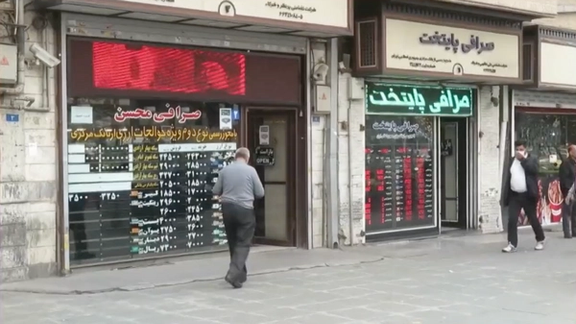
Iranians passing in front of exchange offices

The Islamic Republic’s currency rial has hit yet another low, sieving through the regime insiders who either remain in denial or blame the West for the catastrophic downfall. 

As the dollar surpassed 430,000 rials , President Ebrahim Raisi replaced the chief of the Central Bank of Iran and ordered his economic team to come up with ideas to support the collapsing rial. 

Raisi appointed Mohammad Reza Farzin as chief banker. Farzin, who has been the CEO of Bank Melli Iran since last year, was also chairman of the board of Karafarin Bank before that. 

During the cabinet meeting where Farzin was appointed, Raisi stressed the importance of controlling the value of foreign currencies, asking central bank chief to “manage” the situation. 

Former (left) and current chiefs of the Central Bank of Iran Ali Salehabadi and Mohammad Reza Farzin (file photo)
100%
Former (left) and current chiefs of the Central Bank of Iran Ali Salehabadi and Mohammad Reza Farzin

Since the current wave of protests began in Iran in mid-September the rial has fallen to record lows, losing more than a third of its value against the dollar, fueling inflation of around well over 50 percent. The rial has now lost about 80 percent of its value compared to mid-2021 and close to 50 percent since December 2021. Inflation is also skyrocketing. Food prices have jumped much faster than the overall inflation, with some items registering 100-percent increase in one year.

The impact of rial’s devaluation is still not fully felt in the market, but Iran faces the danger of hyper inflation in the coming months.

On Wednesday, Khabar Online, an Iranian conservative website published an article that said the historic devaluation has proven to be divisive among the country’s hardliners. Hardliners in parliament and some in the military have begun harshly criticizing the presidential administration that they were praising just recently. 

Numerous officials and insiders, including senior clerics are issuing warnings about the rial’s fall that puts people’s livelihoods in jeopardy, but no one is willing to take responsibility.

Mohammad Eslami, the head of Iran's Atomic Energy Organization, said, "The dollar rise and rial’s fall is one of the plots by the Americans," adding that the US wants people to be fed up with the economic hardships so they took to streets to protest.

He was probably referring to tough sanctions imposed by the United States since 2018, when the Trump administration withdrew from the Obama-era nuclear accord known as the JCPOA. The Biden administration held talks with Iran for 18 months to revive the agreement but the diplomatic effort stalled in late August, because Tehran made unacceptable demands, according to Washington. 

Interior Minister Ahmad Vahidi claimed that "There is plenty of foreign currency in the country," a statement which might anger ordinary people even more, who would blame the government for not supporting the rial. 

Professor of Economics at California Lutheran University Jamshid Damooei, described the situation as an unprecedented “economic storm” whose root cause is the lack of confidence in the government’s economic policies. He told Iran International that the majority of the Islamic Republic’s income has always been from selling oil, which has been impeded due to US sanctions. Rial’s fall will lead to higher inflation, which in turn will drag the currency lower, he argued.


Most Viewed

Iran negotiators ordered to return after internal rift over Islamabad talks
1
EXCLUSIVE

Iran negotiators ordered to return after internal rift over Islamabad talks

2
ANALYSIS

US blockade enters murky phase as tankers spoof signals and buyers hesitate

3
ANALYSIS

Why the $100 billion Hormuz toll revenue is a myth

4

US tightens financial squeeze on Iran, warns banks over oil money flows

5
ANALYSIS

US blockade targets Iran oil boom amid regional disruption

Banner
Banner

Spotlight

  • Hardliners push Hormuz ‘red line’ as US blockade tests Iran’s leverage
    INSIGHT

    Hardliners push Hormuz ‘red line’ as US blockade tests Iran’s leverage

  • Ideology may be fading in Iran, but not in Kashmir's ‘Mini Iran'
    INSIGHT

    Ideology may be fading in Iran, but not in Kashmir's ‘Mini Iran'

  • War damage amounts to $3,000 per Iranian, with blockade set to add to losses
    INSIGHT

    War damage amounts to $3,000 per Iranian, with blockade set to add to losses

  • Why the $100 billion Hormuz toll revenue is a myth
    ANALYSIS

    Why the $100 billion Hormuz toll revenue is a myth

  • US blockade targets Iran oil boom amid regional disruption
    ANALYSIS

    US blockade targets Iran oil boom amid regional disruption

  • Iran's digital economy battered by prolonged blackout
    INSIGHT

    Iran's digital economy battered by prolonged blackout

•
•
•

More Stories

Sunni Youths In Iran Call For Protests On Friday

Dec 29, 2022, 21:48 GMT+0

Following the arrest of a leading Sunni cleric in Taybad, northeastern Iran, a group of Sunni and Shia youths in the city have called for a protest rally on Friday.

Abdolnaser Ghaderi (Qaderi) was arrested Tuesday after being summoned by local intelligence and there is no information about his whereabouts.

In addition to Taybad, a group of Sunni citizens in southeastern city of Zahedan and Golestan province in the north also called for a rally on Friday in support of MowlaviAbdolhamid, the outspoken Imam of Zahedan, as well as MowlaviGargij and Ghaderi.

No details have been published about the reasons behind the arrest of MowlaviAbdolnaser, but some sources have said the Sunni cleric was summoned after apparently organizing the release of a statement last week.

In the statement, a group of religious leaders in Taybad said the uprising of Iranians is due to “tyranny and discrimination, inequality and injustice, embezzlement and overwhelming political and economic pressures at various levels.”

The Sunni religious leaders of Taybad also condemned the suppression and execution of protesters and demanded the release of political prisoners including scholars, journalists, and students.

In the past weeks, several Sunni Imams have been summoned and apprehended by the Shiite clerical regime for expressing support for the people.

On December 12, Saifullah Hosseini, a Sunni cleric and Imam of Javanrud in western Kermanshah province was arrested by the government forces and taken to an unknown location.

Fresh Unrest In Iran As Memorial Gatherings Turn Into Protests

Dec 29, 2022, 18:12 GMT+0
•
Maryam Sinaiee

Memorial services for several protesters killed by security forces turned into new protests in several Iranian cities Thursday, including in the capital Tehran.

“This blossom killed in the bud was an offering to the homeland”, a large crowd of protesters who gathered around Hamidreza Rouhi’s grave at Behesht-e Zahra Cemetery in the south of Tehran chanted Thursday afternoon.

Rouhi, a university student who also had a modeling career since childhood, was shot dead near his home in Shahr-e Ziba neighborhood in the west of the capital on November 18. Thursday was the 40th day after his death, when Iranians hold a memorial.

Later, protesters began chanting against Supreme Leader Ali Khamenei, who they believe has ordered the killing of protesters. “Down with the Dictator”, video footage shows hundreds of protesters chanting. A new slogan was also heard against Khamenei: This homeland will not thrive before he is wrapped in a shroud.

“Poverty, corruption, high cost of living, We will continue until the toppling [of the regime]”, people began chanting as the crowd grew even larger. Security forces used tear gas against the protestersat Behesht-e Zahra, who burned trash cans to neutralize the gas. Government forces also reportedly fired shotgun pellets at them, and shut the gates to prevent more people from joining those already inside.

Behesht-e Zahra, a massive cemetery spread over an area of 1,320 acres, and other cemeteries in Iran are generally very busy on Thursdays as people traditionally visit the graves of their loved ones. Many visitors may have joined in the protest when they heard the chanting.

Several hours later, after darkness fell, people reported on social mediathat protesters were still chanting inside the cemetery and traffic on the road outside had come to a standstill by honking cars.

All this happened in the absence of Hamidreza’s parents who security forces did not allow to leave their home to attend their son’s memorial. Many later went to Hamidreza’s neighborhood as a gesture of support for his parents.

Security forces have repeatedly attacked funerals and memorial services in the past three months, used tear gas, and even fired at participants fatally including on November 20 when they killed Heydar Mahali at the funeral of the 16-year-old Karvan Ghader-Shukri in Piranshahr.

The 40th day after one’s death carries immense religious and cultural significance in Iran where memorials are held on days three, seven, and forty after death. There is also a historical parallel in the events leading to the 1979 revolution when 40th day memorials invigorated the revolutionaries and their protests.

State media initially claimed that Hamidreza was a member of the Basij militia of the Revolutionary Guards, blamed protesters for his killing, and called him a “martyr” as in the case of several other protesters.

They had to admit later that he was a protester after his friends exposed the lie by posting photos of him on social media showing him protesting and chanting.

“They killed Hamidreza and claimed him as a Basiji”, mourners chanted at his memorial service at Behesht-e Zahra three days after his death.

Thousands also attended the 40th day memorials of several other protesters in other cities.

In Samirom in Esfahan Province Thursday, thousands of chanting people marched on a dirt track in the snowy countryside to a cemetery where Ali Abbasi (25) who was shot dead by security forces is buried.

Other memorial services included those of Mohsen Niazi (32) in Dehgolan in Kermanshah Province; Reza Shariati(25), Milad Saeedianjoo (age not known) and Sepehr Maghsoudi (14) in the restive southern city of Izeh in Khuzestan; Arman Emadi (27) in Marvdasht in Fars Province; Javad Mousavi, also a young man, in Khorasgan in Esfahan Province; as well as Atefeh Na’ami (37) in Ahvaz in Khuzestan Province who authorities claim committed suicide in her apartment in Karaj. Participants chanted anti-government slogans at most of these memorial services too. 

With a video showing a large crowd chanting against Khamenei at Rouhi’s memorial, one tweeter user, presumably addressing those who claim that street protests have lost their momentum and will eventually subside, asked: “Who was afraid of this revolution coming to a halt?’

Italian PM Says Repression Of Protesters In Iran ‘Unbearable’

Dec 29, 2022, 15:55 GMT+0

Italy’s prime minister has slammed the repression of protesters in Iran saying that issuing death penalty for demonstrators is “unacceptable and intolerable”.

Prime Minister Giorgia Meloni said Thursday that the events underway in Iran cannot be tolerated by the European country.

“What is happening today in Iran is unacceptable for us, Italy can no longer tolerate it,” she told to an end-of-year press conference.

If the Iranian regime does not change its stance, Rome will consult with its allies to take more effective action against the Islamic Republic, added Meloni.

On Wednesday, Italian Foreign Minister Antonio Tajani summoned the Iranian envoy to Rome urging the regime to stop executions and start a dialogue with protesters.

Last week, Italian lawmakers approved a draft resolution urging Iran to immediately stop issuing death sentences to anti-government protestors and free all detainees.

The resolution was unanimously passed by the Foreign and European Affairs Committee of the Italian Chamber of Deputies, and they called on the Islamic Republic to withdraw all charges against protesters.

Earlier, the Italian Senate’s Foreign and Defense Committee approved a similar resolution.

Iran on December 8 hanged 23-year-old Mohsen Shekari after a secret Revolutionary Court trial. Four days later Majidreza Rahnavard, also 23, was hanged in Mashhad in front of a hand-picked group of insiders.

At least forty protesters are in risk of execution or death penalty sentences by courts while nearly all their rights are grossly violated.

Former Revolutionary Says Iran's Khamenei 'Biggest Enemy Of People'

Dec 29, 2022, 08:45 GMT+0
•
Iran International Newsroom

A former Islamic revolutionary who turned into an outspoken critic of the regime has said that Iran's ruler Ali Khamenei “is the biggest enemy” of the people.

Abolfazl Ghadiani (Qadiani), openly called for Khamanei to step down in 2018, which led to a three-year jail term in 2019, but he was not forced to serve it.

In a new video the BBC Persian aired this week, Ghadiani says that Khamenei and his minions are the real culprits who commit “corruption on earth” and “fighting God”, a reference to Islamic Sharia crimes punishable by death. The regime has accused many dissidents and protesters of these two crimes, and some have received the death sentence.

The former revolutionary and an ex-comrade in arms of Khamenei said the ruler and his soldiers are the clear example of people committing these crimes because “all their zeal and intention is to create fear and terror in society and not allow this society to free itself from their tyranny.”

He argued that protesters are not ‘mohareb’, or God’s enemies, because they defend themselves against regime agents who use violence against them and kill unarmed people.

Ghadiani (76), who is a founding member of a revolutionary group before 1979 called the Mojahedin of the Islamic Revolution of Iran Organization (MIRO). He and his comrades helped the clerics consolidate power 43 years ago. But he became a critic of Khamenei when in 2009 the Supreme Leader backed the disputed official results of the presidential election that kept Mahmoud Ahmadinejad in office, and triggered months of protests.

He was arrested and spent a year in prison for demanding the real results of the vote to be announced.

Ghadiani expressed satisfaction that “people have realized that the source of all the calamities is Ali Khamenei himself.”

The former political prisoner attacked Iran’s 83-year-old ruler, insisting, “I will say again that Khamenei is the biggest enemy of the Iranian people, and I have said this from prison. Presiding over the state that kills people is Khamenei. They want to spread fear and terror…”

Perhaps the most important characteristic of the current protests is the clear and persistent rejection of Ali Khamenei and the Islamic Republic. Never before public hatred toward Khamenei was expressed so ferociously and sometimes in vile and disrespectful language.

This has destroyed the last vestiges of any commanding public image he might have had in the past and any semblance of political or religious legitimacy, except for a minority of military officers, Basij members, clerics and other elements still committed to preserving the political order.

Ghadiani in his message has also pointed to a weakening of Khamenei’s power among loyal forces, who he said are telling the Leader to make compromises but have been told “to shut up.”

Ghadiani who in the past believed in reforming the Islamic Republic, said, “Reforms are not possible.” He argued that the reform movement failed to produce any results in 25 years. “Ebrahim Raisi, an illiterate murderer has become president.”

He went on to say that Islamic Republic’s ruling class “is unique in corruption and exporting corruption among its peers and tyrants around the world. They have turned religion into a tool for repression.”

Iranian Rial Hitting Historic Lows, Dividing Regime Hardliners

Dec 28, 2022, 20:14 GMT+0
•
Iran International Newsroom

Iran’s currency has dropped to a new historic low again, breaking the 430,000 rial resistance point against the US dollar Wednesday, amid global political isolation and economic woes.

As the dollar hit 432,700 rials on Wednesday, the hardliners of the regime have also started rebuking the administration of President Ebrahim Raisi, who belongs to their camp. 

The rial has now lost about 80 percent of its value compared to mid-2021 and close to 50 percent since December 2021. Inflation is also skyrocketing. Food prices have jumped much faster than the overall inflation, with some items registering 100-percent increase in one year.

On Wednesday, Khabar Online, an Iranian conservative website published an article that has been growing among the country’s hardliners. Hardliners in parliament and some in military have begun harshly criticizing the presidential administration that they were praising just recently. The parliament has been pushing to get some explanations for the plummeting currency, but Raisi’s team tries to defend the status quo and their performance, mostly blaming everything on US sanctions, foreign pressures and the international economic situation. 

"The issue of the dollar in Iran is a complex issue,” the article read, noting that the same hardliners who were writing to former president Hassan Rouhani urging him not to blame sanctions for the country’s deteriorating economic situation, now blame problems on popular protests. State media seek to pretend that the reason behind the fall of rial is a foreign conspiracy to foment unrest across the country, . 

Economic analyst Albert Boghosian told Rouydad24 on Wednesday that the situation is very chaotic and no one would want to take responsibility for it. “The government does not view the lifting of the sanctions as important and necessary, and they have no concern at all to free the country from sanctions. The decision makers who are in charge have a more important priority than the people's food table. Therefore, they do not feel alarmed even when the dollar hits 500 or 600 thousand rials.”

Talks to revive the 2015 nuclear deal – or the JCPOA -- and lift most of the US sanctions have stalled since August when the last attempt by the European Union to broker a deal fell apart.

There are also reports that calls to fire the chief of Central Bank of Iran (CBI) Ali Salehabadi are increasing. He has reportedly demanded a three-month opportunity from the president. Salehabadi denied rumors on Wednesday that the government is profiting from the devaluation of the rial. Some argue the government encourages the fall of the rial to sell its dollars at much higher rates and gain more rials to pay salaries and other expenses.

While the rial is in a freefall, Raisi’s government has not even finalized the country's budget for the next Iranian year starting March 21. This can bring more chaos into the economy and government operations..

The economic upheaval comes on the backdrop of the biggest challenge against the Islamic Republic since its inception in 1979. Iran has been rocked by nationwide antigovernment protests since mid-September after a 22-year-old woman, Mahsa (Zhina) Amini, was killed in police custody. She was arrested for violating the country’s forced hijab rules. But since then, protests are coupled with strikes and have turned against the ruling regime, with many Iranians demanding a secular and democratic form of government.