• العربية
  • فارسی
Brand
  • Iran Insight
  • Politics
  • Economy
  • Analysis
  • Special Report
  • Opinion
  • Podcast
  • Iran Insight
  • Politics
  • Economy
  • Analysis
  • Special Report
  • Opinion
  • Podcast
  • Theme
  • Language
    • العربية
    • فارسی
  • Iran Insight
  • Politics
  • Economy
  • Analysis
  • Special Report
  • Opinion
  • Podcast
All rights reserved for Volant Media UK Limited
volant media logo

Criticism Of One-Sided Foreign Policy Continues In Iran
Dec 26, 2022, 08:57 GMT+0
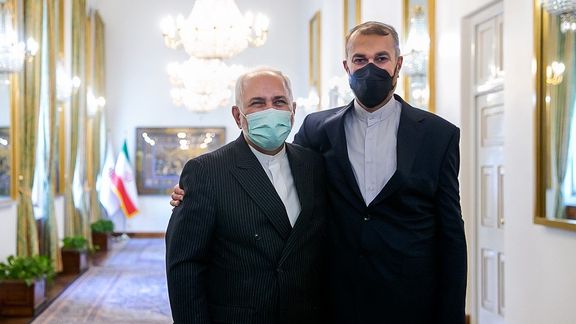
Iran's current foreign minister Amir-Abdollahian with his famous predecessor Javad Zarif in August 2021

Amid its most serious internal crisis in 40 years, the Islamic Republic is now facing daily criticism of its foreign policy, even in its government-controlled media.

Multiple pundits and politicians are questioning a one-sided foreign policy in favor of China and Russia and calling for balance and a resumption of the suspended nuclear talks with the West. They have also unleashed tough criticism against foreign minister Hossein Amir-Abdollahian, saying that he is not capable of steering the country’s foreign relations.

The attacks began after he attended a regional summit in Jordan, where he met the European Union foreign policy chief Josep Borrell, expressing Tehran’s readiness to resume nuclear talks. No tangible results emerged from the trip.

Expediency Council member Mohammad Sadr, has harshly criticized Iran's dependency on Russia and China in an interview with the centrist Entekhab News, charging that the two countries are not Iran's strategic allies, but they solely follow their own interests. He further criticized the foreign minister and the President Ebrahim Raisi for failing to give a proper response to China putting its signature on a statement with the Gulf Cooperation Council states that questioned Iran's ownership of three Persian Gulf islands.

Mohammad Sadr, member of Islamic Republic's Expediency Council
100%
Mohammad Sadr, member of Islamic Republic's Expediency Council

In the reality of the Islamic Republic, everyone knows that these decisions are made in the office of Supreme Leader Ali Khamenei, not at the foreign ministry or by the president.

Earlier last week, others including academic and foreign relations expert Pirouz Mojtahedzadeh also attacked Iran's ideological foreign policy and the performance of the Foreign Ministry, while former diplomat Ahmad Azizi called on Khamenei's office to take over the responsibilities of the Foreign Ministry.

Sadr also criticized Iran's policy regarding relations with Saudi Arabia, adding that Riyadh is waiting for US Republicans to win the presidency, before revealing its real intentions toward Iran. Sadr called for a realistic foreign policy that would prioritize the country's national interests. Iran, he said, should maintain relations with all countries except Israel, and seek to revive the 2015 nuclear deal, or JCPOA.

Academic and expert on foreign policy Mehdi Motaharnia
100%
Academic and expert on foreign policy Mehdi Motaharnia

An expert on international relations Mehdi Motaharnia told Fararu website in Tehran that if Iran continues its current foreign policy of aligning with China and Russia and considering itself an enemy of the United States and Europe, it will have no third option soon vis-à-vis the EU-US-Israeli alliance and the new alliance between Arab countries and Israel. He warned that China and Russia have also let Tehran down.

Fararu observed that the biggest political upheaval of the country in the past 43 years has paralyzed the government and asked Motaharnia if there was a third way out for Iran.

Motaharnia responded that Iran's tilt towards the Russia and China has left nothing of its initial non-alignment policy. As a result, whatever is against the West finds legitimacy. This inevitably brings about an identity crisis for the political system.

He added that Tehran not only needs to redefine its relations with the West, but it also needs to reform its internal governance. Motaharnia said that this will determine international community's approach to Iran in coming months.

Meanwhile, as some of Iran's hardliners such as the editor of Kayhan newspaper have harshly attacked Amir Abdollahian's attempts to resume talks with the West, former diplomat Fereidouin Majles has said in an interview with moderate Roiuyda24 website that the approach of some of Raisi's supporters will lead to Iran's further isolation. Majlesi said ironically that while everybody wants to determine the fate of the JCPOA in his own way, let us shut down the Foreign Ministry and let the Tehran Municipality to regulate Iran's relations with the rest of the world. Majlesi charged that the Foreign Ministry's critics have no concern about Iran's interests.


Most Viewed

Ghalibaf defends Iran-US talks amid hardline backlash
1
INSIGHT

Ghalibaf defends Iran-US talks amid hardline backlash

2
ANALYSIS

From instability to influence: Pakistan’s pivotal role in US-Iran diplomacy

3
ANALYSIS

100 days on: why Iran’s January protests spread across social classes

4

War-hit homeowners feel abandoned as Iran’s reconstruction aid fades

5

Iran says no decision yet on talks as Pakistan prepares to host US team

Banner
Banner

Spotlight

  • The politics of pink: how Iran uses cuteness to rebrand violence
    ANALYSIS

    The politics of pink: how Iran uses cuteness to rebrand violence

  • Bread shortages, soaring prices strain households in Iran, residents say
    VOICES FROM IRAN

    Bread shortages, soaring prices strain households in Iran, residents say

  • War-hit homeowners feel abandoned as Iran’s reconstruction aid fades

    War-hit homeowners feel abandoned as Iran’s reconstruction aid fades

  • 100 days on: the anatomy of Iran’s January crackdown
    INSIGHT

    100 days on: the anatomy of Iran’s January crackdown

  • Ghalibaf defends Iran-US talks amid hardline backlash
    INSIGHT

    Ghalibaf defends Iran-US talks amid hardline backlash

  • From instability to influence: Pakistan’s pivotal role in US-Iran diplomacy
    ANALYSIS

    From instability to influence: Pakistan’s pivotal role in US-Iran diplomacy

•
•
•

More Stories

Talks Underway To Normalize Ties Between Riyadh, Jerusalem: Media

Dec 25, 2022, 15:28 GMT+0

The Israeli media have reported that negotiations between Israel, the United States and Saudi Arabia to normalize ties between Jerusalem and Riyadh are underway.

The Hebrew daily Yediot Aharonot said over the weekend that talks were underway between Israel, the United States and Saudi Arabia with respect to a normalization deal between the Jewish state and the most important Persian Gulf Arab country.

Such an agreement would make Saudi Arabia the fifth Arab state to normalize ties with Israel under the 2020 Abraham Accords.

The UAE, Bahrain, Morocco, and Sudan normalized ties with Israel in exchange for its suspension of plans to annex West Bank settlements. Netanyahu would similarly suspend plans for annexation in exchange for a Saudi deal as well, Yediot Ahronot said.

In an interview with Jewish Insider Friday the Israeli Prime Minister said, “I hope to bring about a full, formal peace as we’ve done with the other Gulf states like Bahrain and the United Arab Emirates.”

He further noted that “It’s up to the Saudi leadership to decide that. I hope they will. And I intend to explore that alongside my other main goals. This is a very important goal, because if we have peace with Saudi Arabia, we are effectively going to bring an end to the Arab-Israeli conflict.”

The so-called Abraham Accords, implemented by Benjamin Netanyahu during the Donald Trump administration in 2020, brought peace between Israel and the United Arab Emirates, Bahrain, Morocco and Sudan.

Experts In Iran Slam Tehran’s ‘Ideological’ Foreign Policy

Dec 25, 2022, 09:15 GMT+0
•
Iran International Newsroom

Debates on Iran's unsuccessful foreign policy and the Raisi administration's obvious weakness in this area have come into the spotlight in Iranian media.

The debate began following Foreign Minister Hossein Amir Abdollahian and chief nuclear negotiator Ali Bagheri's reportedly unsuccessful meeting with EU foreign policy chief Josep Borrell in Amman.

Iranian academic Pirouz Mojtahedzadeh said in an interview with Didban Iranwebsite that "Iran's foreign policy is bankrupt." He charged that Iran's diplomats are not well experienced and well trained, adding that Tehran's foreign policy is ideological. He also charged that IRGC generals are the wrong people in the foreign relations arena.

Elsewhere in the interview Mojtahedzadeh argued that the foreign ministry should have a technical rather than ideological approach to foreign policy, adding that Iran needs skilled diplomats who can at least speak English. He said Iranian diplomats should confront their international counterparts, even US diplomats based on the country's national interests rather than any ideology.

Meanwhile, criticizing Tehran's foreign policy priorities which is evident from its attempts to get closer to Moscow and Beijing. He lashed out at China for "its double-standards in the region" and said "Russia will also let us down."

Former senior Iranian diplomat Ahmad Azizi
100%
Former senior Iranian diplomat Ahmad Azizi

Career diplomats such as Ahmad Azizi have also expressed disappointment over the performance of the foreign minister and his team. Azizi, a former deputy foreign minister, ambassador to Germany and the broker of the deal with the United States over releasing US diplomats who were taken hostage in Iran following the 1979 seizure of the US embassy in Tehran, wrote in a letter to Kamal Kharrazi, the head of Khamenei's Foreign Relations Council that "The foreign minister cannot do anything. Please think of a solution yourself."

Azizi said in the letter that "the chronic and painful crisis of sanctions needs an urgent solution." Meanwhile, he stressed: "The problem is that we have never thought of any problem as a crisis!" He reiterated that solving many of Iran's problems,” including the current economic pressure on the people, “depend on tackling the crisis of sanctions."

According to the letter, published as an op-ed in the reformist daily Etemad, "The routes to decision making in Iran are closed in the Iranian political system which is facing a catalogue of crises. "

As a result of these crises, Iranians' shopping baskets have become increasingly smaller while there is no solution in sight for the problems of industries and entrepreneurship including rising unemployment figures and the government's indecision about the future of the young generation.

The biggest hurdle is opposition by Iran's hardliners to reviving the 2015 nuclear deal based on their ideological, anti-US stance. On Thursday, Hossein Shariatmadari the editor of Khamenei-funded ultraconservative Kayhan newspaper lashed out at Iranian negotiators and diplomats for expressing readiness for a deal with the West during the meeting in Amman.

He wrote: "Why did you say you were ready for negotiations over the JCPOA while Europe and the United States are insisting on their support for Iranian rioters [protesters]?" Other Iranian media including Didban have said that Shariatmadari's opposition to renewed negotiations reveals that a key part of the Iranian government opposes the revival of the talks.

Shariatmadari's connection to Khamenei, once again point fingers at the Supreme Leader as the main obstacle to a deal that could save ordinary Iranians from a long-standing financial misery.

Energy Shortages In Iran Herald More Bad Economic News

Dec 24, 2022, 14:21 GMT+0
•
Mardo Soghom

Government has cut off gas to 840 government and public entities, Iran’s Tasnim news reported Saturday, as consumption outpaces production.

The news might sound shocking for a country that has the second largest natural gas reserves in the world, but it has been long clear that production is falling with lack of investments and Western technology. This means many factories and steel as well as petrochemical plants stopping production, which will deal a severe blow to an economy in crisis.

Equally shocking was news this week, published by Tejarat (Commerce) newspaper in Tehran, that some Iranian oil experts believe the government is selling oil at just $37 per barrel amid US sanctions. This is only $7 more than the production cost for Iran, which might explain why the government is facing a serious financial crisis.

As the year comes to a close, the Iranian currency, rial, has been shattering low records against major currencies. On Thursday, the rial fell to 400,000 against the US dollar and the fall continued Saturday in a sign that the Islamic Republic, grappling with antigovernment protests, is unable to support its currency.

As international oil industry watchers believe Iran is selling around 700,000 barrels of oil per day, it is puzzling as to why it is in deep financial trouble, even unable to import sufficient medicines in the past few months.

The estimate that Iran is shipping crude for just $37 a barrel is piece of new information that might explain the puzzle. Previously, it was believed that Iran was giving 10-20 percent discounts to China, its major oil customer, which would still price its exports at around $65 per barrel at current prices. But $37 had never been mentioned by an informed source.

It means that Tehran might be making less than $6 million per day, or around $16 billion annually – less than half the previous estimates. That is $200 per capita in oil income, only higher than Nigeria and Venezuela in OPEC.

Despite these facts, the government has been issuing rosy news about its oil shipments, without saying anything about actual revenues, which it says is a national security secret.

Its budget and economy dependent on oil exports, the Islamic Republic has been claiming that sanctions imposed by the United States since 2018 have been defeated and it does not need to make concessions in nuclear talks with the West, which have stalled since September.

But the danger of an overall popular revolt lies in the economic misery facing a large majority of Iranians who do not have savings in foreign currencies or gold. The middle and working classes have already become impoverished by unabating high inflation since 2018.

While the general annual inflation rate is estimated to be around 50 percent, many food items have doubled in price, and so have rents.

Instead of accepting a Western offer, deemed generous, on the nuclear issue, Tehran has started supplying weapons to Russia, which has angered the US and its NATO allies.

With no prospect of resolution, the Islamic Republic is walking a tightrope, as daily sporadic protests continue, with signs of some young people becoming more radical and prone to resort to arms.

Luxembourger of Iranian Descent Sentenced To Death By Islamic Republic

Dec 23, 2022, 12:39 GMT+0

Luxembourg’s Foreign Ministry says a resident of the country of Iranian descent has been arrested in the Islamic Republic and sentenced to death.

Foreign Minister Jean Asselborn spoke on the phone with his Iranian counterpart Hossein Amir- Abdollahian to discuss the case and speak about the situation in the country.

According to the statement from the Luxembourg Foreign Office, Minister Asselborn supports the efforts of the EU and member countries to stand up for the rights of Iranian demonstrators. Luxembourg opposes the death penalty without exception, calling it a cruel and inhuman punishment.

In the readout of the conversation issued by the Islamic Republic, there is no mention of the Luxembourger who faces execution. The Iranian foreign minister only said that he voiced Tehran’s willingness for closer relations with Luxembourg in various fields.

Protests have been raging in Iran for over three months with people seeking the fall of the clerical regime. The Islamic Republic has been cracking down on protesters while blaming foreign countries for the unrest. 

On September 30, Iran’s Intelligence Ministry announced the detention of at least nine non-Iranian citizens from Germany, Poland, Italy, France, the Netherlands and Sweden. On October 20, Fars New Agency, which is affiliated with the Revolutionary Guard, said “citizens of 14 countries, including the United States, Russia, Austria, France, the United Kingdom, and Afghanistan, have been arrested in recent riots in Iran.”

The Regime has sentenced dozens of protesters to death and has hanged two of them so far with many more facing imminent execution.

US, Israel Hold Strategic Meeting On Countering Iran Threat

Dec 23, 2022, 11:35 GMT+0

US National Security Advisor Jake Sullivan and his Israeli counterpart Eyal Hulata held a discussion Thursday over Islamic Republic growing’s military cooperation with Russia. 

Senior representatives from foreign policy, defense, and intelligence agencies also took part in the virtual meeting of the US-Israel Strategic Consultative Group (SCG). The national security chiefs and their aides reviewed Islamic Republic’s growing military relationship with Russia, including the transfer of weapons the Kremlin is deploying against Ukraine, targeting its civilian infrastructure, and Russia’s provision of military technology to Iran in return.

The officials also expressed commitment to countering Iran’s threats in the region, and to ensuring that Tehran can never acquire a nuclear weapon. 

According to a read out of the meeting released by the White House, they also discussed the broad array of economic sanctions imposed in recent months against Iran, reviewed ongoing cooperation and exercises between the US military and Israel Defense Forces, and assessed means for enhancing Israel’s security and economic integration throughout the Middle East region.

British defense minister Ben Wallace also said on Tuesday that Russia was planning to give Iran advanced military components in exchange for hundreds of drones. "Iran has become one of Russia's top military backers," Wallace said.

The West is particularly concerned over the possibility of Iran supplying missiles to Russia, as Moscow’s stockpiles dwindle.

Russian Energy Minister Nikolai Shulginov said in a statement on Tuesday that Russian companies are interested in cooperating with Iran on gas turbine technology and joint production. Russia has been trying to start producing its own gas turbines of medium or large capacity for years, but is yet to fine tune the process.