• العربية
  • فارسی
Brand
  • Iran Insight
  • Politics
  • Economy
  • Analysis
  • Special Report
  • Opinion
  • Podcast
  • Iran Insight
  • Politics
  • Economy
  • Analysis
  • Special Report
  • Opinion
  • Podcast
  • Theme
  • Language
    • العربية
    • فارسی
  • Iran Insight
  • Politics
  • Economy
  • Analysis
  • Special Report
  • Opinion
  • Podcast
All rights reserved for Volant Media UK Limited
volant media logo

Iranian Banks Limit Cash Withdrawals As Financial Crisis Bites
Iran International Newsroom
Dec 20, 2022, 15:00 GMT+0Updated: 17:54 GMT+1
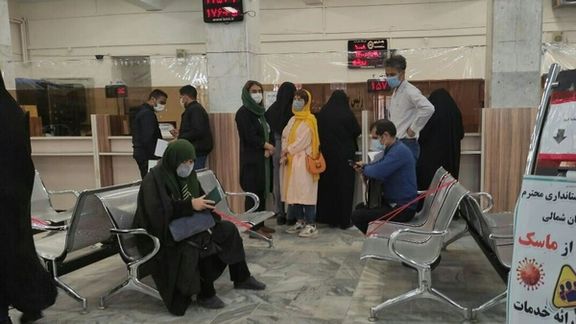
People stand in a line inside a bank

One of the new ways Iranians are causing trouble for the regime is through removing their money from banks, forcing them to limit large withdrawal amounts. 

Several videos have surfaced on social media showing people quarreling with bank clerks or officials who say they do not have enough cash for withdrawals. 

Having lost their trust on the Islamic Republic’s embattled currency after a steep fall with no prospect of bouncing back, many Iranians want to remove their money from banks to exchange them for foreign currencies or gold.

Iranian political activist, lawyer and Nobel Peace Prize laureate Shirin Ebadi urged people on Sunday to join the campaign of withdrawing money from banks, noting that state-controlled banks in Iran are not institutions to serve the people and only act as the economic arm of the “killing Republic” referring to the clerical regime. "Now it has been proven to everyone that there is no will in the regime to accept the demands of the people," she said, adding that the campaign to shun banks in daily transactions can deal a "fundamental blow" to the government.

Criticizing the government’s economic policies, Iran's former central banker, Abdolnaser Hemmati, said Tuesday that the administration of President Ebrahim Raisi was so sure about the revival of the 2015 nuclear deal that it moved to stop the indirect subsidy for essential goods, triggering more inflation. He said that now that the deal seems doomed to fail and the currency has lost its value dramatically, the authorities are looking for ways to remedy the dire situation. 

The government stopped offering cheap dollars to importers of essential goods earlier this year to save around $15 billion annually. The move immediately doubled and tripled food prices and led to shortages of medicines, medical equipment and animal feed.

Iran's former central banker Abdolnaser Hemmati (file photo)
100%
Iran's former central banker Abdolnaser Hemmati

Hemmati, who was a presidential candidate in the 2021 election and held heated debates with Raisi, addressed him, saying that “if you knew the problems and had solutions for them, why don’t you do anything? And if you just want to blame your predecessors, why did you even bother to run for office?”

Unfortunately for Raisi, the famous anecdote about an outgoing manager imparting his wisdom to the new one in the form of three sealed envelopes would not work here. The outgoing manager told the new one that the first time things go wrong, open the first letter. Open the second letter for the second incident and open the third letter for the third incident. “Blame Your Predecessor!” was written in the first letter, which Raisi has been doing since the day he took office. “Blame Your Employees!”, read the second one, which is a strategy exhausted by the current administration. The third letter instructed the manager to “Prepare three Letters!”, something Raisi has not done yet because he has no scapegoat ready yet as the next election is in more than two years. 

In addition to critics of the government, a 25-percent fall in the value of Iran’s currency in three months and a more than 50-percent drop in 15 months has led to sharp criticism even among conservatives. Conservative politician Mansoor Haqiqatpur has accused Raisi of sharply reducing the value of assets held by rich and ordinary Iranians.

“Less than 18 months ago, when Raisi took office as the President of the Islamic Republic one US dollar was equal to 230,000 rials in Tehran markets. Now the value of every US dollar is over 380,000 rials. The devaluating Iranian currency is now as cheap as straw. This means Iranians have lost half of their assets during this period." In fact, since Haqiqatpur spoke the rial has dropped further and on Tuesday it was close to 400,000 against the US dollar.

Ehsan Khandozi, the government spokesman for economic affairs (file photo)
100%
Ehsan Khandozi, the government spokesman for economic affairs

Ehsan Khandozi, the government spokesman for economic affairs who doubles as the minister of economic and financial affairs, said on Tuesday that Supreme Leader Ali Khamenei has agreed to dedicate 11 trillion rials (or about $31.4 million) from the National Development Fund to the government’s treasury to be used for its unfinished projects. He added Ali Khamenei has also given the go-ahead to bartering oil in exchange for railroad and transit projects across the country. 

Most Viewed

Iran negotiators ordered to return after internal rift over Islamabad talks
1
EXCLUSIVE

Iran negotiators ordered to return after internal rift over Islamabad talks

2
INSIGHT

What the US naval blockade would mean for Iran’s economy

3
EXCLUSIVE

Iran’s central bank warns economy may take 12 years to rebuild after war

4
INSIGHT

Iran's digital economy battered by prolonged blackout

5
PODCAST

Iran-US ceasefire nudges sidelined Arab states toward Israel, expert says

Banner
Banner

Spotlight

  • War damage amounts to $3,000 per Iranian, with blockade set to add to losses
    INSIGHT

    War damage amounts to $3,000 per Iranian, with blockade set to add to losses

  • Why the $100 billion Hormuz toll revenue is a myth
    ANALYSIS

    Why the $100 billion Hormuz toll revenue is a myth

  • US blockade targets Iran oil boom amid regional disruption
    ANALYSIS

    US blockade targets Iran oil boom amid regional disruption

  • Iran's digital economy battered by prolonged blackout
    INSIGHT

    Iran's digital economy battered by prolonged blackout

  • Iran-US ceasefire nudges sidelined Arab states toward Israel, expert says
    PODCAST

    Iran-US ceasefire nudges sidelined Arab states toward Israel, expert says

  • What the US naval blockade would mean for Iran’s economy
    INSIGHT

    What the US naval blockade would mean for Iran’s economy

•
•
•

More Stories

Iran's Out-of-Touch Leaders Are Likely To Repeat Old Mistakes

Dec 20, 2022, 09:08 GMT+0
•
Iran International Newsroom

A 25-percent fall in the value of Iran’s currency in 3 months has shaken the Iranian government and led to sharp criticism even among conservatives.

Conservative politician Mansoor Haqiqatpur has accused the President Ebrahim Raisi’s administration of sharply reducing the value of assets held by rich and ordinary Iranians.

“Less than 18 months ago, when Raisi took office as the President of the Islamic Republic one US dollar was equal to 230,000 rials in Tehran markets. Now the value of every US dollar is over 380,000 rials. The devaluating Iranian currency is now as cheap as straw. This means Iranians have lost half of their assets during this period."

In fact since Haqiqatpur spoke the rial has dropped further and on Tuesday it is close to 400,000 against the US dollar.

The significance of this remark by a conservative who is a natural ally of President Raisi should not be taken lightly. In his interview with ILNA website, Haqiqatpur, like many other Iranian politicians, said that the Islamic Republic needs to update and upgrade its governance.

He charged that "the government in Iran does not follow a pre-planned path. We still do not know who is in charge of culture or identity. Who has to determine and engineer the identity of generation Z?" It appears that he still believes in strong government control even over the citizens' identity.

Haqiqatpur went on to say that "a new governance can help, but in some areas we need to change the Islamic Republic's constitution." This has become a fashionable catch phrase by some regime insiders after their political position was shaken by nationwide protests.

Mansoor Haqiqatpur, Iranian conservative speaking with ILNA. Dec. 18, 2022
100%
Mansoor Haqiqatpur, Iranian conservative speaking with ILNA

But like other Iranian politicians and political observers he also ignored Supreme Leader Ali Khamenei's role in undermining the constitution and other laws of the country.

The main issue with the constitution is the overwhelming power of the Supreme Leader that is the commander of chief of the armed forces and the religious institutions of the clerical regime. Therefore, he easily augments his powers, making other constitutional institutions like the presidency irrelevant.

Insiders shy away from saying that the Islamic Republic is a dictatorship and Khamenei is the only one who has the final say even in the people's private lives. How many children they need to have, what they need to wear and what they are allowed to watch on television. He even did not consult the parliament when he decided to deploy troops to Syria to save another dictator or to send weapons to Russia to assist with Putin's ambitions in Ukraine.

Three Iranian presidents, Mohammad Khatami, Mahmoud Ahmadinejad and Hassan Rouhani begged Khamenei to change a couple of articles in the constitution to allow for some reforms, but he arrogantly silenced them.

However, Haqiqatpur was brave enough to criticize the Guardian Council for its unilateral decisions to allow some politicians to run for parliament and to disqualify others without offering any explanation for its decisions. But he also said that some of the articles of the constitution including the powers of the Supreme Leader are unchangeable. Without that clarification, his words would not have been published in Tehran.

However, it was easy for him to attack Raisi as a soft target.

Iranian academic observers spoke along the same line in a gathering to probe into the idea of progress and development in Iran." Social scientists Hadi Khaniki, Ahmad Meydari and Mohammad Fazeli concluded at the gathering in Tehran that "many of Iran's problems today are because of the limitations imposed on political participation. When there is no political participation, there will be political decline," they said.

The academics further agreed that the only way out of the current crisis in Iran is recognizing the role of dialogue in social processes. Meanwhile they paid tribute to Iranian political economist Professor Majid Tehranian who had predicted the Islamic revolution in 1976, three years before it took place. "But no one heard him," Said Khaniki.

Fazeli added that "if Iranian politicians refuse to pay attention to the route Iranian government took in the 1970s, and Iranian leaders avoided contact with the public, they are likely to make the same mistakes as their predecessors."

Iranians Hold Large Protests On First Day Of 3-Day Action

Dec 19, 2022, 23:13 GMT+0
•
Iran International Newsroom

Monday evening thousands of Iranians came out in numerous cities to protest against the Islamic Republic and confrontations ensued with security forces.

The government shut down the Internet in most parts of the country to prevent footage from the protests to appear online. Although some videos were published on social media but the Internet disruption made it much more difficult.

In several cities, gatherings were held for the mourning ceremonies of protesters killed during the past three months. 

The situation in dozens of neighborhoods in Tehran and nearby cities, such as Golshahr and Fardis in Karaj, were hectic as large numbers of protesters came out into the streets, after the government executed two detainees in the past 10 days. Many streets in downtown Tehran were also packed with demonstrators who vowed to continue the protests until the regime is toppled. 

In Bukan, in West Azarbaijan Province, people laid to rest Mohammad Haji-Rasulpour who was killed under torture, and in Rasht people were holding rallies in many neighborhoods chanting antigovernment slogans. Gunshots are heard in videos coming from the city. Similar demonstrations were also reported in the religious city of Mashhad in the northeast.

Workers of companies in many cities, including Sanandaj, Kerman, Bushehr, Kermanshah, Bandar Abbas, Ilam, Esfahan and Ahvaz, covering almost all western, central and southern Iran, were also on strike on Monday. During the nationwide protests in the past three months, workers, and employees in various industrial and energy sectors have held numerous protest gatherings and strikes. Low wages, non-payment of arrears, and inattention to their demands have been mentioned as among workers’ main grievances.

Frustrated over how to quash the protests that ignited after the death in custody of 22-year-old Mahsa Amini, Islamic Republic’s Chief Justice Monday urged prosecutors and judges to carry out final sentences without any delay.

The Islamic Republic has so far executed Mohsen Shekari and Majidreza Rahnavard, both 23, and based on the latest report by the Oslo-based Iran Human Rights Organization, 39 other people are at risk of execution on charges of “war against God” and “corruption on earth.” However, the executions seem to have halted since last week, therefore Ejei’s order can mean the greenlight for further executions.

The US-based Human Rights Activists News Agency (HRANA) announced in its latest report that from September 17 until December 13, at least 493 protestors have been killed, of which at least 68 were minors. While the Islamic Republic has not provided accurate figures of those detained in the recent protests, the watchdog went on to say that at least 18,424 protesters have been arrested including 632 students.

US Lawmakers Propose Legislation To Bar Iran Regime Insiders

Dec 19, 2022, 21:53 GMT+0

A bipartisan group of US lawmakers have proposed legislation to refuse visas and revoke any issued to Iranian regime insiders and their families.

The initiative is dubbed Revoking Entry Granted to Iranian Mullahs and Elites Act of 2022 or REGIME Act. It would target not only those officials responsible for repression and crackdown on protesters but also their immediate family members, Al Monitor reported Monday.

The legislation would direct the Secretary of State to conduct a review of whether a wide-ranging group of Islamic Republic officials – including members of the Revolutionary Guard (IRGC), Supreme Leader’s office and security forces – and their family members are in possession of US visas or have applied for them.
The legislation is led by Reps. Joe Wilson (R-S.C.), Josh Gottheimer (D-N.J.), Claudia Tenney (R-N.Y.), and Vicente Gonzalez (D-Texas).

It is not clear what sorts of US visas will be impacted if the legislation is adopted. Already, some individuals fitting the criteria might have obtained US permanent residency or even became naturalized citizens.

These individuals can apply for visas for their immediate family members according to US immigration law.

Recently, Canada also issued regulations banning entry for 10,000 IRGC members and possibly people affiliated with Key elements of the Iranian regime.

“In light of the actions of the regime it is particularly unbelievable that Iranian officials and family members are being given visas to come to the US to enjoy the very liberties their own citizens can only imagine,” Wilson told Al-Monitor.

Top Iran Judge Wants Swift 'Justice' For Protestors

Dec 19, 2022, 19:35 GMT+0
•
Iran International Newsroom

In an ominous sign for detained protestors, Islamic Republic’s Chief Justice has called on prosecutors and judges to carry out final sentences without any delay. 

In a decree issued on Monday, Gholam-Hossein Mohseni-Ejei demanded a swift process to carry out sentences handed down to those who have indicted on serious charges during three months of unrest. 

He did not directly mention capital punishment for detained protesters but said the sentences issued for “serious crimes,” whether or not related to the security of the country, should be well-documented and deterrent. 

His remarks can be construed as a signal to judges to go ahead with sentencing more people to death over their participation in the protests that began in mid-September, when 22-year-old Mahsa Amini was killed in custody of hijab enforcement police.

The Islamic Republic has so far executed Mohsen Shekari and Majidreza Rahnavard, both 23, and based on the latest report by the Oslo-based Iran Human Rights Organization, 39 other people are at risk of execution on charges of “war against God” and “corruption on earth.” However, the executions seem to have halted since last week, therefore Ejei’s order can mean the greenlight for further executions. 

It can also be seen as a measure to hand down more prison sentences, and carry out more executions to intimidate the population and stifle dissent. 

In his 15-point decree, he also called on judicial officials to inform higher authorities in cases deemed sensitive. Ejei also called for coordination with state media and the media center of the judiciary in cases that are important for public opinion. 

Last week, Tehran’s judiciary chief Ali Alghasi-Mehr said 400 protesters have been sentenced to prison terms of between 2 to 10 years for participation in Tehran alone. “In hearings on cases of rioters in Tehran province, 160 people were sentenced to between five to 10 years in prison, 80 people to two to five years and 160 people up to two years,” he said.

iranian-schoolgirls
100%

There are no independent courts in Iran. Both prosecutors and judges answer to the same Judiciary controlled by hardliners. In most political trials, there is no due process of law, no freedom to choose defense lawyers and little access to case files. The Judiciary can frame people for crimes they did not commit, as multiple cases have demonstrated in the past. It can define what “disruption” means and sentence any protester to death for causing an ill-defined act of disruption.

In November, a group of 227 parliament members called on the Judiciary to issue death sentences for people arrested during the ongoing antigovernment protests. As the Islamic Republic is adamant to execute more protesters, some Islamic law experts are voicing opposition to the Judiciary’s interpretation of Sharia.

The US-based Human Rights Activists News Agency (HRANA) announced in its latest report that from September 17 until December 13, at least 493 protestors have been killed, of which at least 68 were minors. While the Islamic Republic has not provided accurate figures of those detained in the recent protests, the watchdog went on to say that at least 18,424 protesters have been arrested including 632 students.

The Washington-based Abdorrahman Boroumand Center for Human Rights in Iran and London-based Amnesty International said in a joint statement in July that at least more than 250 hangings had been confirmed. "If executions continue at this horrifying pace, they will soon surpass the total of 314 cases recorded for the whole of 2021," the groups said.

People In Several Iranian Cities Hold Anti-Regime Protests

Dec 19, 2022, 17:43 GMT+0

Reports from Iran say people have poured into streets in several cities following calls by underground groups to hold nationwide protests for three days starting Monday.

Based on reports on social media, people in Tehran, Mashhad, Rasht, Mahabad, Kermanshah, and several others have taken to streets to protest against the clerical regime.

In the capital Tehran people have held a gathering in a subway station chanting “Death to Dictator” and “Death to Khamenei”.

Some say a large crowd gathered at Enghelab Square in downtown Tehran without chanting slogans, but regime forces attacked to disperse them. The internet is reportedly cut off around Tehran.

In Javanrud west of Iran, a large group gathered for the funeral of Mohammad Haji Rasoulpour, who was earlier killed by security forces. The funeral ceremony turned into a protest with people chanting, “Martyrs don’t die!”

In Mahabad, West Azarbaijan province, residents marked the 40th day after the murder of Faeq Mam-Ghaderi by government forces, chanting anti-regime slogans.

Similar gatherings have also been reported in Rasht, Mashhad and Golshahr west of Tehran.

Reports say the Revolutionary Guard (IRGC) has been flying choppers over some Kurdish cities including Sardasht, Piranshahr, and Oshnavieh for the second consecutive day.

The protests in Iran began following the death of Mahsa Amini in police custody in mid-September. Nearly 500 people have been killed by the security forces and thousands have been detained so far.






